


California Consumer Privacy Act (CCPA) compliance presents complex challenges for organizations navigating consumer data rights, privacy obligations, and evolving regulatory requirements. From establishing comprehensive data inventories to implementing automated decision-making oversight, businesses struggle with the technical complexity and resource demands of achieving sustained compliance.
This comprehensive CCPA compliance checklist provides a structured roadmap to systematically address every critical requirement, minimize compliance gaps, and leverage AI-driven automation to streamline implementation while ensuring audit readiness.
What is CCPA?
The California Consumer Privacy Act (CCPA) is comprehensive privacy legislation that grants California residents fundamental rights over their personal information while imposing specific obligations on businesses that collect, process, or sell consumer data. Enacted in 2018 with enforcement beginning in 2020, the CCPA establishes a framework for consumer privacy protection that extends beyond traditional data protection to encompass transparency, control, and accountability in data handling practices.
The CCPA applies to for-profit businesses that meet specific criteria: annual gross revenue exceeding $25 million, buying, receiving, selling, or sharing personal information from 50,000 or more California residents annually, or deriving 50% or more of annual revenue from selling consumer personal information. The law grants consumers rights to know what personal information is collected, access their data, delete personal information, opt out of data sales, and receive equal service regardless of exercising privacy rights. As detailed in the official California Attorney General CCPA guidance, the framework continues evolving with enhanced regulations covering cybersecurity audits, risk assessments, and automated decision-making technology oversight.
CCPA Requirements
CCPA compliance demands comprehensive implementation across data governance, consumer rights, security controls, and operational procedures. Organizations must address fundamental requirements spanning data inventory management, privacy policy transparency, consumer request processing, opt-out mechanisms, cybersecurity safeguards, and ongoing compliance monitoring.
- Data Inventory and Mapping: Complete documentation of personal information collection, processing, storage, and sharing practices
- Privacy Policy Compliance: Detailed disclosures covering data categories, sources, purposes, and consumer rights
- Consumer Rights Implementation: Robust procedures for handling access, deletion, correction, and opt-out requests
- Security and Risk Management: Reasonable security measures, cybersecurity audits, and risk assessments for high-risk processing
- Third-Party Oversight: Vendor compliance management and contract provisions ensuring CCPA alignment
| Business Threshold | Compliance Requirement | Timeline |
| $100M+ annual revenue | Cybersecurity audit certification | April 1, 2028 |
| $50M-$100M annual revenue | Cybersecurity audit certification | April 1, 2029 |
| Under $50M annual revenue | Cybersecurity audit certification | April 1, 2030 |
CCPA Compliance Checklist
This comprehensive CCPA compliance checklist provides systematic implementation guidance for achieving and maintaining regulatory compliance. Each step includes detailed implementation requirements and practical guidance for building robust privacy protection capabilities.
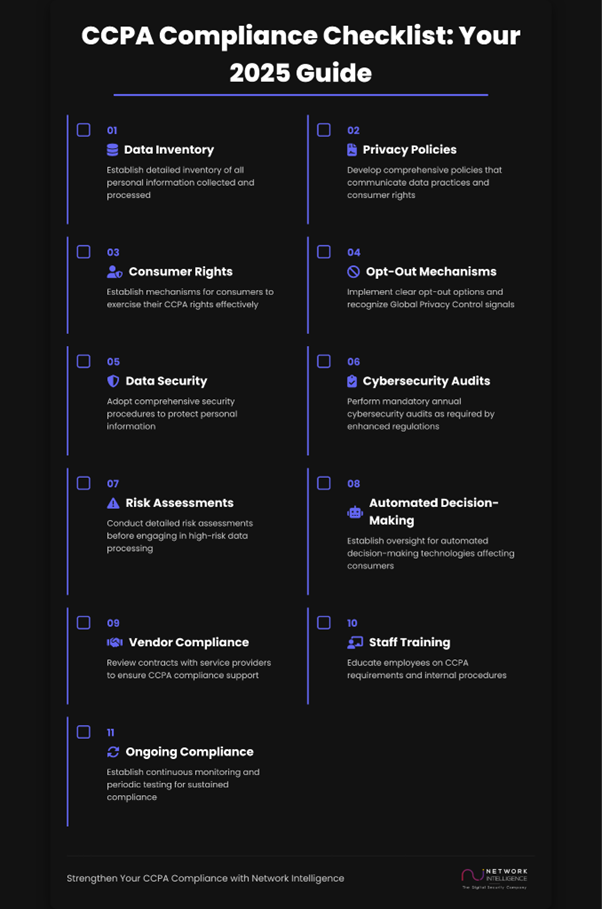
1. Conduct Comprehensive Data Inventory and Mapping
Establish a detailed inventory of all personal information collected, processed, stored, and shared throughout your organization. This foundational step enables transparency, supports consumer rights fulfillment, and provides the basis for all subsequent CCPA compliance activities. Modern AI-powered platforms like Transilience AI can automate data discovery across complex environments, significantly reducing the manual effort traditionally required for comprehensive data mapping.
- Audit all data collection practices across systems, applications, and business processes
- Document data categories, sources, processing purposes, and retention periods
- Map data flows between internal systems and third-party integrations
- Identify sensitive personal information requiring enhanced protection
- Maintain updated records of all data processing activities with regular validation
2. Update and Maintain CCPA-Compliant Privacy Policies
Develop comprehensive privacy policies that clearly communicate your data practices and consumer rights under CCPA. Effective privacy policies serve as the primary interface between your organization and consumers regarding data handling practices, requiring precise language and regular updates to reflect operational changes.
- Disclose all categories of personal information collected in the preceding 12 months
- Identify specific sources of personal information collection including websites, mobile apps, and third parties
- Explain detailed business and commercial purposes for personal information collection and use
- List categories of third parties receiving personal information with specific purpose explanations
- Provide comprehensive consumer rights explanations with step-by-step exercise instructions
- Include multiple contact methods and response timeframes for consumer requests
- Update privacy policies annually and whenever material changes occur
3. Implement Consumer Rights Request Procedures
Establish comprehensive mechanisms enabling consumers to exercise their CCPA rights effectively and efficiently. Consumer rights implementation represents a critical compliance component that directly impacts consumer experience and regulatory compliance, requiring streamlined processes that balance operational efficiency with consumer accessibility.
- Provide multiple request submission methods including online forms, toll-free numbers, and email addresses
- Implement identity verification procedures that balance security with accessibility requirements
- Establish tracking systems for all consumer requests with detailed documentation and audit trails
- Respond to consumer requests within 45 days with possible 45-day extensions for complex requests
- Ensure deletion and opt-out requests are propagated across all systems and third-party partnerships
- Train customer service representatives on CCPA procedures and consumer rights
4. Enable Opt-Out Mechanisms and Global Privacy Control (GPC) Recognition
Implement clear, accessible opt-out options and recognize Global Privacy Control signals to honor consumer preferences regarding data sales and sharing. According to the International Association of Privacy Professionals guidance, GPC recognition has become a critical enforcement focus, with recent regulatory actions highlighting failures in automated signal processing.
- Display prominent “Do Not Sell or Share My Personal Information” links on homepage and privacy policy pages
- Create dedicated opt-out request webpages with user-friendly interfaces
- Implement automated GPC signal recognition that immediately honors browser-based opt-out preferences
- Override existing privacy settings when GPC signals are detected from user devices
- Block third-party data sharing for users with active GPC signals
- Provide alternative service options for opted-out users including first-party analytics
5. Implement and Maintain Data Security Measures
Adopt comprehensive security procedures and practices protecting personal information from unauthorized access, disclosure, or destruction. The FTC’s privacy and security guidance emphasizes risk-based security approaches that scale protection measures based on data sensitivity and processing contexts.
- Deploy encryption for personal information at rest and in transit using industry-standard algorithms
- Implement multi-factor authentication and role-based access controls for all systems processing personal information
- Conduct regular security audits and vulnerability assessments with qualified internal or external professionals
- Monitor networks continuously for unauthorized access attempts and data breach indicators
- Follow recognized security frameworks such as Center for Internet Security controls as baseline protection
- Establish incident response procedures for data breaches with notification requirements
6. Conduct Annual Cybersecurity Audits (New Requirement)
Perform mandatory annual cybersecurity audits as required by enhanced CCPA regulations taking effect January 1, 2026. These audits represent significant regulatory expansion requiring independent assessment of cybersecurity controls and executive certification of security posture, with staggered compliance deadlines based on organizational revenue thresholds.
- Determine applicable audit deadlines based on annual gross revenue thresholds and processing volumes
- Engage qualified independent auditors meeting CPPA structural independence requirements
- Document comprehensive security assessments covering all personal information processing systems
- Identify security gaps with detailed remediation plans and implementation timelines
- Retain audit reports for mandatory five-year periods with secure storage procedures
- Submit annual certifications to the California Privacy Protection Agency with executive attestation
7. Perform Risk Assessments for High-Risk Data Processing (New Requirement)
Conduct detailed risk assessments before engaging in high-risk processing activities including data sales, sensitive information processing, or automated decision-making technology deployment. These assessments must evaluate risks versus benefits while considering safeguards and stakeholder impacts across the data processing lifecycle.
- Assess processing purposes, personal information types, and specific operational activities
- Identify comprehensive safeguards including technical, administrative, and physical controls
- Document stakeholder contributors, approval processes, and decision-making authority
- Analyze consumer risks versus business benefits with quantitative and qualitative measures
- Submit annual risk assessment reports to CPPA beginning April 1, 2028
- Obtain executive attestation under penalty of perjury for assessment completeness and accuracy
8. Oversee Automated Decision-Making Technology (ADMT) (New Requirement)
Establish comprehensive oversight for automated decision-making technologies affecting consumer rights or access to services. ADMT regulations, effective January 1, 2027, require human involvement, transparency measures, and consumer access rights while protecting legitimate business interests and fraud prevention mechanisms.
- Ensure qualified human reviewers can interpret, analyze, and override ADMT outputs with actual decision-making authority
- Implement transparency measures including logic summaries and primary decision factors accessible to consumers
- Provide consumer access rights to ADMT outputs where technically feasible and legally permissible
- Protect trade secrets and fraud prevention mechanisms while meeting transparency requirements
- Document ADMT governance procedures with regular review and update cycles
9. Ensure Vendor and Third-Party Compliance
Review and enhance contracts with service providers, vendors, and business partners to ensure comprehensive CCPA compliance support and obligation sharing. Third-party compliance management represents a critical area where many organizations experience compliance gaps, as evidenced by recent enforcement actions highlighting inadequate vendor oversight.
- Audit existing service provider agreements for CCPA-specific compliance clauses and obligations
- Ensure vendors can honor consumer deletion, correction, and opt-out requests within required timeframes
- Monitor third-party data sharing practices with regular compliance assessments
- Implement vendor risk management procedures including due diligence and ongoing monitoring
- Document all vendor compliance reviews with remediation tracking for identified gaps
10. Provide Ongoing Staff Training and Awareness
Educate employees across all organizational levels on CCPA requirements, privacy best practices, and internal procedures ensuring consistent compliance implementation. Comprehensive training programs reduce human error risks while building privacy-conscious organizational culture that supports sustainable compliance.
- Conduct role-specific CCPA training covering relevant requirements and procedures for different organizational functions
- Maintain detailed training records with attendance tracking and competency assessments
- Update training materials regularly to reflect regulatory changes and enforcement trends
- Include practical guidance for handling consumer data, processing requests, and escalating privacy issues
- Establish privacy champion networks within departments to support ongoing awareness and implementation
11. Monitor, Test, and Maintain Ongoing Compliance
Establish continuous monitoring and periodic testing ensuring sustained CCPA compliance and rapid response to regulatory changes. Advanced AI-powered platforms like Transilience AI provide automated monitoring capabilities that significantly reduce manual oversight requirements while improving compliance accuracy and responsiveness.
- Implement automated monitoring tools tracking compliance status across all personal information processing activities
- Schedule regular internal compliance audits with gap assessment and remediation tracking
- Monitor regulatory updates from the California Privacy Protection Agency and Attorney General’s office
- Adjust policies, procedures, and controls promptly based on regulatory guidance and enforcement actions
- Document all monitoring activities and remediation efforts for audit readiness and continuous improvement
Common Mistakes to Avoid in CCPA Compliance
- Failing to recognize or properly implement Global Privacy Control (GPC) signals, resulting in continued data sharing despite consumer opt-out preferences
- Inadequate opt-out mechanisms that create barriers for consumers or fail to propagate across all data processing activities
- Incomplete data inventories that miss shadow IT systems, third-party integrations, or legacy data stores containing personal information
- Insufficient third-party contract provisions that fail to ensure vendor compliance with CCPA obligations and consumer rights
- Neglecting enhanced requirements for cybersecurity audits, risk assessments, or automated decision-making technology oversight under new regulations
- Using manipulative design patterns that discourage or frustrate consumer opt-out attempts, violating good faith compliance expectations
- Failing to propagate deletion or opt-out requests to all relevant systems and service providers within required timeframes
- Inadequate identity verification procedures that either create excessive barriers or insufficient security for consumer requests
Strengthen Your CCPA Compliance with Network Intelligence AI-Driven Solutions
Achieving sustainable CCPA compliance requires more than manual processes and static policies—it demands intelligent automation, continuous monitoring, and expert guidance that adapts to evolving regulatory requirements. Network Intelligence delivers cybersecurity compliance solutions that combine advanced AI-powered automation through Transilience with deep regulatory expertise, enabling organizations to transform compliance from a resource-intensive burden into a strategic competitive advantage.
Transilience AI’s revolutionary autonomous compliance platform addresses the most challenging aspects of CCPA implementation through guaranteed certification outcomes and zero-touch automation. The platform’s LLM-based security agents automate complex compliance tasks that traditionally require extensive manual effort, including automated evidence collection across 100+ control points, real-time compliance gap identification, and continuous monitoring that reduces vulnerability backlogs by 70%. For organizations struggling with the technical complexity of security audit requirements, Transilience provides comprehensive automation that replaces traditional $150,000+ annual compliance overhead with predictable subscription costs while delivering compliance certifications 2+ months faster than conventional approaches.
Network Intelligence’s proven ADVISE framework (Assess, Design, Visualize, Implement, Sustain, Evolve) provides structured guidance through every stage of CCPA compliance implementation, backed by 23+ years of cybersecurity expertise and specialized knowledge in regulated industries including banking, healthcare, and technology. The company’s comprehensive approach addresses specific CCPA challenges including automated data discovery and classification, consumer rights request processing, Global Privacy Control implementation, and the enhanced requirements for cybersecurity audits and risk assessments. As detailed in their compliance implementation methodology, Network Intelligence combines human expertise with AI-powered automation to deliver measurable results including 10x amplification of security team capabilities and 80% reduction in wasted development effort.
The integration of Transilience AI’s autonomous compliance capabilities with Network Intelligence’s regulatory expertise creates a powerful solution for organizations facing complex CCPA requirements. From initial data inventory and mapping through ongoing compliance monitoring and regulatory change management, this comprehensive approach ensures that privacy protection becomes embedded within operational workflows rather than remaining a separate compliance exercise. For healthcare organizations requiring specialized compliance support, Network Intelligence’s HITRUST assessment services demonstrate the depth of regulatory expertise that extends across multiple privacy and security frameworks, ensuring comprehensive protection that addresses evolving regulatory landscapes.Talk to an expert