
The Security Reality — In Plain Terms
This assessment tested whether a determined adversary could breach LEADING
PHARMACEUTICAL MANUFACTURER’ physical locations, gain access to the internal
network, and exfiltrate sensitive data — without being detected. The answer was yes, on
every count.
“Over five days in June 2025, the Network Intelligence red team walked through the doors of four LEADING PHARMACEUTICAL MANUFACTURER facilities — a data centre, a manufacturing
operations hub, and two corporate headquarters — using forged ID cards, social engineering, and physical access control blind spots. Not one alert was raised. Once inside the network, the team obtained full administrator-level access, accessed over 24,000 internal file repositories containing employee PII, and exfiltrated 29MB of sensitive data to an external server. The Security Operations Centre detected one of eight attacks. Everything else went unnoticed.”
— Network Intelligence Assessment Lead, Red Team Engagement Summary, June 2025
Physical Security
C R I T I C A L
- All 4 facilities breached — zero detections
- Server rooms and operations centres accessed unescorted
- Forged IDs and social engineering bypassed all controls
- Visitor verification protocols completely failed
- Physical network equipment found unlocked and unmonitored
Identity & Endpoint Security
C R I T I C A L
- Full domain administrator access achieved
- Endpoint security solutions bypassed
- Corporate data exfiltrated without restriction
- 24,894 file repositories exposed
- Employee PII and encryption keys accessible
Security Operations Centre
I N A D E Q U A T E
- Only 1 of 8 attacks detected (12.5%)
- Industry minimum benchmark: 85%
- No alerts on physical breach activity
- Data theft and escalation missed
- 87.5% gap vs industry standard
S E C U R I T Y F I N D I N G S
8 Findings — Business Risk Summary
All findings are presented in business terms for executive review. Full technical
specifications, evidence, and remediation guidance are available in the accompanying
technical assessment report.
| # | Domain | Business Risk | Severity | SOC Alert? |
|---|---|---|---|---|
| 01 | Endpoint | Endpoint security controls bypassed
Antivirus and endpoint detection |
HIGH | ✗ None |
| 02 | Active Directory | Full administrator takeover possible
A misconfigured internal certificate |
HIGH | ✗ None |
| 03 | Network Egress | No restrictions on outbound data
Any internal user or attacker can freely
|
HIGH | ✗ None |
| 04 | Data Protection | 29MB data exfiltrated undetected
A simulated data theft of 29MB of |
HIGH | ✗ None |
| 05 | Data Exposure | 24,894 repositories exposed
331 repositories were writable by any |
HIGH | ✗ None |
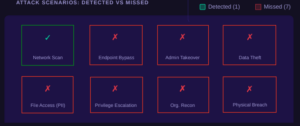
| 06 | SOC | Security Operations Centre missed 7 of 8 attacksThe SOC was fully operational throughout the engagement. It detected only one low-sophistication technique — a routine network scan. Advanced attacks including data theft, privilege escalation, and physical breaches generated zero alerts. |
HIGH | ⚠ Partial |
| 07 | Active Directory | Complete organisational IT structure visible to any employee Any authenticated user can enumerate all employee accounts, security groups, and department structures — providing attackers with a comprehensive map for targeted social engineering or lateral movement. |
MEDIUM | ✗ None |
| 08 | Info Disclosure | Server versions publicly visible
Web servers and remote access |
LOW | ✗ None |
DETECTION GAP ANALYSIS
The SOC Could Not See the Attack
LEADING PHARMACEUTICAL MANUFACTURER’ Security Operations Centre was fully
operational and staffed throughout the five-day assessment. Despite this, seven of eight
attack scenarios completed without generating a single meaningful security alert or
response.
12.5%
LEADING PHARMACEUTICAL
MANUFACTURER — Actual
Detection Rate
1 out of 8 attacks detected (network scan only)
85%+
Industry Minimum Benchmark
Best-in-class SOC targets ≥ 95%
detection rate
At the current 12.5% detection rate, a real attacker could maintain persistent, undetected access to LEADING PHARMACEUTICAL MANUFACTURER’ environment for weeks or months — monitoring executive communications, exfiltrating intellectual property, and preparing a destructive or ransomware attack — without the SOC raising a single alert.
BUSINESS IMPACT
What a Real Attack Could Mean for LEADING
PHARMACEUTICAL MANUFACTURER
The assessment demonstrated realistic, exploitable attack paths. The following scenarios
represent the probable business consequences if the same capabilities were used by a
real threat actor.
1
2
3
4
5
6
REGULATORY & COMPLIANCE EXPOSURE
Immediate Legal and Regulatory Risk
The findings of this assessment create exposure across multiple Indian regulatory
frameworks. Remediation is both a security imperative and a compliance obligation.
Digital Personal Data Protection Act
2023
repositories constitutes a breach of data fiduciary obligations. PDPB 2023 requires organisations to implement appropriate technical and organisational measures to protect personal data.
IT Act 2000 — Section 43A
Section 43A requires corporate bodies handling sensitive personal data to implement and maintain reasonable security practices. The absence of data loss prevention controls, unrestricted network egress, and open file access are direct gaps against this standard. Compensation liability applies.
CDSCO & GxP Compliance Obligations
As a pharmaceutical manufacturer, LEADING PHARMACEUTICAL MANUFACTURER is subject to CDSCO
cybersecurity and data integrity requirements, as well as GxP guidelines governing electronic records and computerised systems. Physical access to manufacturing and quality systems without detection represents a direct gap in mandated infrastructure protection requirements.
ISO 27001 / Information Security
Multiple ISO 27001 control domains have identified gaps: physical and environmental security (A.7), network security (A.8), access control, incident management (A.5), and security monitoring (A.8.16). The current posture would not satisfy an ISO 27001 surveillance or certification audit.
REMEDIATION ROADMAP
Priority Actions for Leadership
Structured for executive decision-making and resource allocation. Full technical
implementation specifications are provided in the accompanying detailed technical report.
IMMEDIATE PRIORITY
Critical Security Gaps
- Audit and remediate certificate authority — close full administrator takeover risk
- Restrict all outbound data transfers — enforce egress firewall policy
- Remove employee PII from open file repositories —enforce least-privilege access
- Migrate device encryption keys to secure, managed storage
- Implement mandatory visitor verification at all facilities — no email- only confirmation
- Deploy emergency SOC detection rules for data exfiltration and privilege escalation
SHORT – TERM
Detection & Controls
- Deploy Data Loss Prevention (DLP) solution with real- time transfer monitoring
- Physical security audit at all four assessed locations — close all access control gaps
- Upgrade SOC detection rules for advanced attack patterns
- Implement centralised visitor management with mandatory photo ID verification
- Security awareness training for all staff — social engineering recognition
- Deploy alerts for abnormal file access and account activity patterns
STRATEGIC
Security Maturity
- Deploy User & Entity Behaviour Analytics (UEBA) for insider threat detection
- Implement Zero Trust Network Architecture — eliminate implicit internal trust
- Quarterly physical red team exercises across
- all facilities Annual purple team exercise to validate SOC detection against real attack scenarios
- Deploy security orchestration (SOAR) to automate response and reduce attacker dwell time
- Target: SOC detection rate ≥ 85% within 12 months