


Achieving NIST compliance represents one of the most challenging yet critical endeavors for organizations managing cybersecurity risk and regulatory obligations. Security leaders struggle with complex, overlapping requirements across multiple NIST publications while facing resource constraints and expertise gaps that can derail compliance initiatives. This comprehensive guide addresses these pain points by providing a structured, actionable NIST compliance checklist that transforms overwhelming regulatory requirements into manageable implementation steps, enabling organizations to build robust security programs that meet federal standards while protecting critical assets and data.
What is NIST Compliance?
The NIST compliance checklist represents a structured approach to implementing cybersecurity standards developed by the National Institute of Standards and Technology. NIST compliance encompasses multiple frameworks and publications designed to help organizations manage cybersecurity risks, protect sensitive information, and meet regulatory obligations. Organizations across industries—particularly those handling federal information, controlled unclassified information (CUI), or operating in regulated sectors—must achieve NIST compliance to maintain business relationships, qualify for government contracts, and demonstrate effective risk management capabilities.
NIST compliance extends beyond simple checklist completion to encompass comprehensive security program development that addresses governance, risk assessment, control implementation, and continuous monitoring. The framework provides organizations with systematic approaches to cybersecurity that can adapt to evolving threats while maintaining regulatory alignment. Modern NIST frameworks incorporate advanced concepts such as zero-trust architecture, supply chain risk management, and artificial intelligence integration that reflect contemporary cybersecurity challenges and technological capabilities.
NIST Compliance Requirements
NIST compliance requirements are organized around multiple core frameworks and publications that address different aspects of organizational cybersecurity. The NIST Cybersecurity Framework establishes six core functions—Govern, Identify, Protect, Detect, Respond, and Recover—that provide comprehensive lifecycle approaches to risk management. Organizations must also implement controls from NIST SP 800-171 when handling CUI, while federal agencies follow NIST SP 800-53 requirements for comprehensive security control implementation.
- Six core CSF functions: Govern, Identify, Protect, Detect, Respond, Recover that establish foundational cybersecurity capabilities
- Key standards: NIST SP 800-53 (security controls catalog), SP 800-37 (risk management framework), SP 800-171 (CUI protection requirements)
- Comprehensive requirements spanning governance, asset management, risk assessment, access control, training, audit, configuration management, incident response, and recovery planning
- Integration requirements with privacy controls, supply chain risk management, and emerging technology security considerations
The complexity of NIST compliance requirements often overwhelms organizations lacking dedicated security expertise. Each publication contains hundreds of specific controls and implementation guidance that must be tailored to organizational contexts while maintaining compliance with overarching framework principles. This complexity has driven increasing adoption of AI-powered compliance solutions, such as those offered by Transilience AI, which automate evidence collection, gap assessment, and continuous monitoring activities that traditionally required significant manual effort.
NIST Compliance Checklist
This comprehensive NIST compliance checklist provides step-by-step guidance for implementing effective cybersecurity programs that align with NIST standards. Each item includes detailed implementation guidance based on authoritative sources and proven methodologies that have enabled organizations to achieve successful NIST compliance outcomes.
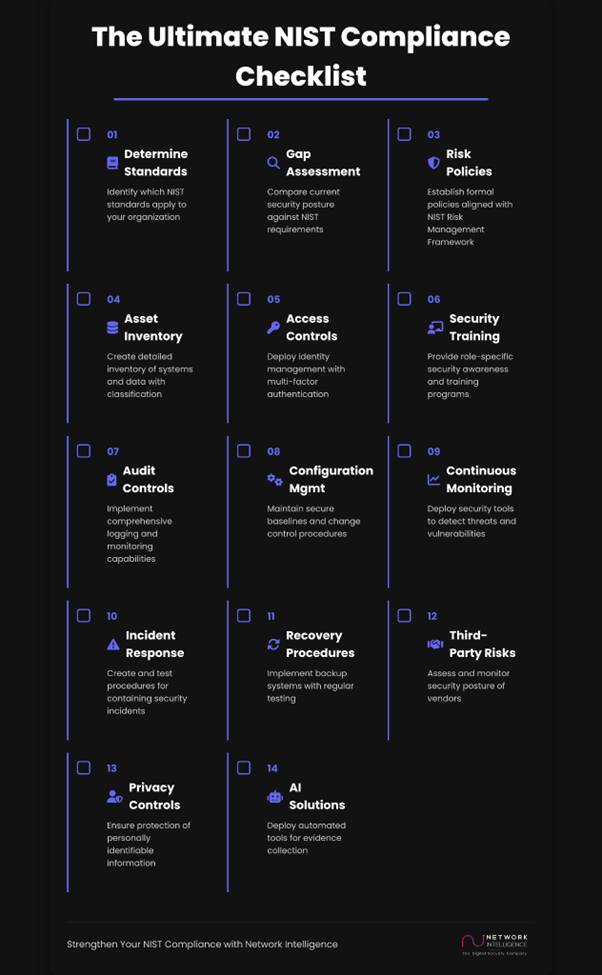
1. Determine Applicable NIST Standards
Identifying which NIST standards apply to your organization establishes the foundation for focused compliance efforts that address actual regulatory obligations rather than implementing unnecessary controls. This assessment ensures resources are allocated efficiently while addressing all applicable requirements for your operational context and industry sector.
- Conduct comprehensive analysis of organizational context, including industry requirements, data handling responsibilities, and regulatory obligations that drive NIST compliance needs
- Map specific business activities to relevant NIST publications, such as SP 800-171 for CUI handling, SP 800-53 for federal systems, or CSF for general risk management
- Document detailed rationale for selected standards including business justification, regulatory drivers, and scope limitations that guide implementation priorities
- Engage legal and compliance teams to validate standard selection and ensure alignment with contractual obligations and regulatory requirements
2. Conduct a Gap Assessment
Comprehensive gap assessment provides detailed understanding of current security posture compared to NIST requirements, enabling organizations to prioritize remediation efforts and allocate resources effectively. This assessment forms the basis for all subsequent implementation activities and helps establish realistic timelines for achieving compliance.
- Perform detailed inventory of existing security controls, policies, procedures, and technical implementations across all organizational systems and processes
- Execute systematic assessment comparing current capabilities against specific NIST requirements using automated security audit tools where possible
- Document identified gaps with detailed descriptions, impact assessments, and recommended remediation approaches that support informed decision-making
- Develop comprehensive remediation roadmap with realistic timelines, resource requirements, and milestone definitions that guide implementation efforts
3. Define and Document Risk Management Policies
Formal risk management policies aligned with the NIST Risk Management Framework provide governance structures that support consistent security decision-making and resource allocation. Well-documented policies ensure organizational commitment to cybersecurity while establishing accountability mechanisms for security program effectiveness.
- Develop comprehensive policies covering governance structures, risk assessment methodologies, control selection processes, implementation guidelines, and continuous monitoring procedures
- Establish clear roles and responsibilities for cybersecurity activities across organizational functions, including executive oversight, operational management, and technical implementation
- Ensure policies receive formal review and approval from appropriate leadership levels with documented approval processes and version control mechanisms
- Implement policy maintenance procedures that address regular updates, change management, and stakeholder communication requirements
4. Inventory and Classify Assets and Data
Comprehensive asset and data management enables effective security control selection and implementation by providing detailed understanding of organizational resources requiring protection. This inventory supports risk-based security approaches that prioritize protection of critical assets while optimizing resource allocation across organizational systems.
- Create detailed inventory of all information systems, applications, databases, network infrastructure, and data repositories with comprehensive attribute documentation
- Implement data classification scheme based on sensitivity levels, regulatory requirements, and business criticality that supports appropriate control selection
- Establish asset lifecycle management procedures that address security requirements from acquisition through disposal, including change management and update processes
- Deploy automated asset discovery and inventory tools that maintain current visibility into organizational assets and support continuous monitoring requirements
5. Implement Access Control Mechanisms
Robust access control implementation protects sensitive information and systems through granular permission management and continuous verification mechanisms. NIST frameworks emphasize comprehensive access control that extends beyond traditional authentication to encompass authorization, accounting, and continuous monitoring of access activities.
- Deploy comprehensive identity and access management (IAM) systems that support centralized identity management, role-based access controls, and integration with organizational directory services
- Implement multi-factor authentication across all systems with risk-based authentication policies that consider user roles, system sensitivity, and access contexts
- Establish detailed user role definitions, permission matrices, and access review procedures that ensure appropriate access levels while supporting operational requirements
- Configure session management controls including timeout policies, concurrent session limitations, and remote access restrictions that balance security with user productivity
6. Deliver Security Awareness and Training Programs
Comprehensive security awareness and training ensures all personnel understand cybersecurity responsibilities and can effectively recognize and respond to security threats. Training programs must address role-specific requirements while maintaining currency with evolving threat landscapes and organizational security policies.
- Develop comprehensive security awareness curricula that address general cybersecurity principles, organizational policies, threat recognition, and incident reporting procedures for all personnel
- Provide specialized training for personnel with elevated security responsibilities, including system administrators, security professionals, and incident response team members
- Implement training tracking systems that monitor participation rates, assess learning effectiveness, and ensure compliance with training requirements across organizational functions
- Maintain current training content that reflects emerging threats, regulatory changes, and organizational policy updates through regular content review and update processes
7. Establish Audit and Accountability Controls
Comprehensive audit and accountability capabilities provide essential visibility into user activities and system events that support threat detection, incident investigation, and compliance demonstration. These controls require systematic logging, monitoring, and analysis capabilities across organizational systems and networks.
- Implement centralized logging infrastructure that collects security-relevant events from all organizational systems with standardized log formats and secure transmission mechanisms
- Define detailed logging standards that specify event types, retention periods, and analysis procedures while balancing security monitoring needs with storage and performance considerations
- Establish regular audit log review procedures that identify suspicious activities, policy violations, and security incidents through both automated analysis and manual review processes
- Maintain comprehensive audit trails that support compliance reporting, incident investigation, and forensic analysis requirements with appropriate data protection and retention controls
8. Apply Secure Configuration Management
Secure configuration management maintains system security through standardized baselines, change control procedures, and continuous monitoring of configuration states. This approach reduces vulnerabilities and prevents unauthorized changes that could compromise security effectiveness across organizational systems.
- Develop comprehensive secure configuration baselines for all system types with detailed configuration specifications that address security requirements while maintaining functionality
- Deploy automated configuration management tools that enforce standard configurations, detect unauthorized changes, and support rapid configuration updates across organizational environments
- Implement formal change control procedures that evaluate security impacts of configuration changes while ensuring appropriate approval and documentation requirements
- Establish continuous monitoring capabilities that detect configuration drift and unauthorized modifications with automated alerting and remediation procedures where appropriate
9. Implement Continuous Monitoring
Continuous monitoring provides ongoing visibility into organizational security posture and supports rapid detection of threats, vulnerabilities, and compliance drift. Modern continuous monitoring leverages advanced analytics and automation to process large volumes of security data while identifying actionable security insights.
- Deploy security information and event management (SIEM) systems that aggregate and correlate security events from multiple sources with automated analysis and alerting capabilities
- Conduct regular vulnerability scanning and security assessments that identify new vulnerabilities and assess the effectiveness of implemented security controls
- Implement behavioral monitoring and anomaly detection capabilities that identify unusual user activities, system behaviors, and potential security incidents through advanced analytics
- Establish monitoring process updates that adapt to changing system environments, threat landscapes, and organizational requirements through regular review and improvement activities
10. Develop and Test Incident Response Plans
Effective incident response planning enables organizations to contain and mitigate cybersecurity incidents efficiently while minimizing business disruption and data exposure. Incident response capabilities must be regularly tested and updated to address evolving threats and organizational changes.
- Document comprehensive incident response procedures that address incident classification, escalation protocols, containment strategies, and communication requirements for various incident types
- Conduct regular tabletop exercises and incident simulations that test response procedures, identify improvement opportunities, and ensure personnel familiarity with response processes
- Establish incident response team structures with defined roles, responsibilities, and decision-making authorities that support coordinated response efforts across organizational functions
- Implement post-incident review processes that capture lessons learned, identify process improvements, and update response procedures based on actual incident experience
11. Establish Recovery and Business Continuity Procedures
Recovery and business continuity planning ensures organizations can restore operations efficiently after cybersecurity incidents while incorporating lessons learned to improve future resilience. These capabilities require coordination between technical recovery procedures and broader business continuity requirements.
- Implement comprehensive backup and restoration procedures that protect critical data and systems with regular testing to verify restoration capabilities and recovery time objectives
- Develop integrated disaster recovery and business continuity plans that address both technical system recovery and broader business process resumption requirements
- Conduct regular recovery testing that validates backup systems, restoration procedures, and business continuity processes while identifying improvement opportunities
- Establish stakeholder communication strategies that provide appropriate information to internal teams, customers, and partners during recovery operations while maintaining operational security
12. Manage Third-Party and Supply Chain Risks
Comprehensive third-party risk management extends security controls beyond organizational boundaries to address risks introduced by vendors, service providers, and supply chain partners. This requirement has become increasingly critical as organizations depend on complex networks of external relationships for essential business functions.
- Conduct thorough vendor security assessments that evaluate third-party security posture, compliance status, and risk management capabilities through standardized assessment procedures
- Implement contractual security requirements that define vendor security obligations, incident notification procedures, and audit rights while ensuring appropriate risk allocation
- Establish ongoing vendor monitoring procedures that track third-party security performance, compliance status, and incident response coordination through regular reviews and assessments
- Maintain comprehensive documentation of third-party relationships, risk assessments, and monitoring activities that support compliance demonstration and risk management decision-making
13. Integrate Privacy Controls
Privacy control integration ensures comprehensive protection of personally identifiable information (PII) while supporting compliance with data protection regulations that intersect with cybersecurity requirements. This integration requires coordinated implementation of security and privacy controls that address both unauthorized access and inappropriate data handling.
- Map privacy requirements to existing security controls while identifying additional privacy-specific controls needed to address data protection obligations comprehensively
- Implement data minimization and consent management procedures that limit data collection and processing to legitimate business purposes while respecting individual privacy rights
- Establish individual rights protection mechanisms including data subject access procedures, correction capabilities, and deletion processes that comply with applicable privacy regulations
- Deploy privacy impact assessment procedures that evaluate privacy risks associated with new systems, processes, or data handling activities while identifying appropriate mitigation measures
14. Leverage AI-Driven Compliance Solutions
AI-powered compliance platforms revolutionize NIST compliance by automating complex assessment procedures, continuous monitoring activities, and evidence collection processes that traditionally require extensive manual effort. These solutions enable organizations to achieve more comprehensive compliance while reducing resource requirements and improving accuracy.
- Deploy AI-driven compliance management platforms like Transilience AI that automate evidence collection, gap assessment, and continuous monitoring across multiple compliance frameworks simultaneously
- Implement automated assessment tools that continuously evaluate security control effectiveness, identify compliance drift, and generate actionable remediation recommendations based on real-time analysis
- Integrate AI analytics capabilities for threat detection and risk prediction that enhance traditional security monitoring with behavioral analysis and predictive capabilities
- Utilize intelligent automation to reduce manual compliance workload while improving accuracy and consistency of compliance activities across organizational environments
Common Mistakes to Avoid in NIST Compliance
- Over-implementing unnecessary controls while under-implementing critical security measures due to inadequate understanding of applicable requirements and organizational risk contexts
- Neglecting continuous monitoring and regular assessment updates that ensure compliance effectiveness remains current with evolving threats and organizational changes
- Failing to maintain comprehensive documentation and evidence collection that supports compliance demonstration during audits and assessments
- Overlooking third-party and supply chain security risks that can introduce vulnerabilities despite internal security control effectiveness
- Focusing solely on checklist completion without understanding underlying security principles that drive NIST requirements and ensure actual security improvement
- Inadequate integration of NIST compliance with other regulatory requirements, creating conflicting control implementations and inefficient resource utilization
- Insufficient training and awareness programs that limit organizational understanding of security responsibilities and reduce overall program effectiveness
Strengthen Your NIST Compliance with Network Intelligence AI-Driven Solutions
Navigating the complexities of NIST compliance requires more than traditional consulting approaches—it demands innovative technology solutions that can automate complex processes while maintaining the human expertise necessary for strategic decision-making. Network Intelligence, with over 23 years of global cybersecurity expertise, combines proven methodologies through our ADVISE framework (Assess, Design, Visualize, Implement, Sustain, Evolve) with cutting-edge AI capabilities delivered through our subsidiary, Transilience AI.
Our approach to cybersecurity compliance transforms traditional manual compliance processes through intelligent automation that reduces vulnerability backlogs by 70% and eliminates wasted development patching efforts by 80%. Transilience AI’s LLM-based security agents automate the most time-consuming aspects of NIST compliance, including evidence collection across 100+ control points, real-time gap identification, and continuous monitoring that traditional approaches simply cannot match at scale.
Unlike compliance tools that merely provide software without results, our AI-powered platform guarantees certification outcomes through autonomous agents that work 24/7 without human intervention. This revolutionary approach has already delivered industry-first achievements, including the first fully automated SOC2 certification with zero human resources required. Organizations implementing our solutions typically redirect $150,000+ annual compliance overhead to core business development while achieving certifications 2+ months faster than traditional approaches.
The integration of Network Intelligence’s deep domain expertise with Transilience AI’s autonomous capabilities creates a unique value proposition for organizations pursuing NIST compliance. Our compliance services extend beyond simple checklist completion to encompass comprehensive security program development that addresses governance, risk management, and continuous improvement requirements that modern NIST frameworks demand.
For organizations struggling with resource constraints and expertise gaps that traditionally limit NIST compliance effectiveness, our AI-driven approach offers transformational capabilities. Transilience AI’s vulnerability prioritization and management capabilities, combined with Network Intelligence’s proven implementation methodologies, enable organizations to focus their limited security resources on the highest-impact activities while ensuring comprehensive compliance coverage across all applicable NIST requirements.
Talk to an Expert to discover how Network Intelligence and Transilience AI can accelerate your NIST compliance journey while reducing costs and improving security effectiveness through intelligent automation and proven expertise.