


Defense contractors and organizations handling Controlled Unclassified Information (CUI) face mounting pressure to achieve NIST 800-171 compliance while managing limited cybersecurity resources and complex technical requirements.
The challenge of implementing 110 security controls across 14 control families often overwhelms security teams already stretched thin by daily operational demands.
This comprehensive NIST 800 171 compliance checklist addresses these critical pain points by providing a structured, step-by-step approach to achieving and maintaining compliance. Whether you’re preparing for CMMC Level 2 certification or ensuring ongoing contract eligibility, this guide leverages proven methodologies and AI-powered automation capabilities to streamline your compliance journey while reducing costs and implementation timelines.
What is NIST 800 171?
NIST Special Publication 800-171, “Protecting Controlled Unclassified Information in Nonfederal Systems and Organizations,” is a comprehensive cybersecurity framework designed to protect Controlled Unclassified Information (CUI) in non-federal systems and organizations, particularly those within the Defense Industrial Base. This framework establishes mandatory security requirements for contractors and subcontractors handling CUI for the U.S. Department of Defense and serves as the foundation for CMMC Level 2 certification.
The framework emerged from the critical need to standardize cybersecurity practices across the defense supply chain, where sensitive government information is processed, stored, and transmitted by private organizations. Unlike broad cybersecurity frameworks, NIST 800-171 focuses specifically on CUI protection requirements, making it highly relevant for defense contractors, subcontractors, and organizations seeking federal contracts. The framework’s regulatory foundation stems from the Defense Federal Acquisition Regulation Supplement (DFARS) clause 252.204-7012, which contractually mandates compliance for organizations handling CUI. Organizations must demonstrate adherence to these requirements through self-assessment scores submitted via the Supplier Performance Risk System (SPRS), with full compliance becoming increasingly critical as CMMC assessments expand across the defense sector.
NIST 800 171 Requirements
The NIST 800-171 framework consists of 110 security controls organized into 14 control families that collectively address the full spectrum of cybersecurity requirements necessary to protect CUI. Organizations must implement, document, and maintain these controls to demonstrate compliance and remain eligible for federal contracts. The framework’s comprehensive approach integrates with broader risk management strategies, as emphasized by the NIST Cybersecurity Framework.
Control Family | Number of Controls | Key Focus Areas |
Access Control | 22 | User authentication, authorization, session management |
Awareness and Training | 3 | Security education, role-based training |
Audit and Accountability | 9 | Logging, monitoring, audit record protection |
Configuration Management | 9 | Baseline configurations, change control |
- Mandatory for organizations handling CUI under DFARS clause 252.204-7012
- Direct mapping to CMMC Level 2 requirements for third-party assessments
- Scoring system ranging from +110 to -203 points based on implementation
- Assessment methodology defined in NIST 800-171A with 320 specific assessment objectives
NIST 800 171 Compliance Checklist
This comprehensive nist 800 171 compliance checklist provides a systematic approach to implementing and maintaining compliance with all framework requirements.
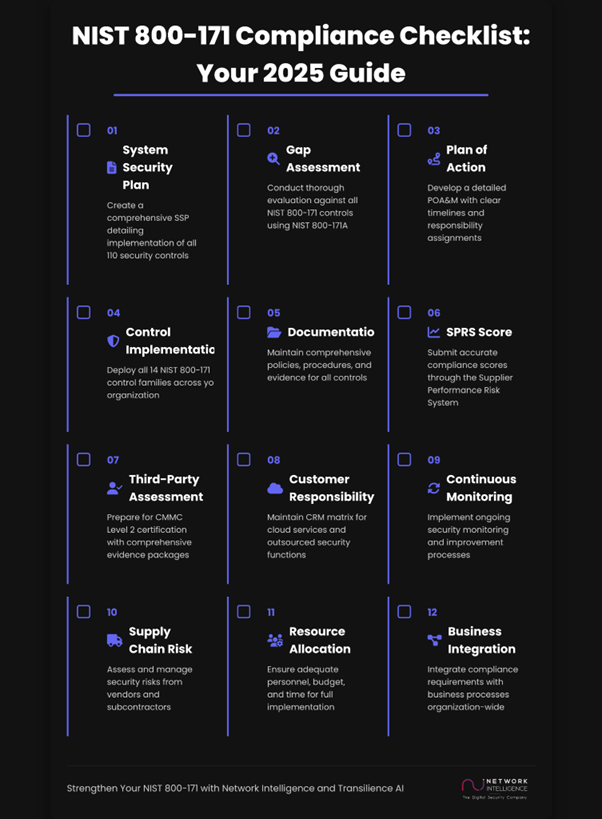
Each step includes detailed implementation guidance and leverages AI-powered solutions like those offered by Transilience AI to automate evidence collection and continuous monitoring processes.
1. Establish a System Security Plan (SSP)
The System Security Plan serves as the foundational document that details how your organization implements each of the 110 NIST 800-171 controls. This comprehensive blueprint is essential for demonstrating compliance and guiding ongoing security operations throughout your organization.
- Document implementation status and approach for all 110 security controls
- Identify responsible personnel and organizational roles for each control area
- Include detailed network diagrams, system inventories, and data flow documentation
- Establish regular review and update procedures to maintain SSP accuracy
- Integrate with Transilience AI’s automated documentation capabilities to streamline SSP maintenance
2. Conduct a Comprehensive Gap Assessment
A thorough gap assessment against all NIST 800-171 controls identifies current security posture deficiencies and provides the foundation for prioritized remediation efforts. This critical step enables organizations to understand their compliance readiness and resource requirements.
- Use NIST 800-171A assessment objectives as evaluation criteria
- Leverage automated assessment tools to identify technical control gaps
- Document all findings with supporting evidence and impact analysis
- Prioritize remediation efforts based on risk levels and business criticality
- Utilize Transilience AI’s gap analysis capabilities for continuous monitoring and assessment automation
3. Develop a Plan of Action and Milestones (POA&M)
The POA&M provides a structured approach to addressing identified compliance gaps by establishing clear remediation plans, timelines, and accountability measures. This living document ensures systematic progress toward full compliance.
- List all identified deficiencies with corresponding remediation strategies
- Assign specific owners and realistic completion deadlines for each action item
- Include resource requirements and potential implementation challenges
- Establish regular progress tracking and reporting mechanisms
- Integrate with AI-powered project management tools for automated progress monitoring
4. Implement the 14 NIST 800-171 Control Families
Systematic implementation of all control families ensures comprehensive protection of CUI across your organization’s systems and processes. This represents the core technical and administrative work required for the NIST SP 800-171 compliance checklist.
- Access Control: Implement user access restrictions, multi-factor authentication, and privileged account management
- Awareness and Training: Develop role-based security training programs and ongoing awareness campaigns
- Audit and Accountability: Deploy comprehensive logging systems with automated log analysis capabilities
- Configuration Management: Establish secure baseline configurations and automated change control processes
- Identification and Authentication: Implement strong authentication mechanisms and account lifecycle management
- Remaining families: Deploy incident response, maintenance, media protection, personnel security, physical protection, risk assessment, security assessment, system and communications protection, and system and information integrity controls
5. Maintain Comprehensive Documentation
Detailed documentation of all policies, procedures, and technical implementations supports each security control while facilitating ongoing compliance verification and assessment preparation. Effective documentation practices are critical for successful third-party assessments.
- Develop comprehensive policy and procedure documents for each control family
- Ensure documentation includes implementation details and operational guidance
- Establish version control and regular review processes for all documentation
- Maintain evidence repositories with automated collection and organization capabilities
- Leverage Transilience AI’s documentation automation to reduce manual effort and ensure consistency
6. Submit Supplier Performance Risk System (SPRS) Score
SPRS score submission demonstrates your organization’s NIST 800-171 compliance status to the Department of Defense and enables continued participation in federal contracting opportunities. This regulatory requirement must be maintained and updated regularly.
- Calculate accurate scores based on fully implemented security controls
- Submit scores and supporting documentation through the SPRS portal
- Maintain updated submissions at least every three years or after significant changes
- Document score calculations and supporting evidence for audit purposes
7. Prepare for Third-Party Assessments (CMMC Level 2)
Organizations seeking CMMC Level 2 certification must demonstrate readiness for comprehensive assessments by Certified Third-Party Assessment Organizations (C3PAOs). Thorough preparation ensures successful certification outcomes and continued contract eligibility.
- Validate full implementation and effectiveness of all 110 security controls
- Organize comprehensive evidence packages for each control family
- Address findings from previous assessments or internal audits
- Conduct mock assessments to identify potential deficiencies
- Ensure all personnel understand their roles during the assessment process
8. Maintain a Customer Responsibility Matrix (CRM) for Cloud and Outsourced Services
Cloud and external service utilization requires clear delineation of security control responsibilities between your organization and service providers. The CRM ensures all NIST 800-171 controls are adequately addressed through appropriate implementation arrangements.
- Identify all cloud and external service providers handling CUI
- Map each NIST 800-171 control to responsible parties (customer, provider, or shared)
- Document provider security capabilities and compliance attestations
- Maintain current CRM documentation and update as service relationships change
- Validate provider security implementations through regular assessments
9. Continuously Monitor and Improve Security Posture
Continuous monitoring ensures ongoing effectiveness of implemented security controls while enabling rapid adaptation to evolving threats and regulatory changes. This proactive approach maintains the NIST SP 800 171 compliance checklist requirements over time.
- Implement automated security monitoring and real-time alerting systems
- Conduct regular internal assessments and control effectiveness reviews
- Update security controls based on threat intelligence and vulnerability assessments
- Maintain incident response capabilities with lessons learned integration
- Utilize Transilience AI’s continuous monitoring platform for 24/7 compliance tracking and automated evidence collection
10. Address Supply Chain Risk Management
Supply chain security has become increasingly critical as threats target partner relationships and vendor connections. Ensuring that suppliers and subcontractors maintain appropriate security measures protects your organization from indirect compliance risks.
- Assess vendor and subcontractor compliance with NIST 800-171 requirements
- Include specific security requirements in procurement contracts and agreements
- Implement ongoing monitoring of supply chain partner security postures
- Establish incident notification and response coordination with key suppliers
- Develop contingency plans for supply chain security incidents
Common Mistakes to Avoid in NIST 800 171 Compliance
Organizations frequently encounter predictable obstacles during NIST 800-171 implementation that can delay compliance timelines and increase costs. Understanding these common pitfalls enables proactive mitigation strategies and more efficient compliance efforts. Many of these challenges can be addressed through AI-powered automation and expert guidance, as demonstrated by successful implementations across the Defense Industrial Base.
- Inadequate documentation: Failing to maintain comprehensive, current documentation of security controls, policies, and procedures that can withstand third-party assessment scrutiny
- Underestimating resource requirements: Insufficient allocation of personnel, budget, and time for full implementation of technical and administrative controls
- Poor change management: Failure to update System Security Plans, POA&Ms, and control implementations after system changes or process modifications
- Ignoring supply chain responsibilities: Overlooking vendor and subcontractor security requirements that can create compliance gaps and risk exposure
- Reactive monitoring approaches: Relying on periodic assessments rather than implementing continuous monitoring and improvement capabilities
- Self-assessment only focus: Preparing exclusively for self-assessments without considering third-party CMMC evaluation requirements and evidence standards
- Siloed implementation: Treating cybersecurity compliance as an IT-only initiative rather than an organization-wide responsibility requiring cross-functional coordination
To understand cybersecurity compliance fundamentals and avoid these common mistakes, organizations should adopt structured approaches that integrate compliance requirements with business processes. Many successful organizations have found that AI-powered platforms can significantly reduce the burden of documentation maintenance, evidence collection, and continuous monitoring while ensuring consistent implementation across all control families.
Strengthen Your NIST 800 171 with Network Intelligence and Transilience AI
Network Intelligence delivers comprehensive cybersecurity solutions that transform NIST 800-171 compliance from a burden into a strategic advantage through innovative AI-powered automation and decades of expert guidance. Our proven ADVISE framework (Assess, Design, Visualize, Implement, Sustain, Evolve) provides systematic approaches to achieving and maintaining compliance while reducing costs by up to 70% compared to traditional methods.
Through our subsidiary Transilience AI, we offer revolutionary autonomous compliance solutions that have achieved industry-first milestones including fully automated SOC2 certification with zero human intervention. Our LLM-based security agents transform complex NIST 800-171 requirements into automated evidence collection, gap assessment, and continuous monitoring capabilities that amplify security team effectiveness by 10x. The platform’s multi-agent AI architecture handles the demanding documentation and assessment requirements of NIST 800-171 while freeing your team to focus on strategic security initiatives and business growth.
Organizations leveraging Network Intelligence’s AI-powered approach to NIST 800-171 compliance benefit from continuous 24/7 monitoring, automated policy and procedure documentation, real-time gap identification and remediation guidance, and guaranteed certification outcomes backed by our 23+ years of cybersecurity expertise. Our solutions integrate seamlessly with existing security stacks while providing the comprehensive coverage needed for CMMC Level 2 assessments and ongoing compliance maintenance. Unlike traditional consulting approaches that create dependency relationships, our AI-driven platform enables organizations to maintain ongoing compliance autonomously while dramatically reducing the $150,000+ annual overhead typically associated with compliance programs.
Whether you’re beginning your NIST 800-171 journey or seeking to optimize existing compliance programs, Network Intelligence’s combination of human expertise and AI automation provides the most effective path to achieving certification while building resilient cybersecurity capabilities. Talk to an Expert to discover how our proven methodologies and innovative AI solutions can accelerate your compliance timeline and reduce implementation costs while ensuring robust protection for your CUI environments.