


Organizations are never more secure than the day before an audit.
That moment before audit execution is often when all the evidence is assembled and gaps are patched.
But what happens on the 364 other days? Sessioned compliance programs leave companies exposed to blind spots and fragmented risk.
This is why the new approach to all-around security is continuous compliance. Regulators are already leaning that way as some agencies now expect firms to maintain a compliance monitoring plan as part of their licensing criteria.
For example, the United Kingdom’s FCA’s “Step-by-Step Guide: Compliance Authorisation Application” explicitly requires firms to “provide a document giving details of your firm’s Compliance Monitoring Programme” as part of their authorization submission.
While there are no universal standards for real-time compliance yet, organizations are increasingly using automation and managed security platforms to oversee operations.
Approximately 45% of companies say they would switch audit providers if it meant running compliance more efficiently. And it’s not hard to see why.
AI and machine learning can now digest and analyze data at a speed no manual auditor could match. Approximately 44% of businesses currently utilize AI for compliance purposes. This is because of AI’s value in continuous monitoring; it can track systems in real-time and alert teams before risks escalate.
Efficiency, speed, and proactive oversight, that’s the direction compliance is heading.
What is Real-Time Compliance Monitoring and Why Does it Matter
Real-time compliance monitoring involves the continuous, automated oversight of an organization’s systems and controls to ensure they remain within established policies, regulations, or specific industry standards.
In practice, this means embedding rule logic, analytics, and data collection into the operational fabric of your systems, so that deviations are identified in a timely manner and acted upon.
Why real-time compliance monitoring matters
It’s simple. Risks don’t wait for audit season. Real-time compliance monitoring closes the gap between when a control fails and when the team catches it.
Below are the high-stakes reasons why it’s important:
1. Regulatory and financial penalties
If a compliance failure occurs and is only discovered at audit time, the cost is high. Regulators no longer accept the excuse that you just “didn’t know.”
- The Bank of England fined Vocalink Ltd £11.9 million for inadequate risk management and weak controls, which led to failures due to governance and monitoring gaps.
- For sanctions compliance, H1 2024 saw about $3.7 million in fines globally for failures in sanctions monitoring; across the same period, total penalties in that domain climbed to $228.8 million.
A single unauthorized access, unpatched configuration, or a vendor misstep can trigger regulatory action.
Having real-time monitoring is a mitigation tool that helps show the regulator you actively guard against drift and not only react.
2. Security exposure and emerging attack vectors
From a CISO perspective, the risk of compliance lapses is inseparable from the risks of data breaches, insider threats, misconfigurations, or lateral movements.
Real-time compliance helps reduce dwell time and limits blast radius. Here’s how:
- Detect infiltration quickly: When systems are monitored continuously, teams can detect anomalous behavior as soon as it occurs. This helps minimize the attacker’s time in the organization’s environment.
- Reduce attack surface area: With the increasing use of AI, generative models, and automation in business systems, your attack surface area also grows. Automated components make faster decisions, propagate changes, and expose new paths, and if your compliance logic isn’t constantly verifying them, you risk inadvertently validating a vulnerability.
3. Reputational capital and trust deficit
When a compliance failure becomes public, reputational damage can get out of hand:
- Customers, partners, and regulators lose confidence
- Stock price impact (for public firms)
- Competitors may use your failure as a signal (e.g., “our compliance is stronger”).
- Brand equity and future contract opportunities cease (especially in regulated sectors like finance, healthcare, and payments)
Real-time monitoring helps build a narrative of proactive control. Instead of explaining why something broke, teams can show that they had systems that should have flagged it, and then follow up with what the response was.
4. Business agility, cost efficiency and audit overhead
- Audit burden reduction: With continuous evidence collection, the “pre-audit scramble” becomes less stressful. The audit becomes more of a validation checkpoint than a crisis mode event.
- Faster innovation: Teams can release with more confidence. If compliance checks are run in CI/CD pipelines, there may be no need to slow a rollout for manual reviews.
- Control scaling and alignment: As you bring on new systems, M&A, new geographies, or new cloud services, real-time monitoring gives you scalable coverage without linear headcount growth.
Using Technology to Enable Full Compliance Surveillance
There are about four major compliance touchpoints where technology can help offer all-around oversight:
1. Data ingestion and normalization
Compliance begins as a data engineering problem. If your control evidence is not normalized, you may not be able to prove anything, let alone automate it.
The goal is to capture and standardize every relevant signal (configurations, logs, access events, vendor data, etc) into one analyzable format.
Key technology that can help:
- Security data lakes: Aggregate structured and unstructured compliance data at scale and enable SQL-based or API-based control validation in near real time.
- ETL/ELT and streaming pipelines: Continuously pull data from systems like cloud accounts, HR systems, or SaaS tools and push to the data lake. Keeps compliance data fresh in minutes.
- Metadata tagging and schema mapping engines: Automatically aligning ingested data with regulatory frameworks to prevent evidence drift where data lacks context or traceability.
2. Control mapping and policy intelligence
Organizations need to be able to translate human-readable obligations into machine-enforceable logic.
Key technologies that can help:
- Regulatory knowledge graphs: Connect controls, risks, assets, and frameworks dynamically. Example: link NIST 800-53 control families to AWS configuration parameters.
- Policy-as-Code frameworks: Express compliance policies in declarative code that runs automatically across environments. Example: “All S3 buckets must enforce encryption = true.”
- AI-assisted control mapping: Natural-language models extract requirements from regulatory text and suggest corresponding technical checks or queries.
3. Continuous evidence collection
Evidence is only valuable when it’s live and correlated. Organizations need to continuously verify the effectiveness of every control.
Key technologies that help:
- API-based control testing: Automates evidence pulls from cloud consoles, identity providers, and endpoint managers.
- Behavioral analytics and UEBA (User and Entity Behavior Analytics): Detects deviations in normal patterns, e.g., a privileged user bypassing MFA which could indicate insider threats.
4. Reporting and predictive governance
Compliance teams must provide executives and regulators with real-time situational awareness and predict emerging risks.
Key technologies that help:
- Automated control dashboards: Visualize compliance posture and residual risk directly in analytics platforms.
- Predictive risk scoring models: Use historical evidence and external threat data to forecast which controls are most likely to fail in the next cycle.
Types of Compliance Frameworks Requiring Real-Time Monitoring
Compliance Regulation | Domain / Industry | Continuous Monitoring Expectation | Regulator’s/Risk Rationale |
NIST SP 800-137 (Information Security Continuous Monitoring) | U.S. federal agencies & systems | Explicitly mandates ongoing awareness of security controls, vulnerabilities, and threats to support risk decisions. | The U.S. government demands that control effectiveness is not just periodically tested, but continuously validated so risks can be addressed promptly. |
GDPR (EU General Data Protection Regulation) | Data privacy / personal information | GDPR Recital 83 expects “ongoing” confidentiality, integrity, availability and resilience of processing systems and services to evaluate risks | Because personal data processing is dynamic, regulators want organizations to detect violations as they happen. |
Payment card security | While PCI still employs periodic assessments, modern implementations are shifting toward continuous compliance reporting and real-time status dashboards. | Card brands and acquirers view continuous monitoring as more effective than snapshots, as fraud and attacks evolve constantly. | |
BCBS 239 (Basel Committee – Risk Data Aggregation & Risk Reporting in Banks) | Banking / Financial institutions | Not explicitly “real-time,” but the regulation’s principle of timeliness and frequency demands near-real-time aggregation and reporting of risk data. | In banking, risk exposures shift minute to minute. Regulators want data on liquidity, credit, and and market exposures aggregated quickly to avoid blind spots during crisesis. |
Financial services, banking, fintech | Under FATF Recommendation 20, and the EU AMLD6 Act, financial institutions must detect and report suspicious activity “promptly” or “without delay.” | Money laundering evolves continually. Regulators expect that firms don’t just inspect past transactions — they actively surveil flows for illicit patterns as they occur. |
Common Challenges in Implementing Real-Time Compliance
Some common issues organizations face when implementing real-time compliance monitoring include:
- Data fragmentation: Compliance data sits in dozens of systems, so stitching them into a single, queryable stream in real-time is a massive integration challenge.
- Latency issues: Different systems produce data at different intervals and formats. Delayed or inconsistent feeds can cause false positives, missing context, or failed control triggers.
- High signal-to-noise ratio: Continuous monitoring generates thousands of alerts. Without intelligent filtering or contextual AI, teams may drown in noise.
- Human skill gap: Compliance teams often lack data engineering expertise needed to operationalize monitoring pipelines, APIs, and automation logic.
- AI-induced opacity: As AI models begin to monitor compliance controls, explainability becomes increasingly critical. Regulators may reject evidence that can’t be traced or justified.
- Vendor and third-party blind spots: Real-time visibility often stops at the organizational perimeter. External processors, SaaS providers, and supply-chain partners rarely offer synchronous compliance telemetry.
- Cultural resistance to transparency: Real-time monitoring exposes issues instantly. Some departments resist continuous visibility, fearing loss of control or reputational exposure within the organization.
Implementation Strategy: Building 24/7 Automated Compliance Surveillance
Here’s a stepwise implementation strategy for continuous compliance monitoring:
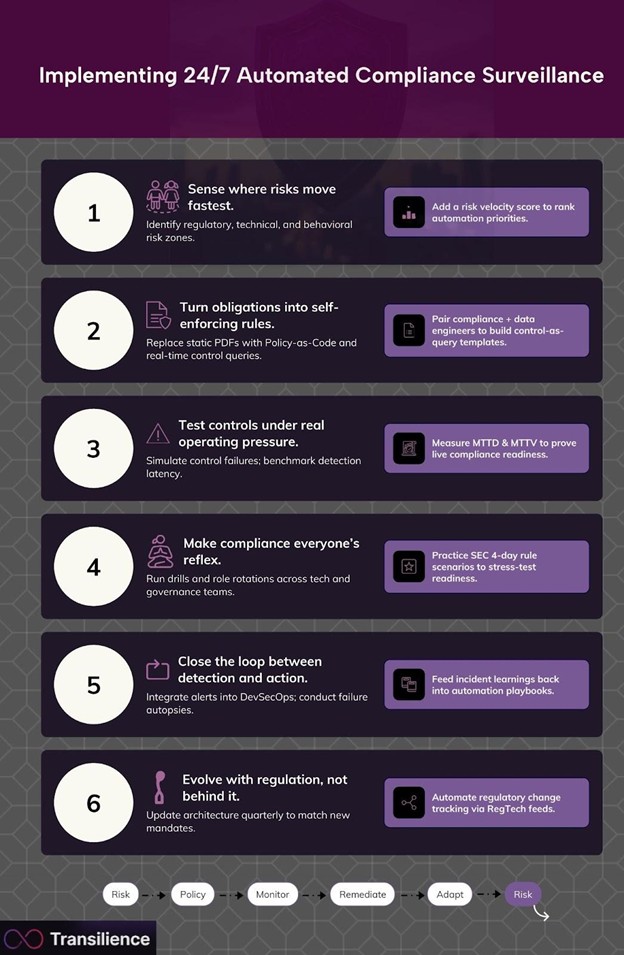
Step 1: Conduct a compliance risk assessment
Identify where regulatory, technical, and behavioral noncompliance is most likely to occur and how quickly each risk evolves.
Tips:
|
Step 2: Codify a policy framework that can execute itself
Once risks are identified, transform them into something the system can comprehend.
Tips:
|
Step 3: Conduct regular testing for compliance monitoring
Validate that your compliance controls actually work, not just in theory, but under real operating conditions as often as possible.
Tips:
|
Step 4: Train and operationalize a compliance-aware culture
Training should be conducted regularly across all relevant stakeholders to ensure they understand their role in maintaining continuous compliance.
Tips:
|
Step 5: Establish continuous assurance and remediation loops
Detection is only useful ifthe response is immediate and measurable. The next step is to close the feedback loop between detection, action, and improvement.
Tips: Integrate compliance alerts directly into DevSecOps and ITSM systems for a traceable closure.
|
Step 6: Treat compliance as a living system
Regulations evolve just as fast as technology does. Organizations have to continuously ingest updates and adapt to regulatory framework.
Tips:
|
How to Select the Right Real-Time Compliance Monitoring Solution
To select the right real-time compliance monitoring solution, assess your regulatory requirements and current processes, and then define key criteria such as scalability, automation, and integration.
Evaluate reputable vendors based on their strong regulatory coverage, automation capabilities, cost-effectiveness, and security measures.
Here are the steps you can follow:
1. Regulatory and operational fit
Before comparing tools, ensure the solution understands your specific compliance terrain. Ask whether it supports your regulatory frameworks end-to-end (SOC 2, ISO 27001, PCI DSS, HIPAA, GDPR, HITRUST).
A mature platform should auto-map controls across frameworks and reduce duplicate testing, allowing for “audit once, comply many.”
Pro tip: Check if the platform already maintains mappings for multi-framework overlap, so you don’t have to rebuild every control manually. |
2. Evaluate vendor solutions and regulatory coverage
Verify the solution covers all the specific regulations relevant to your business and industry.
- Automated reporting: Verify the presence of automated report generation and a centralized dashboard that provides a quick overview of compliance activities.
- Alerting and notifications: Confirm that the solution provides real-time alerts for regulatory changes and compliance issues.
- Audit readiness: Ensure the software includes robust audit trails to demonstrate transparency and compliance efforts.
- Vendor reputation: Research vendors with a proven track record, positive customer reviews, and strong product roadmaps.
- Support and resources: Evaluate the quality of customer support, the availability of user communities, and onboarding support for a smooth implementation.
3. Scalability and Flexibility
Compliance monitoring should scale faster than the organization’s infrastructure. Evaluate whether the tool handles multi-cloud, hybrid environments, and global entity structures. Customization options should let you align the tool with your internal processes.
4. Consider cost and value
Beyond the price, assess the total cost of ownership and the value the solution brings in terms of efficiency and risk mitigation.
Transforming Compliance Operations with Transilience AI’s Intelligent Automation
Manage compliance end-to-end with Transilience AI
Transilience AI, a subsidiary of Network Intelligence, applies intelligent automation to the entire compliance lifecycle. Instead of chasing evidence or waiting for audit season, compliance teams get continuous visibility into how controls are performing, where risks are emerging, and what needs to be fixed.
The platform combines automation, AI, and managed expertise to turn compliance from a recurring burden into an ongoing state of readiness.
What this means for your organization:
- Always-on compliance: Automated evidence collection and control validation mean your organization is continuously audit-ready.
- Context-driven insight: AI filters noise, correlates findings, and helps teams focus on the issues that actually affect risk posture.
- Unified oversight: Compliance, security, and vulnerability data live in one environment, giving leaders a single view of operational health.
- Human and machine partnership: Transilience’s managed experts maintain mappings, workflows, and auditor relationships, so internal teams can focus on strategy.
- Faster certification cycles: Automated documentation and pre-validated controls shorten audit timelines and accelerate go-to-market readiness.
- Predictable compliance spend: Outcome-based pricing aligns cost with measurable progress.
Because regulations, systems, and threats evolve daily, compliance can’t be a point-in-time exercise;; it must adapt as quickly as the business does.
Transilience helps you stay ahead of that curve with intelligent, always-on compliance that scales with your growth. Book a demo today.