


In today’s rapidly evolving regulatory landscape, organizations face mounting pressure to protect personally identifiable information (PII) while navigating an increasingly complex web of compliance requirements. Security leaders and compliance professionals struggle with fragmented data across cloud environments, evolving threat vectors, and the challenge of maintaining continuous compliance across multiple frameworks. Traditional manual approaches to PII compliance often leave organizations reactive, vulnerable to breaches, and struggling to demonstrate ongoing adherence to regulatory standards. This comprehensive guide provides a strategic framework for implementing robust PII compliance programs, leveraging advanced AI-driven solutions to transform compliance from a burdensome obligation into a competitive advantage through intelligent automation and continuous monitoring.
Understanding PII Compliance
What is PII Compliance?
PII compliance refers to the systematic implementation of policies, procedures, and technical controls designed to protect personally identifiable information throughout its lifecycle. This encompasses not only meeting regulatory requirements but also establishing comprehensive data governance frameworks that ensure appropriate collection, processing, storage, and disposal of sensitive information. Modern PII compliance extends beyond traditional perimeter-based security models to encompass zero trust architecture principles that verify every access request regardless of source location.
Organizations must align their PII protection strategies with applicable regulatory frameworks while implementing technical safeguards that prevent unauthorized access, disclosure, or modification. The scope of PII compliance includes structured data within databases, unstructured information in documents and communications, and emerging data types generated by artificial intelligence and analytics platforms. Transilience AI’s automated compliance monitoring capabilities enable organizations to maintain continuous visibility across these diverse data environments, automatically identifying and classifying PII as it flows through complex enterprise ecosystems.
Sensitive vs. Non-Sensitive PII Examples
Understanding the distinction between sensitive and non-sensitive PII is crucial for implementing appropriate protection measures. Sensitive PII includes information that, if compromised, could result in substantial harm, embarrassment, or inconvenience to individuals. This category encompasses Social Security numbers, financial account information, biometric identifiers, medical records, and authentication credentials. The GDPR framework specifically designates special categories of personal data including racial origin, political opinions, religious beliefs, and health information as requiring enhanced protection measures.
Non-sensitive PII typically includes information that is publicly available or poses minimal risk if disclosed independently, such as names, business addresses, and work phone numbers. However, the risk profile of seemingly innocuous data elements can escalate significantly when combined with other information sources. Research demonstrates that approximately 87% of Americans can be uniquely identified using just three data points: gender, date of birth, and ZIP code, illustrating how non-sensitive PII becomes highly sensitive when aggregated.
Modern AI-powered classification systems like those developed by Transilience automatically evaluate PII sensitivity based on contextual factors, regulatory requirements, and potential reidentification risks. These systems continuously assess data combinations and flag instances where multiple non-sensitive elements create sensitive datasets requiring enhanced protection.
The Need for Robust PII Compliance
The imperative for comprehensive PII compliance has intensified dramatically due to several converging factors. Regulatory enforcement has become increasingly aggressive, with organizations facing multimillion-dollar penalties for compliance failures. The NIST Cybersecurity Framework emphasizes that effective PII protection requires systematic risk management approaches that address technical vulnerabilities, organizational processes, and human factors simultaneously.
Cyber threats targeting PII have evolved to exploit sophisticated attack vectors including artificial intelligence-enhanced social engineering, supply chain compromises, and insider threats. Organizations operating in highly regulated industries face particular scrutiny, as compliance failures can result in operational restrictions, loss of professional licenses, and criminal prosecution in severe cases. The proliferation of data across cloud environments, remote work arrangements, and third-party relationships has exponentially increased the attack surface while complicating traditional compliance approaches.
Transilience AI addresses these challenges through autonomous compliance monitoring that provides 24/7 visibility across distributed environments, automatically detecting compliance gaps and potential security incidents before they escalate into regulatory violations or data breaches.
Key Privacy Laws and Regulations for Protecting PII
The regulatory landscape governing PII protection operates across multiple jurisdictions and industry sectors, creating complex compliance matrices for organizations operating in global markets. The Health Insurance Portability and Accountability Act establishes stringent requirements for protected health information, mandating administrative, physical, and technical safeguards that healthcare providers and business associates must implement.
The European Union’s General Data Protection Regulation represents the most comprehensive privacy framework globally, applying to any organization processing personal data of EU residents regardless of where the organization is headquartered. GDPR introduces concepts such as data protection by design, explicit consent requirements, and individual rights including data portability and erasure that extend far beyond traditional security-focused regulations.
State-level privacy laws in the United States continue proliferating, with over twenty states having passed comprehensive data privacy legislation as of 2024. California’s Consumer Privacy Act and Privacy Rights Act establish extensive consumer rights and business obligations, while states like Texas demonstrate particularly aggressive enforcement postures with substantial penalties for violations.
Organizations must also navigate industry-specific frameworks such as the ISO 27001 standard for information security management, which provides systematic approaches to identifying, assessing, and managing information security risks including PII protection requirements.
Principles of Protecting Personally Identifiable Information (PII)
Effective PII protection requires adherence to fundamental principles that transcend specific regulatory requirements and technology implementations. Data minimization mandates that organizations collect only the personal information strictly necessary for specified, legitimate purposes, limiting both scope and duration of data retention. This principle directly supports compliance with multiple frameworks while reducing the organization’s risk exposure and attack surface.
Purpose limitation requires that PII be processed only for the specific purposes disclosed at the time of collection, preventing unauthorized secondary uses that could violate individual privacy expectations or regulatory requirements. Organizations must establish clear business justifications for data collection activities and implement technical controls that prevent unauthorized access or processing.
Transparency principles mandate that individuals understand how their personal information is collected, used, shared, and protected. This extends beyond privacy notices to encompass clear communication about data subject rights, complaint procedures, and organizational accountability measures. Modern privacy frameworks emphasize individual control and consent, requiring organizations to implement mechanisms that enable meaningful choice about personal information handling.
Accountability principles require organizations to demonstrate compliance through documented policies, implemented controls, and regular assessments rather than merely asserting compliance. This includes maintaining evidence of consent, documenting data processing activities, conducting privacy impact assessments, and implementing governance structures with clear roles and responsibilities for PII protection.
Common Challenges Faced When Securing PII
Organizations implementing PII compliance programs encounter numerous obstacles that can undermine effectiveness even when policies appear comprehensive. Data discovery represents a fundamental challenge, as organizations frequently cannot identify all locations where PII exists across complex, distributed environments including cloud services, endpoints, and third-party systems. Traditional data loss prevention tools often generate excessive false positives while missing sensitive information in unstructured formats or emerging data types.
Resource constraints frequently limit organizations’ ability to implement comprehensive compliance programs, particularly for mid-market companies that lack dedicated privacy professionals or specialized technical expertise. The complexity of regulatory requirements creates confusion about specific obligations, leading to either over-implementation that wastes resources or under-implementation that creates compliance gaps.
Third-party risk management poses persistent challenges as organizations must extend PII protection requirements throughout their vendor ecosystems while maintaining limited visibility and control over external partners’ security practices. Cybersecurity compliance requires systematic vendor assessment, contractual safeguards, and ongoing monitoring that many organizations struggle to implement effectively.
Technology integration challenges arise when organizations attempt to implement PII protection controls across heterogeneous environments with legacy systems, cloud platforms, and modern applications that may not support consistent security policies or centralized management. Transilience AI addresses these challenges through its multi-agent architecture that automatically adapts to diverse technical environments while maintaining consistent compliance monitoring and evidence collection across all systems.
PII Compliance Checklist
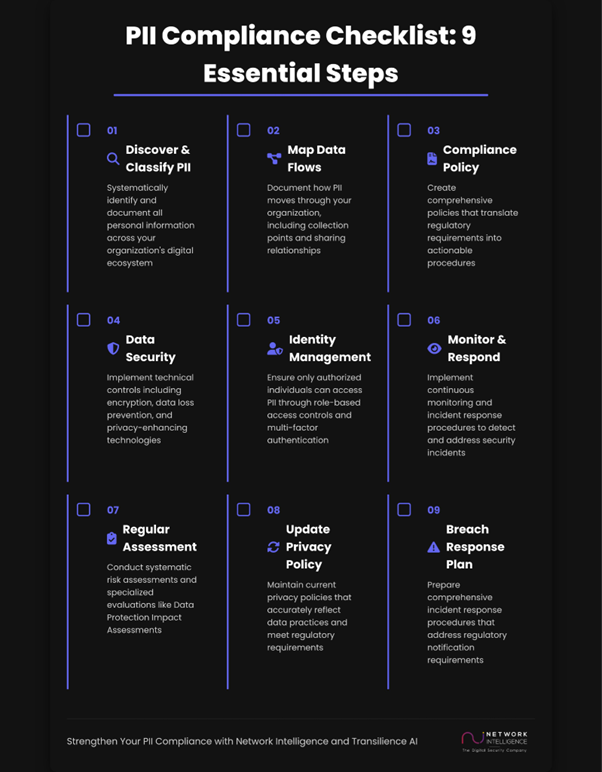
1. Discover, Identify, Classify, and Categorize PII
Comprehensive data discovery forms the foundation of any effective PII compliance program, requiring systematic identification and documentation of all personal information across the organization’s entire digital ecosystem. Organizations must implement automated discovery tools that can identify PII in structured databases, unstructured documents, cloud storage repositories, and emerging data sources including artificial intelligence training datasets and analytics platforms. This process extends beyond obvious identifiers like names and Social Security numbers to encompass indirect identifiers that become sensitive when combined with other data elements.
Data classification must account for regulatory variations, with healthcare organizations distinguishing between general PII and protected health information subject to HIPAA requirements, while financial institutions must identify information subject to GLBA or PCI DSS standards. The classification schema should establish clear handling requirements for each sensitivity level, including encryption standards, access controls, and retention periods. Transilience AI’s intelligent classification algorithms automatically evaluate data sensitivity based on content analysis, regulatory context, and potential reidentification risks, enabling consistent classification across diverse data types and storage locations.
Modern organizations face particular challenges maintaining accurate data inventories due to cloud migration, shadow IT proliferation, and data flowing through numerous third-party integrations. Automated discovery platforms must integrate with cloud access security brokers, endpoint protection systems, and application programming interfaces to maintain continuous visibility as data environments evolve. The inventory should document data lineage, tracking how PII flows between systems and identifying all copies, derivatives, and backups that require protection.
2. Map Your Data Flows
Data flow mapping provides critical visibility into how PII moves throughout organizational boundaries, enabling risk assessment and control implementation across complex processing activities. Organizations must document collection points, processing activities, storage locations, sharing relationships with external parties, and eventual disposal methods for each category of personal information. This mapping effort should identify cross-border data transfers that trigger additional regulatory requirements under frameworks like GDPR or emerging data localization laws.
Effective data flow documentation requires collaboration across business functions to understand operational processes that may not be immediately visible to information security teams. Marketing departments may collect PII through web forms and customer relationship management systems, human resources maintains employee personal information across multiple platforms, and operations teams may process PII through vendor management or customer support activities. Each processing activity requires evaluation for legal basis, necessity, and proportionality under applicable privacy regulations.
Third-party data flows require particular attention, as organizations must identify all vendors, business associates, and service providers that may access or process PII on behalf of the organization. This includes cloud service providers, payment processors, marketing automation platforms, and professional services firms that may have access to personal information in the course of their engagements. Transilience AI’s continuous monitoring capabilities automatically track data flows across these complex relationships, identifying unauthorized transfers or changes in processing activities that could create compliance risks.
3. Create a Compliance-Based PII Policy
Comprehensive policy development translates regulatory requirements and organizational risk tolerance into actionable procedures that guide employee behavior regarding PII handling. The policy framework should encompass data governance structures with clear roles and responsibilities, technical security requirements aligned with applicable standards, and procedural safeguards for collection, use, disclosure, and disposal activities. Policies must be written in accessible language that employees throughout the organization can understand and apply in their daily responsibilities.
The policy development process requires consultation with stakeholders across legal, compliance, information security, human resources, and business operations functions to ensure coverage of all PII processing activities. Executive leadership must formally approve policies and demonstrate commitment through appropriate resource allocation and accountability mechanisms. Regular policy review and update procedures ensure continued relevance as technology, business processes, and regulatory requirements evolve.
Specialized policies may be required for specific data categories or processing activities, such as employee privacy policies, customer data protection procedures, or research subject protection protocols for organizations conducting clinical trials or academic research. International organizations must address jurisdictional variations in privacy requirements while maintaining consistent baseline protections across all operations. The policy framework should integrate with existing information security and risk management policies to create coherent governance structures rather than standalone privacy requirements that may conflict with operational necessities.
4. Implement Data Security With the Right Tools
Technical security implementation represents the operational core of PII protection, requiring deployment of controls that prevent unauthorized access, disclosure, or modification of sensitive information. Encryption serves as a fundamental safeguard, with organizations implementing Advanced Encryption Standard (AES) 256-bit encryption for data at rest and Transport Layer Security (TLS) 1.2 or higher for data in transit. Encryption key management systems must implement proper key rotation procedures, secure storage mechanisms, and access controls that prevent unauthorized key disclosure.
Data loss prevention systems provide automated monitoring and enforcement capabilities that identify sensitive information and prevent unauthorized transmission through email, web applications, or removable media. Modern DLP platforms integrate with cloud access security brokers to extend protection across software-as-a-service applications and cloud storage repositories. These systems must be configured with accurate data classification rules and tuned to minimize false positives that could impede business operations while maintaining effective detection of actual policy violations.
Privacy-enhancing technologies offer sophisticated approaches to protecting PII while maintaining data utility for analytics and business operations. Tokenization replaces sensitive data elements with non-sensitive tokens that preserve referential integrity while rendering underlying data useless if exposed. Data masking and anonymization techniques enable organizations to use realistic datasets for testing, development, and analytics purposes without exposing actual personal information to unnecessary risk.
5. Practice Identity and Access Management (IAM)
Comprehensive identity and access management ensures that only authorized individuals can access PII based on their role and legitimate business need, implementing least privilege principles throughout the organization. Role-based access control systems must align with organizational structure and business processes while preventing privilege creep that occurs when employees accumulate permissions from previous positions without appropriate review and adjustment.
Multi-factor authentication represents a critical control for all accounts accessing sensitive data, particularly for privileged users with administrative capabilities. Authentication systems should integrate with existing directory services and support modern authentication protocols while maintaining usability for end users. Single sign-on solutions can improve both security and user experience by reducing password proliferation while providing centralized authentication logging and policy enforcement.
Regular access reviews and recertification processes ensure that permissions remain appropriate as roles change and employees transition between positions. Automated provisioning and deprovisioning workflows reduce the risk of delayed access changes while maintaining audit trails of all permission modifications. Best security audit software solutions provide continuous monitoring of access patterns and automated alerts when suspicious activity suggests potential insider threats or compromised accounts.
6. Monitor and Respond
Continuous monitoring capabilities provide essential visibility into PII access patterns, enabling detection of unauthorized activities or policy violations that could indicate security incidents. Security information and event management platforms must aggregate logs from multiple systems to enable correlation of events and identification of complex attack patterns that might not be visible in individual system logs. Alert systems should be tuned to specific use cases rather than generating excessive false positives that create alert fatigue among security personnel.
Incident response procedures must address specific requirements for PII breaches, including regulatory notification obligations, evidence preservation, and communication with affected individuals. Response plans should define roles and responsibilities, escalation procedures, containment strategies, and recovery activities while accounting for different types of incidents ranging from accidental disclosures to malicious attacks. Regular tabletop exercises validate response procedures and identify gaps that could create confusion during actual incidents.
Transilience AI’s autonomous monitoring agents provide 24/7 surveillance of PII processing activities, automatically correlating events across multiple systems to identify potential compliance violations or security incidents before they escalate. The platform’s intelligent alerting reduces false positives while ensuring that genuine threats receive immediate attention from security teams who can focus on investigation and response rather than alert triage.
7. Regularly Assess Your Organization’s PII
Systematic risk assessment provides ongoing evaluation of PII protection effectiveness while identifying gaps that require remediation. Annual comprehensive assessments should examine technical controls, organizational processes, personnel training effectiveness, and vendor management practices to ensure continued alignment with regulatory requirements and industry best practices. Risk assessments must consider emerging threats, technology changes, and regulatory developments that could affect organizational risk posture.
Data Protection Impact Assessments represent specialized evaluations required under GDPR and similar frameworks when processing activities are likely to result in high risks to individual rights and freedoms. These assessments evaluate necessity and proportionality of processing operations while identifying measures to address identified risks including safeguards, security measures, and individual rights protection mechanisms.
HITRUST compliance assessments provide structured approaches to evaluating security controls against industry-recognized standards while providing third-party validation of control effectiveness. Organizations in healthcare and other highly regulated industries often pursue HITRUST certification as evidence of comprehensive security programs that exceed minimum regulatory requirements. Regular reassessment ensures that controls remain effective as threats and technology evolve.
8. Keep Your Privacy Policy Updated
Privacy policy maintenance requires ongoing review and update to reflect changes in data collection practices, processing purposes, regulatory requirements, and consumer rights. Policies must provide clear, accessible information about organizational data practices while meeting legal requirements for transparency and individual notice. Regular review cycles should examine policy accuracy, completeness, and alignment with actual organizational practices to prevent discrepancies that could create compliance risks.
Policy communication strategies must ensure that employees understand their responsibilities while providing mechanisms for individuals to exercise their privacy rights. Training programs should cover policy requirements, implementation procedures, and escalation processes for privacy-related questions or complaints. Customer-facing privacy notices require particular attention to ensure they accurately describe data practices in language that consumers can understand and use to make informed decisions about their personal information.
International organizations must address jurisdictional variations in privacy notice requirements while maintaining consistency in underlying data protection practices. Policy management systems should maintain version control and change documentation to demonstrate compliance with regulatory requirements for policy maintenance and stakeholder notification when practices change materially.
9. Prepare a Data Breach Response Plan
Comprehensive incident response planning addresses specific requirements for PII breaches while integrating with broader cybersecurity incident management processes. Response procedures must account for regulatory notification timelines, with GDPR requiring notification to supervisory authorities within 72 hours and affected individuals without undue delay when breaches are likely to result in high risks to rights and freedoms. HIPAA compliance requires notification to affected individuals within 60 days and to the Department of Health and Human Services within 60 days for breaches affecting 500 or more individuals.
Breach assessment procedures must rapidly evaluate incident scope, affected data categories, potential harm to individuals, and regulatory notification requirements while preserving evidence for forensic analysis and regulatory investigation. Assessment frameworks should provide consistent criteria for evaluating breach severity and notification requirements across different types of incidents and regulatory frameworks.
Communication planning addresses both regulatory notifications and public relations considerations, with prepared templates and approval processes that enable rapid response while ensuring accurate and complete information disclosure. Legal counsel involvement ensures that response activities comply with regulatory requirements while preserving attorney-client privilege and litigation preparedness. Regular testing through simulated breach exercises validates response procedures and identifies areas for improvement before actual incidents occur.
Key PII Compliance Standards
Organizations must navigate multiple compliance frameworks that establish varying requirements for PII protection, each with distinct scope, technical specifications, and enforcement mechanisms. The General Data Protection Regulation represents the most comprehensive privacy framework globally, establishing principles-based requirements that apply to any organization processing personal data of EU residents. GDPR introduces concepts such as privacy by design, data protection impact assessments, and individual rights including data portability and erasure that extend far beyond traditional security-focused regulations.
The Health Insurance Portability and Accountability Act creates specific obligations for healthcare providers, health plans, and business associates handling protected health information. HIPAA’s Security Rule mandates administrative, physical, and technical safeguards including access controls, audit procedures, integrity protections, and transmission security measures. The Breach Notification Rule establishes specific timelines and procedures for notifying affected individuals and regulators when PHI is compromised.
State privacy laws continue expanding across the United States, with PCI DSS compliance requirements for organizations processing payment card information adding another layer of regulatory complexity. The ISO 27001 standard provides a systematic approach to information security management that supports PII protection across multiple regulatory frameworks through comprehensive risk management and control implementation procedures.
Transilience AI’s compliance automation platform addresses this regulatory complexity by maintaining current knowledge of multiple frameworks simultaneously, automatically mapping organizational controls to applicable requirements and generating evidence for audit and certification processes across GDPR, HIPAA, SOC 2, and other standards.
The Role of Artificial Intelligence in PII Compliance
Artificial intelligence is fundamentally transforming PII compliance from reactive, manual processes to proactive, automated systems capable of continuous monitoring and adaptive protection. Modern AI-powered platforms leverage machine learning algorithms to identify and classify sensitive information across diverse data types and storage locations, addressing the scale and complexity challenges that render traditional approaches operationally infeasible for most organizations.
Transilience AI represents the forefront of this transformation, deploying specialized AI agents that automate evidence collection across 100+ control points while providing continuous monitoring of compliance posture. The platform’s multi-agent architecture assigns dedicated agents to specific security domains, ensuring deep expertise in vulnerability management, threat intelligence, compliance monitoring, and incident response. Each agent operates continuously without human intervention, collecting evidence, identifying gaps, and generating real-time alerts when potential violations are detected.
Machine learning algorithms enable intelligent data classification that adapts to organizational context and regulatory requirements, automatically identifying PII patterns that human reviewers might miss while reducing false positives that create operational friction. Natural language processing capabilities analyze unstructured content including documents, emails, and communications to identify sensitive information that traditional keyword-based systems cannot detect reliably.
The autonomous nature of AI-driven compliance platforms addresses resource constraints that limit many organizations’ ability to maintain comprehensive PII protection programs. Rather than requiring dedicated compliance personnel to manually collect evidence and conduct assessments, AI systems provide 24/7 monitoring and automated reporting that enables lean security teams to focus on strategic initiatives rather than repetitive compliance tasks. This approach has proven particularly valuable for Series A-C companies that need enterprise-ready compliance certifications without the overhead of traditional consulting-heavy approaches.
How Network Intelligence Empowers Secure, Compliant Innovation Through AI-Driven Solutions
Network Intelligence delivers comprehensive cybersecurity solutions that combine advanced technology with expert human insight, addressing the full spectrum of PII compliance challenges through integrated services and cutting-edge AI capabilities. The company’s proprietary ADVISE framework guides clients through systematic security lifecycle management, from initial assessment through design, visualization, implementation, sustainment, and evolution phases that ensure adaptive protection as threats and regulations evolve.
At the forefront of Network Intelligence’s innovation portfolio, Transilience AI has revolutionized the compliance landscape by achieving the industry’s first fully automated SOC 2 certification with zero human intervention. This breakthrough demonstrates how autonomous AI agents can replace traditional personnel-heavy compliance models while delivering guaranteed certification outcomes rather than merely providing tools that require ongoing manual management. Transilience’s multi-agent architecture leverages 25+ years of Network Intelligence’s cybersecurity expertise, codified into specialized agents that work continuously to collect evidence, monitor compliance posture, and respond to emerging risks.
The Transilience AI platform addresses the core challenges identified in PII compliance implementation through several key capabilities:
Automated Evidence Collection: The platform continuously monitors over 100 control points across cloud environments, automatically collecting and organizing evidence required for compliance frameworks including GDPR, HIPAA, SOC 2, ISO 27001, and FedRAMP. This eliminates the manual effort typically required to prepare for audits while providing real-time visibility into compliance status.
AI-Powered Data Discovery and Classification: Transilience’s advanced algorithms automatically identify and classify PII across structured and unstructured data sources, addressing the foundational data inventory requirements that challenge most organizations. The system adapts to organizational context and regulatory requirements while continuously updating classifications as data environments evolve.
Continuous Compliance Monitoring: Unlike point-in-time assessments, Transilience provides 24/7 monitoring that detects compliance gaps immediately as they occur, enabling proactive remediation before violations escalate into regulatory breaches. The platform’s intelligent alerting reduces false positives while ensuring genuine risks receive immediate attention.
Guaranteed Outcomes: Transilience takes complete ownership of certification results rather than merely providing software tools, fundamentally shifting risk from customer to vendor while creating aligned incentives for compliance success. This outcome-based model has enabled companies like Aucctus to achieve SOC 2 certification two months ahead of schedule while redirecting 100% of their security resources to product development.
Network Intelligence’s comprehensive service portfolio extends beyond AI-driven automation to encompass the full range of capabilities required for effective PII compliance programs. The company’s Governance, Risk & Compliance services support organizations in developing policy frameworks, conducting risk assessments, and maintaining ongoing compliance across multiple regulatory frameworks simultaneously. Advanced Detection and Response capabilities provide the incident management and threat hunting expertise required to address sophisticated attacks targeting PII, while Zero Trust implementation services help organizations redesign their security architecture around data protection principles rather than perimeter-based models.
The integration of human expertise with AI-driven automation represents Network Intelligence’s distinctive approach to PII compliance challenges. While Transilience AI handles routine evidence collection, monitoring, and assessment activities autonomously, the company’s 600+ cybersecurity professionals provide specialized expertise for complex compliance challenges, regulatory interpretation, and strategic security architecture decisions that require human judgment and industry knowledge. This hybrid model enables organizations to achieve the efficiency benefits of automation while maintaining access to expert guidance when circumstances require specialized attention.
For organizations seeking to transform their approach to PII compliance, Network Intelligence provides a comprehensive solution that addresses both immediate compliance needs and long-term strategic objectives. The combination of proven expertise, innovative AI technology, and outcome-focused service delivery enables clients to achieve and maintain regulatory compliance while focusing organizational resources on core business priorities rather than compliance overhead.
Ready to Transform Your PII Compliance Program?
Network Intelligence’s expert team combines proven cybersecurity expertise with cutting-edge AI automation to deliver comprehensive PII compliance solutions tailored to your industry requirements.