


In today’s interconnected business environment, vendors play a crucial role in organizational success. However, they also introduce significant risks related to security, data privacy, regulatory compliance, and operational resilience. A comprehensive vendor compliance checklist helps organizations systematically evaluate and monitor vendors to ensure they meet all necessary requirements, protecting your business from potential legal, financial, and reputational damage.
Introduction to Vendor Compliance
What is Vendor Compliance?
Vendor compliance refers to the systematic process of ensuring that third-party suppliers, service providers, and business partners adhere to your organization’s standards, contractual obligations, and applicable regulatory requirements. It encompasses various aspects including data security, privacy practices, financial stability, operational capabilities, and specific industry regulations that affect your business relationship.
At its core, vendor compliance is about risk management—identifying, assessing, and mitigating the risks that vendor relationships introduce to your organization. As businesses increasingly rely on third-party vendors for critical functions, the importance of robust compliance processes has grown exponentially.
Importance of a Vendor Compliance Checklist
A well-designed vendor compliance checklist serves as the foundation of effective third-party risk management, providing numerous benefits:
First, it helps prevent costly compliance violations that could lead to regulatory penalties, legal liabilities, and reputational damage. Research shows that data breaches involving third parties increase costs by an average of $370,000 per incident, with total costs often exceeding $4 million.
Second, it establishes a consistent, repeatable process for vendor evaluation, ensuring that all vendors are assessed against the same standards regardless of who conducts the assessment. This standardization is critical for demonstrating due diligence to regulators and auditors.
Third, it provides visibility into your vendor ecosystem, helping you understand dependencies, identify high-risk relationships, and prioritize monitoring efforts. Without a structured approach, organizations often lack complete pictures of their vendor relationships, creating dangerous blind spots in their risk management programs.
Finally, a comprehensive vendor compliance checklist helps build stronger, more transparent vendor relationships by clearly communicating expectations and establishing accountability mechanisms from the start.
Understanding Vendor Compliance Requirements
Regulatory Frameworks and Standards
Different industries face varying regulatory requirements that impact vendor relationships. Understanding which frameworks apply to your organization is the first step in building an effective vendor compliance program.
CMMC Checklist and NIST 800-171 Compliance
For organizations working with the Department of Defense or within the Defense Industrial Base, the Cybersecurity Maturity Model Certification (CMMC) framework establishes mandatory security requirements for contractors and subcontractors. As of 2025, CMMC enforcement is in full effect through the Defense Federal Acquisition Regulation Supplement clause 252.204-7021.
CMMC is built upon the foundation of NIST Special Publication 800-171, which specifies 110 security requirements for protecting Controlled Unclassified Information (CUI). Contractors must ensure that their vendors handling CUI implement these requirements, which span 14 security domains including access control, incident response, risk assessment, and system and information integrity.
For organizations in this ecosystem, vendor compliance checklists must verify that vendors have:
- Implemented all applicable NIST 800-171 controls
– Documented their implementation in a System Security Plan (SSP)
– Created Plans of Action and Milestones (POAMs) for any gaps
– Established incident response procedures
– Developed processes for reporting security incidents involving CUI
This requirement extends to subcontractors, making NIST compliance verification a critical component of vendor management for defense contractors.
HIPAA Compliance Vendor Checklist Requirements
Healthcare organizations and their business associates must adhere to the Health Insurance Portability and Accountability Act (HIPAA), which establishes requirements for protecting patient health information. When healthcare providers work with vendors that access, transmit, or store protected health information (PHI), they must ensure these vendors comply with HIPAA requirements.
A HIPAA compliance vendor checklist should verify that vendors have:
- Signed a Business Associate Agreement (BAA) that legally binds them to HIPAA requirements
– Implemented administrative safeguards such as security management processes, workforce security procedures, and information access management
– Established physical safeguards protecting facility access, workstations, and devices
– Deployed technical safeguards including access controls, audit controls, integrity controls, and transmission security
– Developed breach notification procedures aligning with HIPAA requirements
Healthcare organizations bear significant liability for their vendors’ HIPAA compliance, making thorough assessment essential.
Vendor Contract Compliance Checklist Essentials
Beyond industry-specific regulations, all vendor contracts should include provisions that establish compliance requirements and provide legal protection. A comprehensive contract compliance checklist should verify that agreements include:
- Clearly defined scope of work and deliverables
– Specific security and privacy requirements, avoiding vague language like “reasonable security measures”
– Data handling and protection requirements, including encryption, access controls, and destruction procedures
– Breach notification timelines and responsibilities
– Right-to-audit clauses giving your organization the ability to verify compliance
– Clear performance metrics and service level agreements (SLAs)
– Indemnification clauses protecting your organization from vendor negligence
– Termination provisions and data return/destruction requirements
– Insurance requirements appropriate to the services provided
These contractual provisions form the legal foundation for enforcing compliance requirements throughout the vendor relationship.
Developing Your Vendor Compliance Checklist
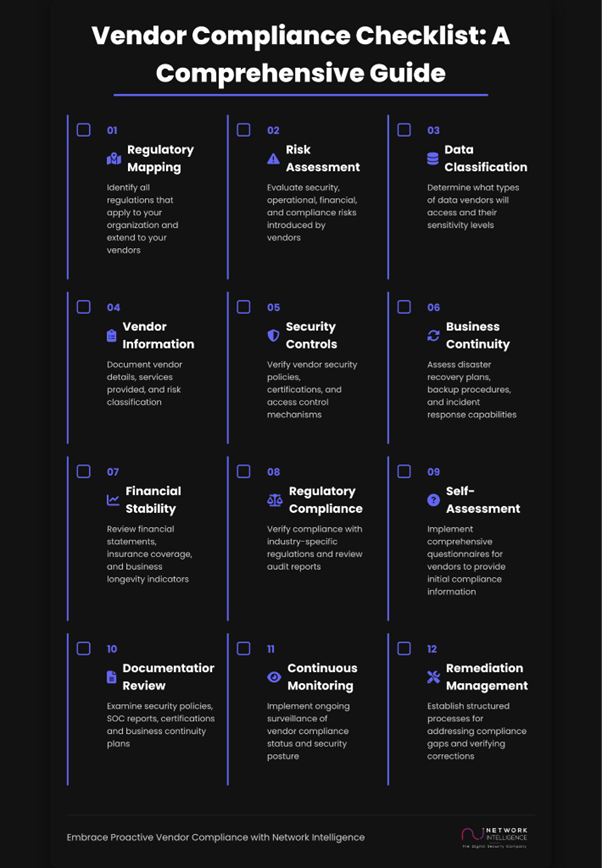
Step 1: Identify Compliance Needs
Before creating your vendor compliance checklist, you need to understand your organization’s specific requirements based on industry, regulatory environment, and risk profile. This process involves:
Regulatory Mapping: Identify all regulations that apply to your organization and extend to your vendors, such as GDPR, HIPAA, PCI DSS, CMMC, or industry-specific requirements.
Risk Assessment: Evaluate the types of risks vendors introduce to your organization, including security risks, operational risks, financial risks, reputational risks, and compliance risks.
Data Classification: Determine what types of data vendors will access or process and the sensitivity levels of that data, as this significantly impacts compliance requirements.
Internal Policy Review: Align vendor requirements with your organization’s internal policies for security, privacy, and compliance to ensure consistency.
This foundational work ensures your vendor compliance checklist addresses your organization’s specific needs rather than applying generic standards that may miss critical requirements.
Step 2: Create a Vendor Compliance Template
With a clear understanding of your compliance needs, you can develop a structured template for assessing vendors. This template serves as your master checklist, though you may need to adapt it based on vendor type and risk level.
Key Elements of a Vendor Compliance Checklist Template
A comprehensive vendor compliance template should include these essential categories:
Vendor Information and Classification
- Basic company information (legal name, address, contact details)
– Services or products provided
– Risk classification (critical, high, medium, low)
– Data access levels and types
– Regulatory frameworks applicable to this vendor
Security and Privacy Controls
- Information security policies and procedures
– Security certifications (ISO 27001, SOC 2, etc.)
– Access control mechanisms
– Encryption practices for data at rest and in transit
– Vulnerability management processes
– Security training programs
– Privacy practices and compliance with relevant regulations
Business Continuity and Operational Resilience
- Business continuity and disaster recovery plans
– Recovery time objectives (RTOs) and recovery point objectives (RPOs)
– Backup procedures and testing
– Incident response capabilities
– Service level agreements and performance metrics
Financial Stability and Insurance
- Financial statements or evidence of financial stability
– Insurance coverage (general liability, cyber insurance, E&O, etc.)
– Business longevity and stability indicators
– References and client history
Regulatory Compliance
- Compliance with industry-specific regulations
– Attestations or certifications for relevant standards
– Regulatory history, including violations or penalties
– Audit reports demonstrating compliance
Fourth-Party Risk Management
- Subcontractor management practices
– Critical subcontractors or dependencies
– Subcontractor compliance verification processes
– Notification requirements for subcontractor changes
This template provides a foundation that you can customize based on specific vendor types, risk levels, and regulatory requirements.
Step 3: Conduct a Vendor Compliance Audit
With your checklist developed, you need a systematic process for gathering and verifying vendor compliance information. This process typically involves multiple methods:
Vendor Compliance Audit Checklist Components
Self-Assessment Questionnaires: Develop comprehensive questionnaires based on your compliance checklist that vendors complete to provide initial information about their controls and practices.
Documentation Review: Request and review supporting documentation including:
- Security policies and procedures
– SOC 2 Type II reports or similar audit reports
– ISO 27001 certification documentation
– Business continuity and disaster recovery plans
– Evidence of security testing (penetration tests, vulnerability scans)
– Insurance certificates
– Financial statements
Technical Validation: For higher-risk vendors, consider:
- Remote or onsite assessments
– Vulnerability scanning (with permission)
– Technical testing of security controls
– Validation of backup and recovery capabilities
Compliance Verification: Verify regulatory compliance through:
- Review of attestations or certifications
– Examination of audit reports
– Validation of specific regulatory controls
– Assessment of regulatory history
The depth of your audit should be proportional to the risk level of the vendor—applying the same intensive process to all vendors is neither efficient nor necessary. A tiered approach that applies more rigorous assessment to high-risk vendors allows you to allocate resources effectively while maintaining appropriate oversight.
Best Practices in Vendor Compliance Management
Implementing AI-Driven Compliance Solutions
As vendor ecosystems grow more complex, many organizations are turning to artificial intelligence and automation to enhance their compliance management capabilities. These technologies can significantly improve efficiency, consistency, and coverage of vendor compliance programs.
AI Vendor Compliance Checklist
When implementing AI-driven solutions for vendor compliance, consider these key capabilities:
Automated Risk Scoring: AI systems can analyze multiple risk factors to generate comprehensive risk scores for vendors, considering factors such as data access, criticality to operations, financial stability, security posture, and compliance history.
Continuous Monitoring: Rather than point-in-time assessments, AI-powered tools can monitor vendors continuously by:
- Scanning for security incidents or breaches
– Monitoring dark web for vendor credentials or data
– Tracking changes in vendor financial stability
– Detecting compliance status changes or certification expirations
– Identifying negative news or regulatory actions
Document Analysis: Natural language processing can review vendor documentation to:
- Extract key compliance information from contracts
– Analyze security policies for gaps or weaknesses
– Review audit reports to identify control deficiencies
– Flag inconsistencies between vendor responses and documentation
Predictive Analytics: Advanced AI systems can predict potential compliance issues before they occur by:
- Identifying patterns that precede vendor problems
– Forecasting which vendors are likely to experience compliance issues
– Recommending proactive interventions to prevent compliance failures
Organizations implementing AI compliance solutions should ensure they maintain appropriate human oversight and judgment, particularly for high-risk vendors and complex compliance decisions.
Continuous Monitoring and Risk Management
Vendor compliance isn’t a one-time assessment but rather a continuous process that requires ongoing monitoring and management. Effective continuous monitoring provides early warning of emerging issues, allowing you to address problems before they escalate into serious incidents.
Vendor Management Compliance Checklist for Effective Oversight
A robust continuous monitoring program should include these elements:
Defined Monitoring Frequency: Establish risk-based schedules for reassessment, with higher-risk vendors reviewed more frequently (quarterly or semi-annually) and lower-risk vendors assessed annually.
Key Performance Indicators: Define measurable KPIs for vendor performance including:
- Security metrics (incidents, vulnerabilities, response times)
– Operational metrics (uptime, service levels, response times)
– Compliance metrics (audit findings, regulatory issues)
– Financial stability indicators
Automated Alerting: Implement systems that provide automatic notification when:
- Certifications or insurance policies expire
– Security incidents occur
– Service level agreements are breached
– Regulatory status changes
– Financial stability indicators deteriorate
Regular Status Reviews: Schedule recurring vendor performance reviews to:
- Assess compliance with contractual obligations
– Review security and operational performance
– Discuss identified issues and remediation plans
– Update risk assessments based on current information
Remediation Management: Establish structured processes for addressing compliance gaps, including:
- Formal remediation planning
– Clear timelines for resolution
– Tracking and verification of corrective actions
– Escalation procedures for unresolved issues
By implementing comprehensive continuous monitoring, organizations can maintain ongoing visibility into vendor compliance rather than relying on point-in-time assessments that quickly become outdated.
Challenges in Vendor Compliance
Common Gaps in Vendor Compliance Checklists
Even organizations with established vendor compliance programs often encounter challenges and gaps that undermine their effectiveness. Understanding these common pitfalls helps you strengthen your approach and avoid critical oversights.
A Documented Vendor Management Process
One of the most significant gaps in many vendor compliance programs is the lack of comprehensive documentation. This includes:
Incomplete Vendor Inventory: Many organizations lack a complete picture of their vendor ecosystem, particularly “shadow IT” vendors onboarded outside formal procurement channels. Without a comprehensive inventory, you can’t effectively assess and monitor all vendor relationships.
Undefined Roles and Responsibilities: Effective vendor management requires clear accountability, yet many organizations fail to define who owns various aspects of the process, from initial assessment through ongoing monitoring and remediation.
Inconsistent Assessment Methodologies: Without standardized processes, vendor assessments vary widely depending on who conducts them, creating inconsistencies that undermine the program’s effectiveness and defensibility.
Inadequate Documentation of Due Diligence: Organizations often perform vendor due diligence but fail to maintain comprehensive documentation of the process, assessments, findings, and decisions—creating significant exposure during regulatory examinations or after security incidents.
Addressing these gaps requires establishing clear, documented processes that define how vendor compliance is managed throughout the relationship lifecycle, from initial assessment through offboarding. This documentation serves as evidence of due diligence and provides consistency as staff changes occur.
Communication Plans and Controls
Another common gap involves inadequate communication mechanisms between organizations and their vendors, particularly regarding compliance expectations and incident response.
Unclear Expectations: Organizations often fail to clearly communicate compliance requirements to vendors, assuming vendors understand expectations without explicit direction.
Weak Escalation Procedures: Many vendor relationships lack defined escalation paths for compliance issues, leading to delayed responses when problems arise.
Inadequate Incident Response Coordination: Organizations frequently neglect to establish joint incident response plans with critical vendors, creating confusion and delays when security incidents occur.
Missing Performance Feedback Loops: Without regular communication about performance against compliance requirements, vendors lack visibility into how well they’re meeting expectations and where improvements are needed.
Effective vendor compliance programs establish structured communication protocols, including:
- Clear documentation of compliance expectations during onboarding
– Regular performance reviews and feedback
– Defined escalation matrices for compliance issues
– Joint incident response procedures for high-risk vendors
– Notification requirements for changes in compliance status or subcontractor relationships
By addressing these communication gaps, organizations can build stronger vendor relationships while ensuring compliance issues are identified and addressed promptly.
Conclusion: Embracing Proactive Vendor Compliance with Network Intelligence
How Network Intelligence Can Help
Leveraging AI and Expert Insight for Compliance
As vendor ecosystems grow increasingly complex and regulatory requirements continue to evolve, organizations need sophisticated approaches to vendor compliance management. The most effective programs combine technology-enabled monitoring with expert risk assessment and management.
Network Intelligence offers comprehensive vendor compliance solutions that help organizations:
- Develop tailored vendor compliance checklists based on your specific regulatory environment and risk profile
– Implement AI-driven continuous monitoring that provides real-time visibility into vendor compliance status
– Establish structured vendor assessment processes that scale efficiently as your vendor ecosystem grows
– Address compliance gaps through remediation planning and verification
– Prepare for regulatory examinations with audit-ready documentation of vendor due diligence
By implementing a comprehensive vendor compliance checklist and management program, organizations can significantly reduce their exposure to third-party risks while building stronger, more transparent vendor relationships. The investment in structured compliance processes pays dividends through reduced incidents, stronger regulatory standing, and enhanced operational resilience.
Remember that vendor compliance is not a one-time project but an ongoing program that requires continuous attention and adaptation as both your organization and the regulatory landscape evolve. With the right approach, vendor compliance becomes a strategic advantage rather than a compliance burden.
Talk to an Expert at Network Intelligence to learn how we can help you build or enhance your vendor compliance program.