


Organizations worldwide are facing an ever-increasing regulatory compliance burden. Existing regulations and frameworks, such as SOC 2, HIPAA, and GDPR, are constantly evolving. In addition, new laws are rapidly emerging, including DORA, the EU AI Act, and various US state privacy rules.
Managing risk and compliance manually is no longer sustainable or scalable. To resolve this, businesses are embracing artificial intelligence (AI) technology. While AI offers a compelling solution, a new challenge has emerged: distinguishing genuine AI compliance tools from those that merely digitize existing workflows. This gap between promises and reality often leads to wasted resources, increased risks of security breaches, and compliance disasters.
This comprehensive guide will help you evaluate and select the right AI tool for compliance management, which delivers true automation and measurable business outcomes.
How AI is revolutionizing compliance management in 2025
Compliance teams are drowning. Regulations are increasing exponentially, and the pace of change is impossible for human teams to manage alone. AI compliance tools are no longer just a nice-to-have; they’re the essential lifeline that fundamentally redefines how you handle risk and compliance.
AI-powered compliance solutions shift you from a reactive, fire-fighting state to one of proactive, continuous readiness. They empower your team to move beyond manually sifting through documents and straight to strategic decision-making.
Here’s how AI is transforming core compliance functions and preparing your business to meet demanding new standards like the EU’s Digital Operational Resilience Act (DORA) and evolving data privacy laws:
AI-driven regulatory change management: the digital oversight
AI acts as a digital watchdog, constantly monitoring thousands of legislative sources, from SEC filings to international mandates. It doesn’t just alert you to a change; it instantly analyzes the text, determines its direct impact on your current controls, and prioritizes which updates your team must address immediately.
- Result: Instantly map new requirements to existing policies, ensuring you implement necessary security and privacy controls the moment authorities announce updates.
Compliance automation: eliminating human error
Automation takes the drudgery out of compliance. AI-driven platforms simplify and execute tasks with consistency and reliability that manual processes can’t match.
- Simplifies document analysis: Quickly sifts through vast libraries of contracts, internal policies, and audit logs.
- Monitors gaps in real time: Pinpoints where actual operations deviate from mandated controls.
- Provides remediation recommendations: Delivers prioritized, actionable steps to close compliance gaps, virtually eliminating common human errors.
AI-powered risk management: integrated threat prioritization
Effective risk management requires continuous, data-driven insights. The best AI compliance tools provide integrated risk assessment capabilities by analyzing large, disparate datasets (e.g., transaction volumes, third-party vendor risks, and operational data). This capability allows you to:
- Identify, assess, and prioritize: Automatically surface the most significant threats to your business, based on potential impact and exploitability.
- Proactively mitigate: Deliver clear, proactive recommendations for reducing your risk exposure before it triggers an incident.
Predictive analytics: future-proofing your strategy
This is where AI moves beyond compliance and into true competitive advantage. By analyzing vast historical data alongside current market and regulatory trends, AI can forecast upcoming threats and predict future compliance trends, such as shifts in anti-money laundering enforcement and key updates in industry standards.
- The power of insight: When new requirements take full effect or emerging threats become a reality, you’ll no longer be caught off guard. With future insights, you can strategically adapt your compliance functions in advance to stay ahead of the curve.
The compliance automation gap: why most tools fall short
While compliance automation promised to solve all our problems, many organizations using basic compliance tools are still hitting a wall. It’s because of the automation gap, the chasm between a system that only digitizes basic workflows and one that genuinely understands a dynamic, complex regulatory context.
The reality is that most traditional compliance tools promise more but deliver less. They are actually designed for simple, transactional, or “check-the-box” tasks.
Even though they help organize documentation, these systems still require significant manual effort to map controls, conduct security tests, and collect evidence. For example, a tool might pull a screenshot, but it won’t fully automate the entire workflow from evidence collection to final reporting. This leads to increased manual work, unpleasant audit surprises, and limited scalability.
Here’s why traditional compliance tools fail:
- The data deluge: The information on emerging threats and regulatory updates is often unstructured. Traditional tools can’t intelligently read, interpret, or map nuanced text—like the complex regulatory guidance or recently identified vulnerabilities—to your internal controls. They eventually require a team of human experts to understand jargonized documents and execute them.
- Speed of regulatory change: Built on fixed rules, they struggle to keep pace with dynamic laws, such as DORA, which are frequently updated and subject to ongoing interpretation. Keeping up requires expensive, slow recoding, leading to compliance lag, unacceptable exposure to threats, and even audit failures.
- Lack of risk prioritization: Non-AI compliance tools lack the learning capacity to distinguish a low-priority vulnerability from a material risk that demands immediate executive attention. They treat all threats equally and fail to correlate them with your specific environment, burying critical vulnerabilities under overwhelming noise.
- The reactive approach: They provide limited security monitoring and vulnerability management. They only report on security and compliance violations after they occur, leaving your organization exposed and responsible for emergency remediation and costly incident management.
This fundamental gap means that legacy compliance platforms are not driving resilience; instead, they drain resources and expose your business to hefty fines and reputational damage. It’s high time to consider moving to AI-powered compliance software that offers autonomous, context-aware, and proactive features.
Let’s explore the features that set these tools apart from their traditional counterparts.
Key features that distinguish leading AI compliance tools
Genuine AI compliance platforms are defined by a set of key features that deliver true automation and solve common security and compliance pain points. These features move beyond simple digitization to create a more comprehensive, efficient, and effective compliance process.
AI compliance tools are like personal assistants who proactively handle tasks, ensuring everything is in place with minimal intervention.
Here’s what makes them truly intelligent:
Automated control mapping
Top-tier platforms automatically connect to your business apps and cloud environment (AWS, Azure, GCP) and read configurations. They then intelligently map them to multiple frameworks, including PCI DSS, SOC 2, HIPAA, and HITRUST. Without this, your teams are left to manually map controls using spreadsheets, which is slow, error-prone, and unscalable.
How it benefits you: AI-driven mapping allows you to reduce errors and save countless hours, enabling you to achieve compliance consistency across your organization and faster audit readiness.
AI-enabled security assessments
When data security and privacy are at stake, robust continuous security testing is paramount. Equipped with machine learning (ML) algorithms, AI compliance tools analyze massive volumes of security data (e.g., network traffic, system logs) to detect malicious patterns that humans might miss. This enables you to identify and address industry-specific threats that could disrupt your business operations or compromise sensitive data.
In addition, they can automate time-consuming penetration testing that requires significant human effort to uncover complex vulnerabilities. This means you can conduct security tests more frequently, cost-efficiently, and more effectively. These tools also provide tailored remediation plans, enabling your teams to act quickly.
How it benefits you: AI-based security testing allows you to move beyond generic testing and focus on evolving threats and attack vectors specific to your business domain. With continuous, context-based testing, you can quickly identify and resolve security weaknesses.
Contextualized vulnerability prioritization
Advanced compliance software goes beyond simple vulnerability scanning and risk identification. It uses AI to deeply understand risks, considering factors such as asset criticality, existing security controls, and exploitability.
Not only that, AI tools employ advanced threat modeling to identify the vulnerabilities posing the highest risk to your critical systems, rather than viewing all risks equally. A lack of risk contextualization means your teams are overwhelmed by a flood of alerts, leading to analyst fatigue and the potential for missed high-risk vulnerabilities.
How it benefits you: Prioritizing high-impact risk mitigation allows you to resolve critical vulnerabilities before attackers can exploit them. This reduces wasted effort on low-risk issues and improves the mean time to resolution (MTTR).
Automated evidence collection
A good AI compliance platform continuously and automatically validates controls and collects evidence in real time. Without it, your teams across business units are forced to take screenshots manually, maintain sprawling spreadsheets, and deal with constant back-and-forth of emails and messages. This is not only time-consuming but also creates a significant gap between compliance checks.
How it benefits you: This feature reduces your audit preparation time drastically and ensures you’re always audit-ready, eliminating last-minute scrambles and audit surprises.
Top AI compliance tools: comprehensive platform analysis
The AI compliance market is a complex and nuanced field. Different tools focus on different aspects of the governance, risk and compliance (GRC) functions. Here’s a comparative analysis of some of the top compliance platforms out there:
1. Transilience AI
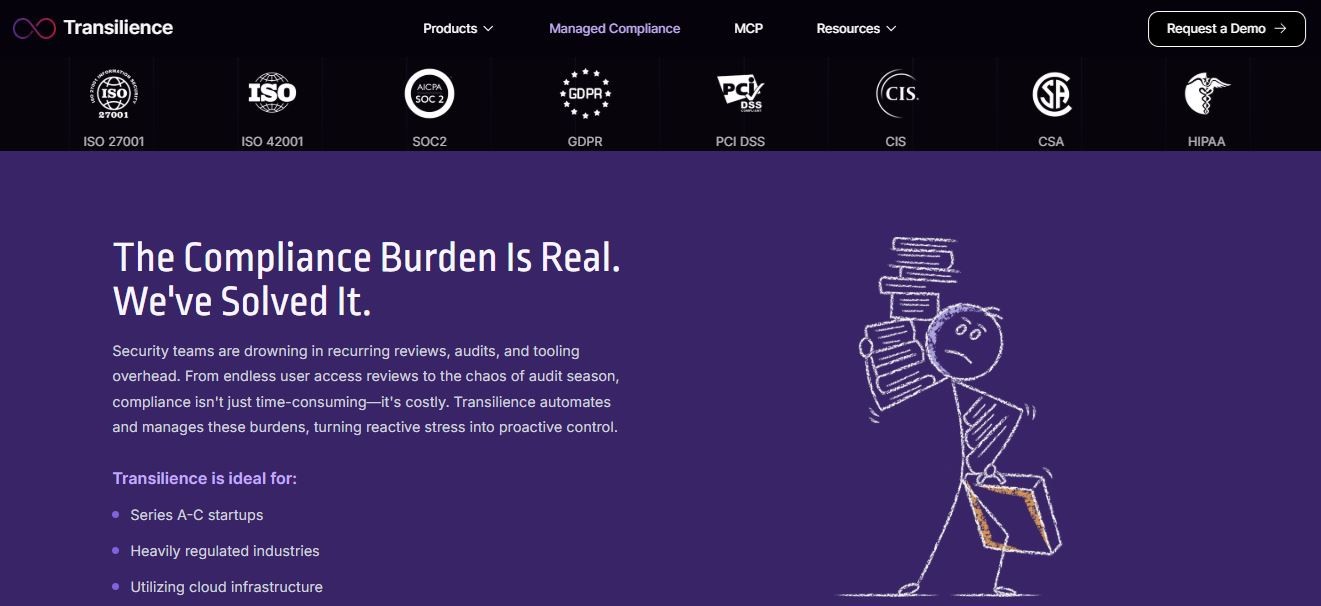
Transilience AI is the first-ever AI-powered end-to-end managed compliance service partner that guarantees a favorable audit outcome across several popular regulations and standards, while you focus on business growth and innovation. It’s the only AI-powered compliance tool that works at both the strategic and operational levels.
From AI-driven vulnerability scans and automated evidence collection to continuous compliance monitoring, Transilience AI is a complete compliance package at a highly affordable cost.
Here are the key features, including AI capabilities, of Transilience AI that set it apart:
- Autonomous LLM-based AI agents: Provides agentic AI technology combined with human expertise to manage tasks from vulnerability management to compliance end-to-end, automating security processes and compliance workflows.
- AI-powered pentesting agent: Provides 24/7, adaptive assessments through automated penetration tests that act like real attackers, identifying hidden attack paths and real-world vulnerabilities. It delivers 90% faster insights than traditional pentests and audit-ready results with executive-ready summaries.
- Rapid vulnerability prioritization and remediation: Employs ML-based agents that accurately identify, prioritize, and provide actionable insights on vulnerabilities, enabling prompt action on high-risk threats and reducing the attack surface to enhance security performance.
- Automated compliance management: Guarantees certification outcomes through automated compliance monitoring and an 80% time reduction in evidence collection, freeing up resources for strategic tasks.
- Contextual threat intelligence: Offers a threat intelligence tool that aggregates and delivers structured, industry-specific vulnerability data with over 75 impact attributes, vendor-specific details, and exploit information.
- API Integrations: Provides a comprehensive suite of APIs, including a Vulnerability API and Threat Intel API, for integration into existing workflows and applications, offering access to key CVE data and vendor advisories.
- Multi-framework support: Helps stay ahead of evolving standards and regulations across industries and regions with automated mapping and compliance gap resolution recommendations for SOC 2, GDPR, HIPAA, ISO 27001, ISO 42001, PCI DSS, and more.
Transilience AI Benefits:
- Faster time-to-insight: Provides 90% faster, targeted intelligence for vulnerability prioritization to protect critical digital assets.
- Improved efficiency: Streamlines complex security tasks, reduces manual efforts, and boosts the productivity of security and compliance teams.
- Reduced risk: Helps stay ahead of the evolving regulatory landscape and rapidly resolve weaknesses, reducing dire threats to business.
- 24/7 security coverage: Always-on security monitoring and expert response, so you don’t need to build extensive security teams.
- No hidden costs: The Transilience AI subscription includes all expenses, covering labor, tools, consultation, and auditor fees.
2. Drata
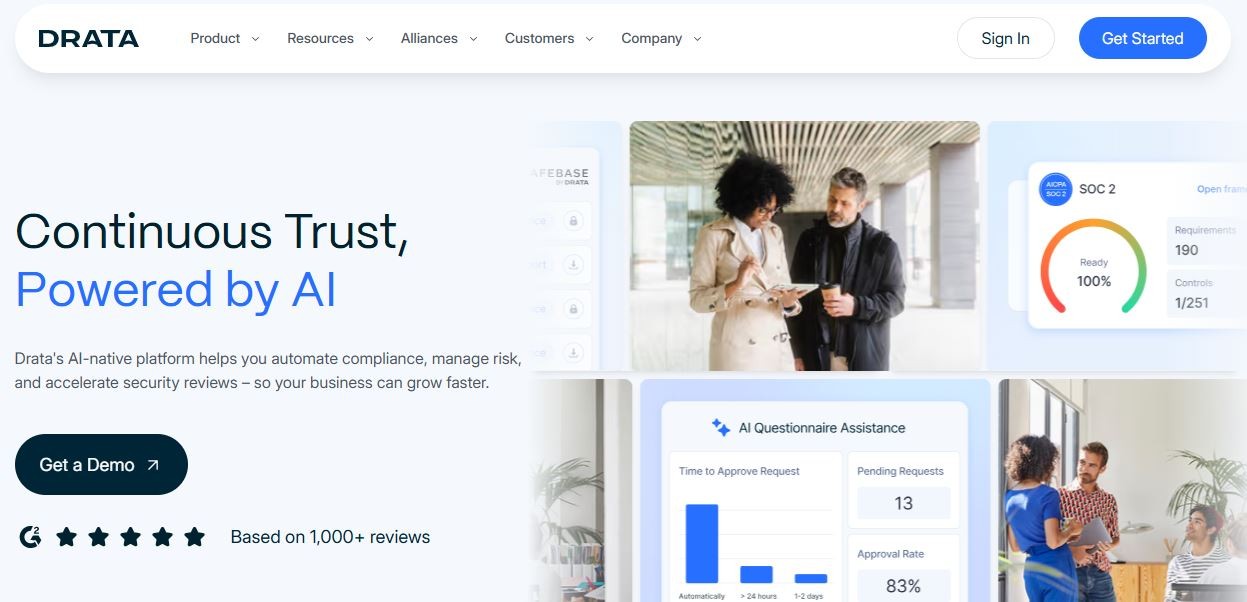
Drata is an excellent compliance automation solution designed primarily to streamline the audit process and continuously monitor compliance for SOC 2, ISO 27001, PCI DSS, and more. It supports businesses seeking robust risk management and rapid security certifications.
It integrates deeply with an organization’s infrastructure to automate the collection of audit evidence and continuously monitor compliance.
Key Features:
- Automated Evidence Collection: Gathers logs and data automatically from integrated systems, significantly simplifying the audit preparation workflow.
- Continuous Control Monitoring: Provides a real-time view of an organization’s security posture against required controls.
- Risk Management: Includes pre-built risk libraries and treatment plans that map controls to risks for comprehensive compliance reporting.
Drata’s focus
Drata provides a robust compliance and auditing layer that ensures sufficient controls are in place, helping resource-constrained GRC teams. However, it focuses exclusively on the governance layer, creating challenges for scaling operational security:
- Offers pricing tied to the number of frameworks and feature tiers, which scales cost with organizational complexity, rather than directly aligning fees with measurable risk reduction and audit outcomes.
- Primarily provides AI capabilities for documenting and assessing cloud and vendor risks, leaving out the much-desired LLM-based contextual risk prioritization.
- Quickly prepares your business for an audit while requiring internal teams to manually stabilize security controls in response to dynamic cloud deployments.
3. Vanta
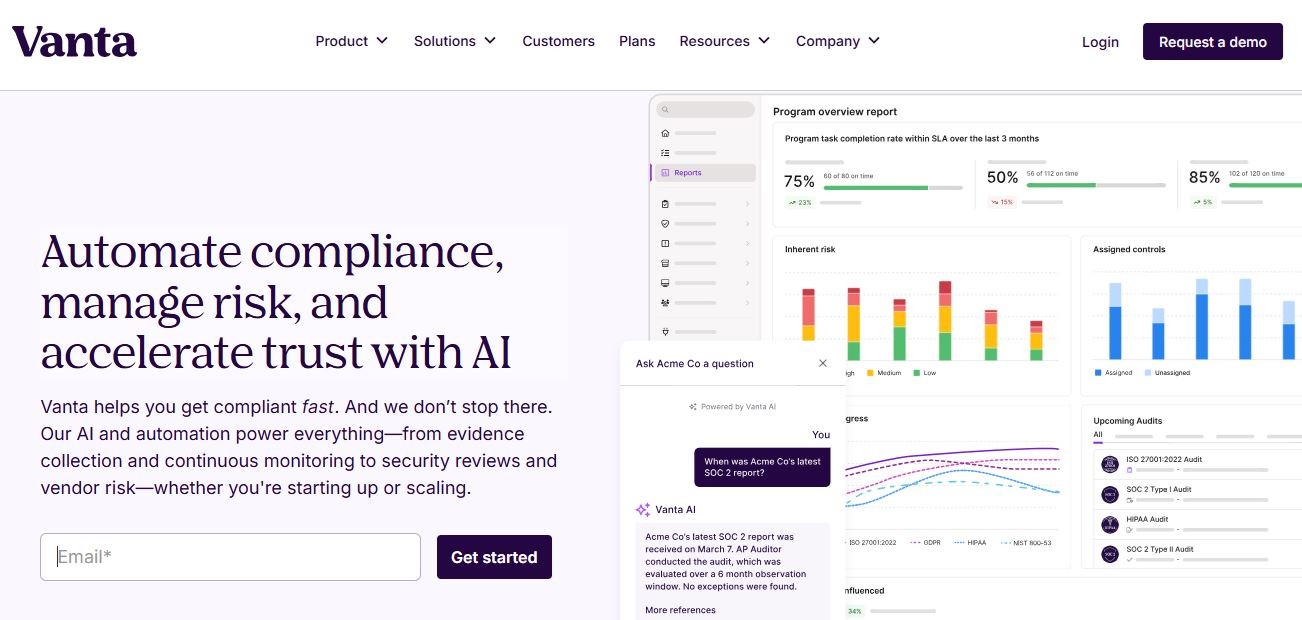
Vanta excels at building trust through its Trust Management platform, focusing on achieving audit-readiness for initial certifications and compliance with standards/regulations such as SOC 2, ISO 27001, and HITRUST. Its AI agent enables you to improve impact across policy onboarding, questionnaire support, and SLA remediation.
Key features:
- AI-driven policy and evidence management: Uses agentic AI technology for evidence checks, mapping controls to policies, and automating policy change summaries.
- Vulnerability management: Features security issues tracking by severity for effective gap remediation and auditor evidence.
- Compliance monitoring: Provides continuous visibility into your organization’s compliance status through real-time control monitoring.
Vanta’s focus
Vanta successfully simplifies audit preparation and execution, and its AI features strongly support GRC documentation and the evidence layer. It offers great value for the GRC reporting function while requiring internal teams to manage security at the operational level:
- Offers a tiered pricing structure based on features and frameworks, meaning total budget is tied to feature usage rather than guaranteed certification outcomes.
- Provides a robust AI agent that automates GRC workflows but requires human SOC analysts to manually assess thousands of security alerts daily and triage complex security incidents to prioritize critical threats.
- Helps you achieve fast certification readiness, but scaling a security program requires bridging the gap between compliance reports and the operational, machine-speed mitigation workflows.
4. Compliance.ai
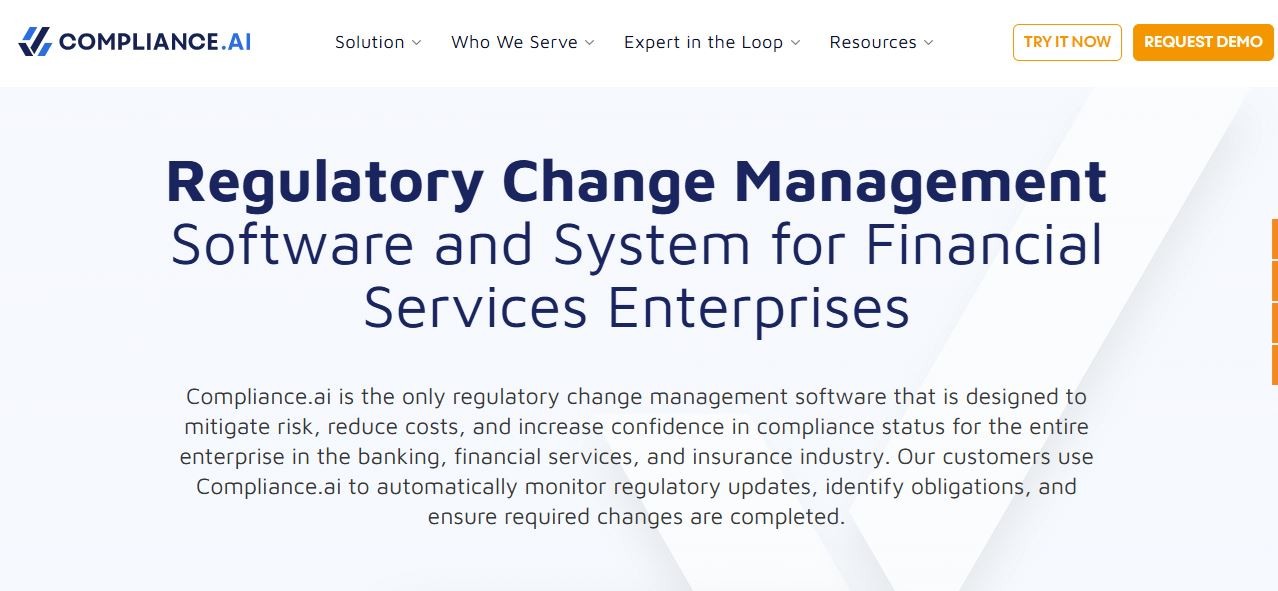
Compliance.ai is a specialized RegTech platform focused on regulatory change management (RCM) for heavily regulated industries, particularly financial services providers (including banks, insurers, and fintechs). At its core, it uses AI/ML to scan global regulatory sources and automatically map updates and obligations to your internal policies and controls.
Key features:
- Regulatory intelligence: Scans and collects vast amounts of legislative documents, guidance, and enforcement actions from global sources.
- Regulatory impact analysis (RIA): Applies ML to identify the relevant obligations within the new text and map them to your existing internal controls and policies.
- Audit reporting: Automatically generates audit-ready reports that show evidence of the regulatory change process and completion of adjustments to existing controls to speed up audits.
Compliance.ai’s focus
This platform focuses primarily on the RCM process. This means you need to invest in additional security-focused tools to ensure comprehensive risk and compliance management across your organization.
- Provides robust change management workflows, but requires internal teams to manage security and ensure favorable audit outcomes.
- Interprets regulatory text and enables policy updates, but lacks integrated vulnerability management and 24/7 compliance monitoring.
- Primarily serves the finance industry, making it less suitable for businesses that need comprehensive compliance automation across multiple regulations and frameworks (such as GDPR, HIPAA, and SOC 2).
Evaluation framework: how to choose the right AI compliance solution
The compliance market is flooded with AI compliance tools. However, not all of them offer a comprehensive set of features to manage risk and compliance in their entirety, from mapping controls to security testing to ensuring certification outcomes. Choosing the best fit for your security and compliance needs requires a strategic approach.
Here are the key factors to consider:
ROI Analysis
Look beyond the platform’s initial costs. Calculate the true ROI by factoring in crucial outcomes, such as the reduction in manual effort, faster time-to-insights, and a decrease in audit surprises.
For example, one of your metrics could be, “How fast can the compliance tool make you audit-ready?”, or “How many hours can you save by automating the time-consuming manual pen tests?”
Proof of concept (PoC) and live demo
A platform’s claims are only good as its performance. Check out live demonstrations of various platforms to determine which one best suits your needs before making a final decision. Ensure the presentation provides a clear view of the platform’s AI capabilities and answers specific questions about your compliance needs.
For instance, Transilience AI guides you through its Managed Compliance Copilot, demonstrating how it automatically pulls cloud configurations and maps them to compliance controls to generate a sample Report on Compliance (RoC).
Robust security validation
Maintaining cybersecurity compliance is among the biggest challenges for heavily regulated industries. Your compliance platform must move beyond simple monitoring to actively confirm that your security defenses are functioning as intended, which is a key evaluation point for auditors.
Select an AI compliance tool that extends beyond simple integration to deliver continuous security validation. It must ensure that your EDR mechanisms are stopping threats and your Web Application Firewall (WAF) is blocking attacks effectively.
AI capabilities
Many platforms claim to be AI-driven to capitalize on the AI hype wave, but fail to deliver. Instead, look for platforms with ML and natural language processing (NLP) features that extract actionable insights from dense regulatory text and map them with your internal controls.
They must also be able to conduct in-depth analysis and identify high-impact vulnerabilities specific to your business with automated contextual threat prioritization. An ideal AI-powered compliance tool should automate the entire risk mitigation workflow: from automatically creating detailed tickets with remediation steps to generating comprehensive compliance reports that meet auditor expectations.
Outcome-driven performance and scalability
An AI compliance tool that scales with your growing business is not optional; it’s a crucial factor. Ensure your preferred platform can scale with your organization’s growth. As your business expands and faces increasing regulatory demands, your compliance tool must keep pace.
Another essential parameter to consider is the tool’s focus on outcomes. Choose a compliance platform that promises results over those that only provide technology while putting the burden of audit on internal teams. Your platform should ease your regulatory burdens and enable you to grow your business with an accelerated time-to-market.
Transilience AI: the industry’s first fully automated compliance platform
Transilience AI stands out as a next-generation solution that addresses the core pain points of modern compliance and security teams. It’s built on a foundation of unique value propositions that offer a clear alternative to traditional tools.
- Outcome-focused, not activity-focused: With Transilience AI, you pay for reduced risk and guaranteed outcomes like a successful audit. The focus is on delivering results, not just providing more tools or seats.
- Compliance without the pain: The platform automates evidence collection, eliminates the need for spreadsheets, and accelerates audit readiness. It transforms a painful, manual process into a faster and more efficient workflow.
- Vulnerability backlog elimination: Transilience AI cuts through the noise of vulnerability reports by up to 70%, helping your teams focus on the issues that truly matter to the business.
- Agentic AI: Transilience AI’s powerful AI agents replace manual triage with autonomous, auditable workflows. This leads to lower SOC costs and faster response times, providing a significant competitive advantage.
Strengthen your cyber defense and transform your compliance program with Transilience AI. Talk to our experts to learn how it can help you beat the regulatory pressure with its all-inclusive managed compliance services.