


Cyberattacks and data exposure have been linked to measurable care disruption and worse clinical outcomes, so the phrase “cyber safety is patient safety” is not far-fetched, given that much of the healthcare industry has digitized its processes.
Meanwhile, the average financial blast radius of a healthcare breach remains the highest of any industry, and United States breach costs continue to climb.
The Centers for Medicare and Medicaid Services (CMS) is now enforcing new rules that require API-driven prior authorizations, transparency, and updated data standards across healthcare technology by 2026.
At the same time, the U.S. Department of Health and Human Services (HHS) has been issuing frequent settlements for privacy and security lapses.
In the first half of 2025 alone, the HHS reached settlements with:
- Comstar, LLC, paid $75,000 after a ransomware incident affecting 585,621 individuals and a failure to conduct a thorough risk analysis.
- Guam Memorial Hospital Authority paid $25,000 for insufficient risk analysis and audit log monitoring after multiple unauthorized access events.
- Vision Upright MRI paid $5,000 following exposure of 21,778 patients’ imaging data and a failure to issue timely breach notification.s
To prevent similar lapses, healthcare organizations must move toward intelligent compliance software that continuously automates risk analysis and maintains verifiable compliance evidence.
What is Healthcare Compliance Software?
Healthcare compliance software is a system that helps healthcare organizations meet the privacy, security, and operational standards set by regulatory frameworks such as HIPAA, OSHA, and FDA.
Done effectively, this software helps compliance teams keep required tasks on schedule, centralizes evidence, and proves that policies and controls are working across clinical, administrative, and technical workflows.
Why is healthcare compliance software essential?
Modern healthcare organizations operate under constant regulatory pressure. Policies must be reviewed and updated, often across multiple facilities and systems.
Trying to manage all this manually is slow, error-prone, and reactive.
Compliance software changes that by turning oversight into an active and automated process. For example, it can track when risk assessments or policies are due for review, or auto-alert teams to emerging security or privacy threats. Beyond prevention, the software helps organizations respond effectively when incidents occur.
Some of the key benefits of a healthcare compliance software include:
- Real-time visibility: Compliance software maintains a live control registry mapped to HIPAA, CMS, and other standards, giving leaders instant visibility into gaps like expired policies or missing BAAs.
- Audit-grade reporting: Compliance software can help generate detailed, citation-level reports linking every rule to verifiable evidence like access logs or encryption checks, reducing manual data pulls and strengthening audit readiness.
- Governed workflows: Compliance software routes key tasks, tracks assessments, investigations, and corrective actions with built-in approvals and timestamps, ensuring timely closure and reducing enforcement risk.
- Centralized documentation and retention: A single, secure repository stores all compliance records with versioning and retention controls, streamlining audits and proving good-faith adherence during investigations.
- Cross-department collaboration: Shared dashboards connect compliance, IT, and revenue cycle teams, improving documentation accuracy, reducing claim denials, and preventing care delays tied to authorization errors.
- Risk reduction by design: The platform continuously scores risks from live system data, helping teams prioritize high-impact vulnerabilities such as vendor access or email-based breaches before they escalate.
- Revenue protection through compliant operations: By validating documentation and prior-authorization evidence upfront, compliance software reduces billing errors and denials, directly protecting revenue and cash flow.
Key Features of Top Healthcare Compliance Software
The core features of a good healthcare compliance software are broken into three main categories:
- Functionality (What the software must do)
- Specifications (How it should be built and measured)
- Business considerations (What makes it sustainable and valuable)
Functionality
The following capabilities define best-in-class functionality:
- 360° visibility and risk oversight: Provide a unified control center that maps policies to specific frameworks and provides real-time status monitoring.
- Continuous risk analysis: Automates recurring security risk assessments, updates registers as systems evolve, and assigns remediation owners with timelines.
- Audit and access controls: Maintains immutable audit trails that capture configuration changes, access events, and data flows across systems handling protected health information (PHI).
- Incident and breach management: Routes investigations, breach notifications, and corrective actions through governed workflows with approval checkpoints.
- Training and policy lifecycle management: Assigns and tracks role-based training, manages attestations, and automates policy review cycles.
- Vendor and business associate management: Maintain a live inventory of business associates with built-in risk scoring, BAA templates, and due diligence tracking.
- Multi-facility management: Provide site-specific dashboards and comparative analytics so corporate compliance officers can monitor each location independently while maintaining organization-wide oversight.
- Evidence and audit trail integrity: Immutable, time-stamped logs with full chain-of-custody for evidence, ensuring documentation stands up to regulatory scrutiny
Specifications
The technical design of compliance software determines its reliability, scalability, and legal defensibility. Leading platforms typically include:
- Customization: Allow administrators to tailor workspaces, forms, policies, and reporting templates to fit the organization’s compliance model, specialties, or state requirements.
- Scalability and flexibility: Support multi-site growth, mergers, and evolving regulatory obligations without rebuilds. Architecture should scale securely as users and data expand.
- Integration capabilities: Connect easily with EHR, HRIS, ticketing, and security platforms through APIs or native integrations.
- Ease of use: Intuitive interface, clear navigation, and contextual alerts that show compliance status at a glance. Dashboards should let users move seamlessly between policies and corrective actions without IT support.
- Comprehensive asset inventory: Maintains an up-to-date record of systems, interfaces, and data flows involving PHI, enabling targeted risk mitigation.
- Retention and legal hold controls: Configurable retention schedules, versioning, and legal-hold capabilities for policies, training logs, and incident records.
Business considerations
Beyond compliance performance, leading solutions deliver measurable operational and financial value to healthcare organizations.
- Workflow integrations that reduce manual effort: Native connectors to EHRs, IAM systems, DLP tools, and ticketing platforms automate evidence collection and eliminate data silos.
- Audit and denial prevention impact: Strengthens documentation and pre-submission validation, reducing audit findings and claim denials tied to missing authorization or coding errors.
- Vendor assurance and total cost transparency: Provides verifiable vendor controls (SOC 2, HITRUST), clear implementation timelines, and pricing models that reflect automation efficiency rather than user seats.
- Regulatory adaptability: Enables quick configuration updates for new CMS, OSHA, or state rules without dealing with the cost of rebuilding the compliance framework.
Top Healthcare Compliance Software Providers
Network Intelligence – Transilience AI
Network Intelligence – Transilience AI for healthcare compliance
Transilience AI offers an agentic-AI compliance platform built to automate and continuously validate controls across healthcare environments.
It ingests logs from EHRs, identity systems, imaging systems, and devices, then maps signals in real time against HIPAA, FDA, HITRUST and other frameworks, creating audit-ready evidence packets in the background.
Key features of Network Intelligence (Transilience AI) for healthcare compliance
- Managed compliance automation: Automates compliance across multiple frameworks by mapping controls to HIPAA, SOC 2, ISO 27001, and PCI DSS standards.
The platform continuously collects and validates evidence so compliance officers can track and control health in real time and generate auditor-ready packages without manual prep.
- Cybersecurity AI consultant: A reasoning-based workspace that answers compliance and security questions in natural language.
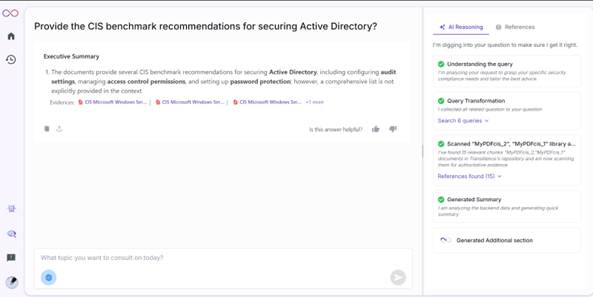
It scans your policy and control libraries, references authoritative documents, and generates executive-ready summaries. This helps reduce audit response time and simplifies control verification across distributed teams.
Transilience Cybersecurity AI Consultant
- Breach advisory intelligence dashboard: Delivers daily, severity-tagged threat advisories enriched with indicators of compromise (IOCs) relevant to healthcare systems and vendors.
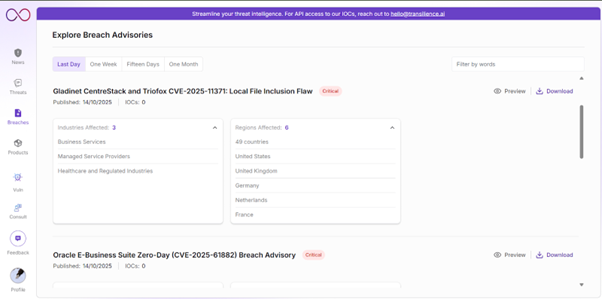
Transilience Breach Advisory Intelligence Dashboard
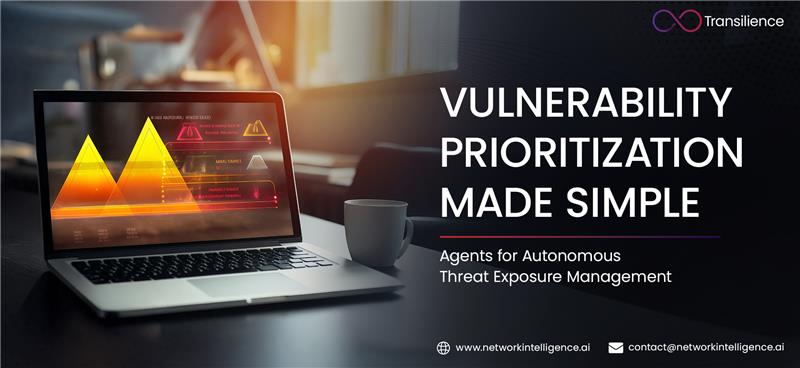
- Vulnerability prioritization engine: Consolidates scanner outputs, removes duplicates, filters false positives, and applies contextual risk scoring that factors in asset criticality, exploitability, and potential patient-care impact.
- Threat intelligence workspace: Provides a live feed of threat data mapped to affected products, software versions, and regions.
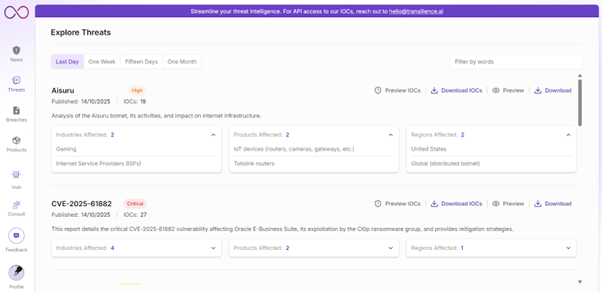
Transilience Threat Intelligence Workspace
SAI360
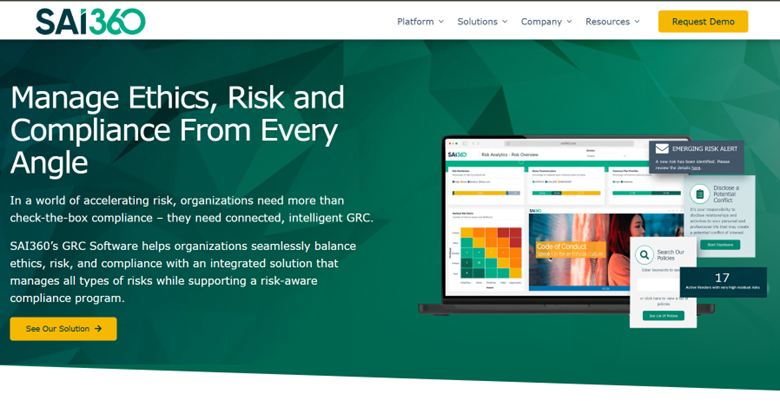
SAI360 compliance software (Source: sai360)
SAI360 is a mature, healthcare-focused GRC platform that unifies policy management, risk assessment, incident management, hotline, and reporting in one system. Buyers value its long-running healthcare benchmark work and broad module set, which supports regulatory audits, third-party risk, and training at scale for providers and payers.
Key features of SAI360 for healthcare compliance
- Regulatory change management: Real-time monitoring for CMS, HIPAA, state-level rules and assigns impact assessments automatically.
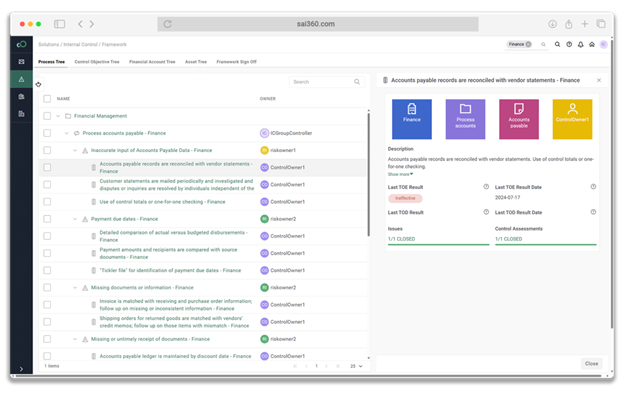
Dashboard displays of live control trees, ownership assignments, and assessment results (Source: sai360)
- Policy lifecycle and attestation: Centralized policy library for HIPAA, patient care and infection control, versioning and attestations. Incident-triage workflows that capture privacy or clinical events and track across facilities.
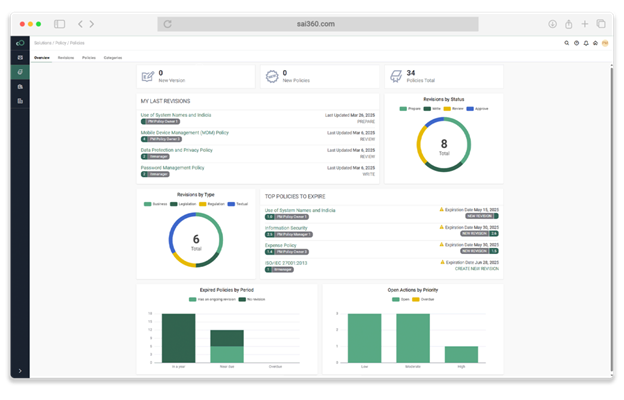
Dashboard tracking policy revisions, expirations, and open actions to keep compliance documentation current (Source: sai360)
- Revenue integrity and audit readiness: Tools to manage physician-industry relationships, gifts, conflicts of interest and Sunshine-Act compliance with automated approvals and audit-ready logs.
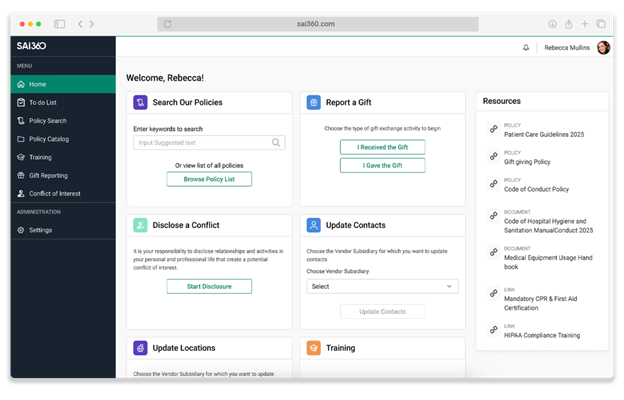
Dashboard for managing disclosures and transparency requirements (Source: sai360)
VComply
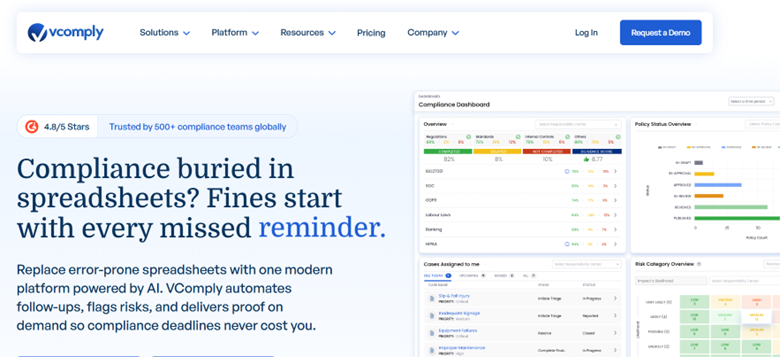
VComply compliance software (Source: VComply)
VComply is a more agile, cloud-native compliance platform that emphasizes workflows, document management and modular adoption. It is well-suited for healthcare facilities looking to move off spreadsheets and manual tracking toward a simpler but effective mode.
Key features of VComply for healthcare compliance
- Pre-built frameworks: Ready-to-use configurations covering quality of care, patient safety, CLIA, FDA, state pharmacy boards, 340B, Medicaid reporting, value-based purchasing, etc.
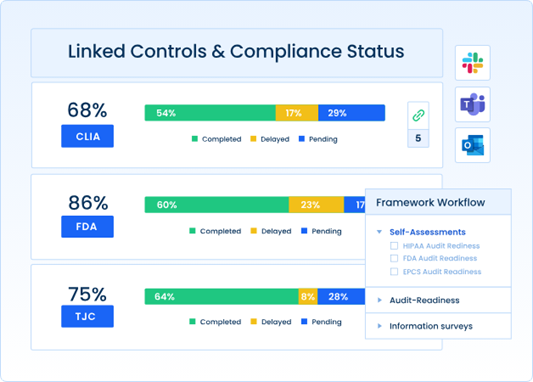
Real-time compliance progress across CLIA, FDA, and TJC frameworks with a clear completion metric (Source: vcomply)
- Policy and documentation hub: A single system where policies are drafted (including templates), version-controlled, distributed, attested by staff and tracked for compliance across locations.
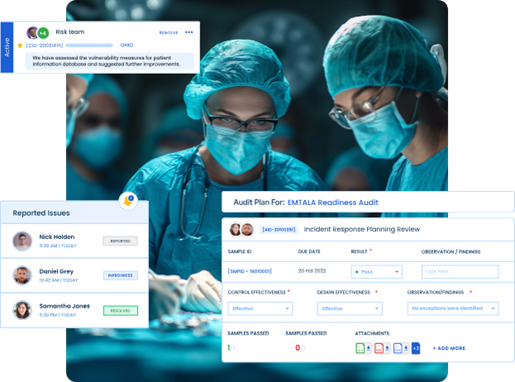
Live audit tracking and status reporting (Source: vcomply)
- Operational workflow and risk tracking: Task automation, alerts, dashboards for issue remediation, risk scoring, multi-framework reporting and third-party control oversight.
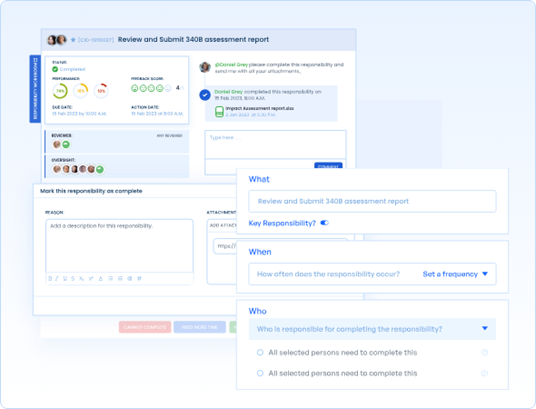
Task and responsibility tracker for verifying assessment responsibilities (Source: vcomply)
How to Choose the Right Healthcare Compliance Software
Here’s how you can take steps to select the right compliance software for a hospital or clinical enterprise:
1. Define the problem and business outcomes
Start by clarifying why you need the software and what success looks like. Identify the top challenges across privacy, security, and operations—such as audit delays, manual reporting, or documentation errors- and translate them into measurable goals.
2. Get input from every stakeholder
Bring compliance officers, IT security, privacy, clinical operations, and even billing managers into the discussion. Each team sees compliance from a different angle.
Ask each group what slows them down the most or what keeps them up at night. These answers shape your must-have list.
3. Define what “good” looks like for your business model
Translate your needs into clear success criteria. For example:
- “We should be able to complete a HIPAA risk analysis in 5 days instead of 3 weeks.”
- “Audit evidence should be retrievable in under 10 minutes.”
- “Training completion should automatically sync with HR systems.”
This way, you now have measurable expectations to evaluate vendors against.
4. Shortlist vendors and issue targeted requests
Narrow down to three to five vendors that specialize in healthcare compliance. Send a short RFP outlining your scope and acceptance criteria. Ask for reference clients, pricing, and implementation timelines.
Check if they support HIPAA, CMS, OSHA, and state-level standards out of the box. Look for:
- Healthcare-specific control libraries
- HITRUST or SOC 2 certification
- Experience integrating with EHR systems (Epic, Cerner, Allscripts, etc.)
5. Define acceptance criteria before demos
Set measurable requirements before meeting vendors. For example: “The system must generate time-stamped audit reports that link regulations to evidence.” Avoid vague criteria like “easy to use.” Create a vendor evaluation checklist with pass/fail criteria for each capability.
6. Script the demos around your workflows
Do not let vendors control the demo. Provide a clear script covering your real scenarios in risk assessments, policy review cycles, breach investigations, and reporting. Observe how well the tool handles each case.
7. Run a proof of concept (POC)
Test the system in your environment with real data. Choose one facility and two or three workflows. Integrate with your EHR, identity system, or ticketing tool, and track how much time automation saves.
8. Scrutinize security and reliability
You are trusting the platform with sensitive PHI. Make sure it meets or exceeds your own security expectations.
Checklist:
- Encryption at rest and in transit
- Role-based access controls
- Multi-factor authentication
- Verified data centers and uptime SLAs
- Vendor breach history and remediation transparency
9. Assess total cost and return on investment
Compare full ownership costs over 3 years: subscription fees, integrations, training, and internal labor. Balance that against value gained like fewer penalties, faster audits, reduced denials, and improved patient trust.
Pro tip: If ROI seems unclear, ask vendors for customer case studies showing measurable time or cost savings.
10. Check references and support quality
Talk to at least two similar healthcare organizations using the software. Ask about implementation time, integration performance, vendor responsiveness, and product updates.
11. Make the final decision based on outcomes
Choose the software that best aligns with your outcomes: reduced audit burden, continuous risk visibility, faster incident response, and measurable cost savings. The features of the software are only valuable if they move those needles.
Why Choose Network Intelligence for Healthcare Compliance?
In healthcare, safety depends on speed, the speed to detect risk, prove compliance, and act before disruptions reach patient care.
Network Intelligence’s Transilience AI delivers that advantage by combining managed compliance, threat intelligence, and autonomous evidence collection in one platform.
Its agentic AI framework continuously maps controls to HIPAA and HITRUST standards, contextualizes vulnerabilities based on patient-impact, and automates the entire audit lifecycle.
This results in measurable improvements where it matters most, as our platform has registered:
- 90% faster vulnerability prioritization
- 75% faster threat intelligence research
- 80% less time spent preparing audit evidence
Your systems deserve the same vigilance you give your patients. Talk to our team of experts and find out how you can deliver continuous compliance readiness and safety for your healthcare facility.