

If you only “feel compliant” during audit season, you are not really compliant. You are temporarily organized.
System and Organization Control 2 (SOC 2) is designed to test whether your controls are well-designed and operating consistently, not whether your team can pull together screenshots on short notice.
This distinction matters more in cloud infrastructure, where changes are frequent, and misconfigurations can appear in minutes.
For information technology managers and compliance officers in mid to large-sized enterprises, the goal is to reduce two risks that keep showing up together:
- Non-compliance findings that slow procurement and renewals
- Security failures that turn into breach impact, regulator attention, and reputational drag
Amazon Web Services (AWS) can make this easier, but only if you use it correctly. AWS has its own independent SOC reports and provides customer access through AWS artifacts, but your SOC 2 audit is still about your system, your controls, and your operating discipline.
What is SOC 2 compliance?
SOC 2 is an independent examination and report on controls at a service organization relevant to security, availability, processing integrity, confidentiality, or privacy. It is built on the American Institute of Certified Public Accountants (AICPA) Trust Services Criteria.
A SOC 2 examination evaluates both the design and operating effectiveness of controls over a defined review period.
In practical terms, SOC 2 compliance requires organizations to demonstrate:
- Clearly defined control objectives aligned to trust services criteria
- Consistent execution of those controls
- Verifiable evidence that controls operated as intended throughout the review period
In cloud environments, much of this evidence is generated automatically through system configuration, access management, logging, and monitoring.
The role of AWS in SOC 2 compliance
AWS supports customer SOC 2 programs in three primary ways:
- Infrastructure assurance: AWS publishes independent SOC reports covering its facilities, infrastructure, and managed services.
- Control evidence generation: AWS services generate system-level telemetry, logs, and configuration data that support customer control testing.
- Compliance enablement tooling: AWS provides services designed to collect, normalize, and present compliance-related evidence.
Understanding the AWS SOC 2 compliance framework
The AWS shared responsibility model is central to SOC 2 implementation in the organization’s security environment.
AWSS is responsible for the security of the cloud, including physical facilities, hardware, networking infrastructure, and foundational services. On the other hand, customers are responsible for security in the cloud, which includes:
- Identity and access management
- Data classification and protection
- System configuration
- Application security
- Logging, monitoring, and incident response
- Compliance governance and documentation
This split directly maps to how auditors think, as AWS evidence supports the parts the organization inherits from AWS and the company’s evidence that proves it configured, monitored, and governed its environment correctly.
Automating SOC 2 Compliance with AWS services
Below is a practical mapping of common SOC 2 evidence needed to AWS-native services.
Note: This is not a promise that a service “completely covers a control”; it is a guide to where evidence typically comes from.
| AWS service category | SOC 2 evidence needs | Compliance relevance |
| AWS Identity and Access Management (IAM) | Access control, least privilege, multi-factor authentication, and role separation | Who can access what, and under what conditions |
| AWS Cloudtrail | Audit trails for configuration and privileged actions | What happened, who did it, and from where, across console, command line interface, software development kits, and APIs |
| AWS Config | Configuration drift detection and control testing | Whether resources match required configurations, continuously or on change |
| AWS Security Hub Cloud Security Posture Management | Security posture checks and centralized findings | Whether the environment aligns with selected standards and controls, with consolidated findings |
| AWS Key Management Service | Encryption and key control | Encryption at rest and in transit, and key management governance |
| AWS Audit Manager | Compliance evidence collection at scale | Automated evidence collection and audit-ready reports, with important limitations |
| AWS Artifact | Inherited AWS control documentation | Access to AWS compliance documents and SOC reports |
AWS Identity and Access Management (IAM)
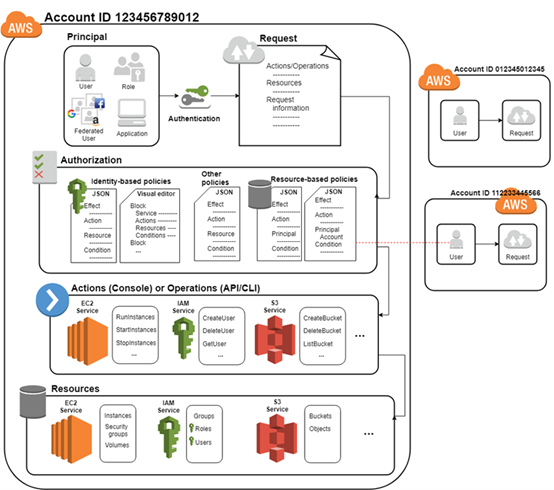
How AWS identity and Access Management Works (Source: AWS Amazon)
AWS IAM is the foundation for most SOC 2 security controls because it governs authentication and authorization for AWS resources.
From a SOC 2 perspective, IAM supports evidence for:
- Role-based access control
- Separation of duties
- Privileged access management
- Access review and revocation processes
This is also where “zero trust security in the cloud” becomes real for auditors.
AWS CloudTrail for SOC2 Compliance
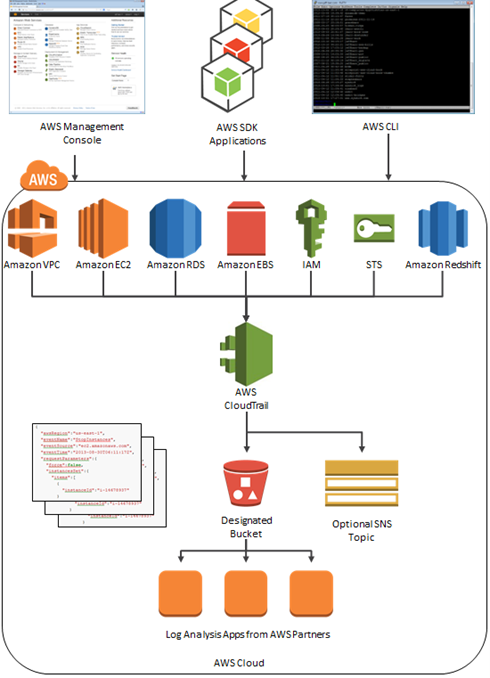
How AWS CloudTrail works (Source: AWS Amazon)
CloudTrail records actions taken across AWS services, including console access, API calls, and service-level activity.
CloudTrail supports SOC 2 controls related to:
- Change management controls
- Incident investigation readiness
- Privileged access oversight
- Audit traceability
AWS Config
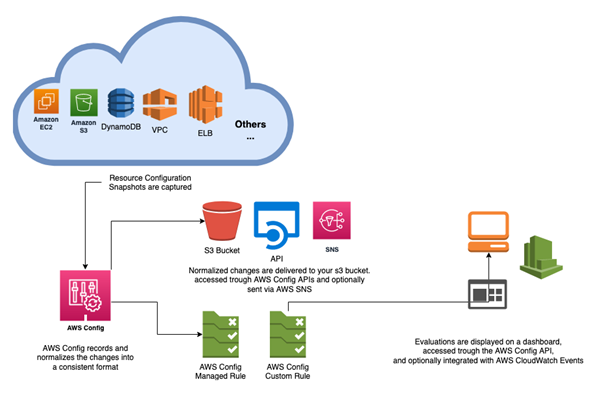
Workflow progression of AWS Config managed rule (Source: AWS Amazon)
AWS Config continuously detects when supported resource types are created, changed, or deleted, and records these events as configuration items.
For SOC 2, AWS Config is often used to support:
- Configuration management controls (baseline configuration, drift detection, and change traceability)
- Rule-based evaluation of resource configurations against required states
- Audit evidence for operating effectiveness
AWS Audit Manager
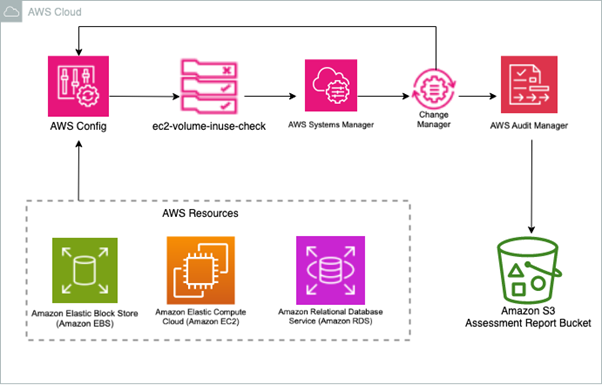
Sample system architecture showing continuous compliance enabled by automated evidence capture with AWS Audit Manager (Source: AWS Amazon)
AWS Audit Manager helps organizations continually audit AWS usage, automate evidence collection, and assess whether controls are operating effectively.
For SOC 2, AWS Audit Manager is often used to support:
- Structured evidence collection
- Framework-based control sets and workflows for internal review and signoff
- Correlation of evidence sources (including Security Hub results, AWS Config coverage, and other AWS service evidence)
AWS Artifact
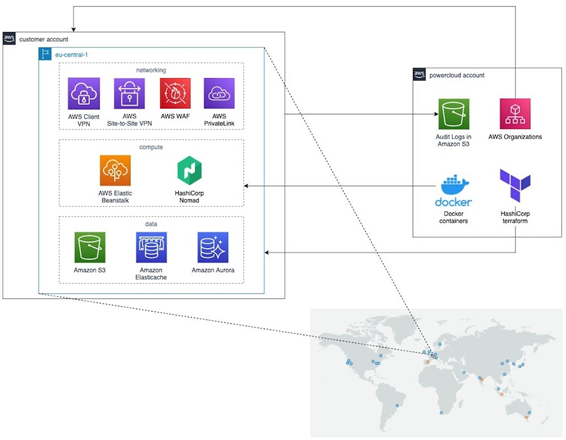
Customer environment integrated with a centralized audit and governance account using AWS Artifact (Source: AWS Amazon)
AWS Artifact provides on-demand access to select AWS security and compliance reports and agreements through a self-service portal. It is used to download AWS security and compliance documents, including SOC reports and ISO certifications.
For SOC 2, AWS Artifact is often used to support:
- Inherited control evidence
- Audit artifacts and regulator documentation
- Tracking and managing compliance-related agreements across accounts in the organization
Steps to achieve SOC 2 compliance on AWS
Two significant steps will guide your compliance teams to better keep up with SOC 2 compliance efforts on AWS:
Step 1: Assessing your current AWS environment
Effective SOC 2 implementation begins with accurate scoping and ownership definition.
A practical assessment sequence to achieve this:
- Define the system boundary: Identify in-scope accounts, regions, services, data stores, and production versus non-production separation.
- Map data flows and trust zones: Where does customer data enter, where is it stored, and where is it processed?
- Clarify control ownership: For each control area, define whether it is AWS-owned, customer-owned, or shared.
- Baseline current evidence sources: Identify where evidence already exists (cloudtrail, configuration history, ticketing systems, monitoring dashboards) and where it is missing.
- Identify “drift-prone” areas: These usually include identity policies, network exposure, storage permissions, and encryption settings.
This is also where the organization decides whether to pursue a minimal SOC 2 scope (security-only) or a broader scope that includes availability, confidentiality, and privacy.
Step 2: Implementing SOC 2 controls using AWS tools
The key is to build controls that are testable, repeatable, and auditable without heroics.
A helpful mental model:
- Policy is the human rule
- Control is the mechanism that enforces or checks the rule
- Evidence is the proof that the control operated as intended
- Exception is a documented deviation with risk acceptance and timeline
Some AWS tools include:
AWS management console for compliance management
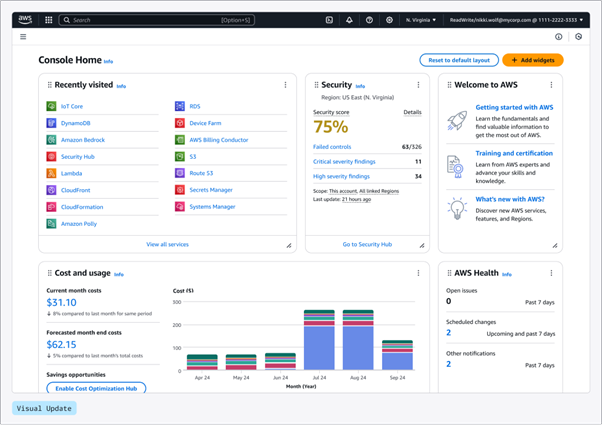
AWS Management Console dashboard showing security posture, service activity, and account health in a single operational view (Source: AWS Amazon)
The AWS Management Console is not a compliance tool in itself, but it is where many control settings are applied and where compliance teams often pull “point-in-time” evidence.
If you rely on console screenshots, treat them as a last resort. Prefer evidence that is:
- Event-driven (Cloudtrail)
- Configuration-driven (AWS config)
- Continuously collected (AWS Audit Manager, Security Hub)
AWS Step Functions in compliance
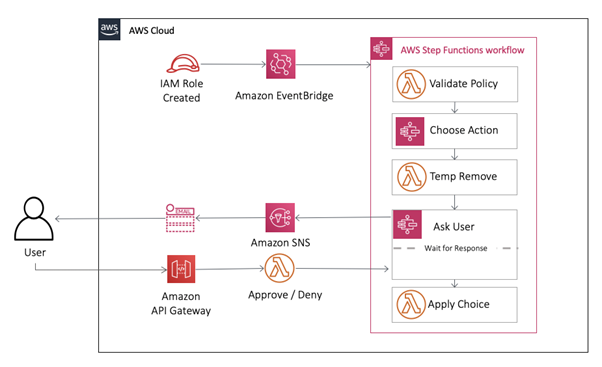
Demonstration architecture of how AWS Step Function works to automate IAM governance (Source: AWS Amazon)
AWS Step Functions is a workflow orchestration service that coordinates services into serverless workflows, which can be helpful for compliance automation when you need repeatable, auditable control processes.
Examples that map well to SOC 2:
- Automated user provisioning workflows with approval gates
- Automated evidence packaging workflows (collect, validate, store, notify)
- Exception handling workflows (approve, time-bound, retest, close)
Amazon Serverless ElastiCache for Valkey
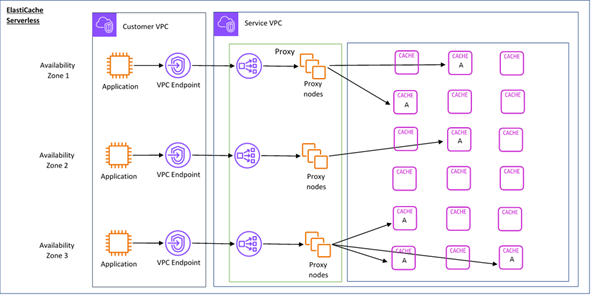
Amazon ElastiCache Serverless architecture illustrating how applications connect through VPC endpoints and proxy nodes to route traffic to managed cache instances (Source: AWS Amazon)
If your environment uses in-memory caching, you might be evaluating Amazon Serverless ElastiCache for Valkey.
From a SOC 2 perspective, this matters only to the extent that it affects:
- Availability and performance reliability of your system
- Logging and monitoring coverage for critical components
- Configuration governance (who can change cache settings)
Treat it like any other in-scope component: define its role and control access, and include it in change management.
Using AWS Alerts for SOC2 Compliance
Alerts only add compliance value when they result in documented action and verifiable evidence. Without traceability, alerts remain operational signals rather than audit-defensible control artifacts.
A defensible alert design for SOC 2 typically includes:
- A defined trigger condition and severity threshold
- An identified owner responsible for review and response
- A recorded review or tracking mechanism
- Documented resolution and verification evidence
- Retention aligned to the audit review period
On Amazon Web Services, services such as AWS CloudTrail, AWS Config, AWS Security Hub, and Amazon CloudWatch generate the underlying signals required for alerting.
These services are effective at detection. They do not, on their own, ensure that alert outcomes are consistently documented, linked to controls, and retained in an audit-ready format.
Compliance audit software fixes this.
Transilience AI – compliance audit software
Network Intelligence embeds Transilience AI to support this control-level traceability by focusing on evidence handling rather than alert generation. With Transilience AI organizations can:
- Map alerts and related system signals to in-scope SOC 2 controls as part of managed compliance automation
- Continuously collect supporting artifacts such as configurations, logs, and tickets, time-stamping them and normalizing them for audit review
- Maintain control of health status over time, enabling auditors to assess operating effectiveness across the audit window
- Support audit response workflows through an AI reasoning workspace that can reference policy and control libraries and generate structured summaries for reviewers
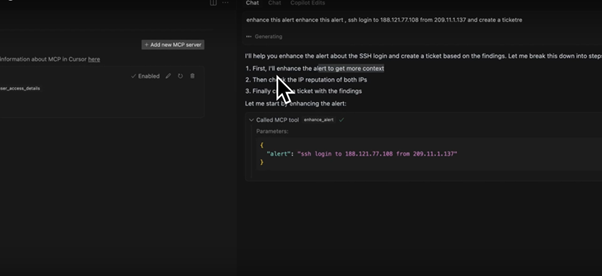
Triaging SOC 2 alerts with Transilience AI
The example above shows an AWS security alert handled inside Network Intelligence using Transilience AI.
Instead of treating the alert as a passive notification, the system treats it as a control execution event:
- An SSH login alert is ingested from AWS telemetry
- The AI agent enhances the alert with contextual data (for example, IP reputation and access context)
- The system records investigative steps taken
- A ticket is created automatically to preserve ownership, timestamps, and resolution evidence
Extending alert-based evidence to access review controls
User access reviews are a recurring SOC 2 requirement under security and confidentiality criteria.
Access reviews often fail audits because they are informal, inconsistently documented, or reconstructed after the fact.
On Amazon Web Services, access evidence typically originates from identity services such as AWS Identity Center and AWS IAM.
As with alerts, AWS provides the signals but does not enforce review discipline, documentation, or audit-ready retention across systems.
By embedding access reviews into the same evidence-handling model as alerts, Network Intelligence ensures that identity governance controls remain testable, traceable and reviewable over time.
User access review for governance executed inside Transilience AI
AWS Security Hub integration for structured alert categorization
AWS Security Hub findings grouped and categorized by Transilience AI for centralized security analysis
AWS Security Hub findings are ingested into Network Intelligence and organized using Transilience AI into structured, analysis-ready categories.
Instead of reviewing findings in isolation, Security Hub data is aggregated and classified by type, configuration issues, software vulnerabilities, techniques, and control-relevant security events.
Through the integration, Transilience AI enables teams to:
- Aggregate Security Hub findings across accounts and regions into a unified view
- Categorize findings by control relevance rather than service origin
- Track security posture and security scores over time
- Align findings with supported standards such as AWS Foundational Security Best Practices, CIS AWS Foundations Benchmark, PCI DSS, and NIST 800-53
- Maintain consistent structure for downstream investigation, remediation, and audit evidence
Challenges and solutions in achieving SOC 2 compliance on AWS
As AWS environments scale, compliance complexity also grows non-linearly. Without deliberate structure, control intent degrades faster than teams realize.
Common challenges
Cost and resource management
Automation reduces labor, but AWS services still have operational costs. The mistake is thinking cost comes only from service spend. In reality, the bigger cost is:
- Duplicated work across teams
- Inconsistent evidence formats
- Audit remediation cycles caused by preventable drift
A cost-effective program is one where evidence is generated once, reused across audits, and continuously updated.
Keeping up with AWS updates
AWS changes fast with new features, new defaults, new services, and evolving security recommendations. This creates two compliance risks:
- Adopting new services without mapping them into controls
- Inheriting new configurations without fully understanding the security impact
This is where continuous compliance is not optional. It is the only way to keep your SOC 2 posture aligned to a changing environment.
Solutions and best practices
-
- Codify control expectations: Define required configurations and enforce them using AWS Config rules where possible.
- Treat CloudTrail as mandatory control evidence: Ensure auditing coverage for critical accounts and services, and keep retention aligned to audit needs.
- Centralize posture signals: Use Security Hub Cloud security posture management to consolidate findings and track posture against enabled standards.
- Use Audit Manager for evidence scaling: Rely on it to collect evidence and package reports, while maintaining manual governance for procedural controls.
- Align to shared responsibility in writing: In the system description and control narratives, clearly document which parts rely on AWS controls and which parts are owned by the organization.
- Extend controls to AI workflows where relevant: If you run artificial intelligence systems, map model access, data handling, and change approval into the same SOC 2 control structure. AI compliance frameworks only work when they are tied back to access, change management, logging, and incident response.
Case Study: Aucctus achieved SOC 2 with Transilience AI-managed compliance
Aucctus, an AI innovation technology firm, required SOC 2 certification without diverting engineering time or building an internal security and compliance function that typically costs $150,000+ annually.
Transilience AI delivered a managed compliance model that assumed end-to-end ownership of the SOC 2 outcome, from continuous evidence collection through auditor submission.
Certification was completed two months ahead of the original timeline, with zero dedicated security or compliance hires.
Throughout the engagement:
- About 100% of the internal team capacity remained focused on product development
- 24/7 continuous monitoring was established and maintained beyond certification.
The delivery followed a structured three-month execution model, including read-only cloud integration, automated evidence validation, real-time gap identification, and audit-ready artifact preparation.
This approach removed audit-period disruption while establishing a sustained compliance operating model rather than a one-time certification exercise.
Here’s what Aucctus had to say:
| “Thanks to Transilience, we got SOC 2 certified without hiring any security staff. Their AI agents monitored the situation, collected evidence, and proactively alerted us. We stayed focused on building our product.” – Vincent Atallah | President, Aucctus. |
Read more about this case study.
The Strategic Importance of SOC2 Compliance
SOC 2 compliance functions as an assurance mechanism within enterprise risk management. On AWS, this requires a compliance operating model that aligns shared responsibility, technical evidence, and governance processes.
In cloud environments, the real differentiator is not how quickly evidence can be assembled for an audit, but how consistently security and monitoring signals are interpreted together over time.
That convergence is where maturity shows up.
Network Intelligence with Transilience AI approaches SOC 2 and security assurance from this operational edge.
By combining AI-enhanced assessment with deep practitioner experience, Network Intelligence evaluates how controls, monitoring, and response actually perform under real conditions, not just how they are documented.
This perspective helps organizations align compliance, threat detection, and SOC maturity into a single, continuously improving operating model rather than parallel initiatives.
For organizations seeking clarity on where their SOC 2 controls truly stand, engaging an expert-led assessment is a practical next step. Talk to an expert today.
Automate and manage compliance with Transilience AI