


Data Security Posture Management (DSPM) for cloud security has shifted from merely providing data visibility and risk findings to automated remediation. In 2026, knowing where your sensitive data lives is meaningless if you cannot secure it instantly.
The market, however, is crowded with tools that excel at diagnosing the problem (often inaccurately) but fail to cure it, overwhelming burnt-out SOC teams with noise. It’s like paying for software that creates more work than it accomplishes.
What you need, instead, is a DSPM cloud security platform that combines discovery with AI-driven action.
Keep reading to discover the advanced features of the best DSPM solutions for cloud security and compare the top 7 vendors that deliver true security outcomes.
Why Top DSPM Solutions for Cloud Security Are Non-Negotiable in 2026
In 2026, cloud adoption spans all business sizes worldwide. With 94% of organizations now cloud-dependent and 89% running multi-cloud environments, data has become fluid and fragmented across AWS, Azure, GCP, and shadow IT.
The persistent threats
Prime target
Sensitive data stored on the cloud is a top target for cybercriminals, compounded by shadow AI risks: unmonitored generative models trained on sensitive PII/PHI often expose it through prompt injection or leaked embeddings.
Data obscurity
You can’t protect what you can’t see. In multi-cloud environments, data constantly moves between clouds, dev environments, and rogue tools, outpacing traditional security approaches.
The cost of blindness
IBM’s 2025 Cost of a Data Breach Report highlights the reality of this visibility gap:
- Data sprawl: 62% of organizations with shadow AI incidents had compromised data spread across multi-cloud/public environments, with customer PII the most frequently breached data type.
- Resolution time: Breaches spanning multiple environments took the longest to identify and contain at 276 days.
- Cost burden: Organizations using high levels of shadow AI incurred an average of US $670K more in breach costs than those using lower or no shadow AI.
Without specialized DSPM cloud security tools, this data remains invisible, exposing your cloud to unnecessary risk.
This makes DSPM cloud security solutions an essential component of your overall cybersecurity strategy. It must be your top priority, especially as AI-enabled cyberattacks targeting cloud systems and AI models (e.g., data poisoning) are surging.
DSPM: The proactive fix
The good news: Per IBM, organizations using security AI and automation saved an average of US $1.9 million in breach costs and shortened the breach lifecycle by 80 days.
Unlike legacy tools, AI-driven DSPM solutions for cloud security provide granular visibility into these decentralized environments. They automatically discover, classify, and monitor data flows to proactively detect and fix misconfigurations, over-permissions, and compliance gaps (SOC 2, PCI DSS), enabling faster remediation to avert breaches and fines.
If you aren’t considering getting one, you’re leaving your cloud’s security to fate.
The next section outlines the key features of the best DSPM solutions for cloud security in 2026.
Features to Look For in Top DSPM Solutions for Cloud Security
To help you choose wisely, we have divided the key features into two categories:
- Basic (common features that define a DSPM solution).
- Advanced (outcome-driven capabilities that the best DSPM solutions offer).
Here are the common features most DSPM tools ship:
- Automated data discovery: Scans cloud storage (S3, Blob), SaaS apps (M365, Slack), databases, and file servers to locate sensitive data.
- Intelligent data classification: Uses machine learning (ML) and regex (regular expression) to label data (PII, PHI, PCI, IP) and categorize it by sensitivity levels (public, confidential, restricted).
- Data lineage and flow: Identifies data origin and maps its movement across cloud environments, shadow IT applications, and AI tools.
- Access analysis (CIEM): Reviews permissions and privileges to flag overprovisioning errors, such as public buckets, excessive IAM roles, and inactive identities.
- Compliance mapping: Maps discovered data to relevant regulations (e.g., ePHI for HIPAA, payment info for PCI DSS) using prebuilt templates.
- Continuous monitoring: Uses agentless scanning to monitor cloud environments in real time for changes to your risk or compliance posture (e.g., new shares, permission drift).
- Dashboard and alerting: Centralizes risk views with graphs, heat maps, and inventory lists, providing notifications for high-severity issues.
- Multi-cloud and SaaS support: Covers cloud services (AWS, Azure, GCP), third-party SaaS apps (HR, CRM, PM), DevSecOps (GitHub, GitLab), shadow IT/AI tools, and security systems (IAM, CNAPP, SIEM/SOAR).
Most DSPM tools stop at the list above. They shine at discovery but fail to act. New threats emerge daily, and regulations update almost weekly. You can’t afford a “glorified scanner” that creates a massive to-do list for your already overworked security team.
Your best defense is an outcome-driven platform that goes beyond simple tagging. It should apply machine intelligence to isolate signals from noise and automate remediation, quickly closing gaps without human intervention.
Top DSPM solutions for cloud security combine data classification and monitoring with AI-powered risk assessment and remediation. Here’s what they offer:
- Contextual risk prioritization (reachability analysis): Filters out noise by correlating data sensitivity with actual exposure, business impact, and adjacent vulnerabilities. It enriches every risk with context: “Fix this vulnerability first because it is exposed to the Internet or has a high likelihood score,” rather than just listing every theoretical risk.
- Attack path visualization: Maps the specific route an attacker could take from an external vulnerability to your critical data, enabling you to stop the attack in its tracks.
- Shadow AI governance: Specifically discovers and secures sensitive data fed into generative AI models, preventing prompt injection risks and ensuring AI training data doesn’t violate privacy laws.
- Automated remediation: Goes beyond suggesting fixes by using AI agents to autonomously repair misconfigurations and enforce policies (e.g., quarantining risky data, closing public links, revoking wildcard permissions), freeing your SOC team to focus on complex security issues.
- Compliance automation: Unifies compliance across multiple frameworks and regulations through automated control mapping, evidence collection, policy enforcement, and non-compliance resolution, ensuring data handling aligns with regulatory requirements.
Now that you know the difference between a basic scanner and a comprehensive defense platform, let’s look at the top DSPM solutions for cloud security aligned with future cybersecurity needs.
Top 7 DSPM Solutions for Cloud Security
7 Best DSPM Solutions for Cloud Security (2026) | |||
| Tool | Key Features | Ideal For | Pricing |
| Transilience | – Agentless data scanning – Continuous access oversight – AI-powered risk prioritization – Attack route mapping – Agentic AI defense – Zero-touch evidence – Advanced GenAI security | Cloud-heavy, highly regulated businesses with data spread across complex environments. | Custom pricing, based on outcomes, not seats or data volume. Offers cost-efficient data security. |
| Sentra | – Data classification – Remediation guidance – Security for AI/LLM deployments | Organizations managing complex cloud environments and GenAI applications. | Custom pricing, based on scale, stack, and data volume. |
| Wiz | – Data lineage mapping – Risk assessment – Access management | Organizations looking for structured data classification and attack surface management. | Custom pricing, based on the number of cloud workloads and add-ons purchased separately. |
| Varonis | – Broad coverage – Access analysis – Data detection and response | Heavily regulated enterprises, especially those relying on Microsoft tools and services. | Custom pricing, based on user count. |
| Securiti | – Data classification – Data flow governance – Compliance management | Global GRC and privacy teams seeking to centralize compliance and consent operations. | Custom pricing, personalized to security requirements and use cases. |
| BigID | – Deep data discovery – Smart access management – Risk assessment | Large, highly regulated enterprises managing massive datasets. | Custom pricing, based on the number of data sources, apps, and connectors. |
| Cyera | – Risk management – Intelligent classification – Visualization dashboards | Cloud-first organizations needing instant visibility into data sprawl. | Custom pricing, based on the number of data stores, SaaS apps, and cloud environments. |
The DSPM market has branched into two distinct camps:
- Legacy security software providers with slow cloud adoption.
- Cloud-native platforms designed specifically for cloud-first, AI-driven businesses.
Evaluating tools to find the right fit can take months. But you don’t have to go through them all. The trick is to select a platform that combines data-centric tools with infrastructure-centric defense and is built for cloud-heavy environments with AI deployment.
To save you the trouble, we have picked the 7 leading DSPM cloud security tools worth your time and consideration:
1. Transilience (by Network Intelligence)
Built by the cybersecurity experts at Network Intelligence, Transilience is an AI-native platform that shifts data security from passive alerting to proactive, autonomous defense.
This agentic AI platform not only catalogs your cloud risks but also actively neutralizes them, a necessity for 2026’s regulated clouds. It leverages AI-driven threat intelligence, smart vulnerability prioritization, and automated remediation to ensure your critical cloud assets remain secure, compliant, and resilient against next-generation threats and evolving regulations.
Ideal for: Cloud-heavy, highly regulated businesses managing sensitive data sprawl across multi-cloud and hybrid environments.
Key features of Transilience that deliver true security outcomes:
- Agentless data classification: Rapidly scans and indexes sensitive information across AWS, Azure, GCP, and SaaS ecosystems without bogging down infrastructure performance.
- Continuous access oversight: Intelligently flags and revokes over-permissioned identities and dormant accounts before they become entry points for malicious actors.
- Dynamic risk scoring: Correlates data sensitivity and security alerts with exploitability, potential impact, asset criticality, and AI-enriched threat intelligence, prioritizing high-risk vulnerabilities and eliminating alert fatigue.
- Attack route simulation: Uses AI-powered threat intelligence and machine-speed modeling to test millions of attack paths that threat actors can potentially exploit to steal your critical data.
- Agentic AI defense: Deploys intelligent AI agents that autonomously respond to identified threats instantly without waiting on SOC intervention (e.g., quarantine risky assets, block lateral movement, trigger MFA, and correct misconfigurations).
- Zero-touch GRC evidence: Continuously collects and validates security proof for frameworks like SOC 2, ISO 27001, HIPAA, and PCI DSS, virtually eliminating audit-season stress.
- GenAI pipeline protection: Actively discovers and prevents PHI, PII, IP, and toxic data combinations from flowing into unstructured AI models, mitigating prompt injection risks and privacy violations.
Learn how Transilience’s AI platform continuously monitors your cloud deployments and accurately surfaces real threats (signals) from operational noise:
On-demand Webinar – Hack or Not? – Decoding Cloud Alerts with AI
Pros
- Delivers outcome-driven security and audit readiness with dedicated, end-to-end expert support.
- Integrates security deeply into AI pipelines, from model training to deployment.
- Leverages intelligent risk scoring and contextualization, eliminating over 70% of false positives.
- Features automated compliance workflows, enabling an 80% reduction in audit workload.
Cons
- Relatively newer provider vs. older legacy giants, though compensates for it with future-proof AI-powered cybersecurity and is trusted by cloud-first companies.
Pricing
Network Intelligence offers outcome-based pricing, eliminating the exponential costs of seat-based pricing. Request a demo or custom pricing through the official websites, Network Intelligence and Transilience.
2. Sentra
Sentra is a cloud-native DSPM platform that provides visibility and classification for structured and unstructured data across hybrid and multi-cloud environments.
It enables organizations running on the cloud to protect their data by identifying, prioritizing, and mapping risks related to data exposure, shadow data, and compliance gaps.
Ideal for: Organizations managing complex cloud environments and GenAI applications.
Key features:
- Data discovery and classification: Scans assets to automatically locate and classify sensitive data (PII, PHI) across popular cloud solutions (like AWS) and SaaS applications.
- Remediation guidance: Provides insights into security gaps and the steps required to fix them (e.g., highlighting misconfigurations and suggesting fine-grained, least-privilege policies).
- Data security for AI/LLM: Monitors AI prompts and outputs to ensure sensitive information does not leak.
Pros
- Known for accurate data classification, even within complex environments.
- Provides context-enriched alerts that reduce false positives.
Cons
- The dashboard complexity and sheer volume of insights can overwhelm lean security teams.
- Requires a dedicated team to manage the security insights it generates.
Pricing
Sentra offers custom quotes tailored to the customer’s scale, stack, and data volume. Visit its website to learn more.
3. Wiz
Wiz is a powerhouse data security posture management solution that uses agentless APIs to connect with and scan cloud workloads to detect, classify, and protect sensitive information.
It includes prebuilt rules for identifying and tagging PHI, PII, and proprietary data. As part of a broader cloud security strategy, it excels at attack path mapping, risk assessments, and the discovery of toxic combinations.
Ideal for: Organizations looking for structured data classification and attack surface management (ASM).
Key features:
- Data lineage mapping: Tracks data movement between cloud systems to identify sensitive data and associated risks in active data pipelines.
- Risk assessment: Uses contextual graphs by correlating sensitive data with permissions, exposure, and publicly known vulnerabilities.
- Access management: Continuously tracks user access to help flag over-permissioning. ensuring only authorized personnel can reach sensitive data.
Pros
- Effectively manages infrastructure risk through graph-based assessment of attack paths.
- Allows rapid, frictionless deployment without needing to install agents on every endpoint.
Cons
- Lacks deep data classification capabilities, especially for unstructured data.
- Requires months of tuning to manage the high alert volume.
Pricing
You can obtain a custom pricing quote by contacting their team through their website. The subscription amount is based on the number of cloud workloads and add-ons purchased separately.
4. Varonis
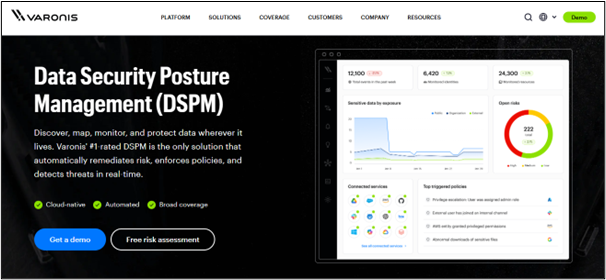
Varonis is a legacy heavyweight in the data security domain, providing comprehensive visibility into an organization’s sensitive data, who has access to it, and its exploitable vulnerabilities.
It discovers and classifies data across SaaS, IaaS, and multi-cloud environments, delivering core security functions, including Data Detection and Response (DDR) and Data Loss Prevention (DLP).
Ideal for: Heavily regulated enterprises (defense, healthcare), especially those relying on Microsoft tools and services.
Key features:
- Broad coverage: Discovers, tags, and protects data wherever it lives, whether it’s file storage, email, SaaS apps, databases, or IaaS.
- Access and permission analysis: Maps complex permissions to show who can access data and identifies overprivileged users.
- Data detection and response: Implements User Entity Behavior Analytics (UEBA) to detect anomalies in user activity (e.g., ransomware attempts, insider threats).
Pros
- Provides complete visibility into user activity across on-prem and cloud systems.
- Enables rapid response to insider risks and data exfiltration attempts.
Cons
- Can be highly cost-prohibitive for SMBs, making it suitable almost exclusively for large enterprises.
- Initial data discovery and categorization can be time-consuming for huge environments.
Pricing
Varonis pricing is based on user count (seats), which can strain IT budgets as a business expands. Contact their team for a precise quote.
5. Securiti
Securiti offers what it calls a “Data Command Center” that unifies privacy, governance, and security into a single platform. While it offers DSPM capabilities, its primary focus is on GRC functions.
It not only provides data discovery workflows but also supports robust privacy practices, consent management, and DSAR handling.
Ideal for: Global GRC and privacy teams seeking to centralize compliance and consent operations.
Key features:
- Data classification: Scans multi-cloud assets, SaaS apps, and shadow tools to unearth data and classify it based on strict regulatory definitions.
- Data flow governance: Identifies where and how data flows into and out of systems to understand lineage and map movement, enabling data protection in transit.
- Compliance management: Tracks access to sensitive data to enforce security and privacy policies, ensuring adherence to complex global regulations.
Pros
- Provides robust out-of-the-box data discovery and classification capabilities.
- Includes an intuitive interface and a clean visualization dashboard.
Cons
- Lacks mature, autonomous remediation workflows to close compliance gaps.
- Initial scanning can generate a high volume of alerts (noise).
Pricing
Securiti’s pricing model isn’t one-size-fits-all; it’s personalized to each customer’s security requirements and use cases. To request a custom quote or book a demo, visit their website.
6. BigID
BigID is a data intelligence platform rooted in privacy and governance that has gradually expanded into security. It provides deep scanning into complex, hybrid environments to locate sensitive data across on-prem servers and multi-cloud architectures.
It enables enterprises to operationalize data privacy (DSARs), automate compliance, and manage risk through a data discovery engine.
Ideal for: Large, highly regulated enterprises managing massive datasets and privacy compliance requirements.
Key features:
- Deep data discovery: Utilizes ML to scan and correlate data across legacy systems and modern cloud repositories to find sensitive data that often hides in shadow tools.
- Smart access management: Prevents data overexposure by analyzing permissions and enforcing the principle of least privilege across hybrid environments.
- Risk scoring: Calculates data security risk based on data sensitivity, location, and residency.
Pros
- Scans almost any data source, including difficult legacy on-prem systems.
- Provides deep dashboard customization, tailoring them to specific business needs.
Cons
- Frequently cited as expensive for small- to medium-sized businesses.
- Some users report latency during daily use and consider its interface clunky.
Pricing
BigID typically uses a need-based pricing model based on the number of data sources, apps, and connectors. Contact their sales team for a custom quote.
7. Cyera
Cyera is another data security posture management solution that uses agentless APIs to scan cloud environments and quickly classify data.
It probes cloud workloads across AWS, Azure, and GCP to gain visibility into where sensitive data resides, who can access it, and its security posture. It also contextualizes data assets, helping teams quickly identify imminent threats.
Ideal for: Cloud-first organizations needing instant visibility and high-accuracy classification.
Key features:
- Intelligent classification: Employs adaptive ML algorithms to accurately label sensitive data and critical assets, reducing manual work.
- Risk management: Enables data security risk mitigation through vulnerability assessments, attack-path mapping, and remediation suggestions.
- Data visualization: Displays data insights on a single dashboard, allowing teams to drill down into exactly where sensitive data resides across the infrastructure.
Pros
- Deploys rapidly across environments (cloud and on-prem).
- Dedicated and responsive customer support team.
Cons
- Some users have reported occasional scanning misses and stability glitches.
- Lack of customizable reporting options forces customers to wait for the support team to generate reports manually.
Pricing
Cyera uses a subscription model, with fees based on the number of data stores, SaaS apps, and cloud environments. For more information about custom quotes, contact their team.
Choose a Modern DSPM Solution for Your Cloud Data Security
The cloud security niche is in constant flux. What worked yesterday is often obsolete today. While visibility is the first step, the ability to act swiftly and autonomously is what separates a secure cloud from an exposed one.
You have weighed the alternatives; now it’s time to choose the option that maximizes your ROI.
Transilience enables you to move beyond passive monitoring to proactive defense, delivering measurable impact from Day 1:
- Outcome-focused: Pay for successful risk mitigation and security outcomes. We deliver results, not budget overruns.
- Enhanced security: Achieve 75% faster time-to-insights with AI threat intelligence and reduce false positives by 70% with AI-driven vulnerability prioritization.
- Force multiplier: Give your SOC a 10x efficiency boost by offloading triage and remediation to autonomous agents.
- Expert guidance: Connect with certified security specialists who provide precise judgment and industry experience to handle complex situations.
Experience first-hand how our AI agents operate around the clock to fortify your cloud security. Book your Transilience demo today.