


Among OT security companies, there is a meaningful split between OT-native platforms and enterprise security vendors that have extended into operational technology.
Dragos, Nozomi Networks, and Claroty are the clearest OT-native OT security vendors here. Their platforms are purpose-built for industrial visibility, threat detection, and OT monitoring across complex cyber-physical environments.
Fortinet and Palo Alto Networks are strong OT security vendors when network segmentation, industrial zoning, policy enforcement, and convergence with broader network security programs matter most.
CrowdStrike is stronger when the organization wants unified IT and XIoT visibility under a cloud-native platform. Forcepoint belongs more in the “critical infrastructure security and secure connectivity” bucket than in the pure-play OT monitoring tool bucket. This is an important distinction for organizations that need deep passive asset discovery.
Network Intelligence is slightly different from the product-led players. Its OT security solutions combine consulting, SOC for OT, maturity assessments, and critical infrastructure security services.
This makes it more relevant for organizations that want execution support and outcome ownership, rather than just another internal tool.
Leading OT Security Companies
- Network Intelligence
- Dragos
- Nozomi Networks
- Claroty
- Fortinet
- CrowdStrike
- Palo Alto Networks
- Forcepoint
How We Compiled This List
Researched real operator problems for operational technology
Before evaluating any OT cybersecurity solutions, we anchored the research in the problems teams are actually trying to solve:
- Lack of visibility across ICS, SCADA, and legacy assets
- Difficulty deploying OT monitoring tools without disrupting operations
- Weak segmentation between IT and OT environments
- Unmanaged remote access to critical infrastructure
- Alert fatigue from tools that may be lacking in an industrial context
To validate this, we reviewed community sentiment and practitioner commentary on third-party platforms to understand the field feedback from engineers comparing different OT security tools.
Verified every vendor against primary sources and peer review platforms
Every vendor included in this list was evaluated across three layers:
- Official product capabilities: Vendor OT-specific product pages where available, as well as the protocol support and claims around OT monitoring, asset discovery, and threat detection.
- Independent review platforms: We examined verified user reviews from G2, Gartner Peer Insights, and Capterra to look for:
- Consistent praise patterns like visibility, ease of deployment, and support quality
- Recurring complaints like cost, complexity, false positives, and tuning effort
- Trade-offs that may not appear in vendor documentation
Evaluated tools based on operational realities
Each OT cybersecurity solution was vetted based on how it performs across the realities that matter, such as:
- If it can be deployed passively without disrupting industrial processes
- If it accurately discovers and classifies OT devices and protocols
- Whether the OT solutions’ monitoring provides actionable signals
- How well it fits into existing SOC and IT security workflows
- Whether it can handle distributed industrial environments across sites
- Whether plant teams and security teams can both work with it
Recommendations of the Best OT Security Solutions in 2026 (Review)
1. Network Intelligence
Network Intelligence OT security solution
Network Intelligence is better understood as an IoT and OT security partner than as a standalone product SKU.
Its OT security solutions focus on IoT and OT security, SOC for OT, maturity assessment, NIST and C2M2-aligned risk programs, and support for critical infrastructure environments. That makes it relevant to security operatives seeking a solution that combines advisory services, OT monitoring, and operational execution.
They also utilize proven industrial technology tools to improve reliability on the shop floor. These include:
-
- IBM QRadar for correlation and analysis of SIEM data streams
- SOAR Platforms for automating workflows with added multi-tool response actions
- Palo Alto Cortex XDR/CrowdStrike for endpoint protection and network-level visibility across cloud workloads
- Darktrace for building deep packet visibility to check lateral movement and covert communication by attackers
Key features
- IoT and OT security services for critical infrastructure and compatibility with common OT protocols and integration for SCADA, PLC, and DCS
- AI-driven predictive and prescriptive insights with Transilience AI to detect issues and suggest solutions
- Specialized SOC for OT with round-the-clock monitoring and response
- Maturity assessments based on NIST Cybersecurity Framework 2.0 and C2M2
- ISO 62443-certified consultation and Zero Trust-oriented implementation support for industrial environments
- Centralized IoT and OT monitoring dashboards for a 360-degree visibility in identifying problems and incident responses
Pros
The strength here is execution depth:
- Recommended option for OT security vendors if the need is a service-led model that spans assessment, design, monitoring, and managed improvement
- Compatibility with legacy equipment, as it connects to your older stack using gateways and adapters without changing the way operators work or affecting safety
- Scalable and adaptable, organizations can add more sites, machines and sensors without needing an overhaul
Cons
- It is not a single mainstream product platform in the same way Dragos, Nozomi Networks, Claroty, or Palo Alto Networks are; It may not be the best fit for teams looking for just a product deployment
Best for
Appropriate for operators in manufacturing environments, energy and utilities, remote and workforce operations, and enterprises that need an OT security partner to help run or mature the program. It fits especially well where compliance, assessment, monitoring, and operational ownership need to come together.
Pricing
Pricing is custom and scope-based.
2. Dragos
Dragos OT cybersecurity tool (Source: Dragos)
Dragos is one of the most purpose-built OT security companies in the market. It provides OT and ICS cybersecurity for industrial infrastructure, with platform coverage across asset visibility, risk-based vulnerability management, threat detection, and managed OT monitoring services.
Key features
- Automated asset inventory and visibility to profile assets using multiple collection methods designed for OT environments, with flexible deployment options
- OT-focused threat intelligence and managed services such as OT Watch and OT Watch Complete for continuous monitoring and triage
- Guided investigation workflows with query-focused datasets, and case management help teams respond to threats
- Access to over 600 ICS protocols with active monitoring to capture network traffic and operational context
- Access to community insights, Neighborhood Keeper for trusted alerts to help organizations detect and respond to bad actors
- Provides OT-corrected CVSS scores prioritization, and practical mitigations when patching is not an option
Pros
- Comprehensive detection and vulnerability monitoring
Cons
- The platform is powerful, but initial deployment may require real expertise to get the most value from it.
- Pricing can be expensive and out of budget range for some companies
Best for
Works for critical infrastructure operators in manufacturing, maritime, energy, water utilities, and brewing sectors. With a high-confidence incident and intelligence posture, it is especially suited to mature teams that will use the intelligence depth.
Pricing
Dragos’ pricing is quote-based; interested parties should reach the sales team for cost analysis.
3. Nozomi Networks
Nozomi Networks OT cybersecurity monitoring tool
Nozomi Networks is one of the most established OT security vendors, with broad visibility, AI-assisted analysis, and flexible deployment across network sensors, endpoints, and the cloud. It provides OT and IoT visibility and security for complex industrial and critical infrastructure environments.
Key features
- Enterprise risk and controls execution covering internal audit, SOX readiness, and controls testing.
- Continuous cyber risk operations that span monitoring, threat detection, incident response, and vulnerability management.
- Third-party risk management and operational resilience programs are designed to assess and monitor compliance across extended ecosystems.
- Enterprise technology risk and control integration across Salesforce, SAP, Oracle, and NetSuite, embedding security controls directly into them.
- Forensics and litigation support delivering defensible analysis for internal and external investigations on economic crime cases and complex claims or disputes.
- Regulatory strategy and compliance leadership for finance and health industries to support regulatory reporting, change management, and remediation.
Pros
- UI is easy to navigate, and the dashboard provides good analysis of network behavior
- Vendor support is reliable, with a team of OT/CPS advisory experts for implementation
Cons
- Some of the advanced modules require separate licenses, such as Vantage IQ, Mandiant TI pack, with extra cost for unlocking analytics and integration features, such as CMDB
- Initial setup can be difficult to pull off, and it also takes time to adjust to alerts if there are multiple OT/CSP environments
Pricing
Pricing is custom-quoted and based on the service scope. Reach out to sales team for cost breakdown.
Best for
Organizations that want OT monitoring tools with strong network visibility and cloud-scale centralization across multiple sites or regions. It is a strong fit for distributed industrial operations.
4. Claroty
Claroty OT security solution (Source: Claroty)
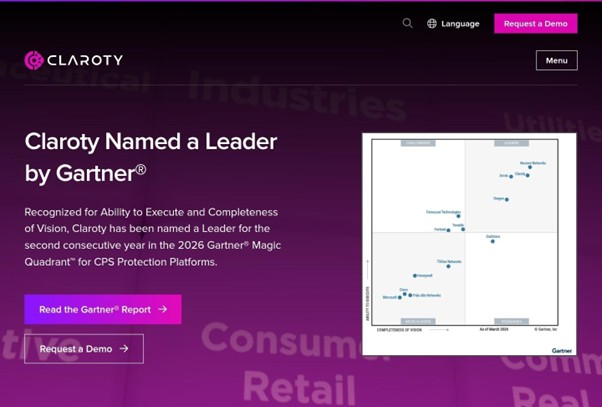
Claroty is one of the security companies specializing in the protection of cyber-physical systems. Its platform is built around deep asset visibility, exposure management, threat detection, and network protection, and it also positions strongly across OT, IoT, IoMT, and facilities-related systems.
Key features
- Combines ecosystem – Claroty Edge, project file analysis, safe queries, and passive monitoring to deliver deep, non-intrusive visibility across OT, IoT, and IoMT environments
- Discovers and profiles assets across enterprise IoT, and medical devices, including PLCs, HMIs, RTUs, sensors, and building systems
- Provides asset and network data with operational context, helping teams understand how devices map to processes, production lines, and critical functions
- Access to unified visibility across OT, IoT, and IoMT for consistent security across cyber-physical systems
- Delivers a solution set including exposure management, network protection, secure access, and threat detection within a single platform
Pros
- Users can centrally control integrations into identity providers like Okta, Azure AD, ADFS, and Google
- Real-time visibility into remote user activity with session-level monitoring and oversight
- Frequent updates with new features and bug fixes, indicating active platform development and improvement
Cons
- Has a steep learning curve, with reports that mastering CTD can take several weeks
- Certain fixes or configurations may require vendor support due to limited administrative control for users
- Works best within the Claroty ecosystem, with reduced visibility and more gaps when integrated into mixed-vendor environments
Best for
Organizations that want strong CPS-wide visibility and OT security solutions that also extend into medical, facilities, and broader connected-asset environments.
Pricing
Pricing is custom. Other sources indicate that organizations may pay up to $150,000 per user.
5. Fortinet
Fortinet OT cybersecurity monitoring tool (Source: Fortinet)
Fortinet is one of the stronger generalist OT security vendors for CSOs who want network-centric OT security solutions. Its OT platform centers on visibility, segmentation, microsegmentation, secure remote access, FortiGuard OT threat intelligence, and automated virtual patching for legacy OT devices.
Key features
- Combines FortiGate NGFW and FortiGuard OT Security Service to deliver network segmentation and OT-specific threat protection across industrial environments
- Integrates FortiSwitch (via FortiLink) and microsegmentation to enforce granular, port-level control and isolate OT assets safely
- Uses ruggedized appliances with OT-aware IPS and virtual patching to protect legacy systems without disrupting operations
- Enables secure remote access through FortiPAM and FortiSRA, allowing controlled third-party and vendor access into OT environments
- Provides centralized policy management and visibility across IT and OT networks, improving control over hybrid environments.
Pros
- Offers a cost-effective OT security solution with strong segmentation capabilities that improve both security and operational manageability
- Makes secure third-party access easier with FortiSRA, supported by centralized management and integrated platform control
- Maintains a user-friendly interface with a relatively low learning curve, especially for teams already familiar with the Fortinet ecosystem
Cons
- Has faced recurring high-severity vulnerabilities, which raises concerns about long-term platform resilience despite timely patching.
- Requires complex initial configuration and tuning, particularly in environments with multiple existing security products
Best for
Infrastructure security teams that want to center OT security around industrial segmentation, ruggedized networking, and remote-access control, especially when they already have Fortinet in the environment.
Pricing
Fortinet does not publish a single standardized price for its OT security solutions because the offering is architecture-driven.
It combines hardware (FortiGate rugged firewalls), licenses (FortiGuard OT Security Service), and optional support bundles.
However, reseller data gives a realistic view of pricing ranges:
- Entry-level FortiGate Rugged OT appliances (for industrial environments) can start at $2,200–$4,000 for hardware, while bundled packages with security services and support can scale to $7,000–$ 10,000+ over multi-year terms.
- On the services side, FortiGuard OT Security Service licenses vary significantly by device and scale, with smaller deployments costing hundreds per year, while enterprise-grade deployments on high-end FortiGate models can reach $30,000–$50,000+ annually
- There are also multi-year license options (for example, about €3,950 for a 5-year OT security service on specific models)
*Fortinet OT pricing should be treated as modular and deployment-dependent. The number of sites, rugged devices, segmentation requirements, and the level of OT-specific threat intelligence and support required determines the total cost.
6. CrowdStrike
CrowdStrike Falcon OT and IoT security solution (Source: CrowdStrike)
CrowdStrike’s OT is now centered on Falcon for XIoT. It is one of the newer OT security vendors for teams seeking unified visibility and protection across IT and XIoT, rather than a purely industrial monitoring stack.
Features
- Continuous asset inventory with ICS-aware context (Purdue level, device behavior) and Falcon visibility, giving unified insight across IT and OT environments
- Existing Windows and Linux hosts (engineering workstations, SCADA, HMIs) together with Falcon telemetry to safely discover and monitor OT and IoT devices
- Falcon XIoT visibility with Next-Gen Identity Security to secure environments where credentials are shared or unmanaged
- Agent-based and cloud-native monitoring with minimal network disruption, aligning with OT safety requirements
Pros
- Cloud-based platform enables remote access and centralized management without requiring constant on-premise presence
- Delivers detailed security analytics and real-time threat detection, helping teams understand attack patterns and respond quickly
- Supports fast deployment with minimal friction, especially in environments already using endpoint or identity management tools
Cons
- Can generate false positives, requiring manual review and whitelisting of legitimate processes
- Agent performance may impact older machines, with higher CPU and memory usage affecting productivity
- Past platform stability incidents and update-related issues have raised concerns about reliability and change management
Best for
Enterprises that want to bring OT security tools into a broader cloud-native detection, identity, and exposure strategy across IT and XIoT.
Pricing
CrowdStrike does not offer standalone pricing for Falcon for XIoT, as it is sold as part of the broader Falcon platform and typically priced through enterprise agreements.
The only publicly available pricing applies to Falcon’s core endpoint tiers:
- Falcon Go starts at $59.99 per device per year
- Falcon Pro starts at $99.99 per device per year
- Falcon Enterprise starts at $184.99 per device per year
These plans are billed annually and include capabilities such as endpoint protection, identity security, threat intelligence, and SIEM functionality, along with a limited free trial.
For organizations that need fully managed security operations, CrowdStrike offers Falcon Complete, a 24/7 managed detection and response (MDR) service. This is quote-based and varies depending on the environment size, coverage, and service requirements. Additional modules, such as identity protection and next-generation SIEM, can also be added, further affecting total cost.
7. Palo Alto Networks
Palo Alto Networks cybersecurity for OT systems (Source: Palo Alto Networks)
Palo Alto Networks has become one of the most visible OT security vendors among broader platform companies. Its OT security solution focuses on device discovery, risk context, IEC 62443-aligned zoning, segmentation, and connected-device protection through its IoT and OT security portfolio.
Key features
- App-ID and Device-ID with machine learning to identify and profile OT, IT, and IoT assets such as DCS and HMI systems with high accuracy
- Continuous traffic inspection and anomaly detection, including identification of unauthorized communications and segmentation breaches in OT networks.
- OT and IoT security into the broader Palo Alto platform (Panorama and Data Lake) for centralized visibility and control
- Offers industrial OT Security for zoning and fine-grained segmentation
- OT Device Security for visibility and actionable risk insights, including policy enforcement based on asset type and protocol
Pros
- Delivers strong visibility into OT networks with actionable insights that improve overall security posture
- Integrates natively into the Palo Alto ecosystem, allowing OT data to enrich centralized analytics and detection workflows
- Benefits from unified platform architecture, making it easier to manage alongside existing Palo Alto deployments
Cons
- Can surface more vulnerabilities than teams can remediate, especially in legacy OT environments with unpatchable systems.
- SIEM integration relies on syslog rather than native connectors, which can limit flexibility.
Best for
Enterprises that want OT solutions tightly aligned with network segmentation, Zero Trust-style policy, and existing Palo Alto Networks infrastructure. It is a very strong crossover choice between OT-native needs and enterprise-standard operations.
Pricing
Services are quote-based; however, reseller and marketplace data provide useful pricing anchors.
For example:
- Palo Alto Networks’ IoT Security (which extends into OT visibility and control) has been listed on the Amazon Web Services Marketplace, starting at approximately $9,500 per year for around 1,000 devices, scaling based on device count and coverage scope
- On the network side, Palo Alto firewalls (which enable OT segmentation and policy enforcement) range widely depending on model and throughput, with entry enterprise appliances starting in the $5,000–$10,000+ range, and large-scale deployments costing significantly more
8. Forcepoint

Forcepoint security for OT devices (Source: Forcepoint)
Forcepoint is the most unusual inclusion in this list because it is not a leading OT-native platform in the same sense as Dragos or Nozomi.
Its value lies more in critical infrastructure connectivity, NGFW, secure remote access, deep packet inspection, and network/data protection in high-consequence environments.
Key features
- Combines human behavior analytics with real-time monitoring to detect and prevent threats in OT and ICS environments based on user activity
- Uses Forcepoint NGFW with consistent policy enforcement to secure OT networks across physical, virtual, and cloud environments while inspecting encrypted traffic
- Enables secure data movement with Forcepoint Data Guard, validating commands and data flows at the application layer to protect sensitive OT operations
- Supports segmented and one-way data transfer architectures for critical infrastructure, helping meet compliance standards such as NERC-CIP and IEC 62443
- Integrates Human Point System capabilities (DLP, CASB, insider threat protection) to secure data, users, and access across IT and OT environments
Pros
- Runs efficiently in the background while still allowing quick access to diagnostics when needed
- Provides centralized visibility with easy export options (CSV and graphical views), making it simple to analyze and report on data
- Offers unified web and data protection across on-premise and remote users through a single management console
Cons
- Interface can feel less interactive in certain areas, impacting usability for some workflows
- May experience minor performance issues depending on deployment conditions
- Advanced data searches can sometimes be slow, particularly when querying historical data
Best for
Critical infrastructure operators that need secure connectivity, NGFW, segmentation, and data/control protection for OT-adjacent environments, rather than a pure OT monitoring platform.
Pricing
Forcepoint does not offer public standalone OT pricing as costs are modular and quote-based.
But we found public pricing in a Forcepoint 2022 price catalogue hosted online and in live reseller listings.
In that catalogue:
- Forcepoint Data Guard hardware is listed at $9,905 for a small 1U R640 appliance and $15,630 for a medium 1U R640 appliance
- The Data Guard Unstructured Data Bundle is listed at $98,700, and the developer license at $49,140.
- The same catalogue also says Essential Support is 15% of the list price, with Enhanced Support carrying a $12,500 minimum per customer per year and Enterprise Support a $75,000 minimum per customer per year.
The document labels these as suggested end-user prices, with the reseller applying discounts.
For adjacent Forcepoint products, reseller pricing on Insight shows that implementation and support can add meaningful cost on top of licensing.
For example, Insight lists a Forcepoint implementation service at $1,519.99 list price, a DLP Discover implementation package at $12,504.99 list price, and a Forcepoint Essential Support renewal item at $20,315.99 list price.
*These are not OT bundle prices, but they are useful as real-world pricing anchors for how Forcepoint costs can expand once services and support are included.
Picking the Best OT Security Solution for Your Organization
The most useful way to evaluate OT security tools is to decide what kind of OT problem you are actually solving.
If the security to-do list for the organization is based solely on OT-native depth, Dragos, Nozomi Networks, and Claroty still feel like the clearest leaders among OT security companies.
If the focus is on broader enterprise fit, segmentation, remote access, and stack alignment, Fortinet and Palo Alto Networks are good options to explore.
If the main goal is service-led operational ownership to protect all operational technology equipment across the organization, Network Intelligence can fill that need.
And if the organization wants unified IT and operational visibility, CrowdStrike is the more natural crossover pick.
Forcepoint can work, but mostly when the requirement is secure critical-infrastructure connectivity rather than best-in-class passive OT monitoring.
If you need execution support and maturity-building for comprehensive protection and ownership of partnership outcomes, talk to the experts at Network Intelligence today.