


Understanding Cybersecurity and Compliance
Implementing a robust information security compliance program requires a structured approach that addresses multiple domains and regulatory requirements simultaneously. Organizations must balance technical controls, policy frameworks, and continuous monitoring to maintain compliance across various standards while managing cyber risk effectively.
What Is Cybersecurity Compliance?
Cybersecurity compliance means aligning your organization’s security practices with recognized standards, laws, and frameworks. This alignment ensures that security controls address both technical vulnerabilities and regulatory mandates specific to your industry and geographic location. The process requires identifying which compliance standards apply based on industry verticals (healthcare, finance, government), geography, customer requirements, and the types of sensitive data handled.
Compliance is not a one-time achievement but rather an ongoing commitment to maintaining security controls, documenting evidence, and adapting to evolving threats and regulatory changes. Organizations that treat compliance as a checklist-only exercise often create compliance blind spots, leading to wasted resources and inadequate protection.
Why Is Compliance Critical for Regulated Industries?
For organizations in regulated industries, compliance isn’t optional—it’s a fundamental business requirement with significant consequences for failure. Financial institutions face potential fines of up to $1 million per day for certain compliance violations. Healthcare organizations that experience HIPAA breaches may face penalties up to $1.5 million per violation category annually, along with mandatory corrective action plans that create significant operational overhead.
Beyond financial penalties, compliance failures can trigger mandatory breach notifications, regulatory investigations, and reputational damage that affects customer trust and market position. For publicly traded companies, security incidents can impact stock valuations, with studies showing an average 5-7% stock price decline following major breaches.
The expanding regulatory landscape creates additional complexity, with new frameworks emerging regularly and existing standards undergoing frequent updates. Organizations must navigate this evolving environment while maintaining operational efficiency and managing resource constraints.
Key Cybersecurity Frameworks and Standards
Organizations typically must address multiple frameworks based on their industry, geography, and business activities:
- ISO 27001: Provides a systematic approach to information security management systems (ISMS) with controls spanning organizational, human, physical, and technical domains. Learn more about ISO 27001 compliance requirements.
- NIST Cybersecurity Framework: Organizes security activities into five core functions—Identify, Protect, Detect, Respond, and Recover—providing a comprehensive structure for security program development. Explore our NIST compliance checklist.
- SOC 2: Focuses on service organizations’ controls relevant to security, availability, processing integrity, confidentiality, and privacy. View our ultimate SOC 2 compliance checklist.
- PCI DSS: Mandates specific controls for organizations that process, store, or transmit payment card data. Check our PCI compliance checklist.
- HIPAA: Establishes requirements for protecting electronic protected health information (ePHI). Review our HIPAA compliance checklist.
- GDPR: Imposes strict requirements on organizations handling EU citizen data, with substantial penalties for non-compliance.
- FedRAMP: Provides standardized security assessment for cloud services used by U.S. federal agencies. See our FedRAMP compliance guide.
- CCPA/CPRA: Establishes data privacy requirements for organizations handling California residents’ personal information. Explore our CCPA compliance checklist.
Many organizations must comply with multiple frameworks simultaneously, creating challenges in mapping overlapping requirements and implementing controls efficiently. A unified compliance approach that addresses common requirements across frameworks can reduce duplication and optimize resource allocation.
Core Elements of an Enterprise Cybersecurity Checklist
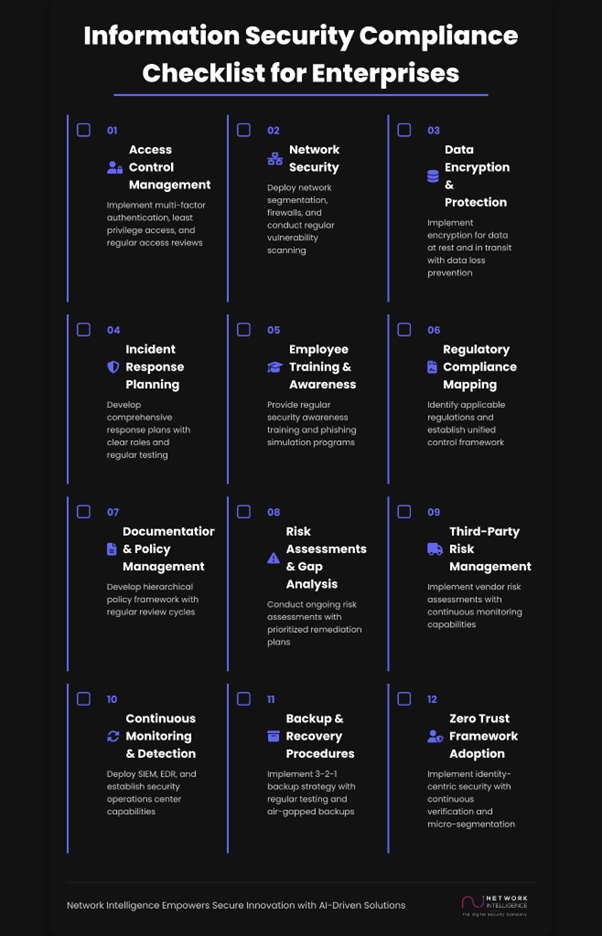
1. Access Control Management
Effective access control serves as the foundation of information security by restricting system and data access based on the principle of least privilege. This domain requires organizations to:
- Maintain comprehensive user account inventories aligned with job responsibilities
- Implement multi-factor authentication for all privileged accounts and remote access
- Enforce strong password policies with complexity requirements and regular rotation
- Establish formal access request and approval processes with appropriate segregation of duties
- Conduct quarterly access reviews to identify and remove unnecessary privileges
- Implement privileged access management (PAM) solutions for administrative accounts
- Automate provisioning and de-provisioning processes to prevent access accumulation
- Monitor and alert on suspicious access patterns or unauthorized attempts
Access control extends beyond user authentication to include role-based access decisions and continuous validation of authorization levels as job functions change or employees transition roles.
2. Network Security
Regular evaluation of network infrastructure is essential for identifying and remediating vulnerabilities before they can be exploited. Network security controls should include:
- Implementing network segmentation to isolate critical systems and limit lateral movement
- Deploying next-generation firewalls with application awareness and intrusion prevention
- Establishing secure configuration standards for network devices
- Conducting regular vulnerability scanning and penetration testing
- Implementing secure remote access solutions with strong authentication
- Monitoring network traffic for anomalies and potential data exfiltration
- Securing wireless networks with enterprise-grade encryption and segmentation
- Implementing DNS filtering to block malicious domains and command-and-control servers
Network assessment should encompass penetration testing, vulnerability scanning, and configuration reviews to identify weaknesses that could lead to unauthorized access, data breaches, or other cyber threats. Our security audit checklist provides a comprehensive framework for evaluating network security controls.
3. Data Encryption and Protection
Protecting sensitive data requires both technical and procedural controls. Organizations should:
- Implement encryption for data in transit using TLS 1.2 or higher
- Deploy encryption for data at rest, particularly for regulated information
- Establish data classification policies with clear handling requirements
- Implement data loss prevention (DLP) solutions to prevent unauthorized exfiltration
- Deploy database activity monitoring for sensitive data repositories
- Establish secure data backup procedures with encryption
- Implement secure file sharing solutions that maintain encryption and access controls
- Develop and enforce data retention and destruction policies
Organizations handling personally identifiable information (PII) must implement additional controls to meet regulatory requirements. Our PII compliance checklist provides detailed guidance for protecting personal data across various regulations.
4. Incident Response Planning
An effective incident response program enables organizations to detect, contain, and recover from security incidents quickly. Key elements include:
- Developing comprehensive incident response plans with clear roles and responsibilities
- Establishing incident classification frameworks to guide response activities
- Defining escalation procedures and communication protocols
- Implementing automated detection capabilities for common attack patterns
- Conducting regular tabletop exercises to test response capabilities
- Establishing relationships with external incident response providers
- Documenting lessons learned and updating procedures after incidents
- Implementing forensic readiness capabilities to support investigations
Plans should address various incident types and severity levels, with clear communication protocols for internal stakeholders and external regulators when required.
5. Employee Training and Awareness
Personnel security represents a critical control that is often overlooked. Organizations must:
- Provide regular security awareness training for all employees
- Conduct role-based security training for employees with specific responsibilities
- Implement phishing simulation programs to test awareness
- Develop security onboarding procedures for new employees
- Establish clear security expectations in acceptable use policies
- Create security champions programs to promote security culture
- Conduct specialized training for developers on secure coding practices
- Maintain records of training completion for compliance purposes
Training should cover current threat landscapes, phishing awareness, password hygiene, and proper handling of sensitive information. Regular reinforcement through multiple channels helps establish security as part of organizational culture rather than a compliance exercise.
6. Secure System Acquisition, Development, and Maintenance
Secure system acquisition, development, and maintenance ensures that security is embedded throughout the system lifecycle rather than added after deployment. Organizations should:
- Implement secure development lifecycle (SDLC) methodologies
- Conduct security requirements analysis during system planning
- Perform threat modeling for new applications and major changes
- Implement automated security testing in CI/CD pipelines
- Establish patch management processes with defined SLAs
- Conduct regular vulnerability scanning of applications and infrastructure
- Implement secure configuration standards for all system components
- Perform security reviews before system deployment
For SaaS providers and organizations leveraging cloud services, additional controls are necessary to address shared responsibility models. Our SaaS compliance checklist provides detailed guidance for securing cloud environments.
7. Physical and Environmental Security
While often overlooked in digital-first organizations, physical security controls remain important, particularly for facilities housing critical infrastructure. Key controls include:
- Implementing physical access controls with multi-factor authentication
- Establishing visitor management procedures
- Deploying video surveillance in sensitive areas
- Implementing environmental monitoring for temperature, humidity, and water
- Establishing fire detection and suppression systems
- Implementing secure media disposal procedures
- Securing telecommunications equipment and cabling
- Maintaining backup power systems for critical infrastructure
Physical security controls should be integrated with logical access controls to provide comprehensive protection for sensitive assets and information.
8. Mobile and IoT/OT Security
The proliferation of mobile devices and IoT/OT systems creates additional security challenges. Organizations should:
- Implement mobile device management (MDM) solutions
- Enforce device encryption and strong authentication
- Establish secure configuration standards for mobile devices
- Implement application whitelisting for corporate devices
- Develop IoT/OT security frameworks with appropriate segmentation
- Conduct security assessments of IoT/OT environments
- Implement monitoring for IoT/OT networks
- Establish secure update mechanisms for connected devices
Organizations with operational technology environments face additional challenges in securing legacy systems while maintaining operational reliability. Specialized frameworks like IEC 62443 provide guidance for industrial control system security.
9. Vendor and Third-Party Risk Management
Many organizations rely on external vendors and service providers, creating supply chain risks. Compliance programs must include:
- Developing vendor risk assessment methodologies
- Conducting pre-contract security assessments
- Establishing security requirements in vendor contracts
- Implementing ongoing vendor monitoring programs
- Conducting periodic reassessments based on risk
- Establishing incident response procedures for vendor breaches
- Implementing right-to-audit clauses for critical vendors
- Maintaining a comprehensive vendor inventory with risk ratings
Our vendor compliance checklist provides a structured approach to managing third-party security risks throughout the vendor lifecycle.
10. Regular Security Audits and Assessments
Conducting baseline risk and compliance assessments establishes the foundation for a targeted security roadmap. Organizations should:
- Implement regular vulnerability assessment programs
- Conduct annual penetration testing of critical systems
- Perform compliance gap assessments against applicable frameworks
- Establish continuous compliance monitoring capabilities
- Conduct security architecture reviews
- Implement red team exercises for critical infrastructure
- Perform configuration compliance scanning
- Establish metrics and reporting for security posture
Leveraging security audit software can significantly enhance assessment efficiency and effectiveness while providing continuous visibility into compliance status.
11. Backup and Recovery Procedures
Effective backup and recovery capabilities are essential for both operational resilience and compliance with various frameworks. Organizations should:
- Implement the 3-2-1 backup strategy (three copies, two different media, one offsite)
- Encrypt backup data both in transit and at rest
- Conduct regular backup testing and validation
- Establish recovery time objectives (RTOs) and recovery point objectives (RPOs)
- Implement air-gapped backups for protection against ransomware
- Develop comprehensive disaster recovery plans
- Conduct annual disaster recovery testing
- Maintain backup documentation and procedures
Ransomware resilience has become a critical focus area, with many frameworks now requiring specific controls to prevent, detect, and recover from ransomware attacks.
12. Continuous Threat Exposure Management
Modern security programs must implement continuous threat exposure management to address emerging vulnerabilities and threats. Key elements include:
- Implementing continuous vulnerability scanning
- Establishing vulnerability management processes with clear SLAs
- Leveraging threat intelligence to prioritize vulnerabilities
- Implementing attack surface management capabilities
- Conducting regular exposure assessments
- Implementing breach and attack simulation tools
- Establishing metrics for exposure reduction
- Integrating exposure management with risk management processes
Continuous threat exposure management represents an evolution from point-in-time assessments to ongoing visibility and remediation of security weaknesses.
Compliance Audit Checklist for Highly Regulated Industries
1. Regulatory Compliance Mapping
Organizations operating in regulated industries must first identify all applicable compliance standards and frameworks. This mapping exercise should:
- Identify all applicable regulations based on industry, geography, and data types
- Document which requirements apply to which systems and business processes
- Identify overlapping requirements across multiple frameworks
- Establish a unified control framework that addresses multiple regulations
- Define compliance ownership and responsibilities
- Establish compliance monitoring and reporting processes
- Develop a compliance calendar with key deadlines and activities
- Implement processes for monitoring regulatory changes
For organizations subject to multiple frameworks, a unified compliance approach can significantly reduce duplication and optimize resource allocation.
2. Documentation and Policy Management
A comprehensive security policy framework serves as the skeleton of an effective security program. Organizations should:
- Develop a hierarchical policy framework (policies, standards, procedures, guidelines)
- Establish policy management processes with regular review cycles
- Implement document control procedures with version tracking
- Align policies with applicable regulatory requirements
- Establish policy exception processes with appropriate approvals
- Develop policy awareness and training programs
- Implement policy compliance monitoring
- Maintain evidence of policy acknowledgment
Policies should address data protection, access controls, incident response, and other security domains. These policies must be continuously reviewed and updated to account for changes in technology, the threat landscape, and business operations.
3. Risk Assessments and Gap Analysis
Beyond initial baseline assessments, organizations must conduct ongoing risk assessments to manage and identify emerging risks. Key activities include:
- Establishing formal risk assessment methodologies
- Conducting annual enterprise risk assessments
- Performing targeted assessments for high-risk systems
- Implementing continuous risk monitoring capabilities
- Developing risk treatment plans with clear ownership
- Establishing risk acceptance processes with appropriate approvals
- Integrating risk management with business processes
- Reporting risk status to executive leadership and boards
Risk assessment processes should identify where current controls fall short of framework requirements and prioritize remediation efforts based on risk exposure and regulatory deadlines.
4. Security Controls Implementation
Implementing the specific controls required by each framework represents the operational phase of compliance. Organizations should:
- Develop control implementation plans with clear ownership
- Establish control testing and validation processes
- Implement compensating controls where primary controls aren’t feasible
- Document control implementation evidence
- Establish control monitoring and maintenance processes
- Implement change management for control modifications
- Conduct regular control effectiveness assessments
- Establish metrics for measuring control performance
Implementation may require policy updates, technical changes, or procedural modifications depending on the control domain.
5. Monitoring, Detection, and Response
Compliance frameworks increasingly require automated monitoring and detection capabilities. Organizations should:
- Implement security information and event management (SIEM) solutions
- Establish security operations center (SOC) capabilities
- Deploy endpoint detection and response (EDR) tools
- Implement network monitoring and traffic analysis
- Establish alert triage and investigation processes
- Develop playbooks for common security scenarios
- Implement threat hunting capabilities
- Establish metrics for detection and response effectiveness
Detection capabilities should feed into incident response processes that enable organizations to respond to potential security events appropriately.
6. Ongoing Compliance Management and Reporting
Moving from periodic compliance reviews to continuous compliance ensures audit readiness at all times. Organizations should:
- Implement continuous compliance monitoring tools
- Establish compliance dashboards with key metrics
- Develop regular compliance reporting for leadership
- Implement automated evidence collection processes
- Establish compliance remediation workflows
- Conduct regular internal compliance assessments
- Prepare for external audits with readiness reviews
- Maintain comprehensive compliance documentation
Many organizations now use automated tools to track compliance metrics and generate reports for regulatory submissions. Our SOC 1 compliance checklist provides guidance for organizations preparing for financial control audits.
7. Evaluating and Managing Third-Party Vendors
Third-party risk management has become a critical focus area for regulated industries. Organizations should:
- Develop comprehensive vendor risk management programs
- Implement tiered assessment approaches based on vendor criticality
- Establish contractual security requirements
- Conduct regular vendor security assessments
- Implement continuous vendor monitoring capabilities
- Establish incident response procedures for vendor breaches
- Develop vendor offboarding procedures to ensure data protection
- Maintain comprehensive vendor inventories with risk ratings
Many regulations now explicitly require organizations to manage third-party risks, with specific requirements for vendor assessment, contractual provisions, and ongoing monitoring.
8. Privacy Assurance and Data Governance
Privacy requirements continue to expand globally, requiring organizations to implement comprehensive data governance programs. Key elements include:
- Developing data inventories and data flow mapping
- Implementing privacy impact assessments for new processes
- Establishing data subject rights fulfillment processes
- Implementing privacy by design methodologies
- Developing privacy notices and consent management
- Establishing data retention and deletion procedures
- Implementing privacy training programs
- Establishing privacy incident response procedures
Organizations handling personal data must navigate an increasingly complex landscape of privacy regulations, including GDPR, CCPA/CPRA, and emerging state and national laws.
9. Responsible AI and Digital Transformation Security
As organizations adopt AI and machine learning technologies, new security and compliance challenges emerge. Organizations should:
- Develop AI governance frameworks
- Implement AI risk assessment methodologies
- Establish model validation and testing procedures
- Implement data quality and integrity controls
- Develop explainability and transparency requirements
- Establish monitoring for AI system performance
- Implement security controls for AI development environments
- Develop ethical AI use policies
Emerging regulations increasingly address AI governance and security requirements. Our Model Context Protocol (MCP) security checklist provides guidance for securing AI systems and models.
10. Zero Trust Framework Adoption
Zero Trust has evolved from a conceptual approach to a specific set of architectural principles and controls. Organizations implementing Zero Trust should:
- Develop Zero Trust architecture plans
- Implement identity-centric security models
- Deploy micro-segmentation for network isolation
- Implement least privilege access controls
- Establish continuous validation and verification
- Deploy data-centric security controls
- Implement comprehensive monitoring and analytics
- Establish Zero Trust governance and metrics
Many regulatory frameworks now explicitly reference Zero Trust principles as recommended approaches for meeting security requirements.
Achieving and Maintaining a Robust Security Posture
Continuous Improvement and Adaptation
Rather than treating compliance as a static achievement, organizations should adopt continuous improvement methodologies that regularly evaluate and enhance security controls. Key elements include:
- Establishing security maturity models with clear progression paths
- Implementing regular security program assessments
- Developing improvement roadmaps with measurable objectives
- Establishing feedback loops from incidents and assessments
- Implementing lessons learned processes
- Conducting regular tabletop exercises and simulations
- Establishing security benchmarking against industry peers
- Developing executive reporting on security program maturity
Continuous improvement methodologies enable organizations to evolve their security programs beyond baseline compliance to address emerging threats and business requirements.
Staying Current with Evolving Threats and Regulations
Regulatory requirements continue to evolve, requiring organizations to establish processes for monitoring and adapting to changes. Key activities include:
- Establishing regulatory monitoring processes
- Participating in industry information sharing groups
- Leveraging threat intelligence to inform security controls
- Conducting regular threat modeling exercises
- Implementing emerging security technologies
- Establishing relationships with regulatory bodies
- Participating in industry working groups
- Conducting horizon scanning for emerging requirements
Organizations must establish processes for monitoring regulatory changes, assessing impact on their compliance programs, and implementing necessary updates within appropriate timeframes.
Integrating Human Expertise with AI-Driven Solutions
Modern compliance programs increasingly leverage technology to move beyond manual, checklist-based approaches. Key integration points include:
- Implementing automated compliance management platforms
- Deploying AI-driven security analytics
- Establishing continuous control monitoring
- Implementing automated evidence collection
- Developing integrated risk dashboards
- Establishing automated compliance reporting
- Implementing predictive risk analytics
- Developing human-AI collaboration models
Organizations seeking to implement comprehensive compliance programs may explore specialized platforms designed to address these challenges. Technology solutions offering automated compliance assessment, evidence collection, and reporting can significantly reduce the manual effort required to maintain compliance across multiple frameworks.
How Network Intelligence Empowers Secure Innovation
AI-Driven Detection and Response
Network Intelligence’s AI-powered security solutions transform traditional security operations with advanced detection and response capabilities:
- Autonomous threat detection that identifies emerging threats without predefined signatures
- Behavioral analytics that establish baseline activity patterns and detect anomalies
- Automated investigation workflows that reduce alert fatigue and accelerate response
- Contextual intelligence that prioritizes alerts based on business impact and threat severity
- Continuous learning systems that adapt to evolving threat landscapes
- Integrated threat intelligence that provides global visibility into emerging attack patterns
- Automated response capabilities that contain threats before significant damage occurs
- Comprehensive forensics that support root cause analysis and future prevention
These capabilities enable organizations to detect and respond to threats at machine speed while maintaining comprehensive audit trails for compliance purposes.
Comprehensive Compliance and Risk Management
Network Intelligence’s compliance solutions address the challenges of managing multiple regulatory frameworks simultaneously:
- Unified compliance dashboards that provide visibility across multiple frameworks
- Automated evidence collection that reduces manual compliance overhead
- Continuous control monitoring that ensures ongoing compliance
- Integrated risk management that aligns security investments with business priorities
- Compliance mapping that identifies overlapping requirements across frameworks
- Automated reporting that streamlines audit preparation
- Gap analysis capabilities that identify compliance deficiencies
- Remediation workflows that track compliance improvements
Organizations implementing these solutions typically reduce compliance overhead by 60-70% while improving compliance effectiveness and accuracy.
End-to-End Cybersecurity Lifecycle with the ADVISE Framework
Network Intelligence’s ADVISE framework provides a comprehensive approach to cybersecurity management:
- Assess: Comprehensive security assessments that identify vulnerabilities and compliance gaps
- Design: Security architecture development aligned with business objectives and regulatory requirements
- Validate: Penetration testing and security validation that confirms control effectiveness
- Implement: Security control deployment with minimal operational disruption
- Secure: Ongoing security operations that maintain protection against evolving threats
- Evolve: Continuous improvement methodologies that enhance security maturity over time
This structured approach ensures organizations address security holistically rather than implementing point solutions that create gaps and inefficiencies.
Tailored Solutions for Banking, Financial Services, Technology, Energy, and Airlines
Network Intelligence provides industry-specific security solutions that address unique regulatory requirements and threat landscapes:
- Banking and Financial Services: Solutions addressing GLBA, PCI DSS, SOX, and financial regulatory requirements
- Technology: Security frameworks for SaaS providers, software developers, and technology innovators
- Energy: Critical infrastructure protection aligned with NERC CIP and energy sector regulations
- Airlines: Aviation security solutions addressing unique operational technology and safety requirements
- Healthcare: Comprehensive HIPAA compliance and medical device security solutions
These industry-specific approaches ensure organizations implement controls that address their unique risk profiles and regulatory requirements.
Supporting Secure Digital Transformation and Zero Trust Initiatives
Network Intelligence enables organizations to pursue digital transformation while maintaining security and compliance:
- Zero Trust architecture implementation with identity-centric security models
- Cloud security frameworks that address shared responsibility models
- DevSecOps integration that embeds security throughout the development lifecycle
- API security solutions that protect critical data exchanges
- Container and microservices security for modern application architectures
- IoT/OT security frameworks for connected devices and operational technology
- AI governance models that ensure responsible AI deployment
- Digital identity solutions that enable secure customer experiences
These capabilities ensure security enables rather than impedes digital transformation initiatives.
Talk to an Expert
Network Intelligence’s cybersecurity experts can help your organization develop and implement a comprehensive security and compliance program tailored to your specific requirements. Our team brings decades of experience across multiple industries and regulatory frameworks, providing practical guidance that balances security effectiveness with operational efficiency.
Contact us today to discuss your security and compliance challenges and learn how our AI-powered solutions can transform your security operations while reducing compliance overhead.
FAQs
What is the difference between cybersecurity compliance and security effectiveness?
Cybersecurity compliance focuses on meeting specific regulatory requirements and implementing mandated controls, while security effectiveness measures how well those controls actually protect against real-world threats. Compliance provides a baseline framework but doesn’t necessarily guarantee security. Effective security programs address both compliance requirements and emerging threats that may not yet be covered by regulatory frameworks.
How often should we conduct security assessments?
Most regulatory frameworks require annual comprehensive assessments, but modern security programs should implement continuous assessment capabilities. Vulnerability scanning should occur at least monthly for external systems and quarterly for internal systems. Penetration testing should be conducted annually and after significant changes. Continuous monitoring tools can provide real-time visibility into security posture between formal assessments.