


By the time a stolen credential shows up in a breach notification or an account takeover, it’s usually been sitting somewhere on the dark web for weeks or months already. It was pulled from a stealer log, bundled with thousands of others, listed for sale on a Telegram channel or a forum, and passed around by an initial access broker looking for a buyer. The breach itself is the last step in a chain that started much earlier and was, in principle, visible the whole time.
That gap between when data actually leaks and when an organization finds out is exactly what dark web monitoring is supposed to close. Most programs that claim to do this don’t close it nearly as well as they should.
Why most dark web monitoring falls short
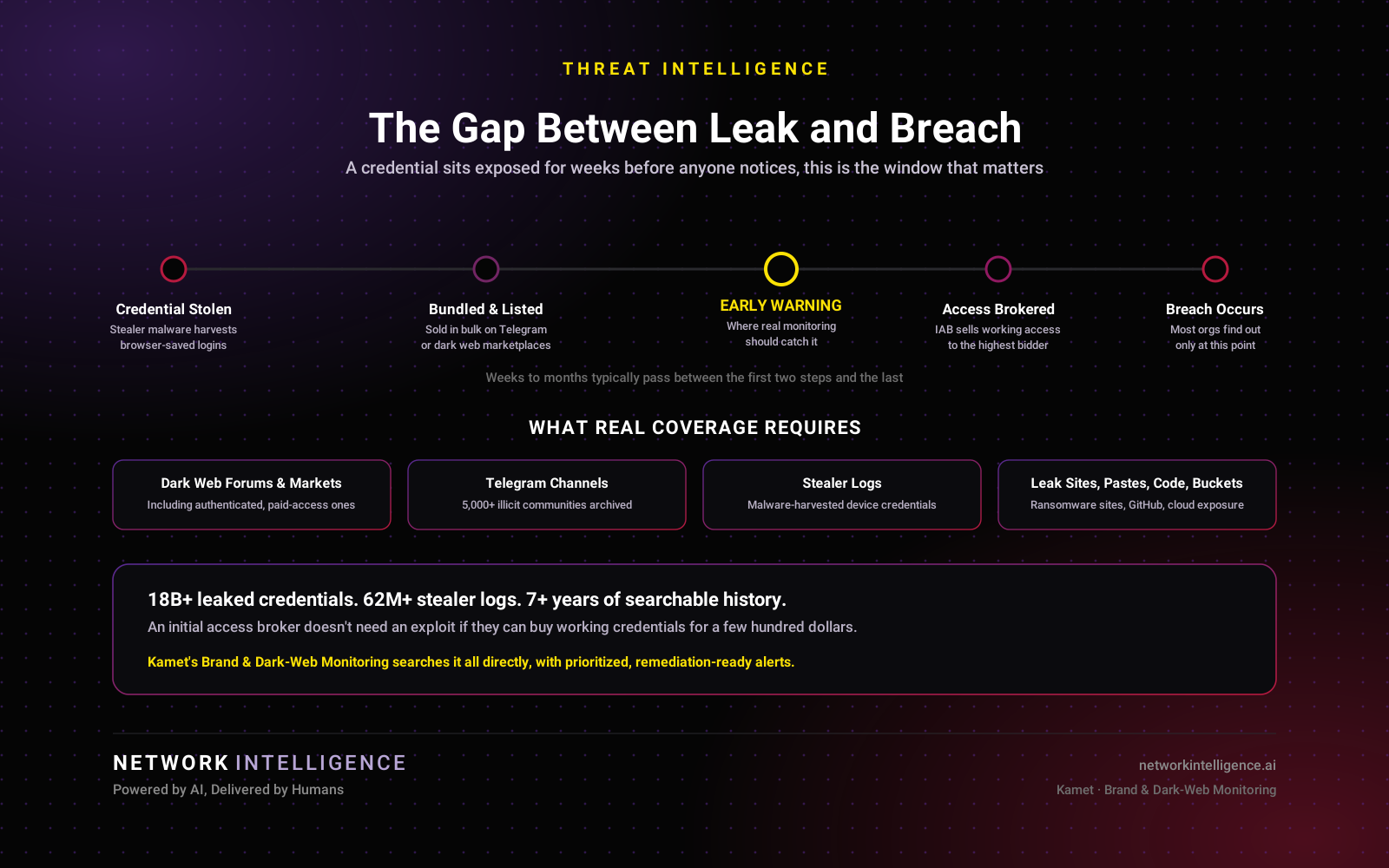
Coverage is thinner than it sounds. “Dark web monitoring” often means a small set of well-known forums checked periodically. Real coverage requires reaching authenticated, paid, and sign-up-only forums and marketplaces, ransomware leak sites, and the Telegram channels where a huge share of this activity now happens, not just the parts of Tor that are easy to crawl.
Stealer logs get missed entirely. A large share of corporate credential exposure today doesn’t come from a company’s own breach, it comes from malware on an individual employee’s device, silently harvesting saved passwords and browser sessions and bundling them into a stealer log sold in bulk. A monitoring program that only watches for its own company name mentioned in a breach dump misses this almost completely.
Alerts arrive without context. A raw hit, “your domain appeared in a paste,” is close to useless without knowing what was actually exposed, how credible the source is, and what to do next. Security teams end up doing the triage work the monitoring tool should have already done.
Brand and credential monitoring run as separate problems. A typosquatted domain, an impersonated executive profile, and a leaked employee password are different symptoms of the same underlying exposure. Treating brand protection and credential monitoring as unrelated tools means nobody sees the full picture of how an organization is being targeted.
Coverage claims aren’t verifiable. It’s easy for a vendor to claim broad dark web coverage. It’s harder to show the actual scale, how many communities are archived, how far back the data goes, and whether a client can search it directly rather than waiting for a pre-filtered alert.
What real early warning actually requires
Depth across the full criminal ecosystem. Genuine coverage spans dark web forums and markets, Telegram channels, ransomware leak sites, stealer logs, paste sites, public GitHub repositories, and exposed cloud buckets. These are different entry points into the same underlying exposure problem, and missing any one of them leaves a real gap.
Credential-level detection, not just brand mentions. Detecting leaked and breached credentials, including data pulled from stealer logs, botnets, and compromised browser profiles, catches exposure that a simple brand-mention search never surfaces.
Searchable history, not just forward-looking alerts. A security team investigating a specific incident needs to search years of archived dark web data directly, by domain, email, username, or password, not wait for a future alert that may never match the specific thing they’re investigating.
Threat actor and initial access broker tracking. Knowing which specific actors or IABs are active against an organization’s sector, or have already listed access for sale, turns a vague “you might be at risk” into a concrete, actionable warning.
Prioritized findings with remediation guidance, not raw noise. A finding is only useful if it tells a security team what to actually do next, not just that something was found.
Integration into existing workflows. Findings need to flow into the SIEM, SOAR, or ticketing system a team already uses, through a real API, not live in a separate portal nobody checks regularly.
Why speed matters more than most people assume
Between a credential leaking and an organization finding out, an attacker has a head start measured in weeks, sometimes months. An initial access broker doesn’t need to exploit a vulnerability if they can simply buy working credentials for a few hundred dollars from a stealer log marketplace. Closing that detection gap from months to days is one of the highest-leverage things a security program can do, because it intercepts the easiest and cheapest attack path there is, one that requires no exploit development at all.
What to ask before trusting a dark web monitoring claim
- Does it cover authenticated and paid forums, not just the easily crawled parts of Tor?
- Is stealer log and compromised browser data included, not just breach-dump mentions?
- Can your team search the archive directly, across years of data, rather than waiting on alerts?
- Does it track initial access brokers and specific threat actors relevant to your sector?
- Do findings come with prioritization and remediation guidance, or just a raw hit?
- Does it integrate into your existing SIEM, SOAR, or ticketing workflow through a real API?
Where Kamet fits
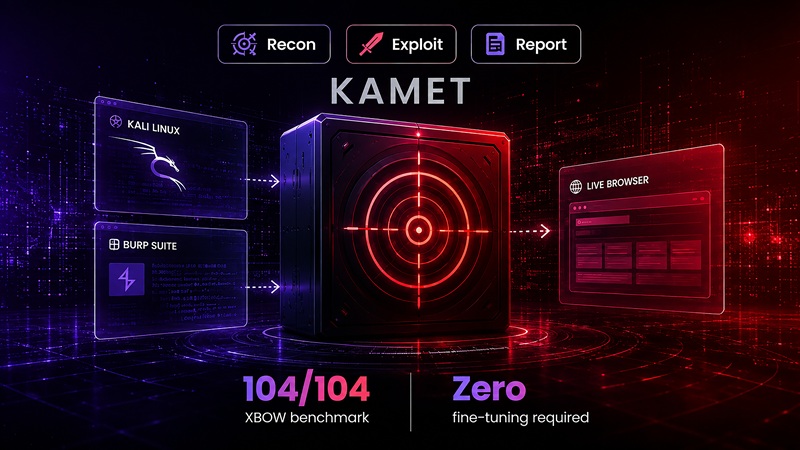
Kamet’s Brand & Dark-Web Monitoring is built around this exact gap. Coverage spans dark web forums and markets, Telegram channels, ransomware leak sites, stealer logs, paste sites, public GitHub, and exposed cloud buckets, archiving more than 5,000 illicit communities and over seven years of searchable history. The platform detects leaked and breached credentials, including data from stealer logs, botnets, and compromised browser profiles, and tracks initial access broker activity to inform strategic risk decisions, not just reactive cleanup. A global search bar lets investigators pivot across both dark and clear web data directly, and findings integrate into existing SIEM, SOAR, and ticketing workflows through REST API, TAXII/STIX, and native connectors. For the fuller picture of brand and dark-web monitoring as a discipline, see our introductory post.
Want to see what’s already out there about your organization? Talk to Network Intelligence.