


Achieving and sustaining compliance with frameworks like SOC 2 and ISO 27001 is no longer merely a regulatory checkbox in the quickly changing digital landscape of 2025; rather, it has become a vital business enabler and a fundamental pillar of trust.
In fact, demonstrating strong security and compliance is frequently a requirement for startups, mid-market tech companies, and venture capital-backed SaaS enterprises in order to obtain funding, draw clients, and expand operations.
However, navigating the complexity of compliance automation software can take a lot of time, money, and experience. SOC 2 compliance platforms, such as Drata and Vanta, have therefore become strong allies in this regard, offering to expedite the process of becoming audit-ready.
Yet, as the market develops, decision-makers—founders, CISOs, and CTOs—are increasingly searching for managed compliance services that go beyond simple software solutions.
To support this need, this comparison article examines Drata and Vanta across key areas, including features, cost, ease of use, support quality, scalability, and reporting capabilities, in order to help businesses assess compliance automation tools more effectively.
Additionally, acknowledging the need for a more comprehensive strategy, we will paint Network Intelligence as a strong contender, particularly for businesses looking for expert advisory support and managed SOC 2 compliance that surpasses the capabilities of a stand-alone software tool.
This guide is intended for mid-market tech companies scaling their compliance operations, security and risk management leaders seeking automation tools, startup CTOs and CISOs getting ready for their first SOC 2 audit, and venture capital-backed SaaS companies that require quick audit readiness for funding rounds. Finally, you’ll know more clearly which platform—or set of services—is best suited for your particular compliance journey.
Platform Overviews
Let’s get a basic understanding of Drata and Vanta, two of the biggest names in the compliance automation market, before delving into a thorough comparison.
What is Drata?
Founded in 2020, Drata quickly emerged as a prominent compliance automation platform. Thanks to its extensive monitoring capabilities and fine-grained control over automation workflows, it has become especially popular among security-conscious tech companies.
Drata, for its part, positions itself as a strong option for companies looking to scale their GRC (Governance, Risk, and Compliance) initiatives and enhance existing compliance programs. Its key advantages lie in continuous control monitoring and automated evidence gathering across multiple cloud environments and internal systems.
What is Vanta?
Among startups and small-to-mid SaaS companies in particular, Vanta—an earlier entrant to the market—has seen rapid adoption. Thanks to its user-friendly interface and quick setup times, it has gained widespread recognition. Its primary goal is to make compliance achievable even for teams without extensive security expertise.
Vanta helps companies obtain and maintain various security certifications and meet regulatory requirements by automating much of the compliance process. Moreover, it continuously monitors systems, tools, and employees to ensure ongoing adherence.
| Characteristic | Drata | Vanta |
| Automation Depth | Deeper, developer-driven automation | Focus on usability and onboarding. |
| Pricing Transparency | Higher upfront pricing | More affordable setup costs |
| Support & Integration | Robust support, extensive integrations | Good support for a wide range of integrations |
| Cloud-based, Automation-First | SaaS solution, continuous monitoring | SaaS solution, continuous monitoring |
| Broad Framework Support | Strong support for compliance frameworks | Strong support for compliance frameworks |
| Dashboard-Driven Workflows | User-friendly dashboards, real-time visibility | User-friendly dashboards, real-time visibility |
Key Similarities
Despite their individual nuances, Drata and Vanta share several fundamental characteristics that define them as modern compliance automation platforms:
Cloud-based, Automation-First:
Both platforms are delivered as Software-as-a-Service (SaaS) solutions, leveraging cloud infrastructure to automate the otherwise laborious process of evidence collection. Additionally, they offer continuous monitoring to ensure ongoing compliance.
Broad Framework Support:
Both of them provide strong support for important compliance frameworks, such as PCI DSS, SOC 2, ISO 27001, HIPAA, and GDPR.
Dashboard-Driven Workflows:
Both platforms feature user-friendly dashboards that simplify otherwise complex workflows. They offer real-time visibility into task management, compliance posture, and audit readiness, thereby streamlining the entire compliance process.
Key Differences
Despite having things in common, Drata vs. Vanta take different tacks and place different emphasis on
Automation Depth:
Often referred to as more “developer-driven,” Drata provides deeper, more detailed automation and integration capabilities that are especially helpful for teams working in complex DevOps environments. Vanta, on the other hand, is perfect for people looking for a quicker route to initial audit readiness because it places a higher priority on usability and quicker onboarding.
Pricing Transparency:
Vanta is generally considered more affordable for smaller businesses, especially when it comes to initial setup costs. However, expenses can increase with the addition of more integrations or services. That said, the exact pricing for both platforms typically requires a direct quote. In contrast, Drata’s extensive automation capabilities—designed to support broader compliance needs—often justify its higher upfront pricing.
Support & Integration:
Drata is renowned for its robust customer support and extensive integration capabilities, often covering a broader tech stack with more comprehensive checks. While Vanta also offers strong support and a wide range of integrations, Drata’s API is often considered more advanced—particularly for organizations requiring complex automation workflows.
Getting Started: Platform Readiness Checklists
Network Intelligence Implementation Checklist
Before You Begin:
- Schedule initial consultation and gap assessment.
- Prepare for a comprehensive security posture review.
- Identify key stakeholders and decision makers.
- Gather existing documentation and policies.
- Define compliance timeline and business objectives.
Weeks 1-2: Assessment & Planning
- Complete expert-led gap assessment
- Develop a customized compliance roadmap.
- Review and approval of the proposed remediation plan
- Establish communication protocols.
- Begin policy development and customization.
Weeks 3-8: Implementation & Remediation
- Deploy recommended security controls.
- Implement custom policies and procedures.
- Complete evidence collection setup
- Conduct ongoing monitoring and validation.
- Prepare for pre-audit review.
Vanta Implementation Checklist
Before You Begin:
- Inventory your current tech stack and integrations.
- Identify your primary compliance framework (SOC 2 Type I/II).
- Assign a dedicated project manager.
- Prepare employee roster and organizational chart.
- Document existing security policies.
Weeks 1-2: Setup
- Complete initial platform configuration.
- Connect core integrations (AWS, Google Workspace, etc.).
- Upload existing policies or customize templates.
- Set up user roles and permissions.
- Configure automated monitoring.
Weeks 3-4: Evidence Collection
- Validate evidence collection workflows.
- Review of automated policy assignments
- Conduct the first compliance health check.
- Address any red flags or gaps.
- Schedule regular review meetings.
Drata Implementation Checklist
Before You Begin:
- Conduct a technical requirements assessment.
- Map complex integrations and custom workflows.
- Assign technical leads for each system integration.
- Review API documentation and custom requirements.
- Plan for more extensive configuration time.
Weeks 1-3: Configuration
- Deploy and configure core platform
- Set up advanced integrations and custom workflows.
- Configure granular monitoring rules.
- Establish role-based access controls.
- Test automated evidence collection
Weeks 4-6: Optimization
- Fine-tune automation rules and workflows.
- Validate complex compliance scenarios.
- Establish custom reporting dashboards.
- Train the team on advanced features.
- Prepare for continuous monitoring.
ROI and Time Savings Analysis
Quantified Benefits Comparison
Traditional Manual Compliance vs. Automated Platforms:
Metric | Manual Process | Network Intelligence | Vanta | Drata |
Initial Setup Time | 6-12 months` | 4-12 weeks | 2-6 weeks | 4-8 weeks |
Annual Maintenance Hours | 800-1200 hours | 50-150 hours | 200-400 hours | 150-300 hours |
Evidence Collection Time | 200+ hours/audit | 10-20 hours | 20-40 hours | 15-30 hours |
Cost of Internal Resources | $80,000-120,000 | $10,000-20,000 | $20,000-40,000 | $15,000-30,000 |
Risk of Audit Failures | 25-40% | 1-5% | 5-15% | 3-10% |
Common Implementation Challenges and Solutions
Challenge 1: Integration Complexity
Problem: Connecting disparate systems and ensuring continuous data flow.
Network Intelligence Solution:
- Expert-managed integration planning and execution
- Custom integration development when needed
- Ongoing technical support and optimization
- Best for: Legacy systems or highly regulated environments
Vanta Solution:
- Pre-built connectors for 100+ popular tools
- Step-by-step integration guides
- Support team assistance for complex setups
- Best for: Standard tech stacks with common tools
Drata Solution:
- Deep API integrations with advanced configuration options
- Custom webhook support for proprietary systems
- Dedicated integration specialists
- Best for: Complex, custom environments
Challenge 2: Policy Development and Customization
Problem: Creating policies that match actual business operations.
Network Intelligence Solution:
- Expert policy development tailored to business needs
- Legal and regulatory compliance review
- Ongoing policy maintenance and updates
- Timeline: 3-6 weeks for a comprehensive policy suite
Vanta Solution:
- Industry-specific policy templates
- Guided customization workflows
- Policy review and approval workflows
- Timeline: 1-2 weeks for basic customization
Drata Solution:
- Granular policy builder with advanced logic
- Custom control mapping capabilities
- Version control and change management
- Timeline: 2-4 weeks for complex customization
Challenge 3: Evidence Collection and Validation
Problem: Ensuring evidence meets auditor requirements and is properly documented.
Network Intelligence Solution:
- Expert evidence reviews and validation
- Pre-audit evidence assessment
- Direct auditor communication and support
- Success Rate: 95-98% evidence acceptance
Vanta Solution :
- Automated evidence collection with basic validation
- Auditor-friendly evidence presentation
- Standard evidence libraries
- Success Rate: 85-90% evidence acceptance
Drata Solution :
- Advanced evidence validation and quality checks
- Custom evidence collection workflows
- Comprehensive audit trail documentation
- Success Rate: 90-95% evidence acceptance
Challenge 4: Team Training and Adoption
Problem: Ensuring team members understand and properly use the compliance system.
Network Intelligence Solution:
- Hands-on training and ongoing support
- Customized training programs for specific roles
- Continuous guidance and best practice sharing
- Training Time: 4-8 hours per user with ongoing support
Vanta Solution:
- Intuitive interface requiring minimal training
- Built-in help documentation and tutorials
- Regular webinars and user community
- Training Time: 2-4 hours per user
Drata Solution:
- Comprehensive training materials and certification programs
- Dedicated customer success managers
- Advanced user workshops and best practices
- Training Time: 8-12 hours per user
Trial Periods and Pilot Programs
Vanta Trial Options
- Free Trial: 14-day full-feature trial
- Pilot Program: 30-day pilot for qualified prospects
- Demo Options: Live demo sessions and sandbox environment
- Getting Started: Sign up directly on the website.
- Support During Trial: Email and chat support included
Drata Trial Options
- Demo Period: Comprehensive demo with sample data
- Pilot Program: 30–60-day pilot for enterprise prospects
- POC (Proof of Concept): Custom evaluation periods for complex requirements
- Getting Started: Contact sales for trial access.
- Support During Trial: Dedicated support engineer assigned
Network Intelligence Evaluation Process
- Initial Consultation: Free 60-minute consultation and gap assessment
- Pilot Project: 30–90-day pilot engagement for specific compliance scope
- Risk Assessment: Complimentary security posture evaluation
- Getting Started: Schedule a consultation through the website or direct contact.
- Support During Evaluation: Direct access to compliance experts
Maximizing Your Trial Period
Week 1: Setup and Configuration
- Complete initial platform setup.
- Connect 2-3 core integrations.
- Import existing policies or customize templates.
- Set up basic monitoring.
Week 2: Evidence Collection Testing
- Validate automated evidence collection.
- Test key integration workflows.
- Review generated reports and dashboards.
- Identify any gaps or issues.
Weeks 3-4: Advanced Features and Scalability
- Test advanced features relevant to your needs.
- Evaluate reporting and audit-readiness tools.
- Assess scalability for your organization size.
- Compare with other platforms if evaluating multiple options.
Evaluation Criteria Checklist:
- Ease of initial setup and configuration
- Quality and comprehensiveness of evidence collection
- Integration compatibility with your tech stack
- User experience and interface intuitiveness
- Support responsiveness and expertise.
- Pricing transparency and total cost of ownership
- Scalability for future growth
Supported Frameworks
A crucial aspect of choosing a compliance platform is its ability to support your current and future compliance needs.
Compliance Programs Offered
Both Drata and Vanta provide comprehensive support for a wide array of compliance frameworks.
- To begin with, SOC 2 is a primary focus for both platforms, addressing the five Trust Services Criteria: security, availability, processing integrity, confidentiality, and privacy.
- Additionally, they support ISO 27001, the international standard for establishing, implementing, maintaining, and continuously improving an Information Security Management System (ISMS).
HIPAA, which is essential for healthcare organizations and any entity handling Protected Health Information (PHI).
GDPR, the stringent data protection regulation applicable to businesses processing the personal data of EU citizens.
PCI DSS, which is vital for organizations involved in storing, processing, or transmitting credit card information.
In addition to standard frameworks, both Drata and Vanta offer support for custom compliance requirements. While each platform provides some level of flexibility for creating or adapting to custom frameworks, the depth and ease of implementation can vary depending on the specific use case and platform capabilities.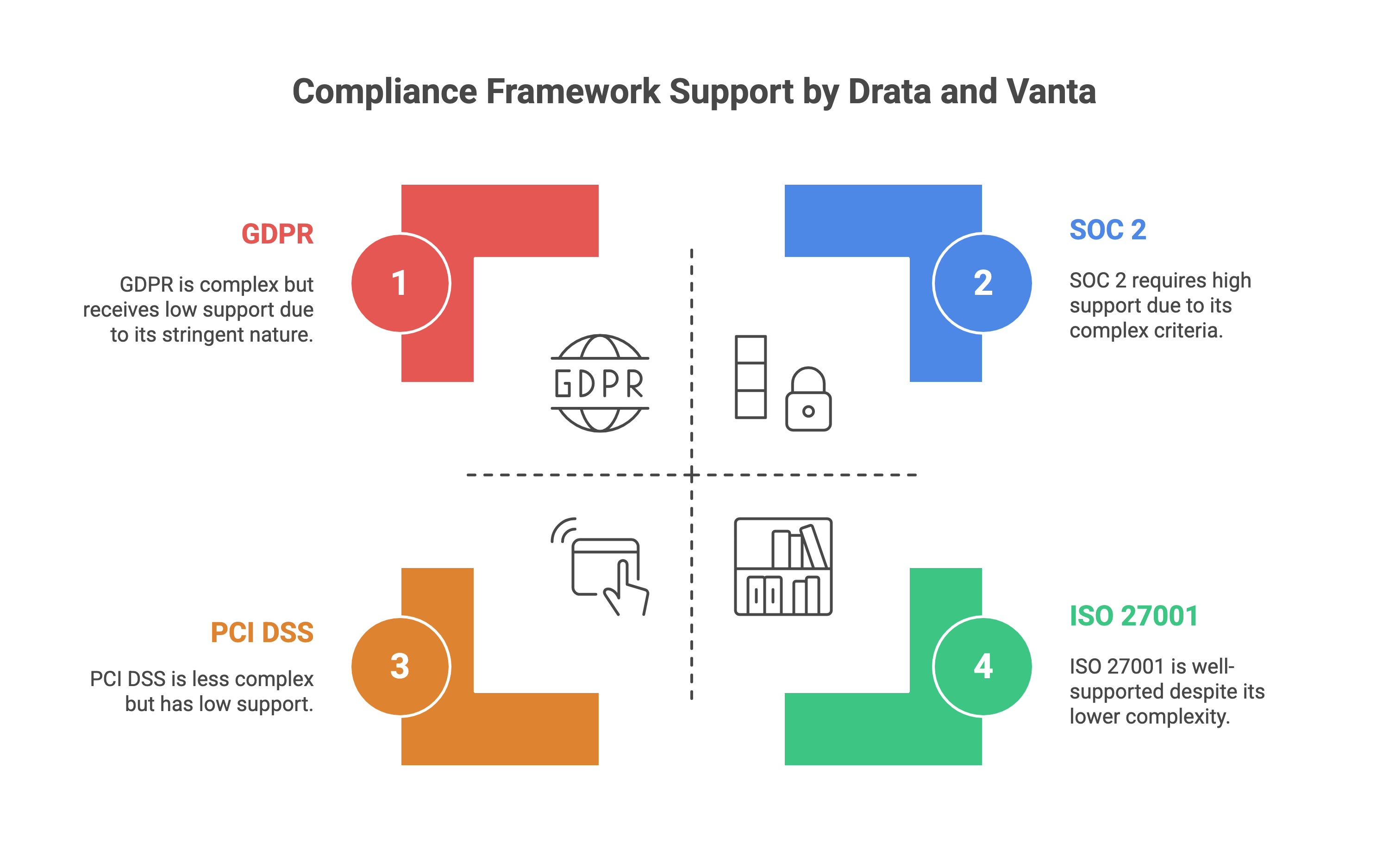
Flexibility & Scalability
When evaluating these platforms, it’s important to consider several key factors:
Managing Multiple Frameworks: Can your team efficiently oversee multiple compliance frameworks from a single dashboard? Fortunately, both Drata and Vanta are built with this capability in mind, offering a centralized view of your compliance posture across various standards.
Cross-framework Mapping: Do the platforms offer intelligent mapping of controls across different frameworks to reduce redundant efforts and ensure consistency? This is one of the core advantages of compliance automation tools, and both Drata and Vanta aim to streamline this process effectively.
Policy Templates vs. Custom Framework Builder: While both platforms provide built-in policy templates to help jumpstart your compliance journey, the ability to create and manage fully customized frameworks or policies becomes increasingly important as your organization scales. In this area, Drata is often recognized for offering greater control over compliance automation and higher levels of customizability.
Feature Comparison
Let’s delve into the specific features that drive compliance automation.
Automation Depth
The true power of these platforms lies in their automation capabilities:
Evidence Collection: Both Drata and Vanta excel at automated evidence collection, continuously pulling data from integrated systems (e.g., cloud providers, HR systems, ticketing tools) to demonstrate adherence to controls. This eliminates much of the manual effort traditionally associated with audits.
Continuous Control Monitoring: Rather than point-in-time checks, both platforms offer continuous monitoring of your controls, alerting you to any deviations or non-compliance in real-time.
Automated Risk Detection: They provide mechanisms for identifying and assessing risks based on your environment and controls, helping you prioritize remediation efforts.
| Feature | Drata | Vanta |
| Evidence Collection | Automated | Automated |
| Control Monitoring | Continuous | Continuous |
| Risk Detection | Automated | Automated |
Policy Management
Effective policy management is crucial for compliance:
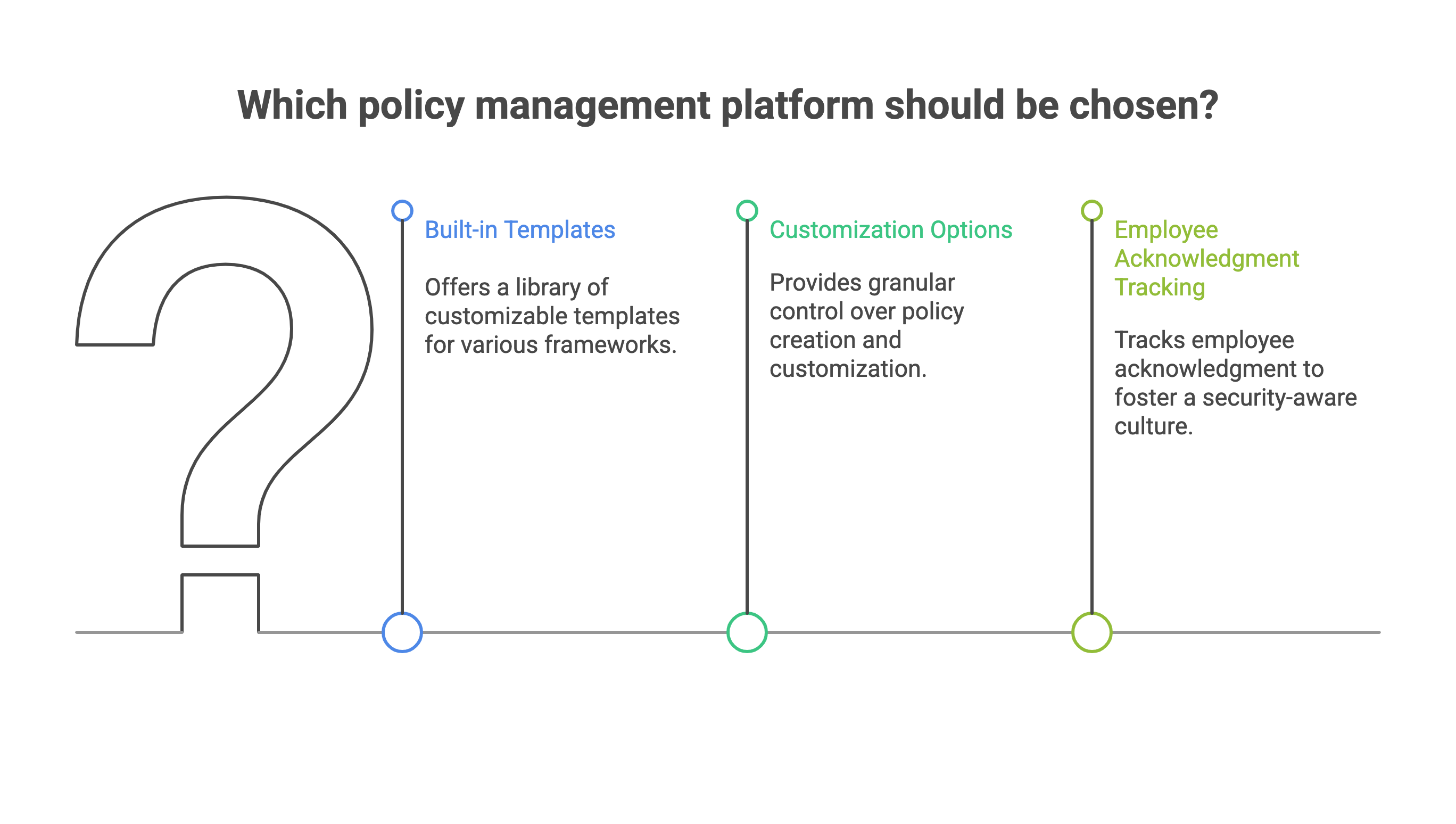
Built-in Templates: Both offer a library of built-in policy templates for various frameworks, which can be customized to your organization’s specific needs.
Customization Options: The degree of customization for these templates and the ability to create entirely new policies vary. Drata generally provides more granular control in this area.
Employee Acknowledgment Tracking: Both platforms help track employee acknowledgment of policies, an important aspect of demonstrating a security-aware culture.
Access Control & User Management
Ensuring proper access controls is fundamental to security:
Role-based Permissions: Both Drata and Vanta allow for role-based permissions within their platforms, enabling you to define who can access and manage compliance data.
Team Workflows: They facilitate team collaboration on compliance tasks, assigning responsibilities and tracking progress.
Onboarding/Offboarding Automation: Integrations with HRIS systems allow for automated checks related to employee onboarding and offboarding, ensuring access is provisioned and de-provisioned correctly.
Audit Readiness Tools
Preparing for an audit can be stressful, but these tools aim to simplify it:
Real-time Audit Dashboards: Both platforms provide real-time dashboards that show your compliance status, highlighting areas that need attention before an audit.
Auditor Collaboration Features: They offer dedicated portals or features for collaborating with external auditors, making it easy to share evidence and track audit progress.
Report Generation: Automated report generation helps compile the necessary documentation for your audit.
Integration Capabilities
The effectiveness of a compliance automation platform heavily relies on its ability to integrate with your existing tech stack.
Available Integrations
Both Drata and Vanta boast extensive integration ecosystems, covering a wide range of tools:
- Cloud providers: AWS, GCP, Azure, etc.
- Identity providers: Okta, Google Workspace, Microsoft Entra ID (formerly Azure AD), etc.
- DevOps tools: GitHub, Jira, Slack, GitLab, etc.
- Endpoint monitoring: JAMF, Intune, CrowdStrike, and more.
- HRIS systems: Rippling, BambooHR, etc.
- Ticketing systems, CRM, etc.
Ease of Integration
Plug-and-Play vs. Custom Setups: While many integrations are designed to be plug-and-play, the complexity of custom setups and API flexibility can differ. Drata is sometimes cited for offering more in-depth integration and greater API flexibility for advanced automation tasks.
API Flexibility: For highly customized environments or specific compliance needs, the depth and capabilities of the platform’s API become crucial.
Integration Coverage by Framework: Ensure the integrations you need are supported across all the compliance frameworks you intend to pursue.
User Experience
A user-friendly platform is key to adoption and efficient compliance management.
Dashboard & Reporting
Compliance Tracking and Visualization: Both offer intuitive dashboards with visual indicators to track your compliance status in real-time.
Alerts, Tasks, and Audit Timelines: They provide clear alerts for non-compliance, manage assigned tasks, and outline audit timelines to keep you on track.
Onboarding Time
Setup Effort and Guided Onboarding: Vanta is often praised for its faster onboarding and simpler UI, making it a good choice for first-time compliance. Drata also offers an efficient deployment process with proactive customer service.
How long it takes to become audit-ready: While both promise to significantly reduce the time to audit-readiness, the actual duration can depend on your organization’s current security posture and the complexity of your environment.
Accessibility & Ease of Use
Intuitive Interface Comparisons: Vanta is generally considered to have a slightly more intuitive and less overwhelming interface for non-technical users. Drata’s interface, while powerful, can sometimes be perceived as having a steeper learning curve due to its advanced functionalities.
Admin vs. Employee Experience: Consider how easy it is for both administrators managing the compliance program and employees interacting with training or policy acknowledgment features.
Implementation Timeline Analysis
Typical Implementation Phases
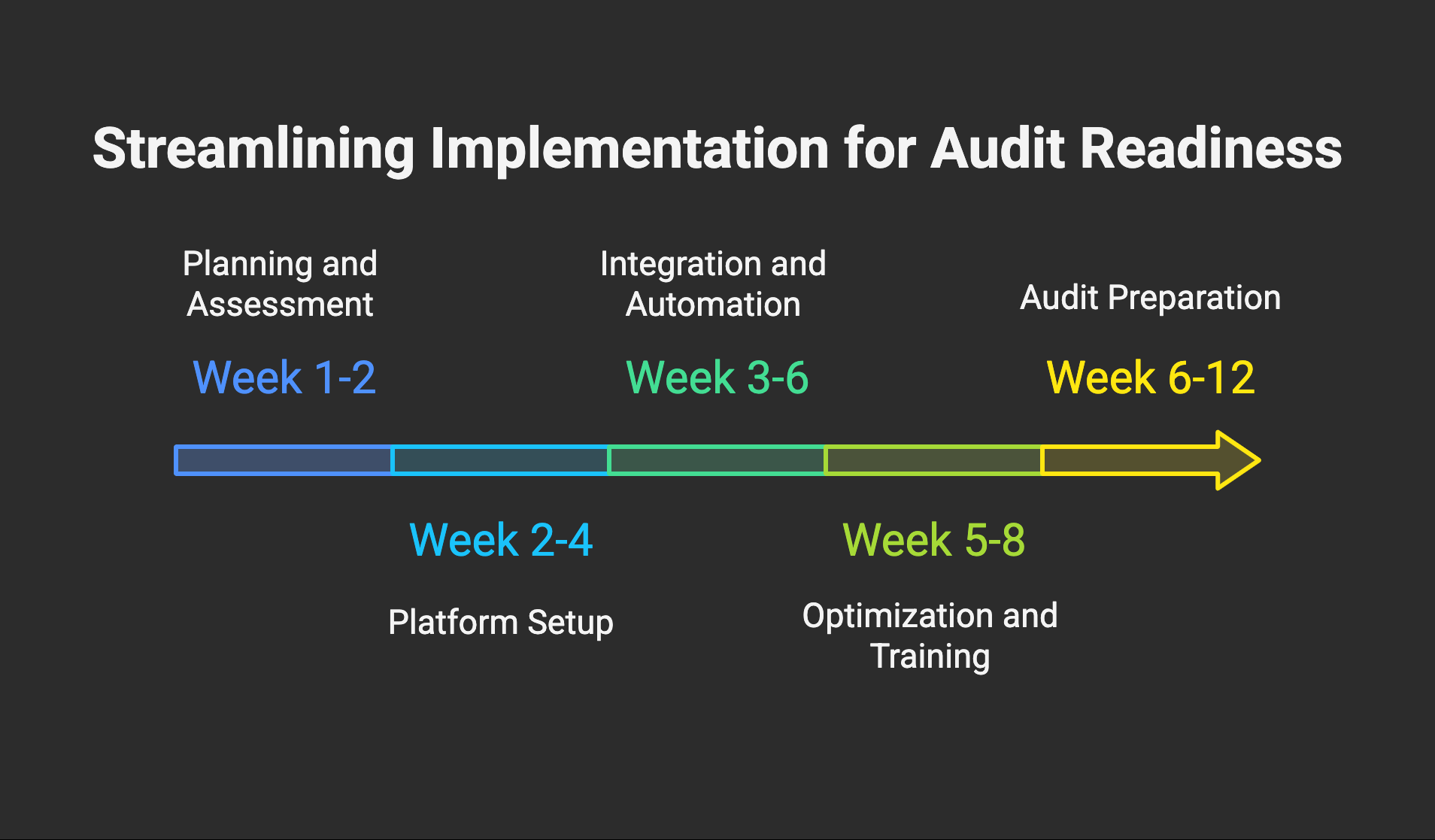
Phase 1: Planning and Assessment (Week 1-2)
- Platform selection and contract finalization
- Initial stakeholder alignment and project planning
- Technical requirements gathering
- Resource allocation and timeline establishment
Phase 2: Platform Setup (Weeks 2-4)
- Core platform configuration
- User account creation and role assignment
- Initial policy template selection or customization
- Basic integration setup
Phase 3: Integration and Automation (Weeks 3-6)
- Complete integration with existing systems
- Automated evidence collection setup
- Control monitoring configuration
- Testing and validation of automated workflows
Phase 4: Optimization and Training (Weeks 5-8)
- Fine-tuning of automation rules
- Team training and adoption
- Process documentation and change management
- Preparation for ongoing monitoring
Phase 5: Audit Preparation (Weeks 6-12)
- Evidence collection and validation
- Gap remediation and control implementation
- Pre-audit reviews and assessments
- Auditor selection and scheduling
Platform-Specific Timelines
Vanta Implementation Timeline:
- Total Duration: 4-8 weeks to audit-ready
- Fastest Track: 2-4 weeks for simple environments
- Key Factors: Existing security posture, integration complexity, team availability
Drata Implementation Timeline:
- Total Duration: 6-12 weeks to audit-ready
- Fastest Track: 4-6 weeks for well-prepared teams
- Key Factors: Custom automation requirements, integration depth, training needs
Network Intelligence Implementation Timeline:
- Total Duration: 8-16 weeks to audit-ready
- Fastest Track: 6-8 weeks for focused scope
- Key Factors: Gap remediation needs, custom policy development, compliance maturity
Factors That Accelerate Implementation
Organizational Readiness:
- Existing documentation and policies
- Dedicated project team and clear ownership
- Executive sponsorship and priority alignment
- Previous compliance experience
Technical Preparedness:
- Well-documented system architecture
- Standard integrations and common tools
- Clean data and organized access controls
- Existing security monitoring capabilities
Vendor Selection:
- Clear requirements and evaluation criteria
- Streamlined procurement and legal processes
- Proper technical evaluation and proof of concept
- Aligned expectations and scope definition
Common Delay Factors
Organizational Challenges:
- Lack of dedicated resources or competing priorities
- Unclear ownership and accountability
- Insufficient executive support or budget constraints
- Change management and adoption resistance
Technical Hurdles:
- Complex or legacy system integrations
- Custom development or configuration requirements
- Data quality issues or incomplete asset inventory
- Security policy gaps or inconsistent controls
Vendor-Related Issues:
- Inadequate support or implementation guidance
- Platform limitations or missing features
- Integration challenges or compatibility issues
- Unclear documentation or training materials
Pricing Breakdown
Understanding the cost structure is vital for budgeting and value assessment. Precise pricing details are often not publicly disclosed by Drata or Vanta and can vary based on company size, number of employees, chosen frameworks, and specific add-ons. However, here’s a general overview based on available information and market insights.
How much does Vanta cost?
Vanta’s pricing typically starts at around $7,500 to $10,000 annually for smaller companies with fewer employees and a single framework (e.g., SOC 2). The cost generally scales with
- Team size: More employees usually mean higher costs.
- Number of frameworks: Each additional framework (e.g., ISO 27001, HIPAA) can add to the annual fee.
- Add-ons and hidden costs: While Vanta aims for simplicity, additional services, premium support, or specific integrations might incur extra charges. Some reviews suggest costs can range from $15,000 to $80,000+ annually for mid-sized and larger organizations with multiple frameworks.
Vanta is often perceived as a cost-effective entry point for early-stage and growth-stage companies.
Drata pricing overview
Drata’s pricing can start from around $15,000 annually for foundational plans, potentially ranging up to $100,000+ per year for larger enterprises with complex requirements and multiple frameworks. Key factors influencing Drata’s cost include:
- Company size and employee count.
- Number and type of compliance frameworks.
- Level of automation and integration required.
- Auditor support inclusions: Some plans might include more robust auditor collaboration features or direct support.
Drata recently updated its packaging, moving towards tiered bundles (Foundation, Growth, and Enterprise) rather than purely a la carte pricing, which might offer more transparency in some respects but still requires direct consultation for exact figures.
Network Intelligence Pricing Model
Network Intelligence follows a service-based pricing model that reflects the comprehensive nature of managed compliance services:
- Project-based pricing: For specific compliance initiatives or audits
- Retainer-based pricing: For ongoing compliance management and advisory services
- Hybrid pricing: Combining project work with ongoing support
Pricing factors include:
- Scope of compliance frameworks and requirements
- Level of gap remediation needed
- Ongoing advisory and support requirements
- Custom policy development and implementation needs
Value Comparison
When comparing Drata vs Vanta vs Network Intelligence, consider:
Initial vs. Long-term Cost: Vanta might offer a lower entry point, while Drata’s higher initial investment could be justified by its deeper automation and scalability for complex needs. Network Intelligence’s service-based model often provides better ROI for organizations requiring significant expertise and support.
What you get at each price point: Evaluate the features, number of users, access to frameworks, and level of support included in each tier.
Ongoing Maintenance and Audit Cycles: Consider the time and effort saved on an ongoing basis due to continuous monitoring and automated evidence collection, which can translate into significant cost savings during annual audits.
Hidden Costs Analysis:
- Vanta: Additional integrations, premium support, extra frameworks
- Drata: Advanced features, custom development, enhanced support tiers
- Network Intelligence: Transparent pricing with comprehensive service inclusion
Support & Customer Success
The quality of support can significantly impact your compliance journey, especially if you’re new to the process.
Support Channels
Both platforms typically offer various support channels:
- Chat, email, Slack, phone: Availability can depend on your service tier.
- Onboarding assistance: Dedicated support during the initial setup and configuration phase is common.
- Premium support tiers: Larger organizations or those with more complex needs may opt for higher-tier support packages that include dedicated account managers or faster response times.
Customer Success Quality
Strategic help vs. Self-service: Does the support team offer strategic guidance on compliance best practices, or is it primarily focused on technical troubleshooting?
Speed and quality of support response: Prompt and effective support can be invaluable, especially when facing audit deadlines or critical issues. Reviews for both platforms generally highlight strong customer support, with Vanta often praised for its responsiveness and Drata for providing extensive set-up guidance.
Support Comparison by Platform
Vanta Support:
- Response Time: 24-48 hours for standard support
- Channels: Email, chat, phone (premium tiers)
- Expertise Level: General compliance and platform support
- Best For: Straightforward implementations and common use cases
Drata Support:
- Response Time: 12-24 hours for standard support
- Channels: Email, chat, phone, dedicated success manager
- Expertise Level: Technical and strategic compliance guidance
- Best For: Complex environments and advanced automation needs
Network Intelligence Support:
- Response Time: Same-day response for urgent issues
- Channels: Direct expert access, email, phone, video calls
- Expertise Level: Senior compliance experts and industry specialists
- Best For: Strategic guidance and comprehensive compliance management
Security and Reliability
Given that these platforms handle sensitive compliance data, their own security and reliability are paramount.
Infrastructure & Data Security
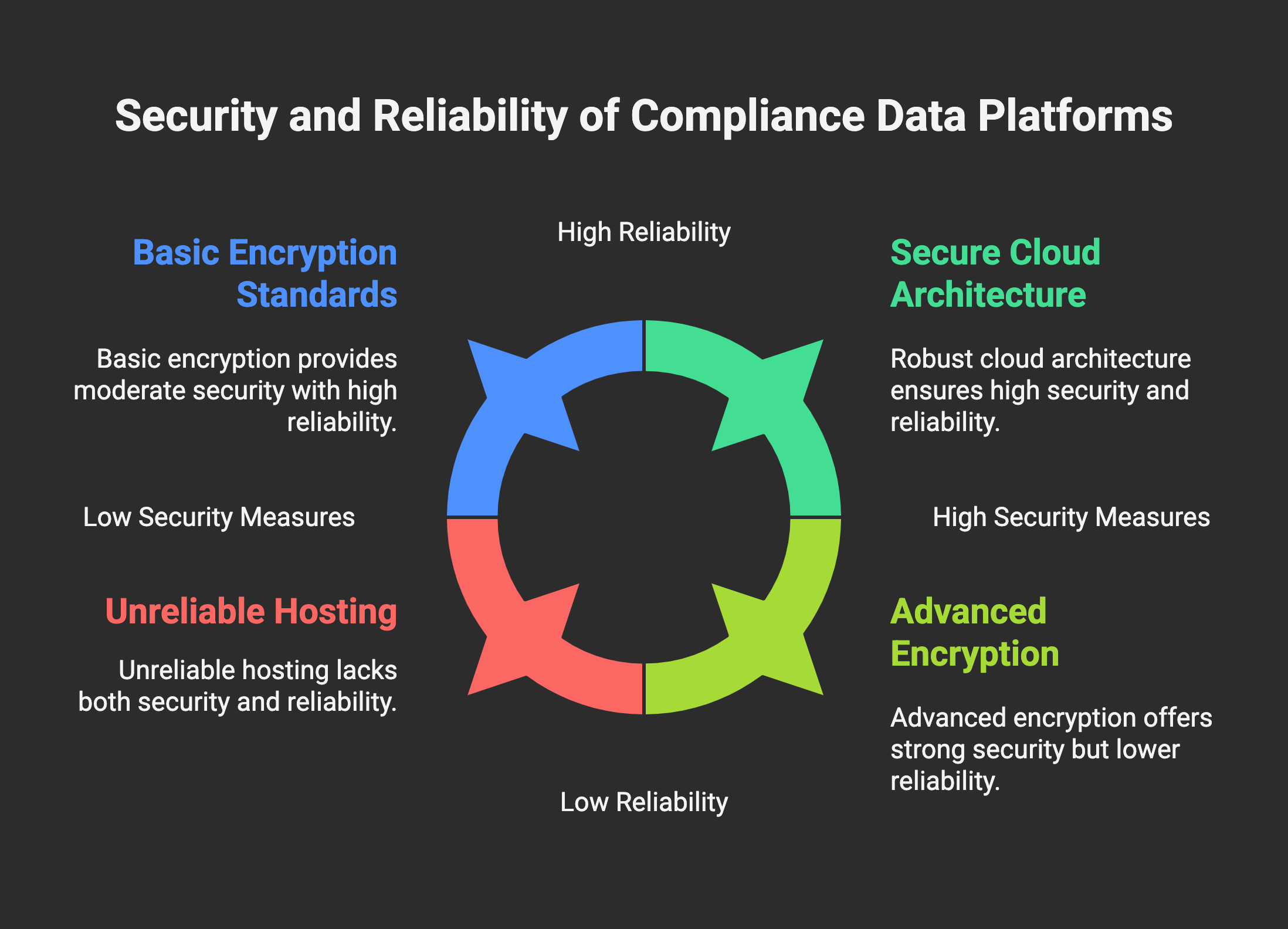
Encryption standards: Both platforms adhere to industry-standard encryption protocols for data in transit and at rest.
Cloud architecture: They typically leverage secure cloud providers (e.g., AWS, Azure) with robust security measures in place.
Hosting transparency: Understanding where your data is hosted and the security certifications of their underlying infrastructure is important.
Platform Security Certifications
Vanta Security Posture:
- SOC 2 Type II compliant
- ISO 27001 certified
- GDPR compliant
- 99.9% uptime SLA
Drata Security Posture:
- SOC 2 Type II compliant
- ISO 27001 certified
- HIPAA compliant infrastructure
- 99.95% uptime SLA
Network Intelligence Security Posture:
- SOC 2 Type II compliant
- ISO 27001 certified
- Multiple industry-specific certifications
- White-glove data handling procedures
Continuous Compliance
Control testing frequency: How often do the platforms test your controls and collect evidence? This continuous nature is a key advantage over manual processes.
Alerts and escalation options: What kind of alerts are triggered for non-compliance, and how can they be integrated into your existing security operations workflows for timely remediation?
Ideal Use Cases
Choosing between Drata and Vanta often comes down to your organization’s specific needs, size, and appetite for hands-on management.
When to Choose Vanta
- First-time SOC 2 compliance: Vanta’s ease of use and streamlined onboarding make it an excellent choice for companies embarking on their first SOC 2 audit.
- Small-to-mid SaaS teams: Its simplicity and competitive entry-level pricing are well-suited for smaller teams with fewer complex integrations.
- Need fast onboarding with minimal setup: If quick audit-readiness with less internal effort is a priority, Vanta’s approach is highly beneficial.
- Teams that prioritize an intuitive user interface and a clear path to compliance.
- Startups seeking investor-ready compliance with tight timelines and limited resources.
When to Choose Drata
- Tech-savvy teams: Organizations with dedicated security or DevOps teams that prefer more granular control and deeper customization will appreciate Drata’s capabilities.
- Need for deeper DevOps/security integrations: If your compliance heavily relies on complex cloud environments, intricate CI/CD pipelines, or advanced security tools, Drata’s robust integration ecosystem may offer more comprehensive monitoring.
- Want more control over compliance automation? For teams that want to define and manage their compliance workflows with greater precision, Drata provides the tools to do so.
- Scaling enterprises with complex regulatory needs and multiple frameworks.
- Organizations with customs or legacy systems requiring advanced integration capabilities.
When to Choose Network Intelligence
- Regulated industries: Financial services, healthcare, and other highly regulated sectors benefit from expert guidance and industry-specific knowledge.
- Limited internal compliance expertise: Organizations without dedicated compliance teams or extensive security knowledge.
- Multiple compliance frameworks: Companies need to achieve and maintain several certifications simultaneously.
- High-stakes audits: Where audit failure could significantly impact business operations or funding.
- Global compliance requirements: Organizations operating across multiple jurisdictions with varying regulatory requirements.
- Preference for managed services: Teams that want to focus on core business activities while experts handle compliance.
Not Just Tools: Why Some Teams Need a Full-Service Compliance Partner
While Drata and Vanta are powerful automation tools, they are ultimately software solutions. For many businesses, especially those in highly regulated industries or those lacking in-house compliance expertise, a tool-only approach can fall short. This is where a full-service compliance partner like Network Intelligence enters the picture.
The Limitation of Self-Serve Tools
Tools still need configuration, decision-making, and interpretation: Automation platforms streamline data collection and monitoring, but they don’t replace the need for understanding compliance requirements, interpreting audit findings, or making strategic decisions about control implementation.
Most platforms assume security/compliance expertise exists: While user-friendly, these tools often presuppose a baseline understanding of security controls, risk management, and the nuances of various compliance frameworks. Without this expertise, teams can struggle to effectively configure the platform, respond to alerts, or prepare adequately for an audit.
Navigating the audit process itself: While platforms provide auditor collaboration features, the actual interaction with auditors, responding to questions, and presenting evidence still require expertise.
Why Choose Network Intelligence?
Network Intelligence offers a distinct advantage by providing a hybrid model: automation + advisory. We recognize that software alone is often insufficient for achieving true, sustainable compliance.
Our approach integrates cutting-edge technology with the deep expertise of our security professionals, ensuring not just audit-readiness but continuous, robust security and risk management.
Here’s why Network Intelligence stands out:
Hybrid Model: Automation + Advisory: We don’t just give you a tool; we provide human expertise to configure it, interpret the data, and guide you through every step of the compliance journey. This blend of technology and human intelligence ensures optimal outcomes.
- Pre-audit Gap Assessments and Evidence Reviews: Our experts conduct thorough pre-audit gap assessments to identify weaknesses before the official audit, significantly reducing the chances of a qualified opinion. We also meticulously review collected evidence to ensure it meets the auditor’s expectations.
- Framework Customization with Expert Input: Beyond standard templates, our team works with you to customize frameworks and policies to precisely fit your unique business operations and risk profile, ensuring practical and effective compliance.
- Full Support from Day 0 to Audit: From initial scoping and policy development to continuous monitoring, remediation guidance, and direct interaction with auditors, Network Intelligence offers end-to-end support, effectively becoming an extension of your team.
- Ideal for Regulated Industries: Our deep expertise in industries like fintech, health tech, and critical infrastructure allows us to navigate complex regulatory landscapes with precision, understanding industry-specific nuances that generic tools might miss. We understand the stringent requirements of ISO 27701, GDPR, HIPAA, PCI DSS, and more, providing tailored solutions.
- Risk Management Aligned with Business Goals: We help you not only identify and assess risks but also align them with your business objectives, ensuring your GRC strategy supports your growth while maintaining a strong security posture.
Alternatives to Drata and Vanta
While Drata and Vanta lead the pack, several other platforms and service models are worth considering:
- Secureframe: Similar to Drata and Vanta, Secureframe offers a tool-first model with strong automation and continuous monitoring capabilities.
- Sprinto: Provides a hybrid approach, combining automation with some consulting services. However, it may offer less flexibility for highly customized environments compared to a dedicated advisory firm.
- Thoropass (formerly Laika): A newer entrant focusing on policy support, audit management, and a comprehensive platform for various compliance frameworks.
- Hyperproof: Offers a broader GRC platform, extending beyond compliance automation to risk management and internal audit functionalities.
Network Intelligence: As discussed, this is a distinct alternative focusing
- on a services-led model complemented by technology, offering deep human expertise for high-risk and complex industries.
Comparison Tables
To provide a quick overview, here’s a comparative look at the key aspects:
Features Comparison Table
Feature/Platform | Network Intelligence | Drata | Vanta |
Model | Hybrid (Automation + Managed Advisory Services)
| Automation Software | Automation Software |
Core Strength | End-to-end managed compliance, expert guidance | Deep automation, granular control | Ease of use, fast onboarding |
Evidence Coll | Automated via tools, expert-validated | Automated, comprehensive | Automated, streamlined |
Cont. Monitoring | Yes, with expert oversight and remediation | Yes, robust | Yes, real-time |
Policy Mgmt | Custom policy development with expert review, templates | Templates, strong customization | Templates, user-friendly customization |
Access Control | Automated via tools, expert-configured & reviewed | Automated via integrations | Automated via integrations |
Audit Readiness | Full audit support, pre-audit reviews, direct auditor liaison | Real-time dashboards, auditor portal | Real-time dashboards, auditor portal |
Integrations | Integrates with client tools; manages data for compliance | Extensive, deep | Extensive, broad |
Custom Frameworks | Full support for custom frameworks, expert-designed | Yes, with granular control | Yes, with some flexibility |
Best For | Regulated industries, teams needing hands-on expertise, complex global compliance | Tech-savvy teams, complex environments | Startups, small-to-mid SaaS, first-timers |
Pricing Comparison Table
Aspect/Platform | Network Intelligence | Drata | Vanta |
Typical Range | Custom pricing (reflects managed services), often competitive for full lifecycle support | $15,000 – $100,000+ per year | $7,500 – $80,000+ per year |
Cost Drivers | Scope of services, number of frameworks, complexity | Company size, frameworks, automation depth | Team size, frameworks, add-ons |
Pricing Model | Project-based or retainer, comprehensive package | Tiered (Foundation, Growth, Enterprise) | Tiered (Essential, Pro, Enterprise) |
Hidden Costs | Transparent; includes advisory, tool integration, and audit support | Potential add-ons for specific modules/support | Add-ons for integrations, advanced features |
Value Prop | Full service, risk reduction, expert-led compliance | High-end automation for scale | Ease of entry, rapid compliance |
Pros & Cons Summary
Platform | Pros | Cons |
Network Intelligence | End-to-end managed service, expert advisory, tailored solutions, and proactive risk management are ideal for regulated industries.
| Not a pure “tool-only” solution, the engagement model is service-led, with less self-service for certain aspects. |
Drata | Robust automation, deep integration, granular control, and strong for scaling complex compliance. | Higher upfront cost, can have a steeper learning curve, and may require in-house security expertise. |
Vanta | User-friendly interface, fast onboarding, cost-effective for smaller teams, good for first-time audits. | Less granular control for highly complex environments; costs can escalate with many integrations/frameworks. |
Final Verdict
Choosing the right compliance solution hinges on your organization’s specific context, resources, and long-term compliance goals.
When to start with Vanta: If you are a startup or a small-to-mid SaaS company embarking on your first SOC 2 audit, and your primary goal is to achieve audit-readiness quickly and with minimal friction, Vanta is an excellent starting point. Its intuitive interface and focus on ease of use will streamline your initial compliance efforts.
When to scale with Drata: As your organization grows, its security posture becomes more complex, or you require deeper integration with your DevOps and security tools, Drata offers the robust automation and granular control necessary to scale your compliance operations effectively. It’s ideal for tech-savvy teams that want more command over their compliance program.
When to bring in Network Intelligence: For organizations in highly regulated sectors (e.g., fintech, health tech) or those facing complex, multi-framework compliance requirements globally, and especially for teams that prefer to offload the heavy lifting of compliance management, Network Intelligence provides an invaluable full-service partnership. We bridge the gap between powerful automation tools and the critical human expertise needed for strategic guidance, proactive risk management, and seamless audit experiences. Our hybrid model ensures you not only get compliant but also stay secure and resilient in the face of evolving threats and regulations.
Ultimately, the “best” platform isn’t a one-size-fits-all answer. It’s about finding the solution that aligns perfectly with your current needs while providing the flexibility to evolve with your business. For many, a combination of smart technology and expert human guidance, as offered by Network Intelligence, is the most robust path to achieving and maintaining compliance in 2025 and beyond.
FAQs
1. Is Drata better than Vanta?
Neither is definitively “better”; they are different. Vanta is often preferred for its ease of use and faster onboarding, making it great for first-time compliance. Drata offers deeper automation and more granular control, appealing to more tech-savvy teams with complex environments.
2. Which is easier to use: Drata or Vanta?
Vanta is generally considered easier to use and has a more intuitive interface, especially for those new to compliance automation. Drata’s interface, while powerful, can have a slightly steeper learning curve.
3. What are the key differences between Drata and Vanta?
Key differences lie in their emphasis: Vanta prioritizes user-friendliness and speed for initial compliance, while Drata offers deeper automation, more granular controls, and robust integrations for complex, scaling environments. Pricing models and the depth of certain features also vary.
4. Is Drata a good company to trust with compliance?
Yes, Drata is widely regarded as a trustworthy and leading provider of compliance automation solutions, used by numerous reputable companies to achieve and maintain various security certifications.
5. What is the main purpose of Drata?
The main purpose of Drata is to automate security and compliance tasks, continuously monitor security controls, collect evidence, and streamline the audit process for various frameworks like SOC 2, ISO 27001, and HIPAA, helping organizations achieve and maintain audit readiness with less manual effort.