


Endpoints are the first line of defense, and attack as well.
Cybercriminals worldwide attempt to exploit endpoint vulnerabilities 24/7, using ever-evolving tactics that rule-based tools often miss: polymorphic and fileless malware, zero-day exploits, advanced persistent threats, AI-driven social engineering, and more.
If you’re still using static antivirus (AV) software, you’re compromising endpoint security and putting your business at risk.
To stay ahead of adversaries, you need next-gen endpoint protection solutions that use AI to stop sophisticated attacks in real time, combined with professional guidance to resolve complex threats.
However, choosing the right vendor from hundreds of alternatives is daunting. That’s why we have cherry-picked the best endpoint protection platforms worth your time.
But before we explore the options, it’s crucial to understand the features that protect your endpoints from compromise in today’s cyber landscape.
Key Features to Look For in Endpoint Protection Platforms (2026 Guide)
In 2026, organizations face cyberattacks daily, not in hundreds but in thousands, most of which target endpoints. What’s worse: the rapid rise of machine-speed AI-driven cyberattacks renders static defense obsolete.
To address this, the best endpoint protection platforms are shifting from being just a shield to a nervous system that intelligently analyses, prioritizes, and resolves threats faster than adversaries can exploit them.
When evaluating top endpoint protection platforms, prioritize features that deliver intelligent threat detection/response, automated compliance, and scalability for your fast-growing needs.
For simplicity, we have divided the features into two categories: table stakes and strategic differentiators.
Table stakes (the baseline)
In 2026, if a platform lacks these, it shouldn’t even make your shortlist:
1. AI-powered anomaly detection
According to IBM’s 2025 CDBR, malicious insider attacks cost an average of US $4.92M, the highest among initial threat vectors.
Modern endpoint protection software uses machine learning (ML) to analyze runtime behaviors, detecting suspicious activity, zero-day exploits, and living-off-the-land (LotL) tactics that signature-based tools miss.
- What to look for: Behavioral anomaly profiling that adapts to your environment to detect deviations (like a user accessing data at 3 AM) with high accuracy and reliability.
2. Automated response and remediation
Manual incident response is no longer sustainable when over 70% of SMBs lack full-time SOC analysts.
Top endpoint protection platforms act faster than humans, auto-isolating compromised devices, rolling back ransomware encryption, and patching vulnerabilities in seconds to minimize mean time to respond (MTTR).
- What to look for: Autonomous AI agents capable of executing complex remediation workflows with zero or minimal human intervention.
3. AI-powered alert triage
Alert fatigue is the primary reason valid threats get missed, with analysts admitting that they ignore 62% of alerts due to volume. You need an AI that not only flags suspicious behavior but also investigates it as a human analyst would.
- What to look for: AI agents that automatically perform pre-investigation (checking IP reputation, process lineage, and user behavior) and notify your team only if a threat is verified, reducing alert volume by 70%.
4. Ransomware and tamper protection
Ransomware crews now use custom “EDR Killer” toolkits to successfully disable security tools 48% of the time and remain undetected for extended periods. Generic detection is no longer sufficient against such attacks.
- What to look for: Self-defense mechanisms that prevent unauthorized uninstallation or tampering of security agents, combined with automated rollback mechanisms to restore encrypted files to their pre-attack state.
5. Lightweight agent architecture
Legacy tools can slow devices by 15-30%, frustrating employees who then disable protections or find workarounds.
A Harvard Business Review study found that 67% of employees knowingly violate security policies when tools hinder productivity.
- What to look for: A single-agent architecture that combines EPP, EDR, and vulnerability management into one lightweight sensor.
6. Extended detection and response (XDR) integration
Endpoint-only visibility creates blind spots. Modern threats move laterally across networks, cloud apps, email, and identity systems. XDR correlates telemetry across these surfaces to turn siloed data into a coherent narrative and detect multi-stage campaigns that isolated tools miss.
According to IBM, unified platforms can detect security incidents 72 days faster and contain them 84 days faster.
- What to look for: Native connectors for major cloud providers (AWS, Azure, GCP), SIEM integration (Splunk, Sentinel), and attack path visualization showing how threats can move from email to endpoint to cloud storage.
7. Universal endpoint coverage (legacy to IoT)
Your network is no longer just Windows laptops. It includes Linux servers, macOS devices, and unmanaged IoT sensors. Cybercriminals increasingly target non-standard endpoints such as IoT devices and edge gateways to gain backdoor access to the main network.
- What to look for: Agents that support legacy systems (like Windows) and modern IoT firmware without degrading performance.
Strategic differentiators (the competitive edge)
These features differentiate “good” tools from “great,” solving business-level problems such as talent shortages, resource constraints, and audits:
1. Risk-based vulnerability prioritization
Trying to fix every vulnerability results in wasted resources. The reality is that only a fraction of them are dangerous to your specific environment.
In 2025, nearly 50,000 vulnerabilities were published (roughly 130 per day), yet NIST research shows only 5% are ever exploited in the wild.
- What to look for: Reachability analysis to filter out non-exploitable CVEs (e.g., on closed ports), enabling your IT teams to focus on what matters most.
2. Pre-exploit defense
Attackers now weaponize vulnerabilities faster than vendors can release patches. In 2025, nearly 61% of newly announced vulnerabilities were exploited within 48 hours. Without proactive defenses, you’re already behind.
- What to look for: Automated virtual patching or exploit-blocking features that can shield against vulnerabilities at the network level immediately before the official patch is applied.
3. Zero-trust enforcement
Endpoints are now the perimeter. Zero trust requires continuous verification of device posture, user identity, and app behavior before granting access to resources.
IBM’s 2025 CDBR found that the remote workforce added US $131,212 to the average cost of a data breach (US $4.44M).
- What to look for: Continuous device trust scoring, conditional access enforcement (MFA), and real-time access analysis, blocking access to sensitive data the moment a device or identity becomes compromised.
4. Managed detection and response (MDR)
While AI amplifies your security capabilities, it isn’t a magic bullet. Human ingenuity remains a critical layer of defense for complex, novel attacks.
Cybercriminal tactics, such as phishing, deepfakes, and social engineering, continue to evade automated systems. This is where human judgment supplements AI-driven automation.
- What to look for: Platforms that offer an MDR layer, giving you 24/7 access to human security experts who perform complex investigations, proactively hunt threats, and support incident response.
5. Continuous compliance automation
Security and compliance have historically been seen as separate. Modern security platforms, however, integrate them into a holistic GRC function.
The best endpoint security solutions don’t stop at data security; they use existing security telemetry to automate compliance and audit workflows, reducing audit preparation time by 50-80%.
- What to look for: Automation features, such as policy management, evidence collection, continuous compliance monitoring, and control mapping for ISO 27001, SOC 2, HIPAA, GDPR, and more.
5 Best Endpoint Protection Platforms in 2026
With the ability to distinguish baseline tools from superior platforms, let’s move on to the central question: Which are the best endpoint protection platforms in 2026 that offer advanced capabilities?
Here’s a quick summary of solutions that exceed basic endpoint protection, followed by an in-depth comparison:
Top Endpoint Protection Platforms: A Snapshot |
||||
| Tool | Ideal For | Considerations | The NI Advantage | Pricing |
| Network Intelligence (Transilience AI) | Organizations seeking managed outcomes (security + compliance + proactive remediation) without building an internal SOC. | May be over-qualified for micro-businesses seeking basic, unmanaged antivirus. | — | Custom, outcome-centric pricing; No per-user/endpoint rates. |
| CrowdStrike Falcon | Large enterprises with established, mature internal SOC teams. | Complex and expensive; assumes you have a full team of analysts to operate it. | Cut operational costs with NI’s 24/7 expert MDR services and autonomous Transilience AI platform. | Tiered annual plans:
– Go: $59.99/device – Pro: $99.99/device – Enterprise: $184.99/device |
| SentinelOne Singularity | Organizations prioritizing automated response/recovery over deep forensics. | Excels at blocking but leaves post-incident forensics and compliance paperwork to you. | Automate mapping of threat mitigation workflows to multiple frameworks and regulations. | Tiered Per-Endpoint:
– Complete: $179.99 – Commercial: $299.99 – Enterprise: Custom |
| Microsoft Defender for Endpoint | Organizations deeply invested in the Microsoft 365 ecosystem. | Microsoft provides compliance scores but doesn’t manage the audit evidence. | Leverage automated evidence collection to stay continuously audit-ready. | Per User/Month:
– P1: $3.00 – P2: $5.20 – Bundled in Microsoft 365 E3 ($23) & E5 ($38) packages. |
| Sophos Intercept X | SMBs need a simple “set it and forget it” solution. | Reports of performance issues; limited support for audit/compliance reporting. | Gain complete visibility into your security and compliance posture with continuous compliance monitoring and audit-friendly reporting. | Custom pricing with per-user/year model: Base plan + add-on costs for EDR, XDR, or MDR modules. |
1. Network Intelligence (Transilience AI)
Network Intelligence (NI) combines its proprietary Transilience AI platform with MDR services, delivering autonomous vulnerability prioritization and 24/7 AI-guided SOC expertise to bridge the cyber skills gap.
Instead of burying your teams in alerts, Transilience’s AI agents prioritize vulnerabilities 10x faster via global threat intelligence correlation and context-aware risk scoring, surfacing the threats that matter most.
The outcome: Real-time enterprise-grade security without internal SOC overhead. AI agents automate remediation, compliance workflows (SOC 2, HIPAA), and evidence collection while experts handle complex threats.
Key features of Transilience (Network Intelligence):
- Reachability-driven patching: Moving beyond standard CVSS scoring, NI analyzes 75+ CVE attributes (including EPSS scores, reachability, and exploitability) to identify the 5% of actionable vulnerabilities, safely eliminating the backlog.
- Intelligent signal filtering: Designed to layer on top of noisy tools like Defender, the platform uses AI agents to filter out 70% of false positives and escalate only verified action items.
- Self-healing architecture: The platform autonomously isolates endpoints and reverses malicious changes (e.g., registry keys, file encryption, security bypassing) to their pre-infection states without manual IT intervention.
- Tech-stack-agnostic orchestration: Provided XDR capabilities by connecting with your existing systems (cloud, identity, SIEM), preventing vendor lock-in common with suite-based tools.
- Pre-emptive shielding: Blocks exploitation attempts at the network level, keeping you safe during the dangerous window between a vulnerability disclosure and the official vendor patch.
- Full-spectrum attack visualization: Correlates fragmented data from email, identity, and endpoints to visualize the entire kill chain, exposing multi-stage attacks that isolated tools miss.
- Broad endpoint coverage: Supports different platforms (Windows, Linux, macOS, Android, iOS), cloud workloads, and OT through a single light-weight agent, unifying EPP, XDR, and vulnerability management capabilities on multiple fronts.
- Zero-touch evidence collection: Automatically captures security proof and maps it to framework requirements, accelerating audit readiness.
- Expert-in-the-loop defense: Unlike other tools that require you to hire analysts to manage alerts, NI provides 24/7 expert-led, AI-driven MDR to handle complex logic-based attacks and to deliver 10x faster threat hunting.
Network Intelligence differentiators
AI-driven detection/remediation with reduced MTTD/MTTR, intelligent vulnerability management, SOC handholding, and outcome-based pricing.
Considerations
Network Intelligence is an enterprise-grade platform designed for organizations that value security outcomes over DIY tools. As a fully managed solution, it is likely over-qualified for micro-businesses simply looking for a basic, unmanaged antivirus for a handful of endpoints.
Verdict
Best overall choice for organizations seeking AI-powered MDR ownership, not just another EPP tool.
Pricing
Network Intelligence offers outcome-centric pricing to its customers, not per-user or per-endpoint rates. Talk to our experts to learn more about our pricing model and to schedule a Transilience demo.
2. Crowdstrike Falcon
Crowdstrike is another contender for the best endpoint security solutions, offering cloud-native protection. Renowned for its speed and visibility, it is the go-to choice for large enterprises that require granular control and have the internal resources to manage sophisticated tools.
Key features:
- Cloud-Native Architecture: Uses a single lightweight agent that offloads heavy analysis to the cloud, ensuring minimal impact on device performance.
- Proprietary Threat Graph: Contextualizes trillions of events per week to predict and block sophisticated breaches in real-time.
- Real-Time Response: Empowers security teams to remotely access endpoints and run commands to remediate threats instantly.
Verdict
The premium choice for Fortune 500s with established, internal SOC teams.
Considerations and the NI advantage
While Falcon is the gold standard for EPP, it is complex, expensive, and assumes you have an analyst team to drive it. For SMBs, it can be overkill. Network Intelligence delivers comparable protection but with expert SOC analysts and an AI-native platform as part of the solution, ensuring security without high operational costs.
Pricing
In addition to a free trial, CrowdStrike offers three annual packages: Go ($59.99 per device), Pro ($99.99 per device), and Enterprise ($184.99 per device), plus a custom-quoted Falcon Complete plan.
3. SentinelOne Singularity
SentinelOne’s USP is the autonomy of its endpoint protection platform, positioning itself as a solution that requires no human intervention.
Its Singularity platform is known for its ability to reverse ransomware damage with a single click, making it highly useful for organizations that give top priority to preventing data loss.
Key features:
- Instant rollback: Automatically restores encrypted or deleted files to their pre-infection state, effectively undoing the adverse impact of a ransomware attack.
- Unified visibility: Tracks potential threats across multiple surfaces, not only endpoints, to uncover hidden vulnerabilities.
- Endpoint detection and response: Delivers accurate, real-time threat detection with contextual enrichment, enabling intelligent triage to eliminate most false positives.
Verdict
The best choice for lean IT teams that prioritize automated response over deep investigation.
Considerations and the NI advantage
SentinelOne excels at stopping endpoint attacks in real time, but it leaves post-incident forensics to your team. Transilience, on the other hand, closes this loop; it automatically maps the blocked threats to your compliance framework (SOC 2, ISO 27001, HIPAA), turning a security win into an audit win.
Pricing
SentinelOne offers three plans for its Singularity endpoint security tool: Complete ($179.99 per endpoint), Commercial ($299.99 per endpoint), and Enterprise (custom pricing).
4. Microsoft Defender for Endpoint
Once considered a basic antivirus, Defender has evolved into a top-tier enterprise security platform. Because it is built directly into Windows, it offers unparalleled visibility into the operating system and is bundled with a Microsoft 365 license.
Key features:
- Native OS integration: Zero deployment friction; the agent is already built into Windows operating systems, requiring only activation.
- Vulnerability management: Continuously scans specifically for Microsoft application vulnerabilities in real time.
- Automatic attack disruption: Uses ML and behavioral analytics to automatically detect and block threats.
Verdict
The default for organizations deeply invested in the Microsoft ecosystem.
Considerations and the NI advantage
Defender offers incredible breadth with a wide range of tools. However, while Microsoft provides a Compliance Score, it doesn’t manage the audit itself. Network Intelligence bridges this gap by combining Transilience AI with expert MDR services, turning raw security telemetry into audit-ready evidence and guiding you throughout the audit.
Pricing
Microsoft Defender for Endpoint is available in two standalone plans, P1 and P2, priced at $3 and $5.20 per user/month. They are also bundled into larger Microsoft 365 licenses with an annual commitment: P1 with Microsoft 365 E3 ($23 per user/month) and P2 with Microsoft 365 E5 ($38 per user/month).
5. Sophos Intercept X
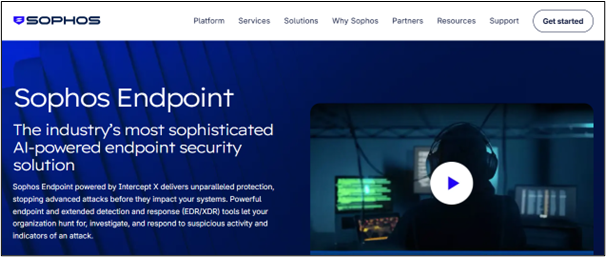
Sophos is a favorite among Managed Service Providers (MSPs) and small businesses for its simplicity. It combines endpoint protection with a straightforward cloud dashboard, making it easy for your IT team to deploy.
It offers a prevention-first approach to threats, blocking them through a range of tactics, including AI-based detection, behavioral analysis, and anti-ransomware defenses.
Key features:
- Ransomware protection: Stops malicious attacks quickly by detecting ransomware-like file-encryption behavior and automatically rolling back encrypted files to their previous state.
- Attack blocking: Provides endpoint protection with advanced defenses that prevent threat actors from escalating during an ongoing attack.
- Alerting: Detects suspicious activity across endpoints and servers and notifies administrators immediately through its centralized dashboard for further response.
Verdict
A strong contender for SMBs that want a “set it and forget it” solution.
Considerations and the NI advantage
Sophos provides outstanding protection against ransomware attacks, but some end users report performance issues and limited support for audit reporting. At the same time, Transilience offers zero-touch audit workflows and 10x faster compliance gap resolution with continuous AI-driven monitoring and automated remediation.
Pricing
Sophos offers custom quotes based on your specific needs. You start with a basic endpoint protection plan with a per-user rate, with prices increasing as you add advanced modules or services (EDR, XDR, MDR).
Choose Security Outcomes Over Just Another Tool
The endpoint protection market in 2026 is crowded with powerful technology. CrowdStrike offers speed, SentinelOne offers autonomy, and Microsoft offers integration. But for most growing organizations, the challenge isn’t a lack of tools; it’s the lack of time and expertise to manage them effectively.
Network Intelligence (NI) is the only solution designed to bridge this gap for resource-constrained organizations.
Unlike software-only platforms that simply hand you a dashboard and walk away, NI integrates its proprietary Transilience AI platform with 24/7 world-class MDR services to deliver total ownership of security outcomes at affordable costs.
With NI, you don’t just get a tool; you get a force multiplier:
- AI-Powered Prioritization: Filters out 95% of alert noise to focus purely on the 5% of threats that matter.
- 24/7 Expert SOC: Human threat hunters handle the complex, logic-based attacks that software misses.
- Automated Compliance: Turns daily security activity into audit-ready evidence with multi-framework support.
- Outcome-Based Value: Enterprise-grade managed security for the price of standard software.
Network Intelligence delivers the power of AI, expert insights, and the assurance of managed security and compliance—all for the price of standard software.
Tired of overwhelming security alerts and fragmented tools? Schedule your Transilience demo today and see the difference.