


Achieving FedRAMP authorization remains one of the most complex and resource-intensive compliance challenges facing cloud service providers today. Organizations seeking federal contracts often struggle with the extensive documentation requirements, lengthy implementation timelines, and ongoing continuous monitoring obligations that can consume months of effort and hundreds of thousands of dollars in resources.
This comprehensive fedramp compliance checklist provides a structured roadmap to navigate these challenges, offering step-by-step guidance informed by industry best practices and enhanced by AI-powered automation capabilities that can significantly reduce implementation complexity and accelerate time to authorization.
What is FedRAMP?
The Federal Risk and Authorization Management Program (FedRAMP) is a comprehensive, standardized framework established in 2011 to provide a unified approach for assessing and authorizing cloud computing products and services used by federal agencies. Unlike fragmented agency-specific evaluations that previously characterized government cloud adoption, FedRAMP operates on the principle of “authorize once, use everywhere,” enabling cloud service providers to achieve a single authorization that can be leveraged across multiple federal agencies.
The program emerged through collaboration between the General Services Administration, Department of Homeland Security, and Department of Defense to address the inefficiencies and security gaps that plagued earlier federal cloud procurement processes. Organizations that achieve FedRAMP authorization gain access to a federal cloud marketplace worth hundreds of billions of dollars annually, while those without authorization are effectively excluded from federal cloud opportunities.
The framework builds upon NIST SP 800-53 security controls with cloud-specific enhancements, ensuring that federal data remains protected in shared infrastructure environments while maintaining the flexibility and scalability that make cloud services attractive to government agencies.
FedRAMP Requirements
FedRAMP requirements are structured around three distinct impact levels that determine the scope and rigor of security controls organizations must implement. Each impact level corresponds to the potential damage that could result from unauthorized disclosure or compromise of federal information, with requirements escalating significantly from Low to High impact classifications. The framework mandates implementation of technical, operational, and management controls that address comprehensive cybersecurity domains including access management, encryption, incident response, vulnerability management, and continuous monitoring capabilities.
- Low Impact: Approximately 125 controls for systems processing public information with minimal risk
- Moderate Impact: Around 325 controls for systems handling Controlled Unclassified Information (CUI)
- High Impact: Over 400 controls for mission-critical systems processing national security information
Impact Level | Number of Controls | Data Sensitivity | Example Use Cases |
Low | ~125 | Public information | Public websites, marketing platforms |
Moderate | ~325 | CUI, serious adverse effects | HR systems, case management applications |
High | 400+ | Mission-critical/national security | Law enforcement, intelligence operations |
FedRAMP Compliance Checklist
This comprehensive fedramp compliance checklist provides detailed implementation guidance for each critical step in the authorization process. Organizations following this structured approach can navigate the complex requirements more efficiently while ensuring comprehensive coverage of all mandatory elements.
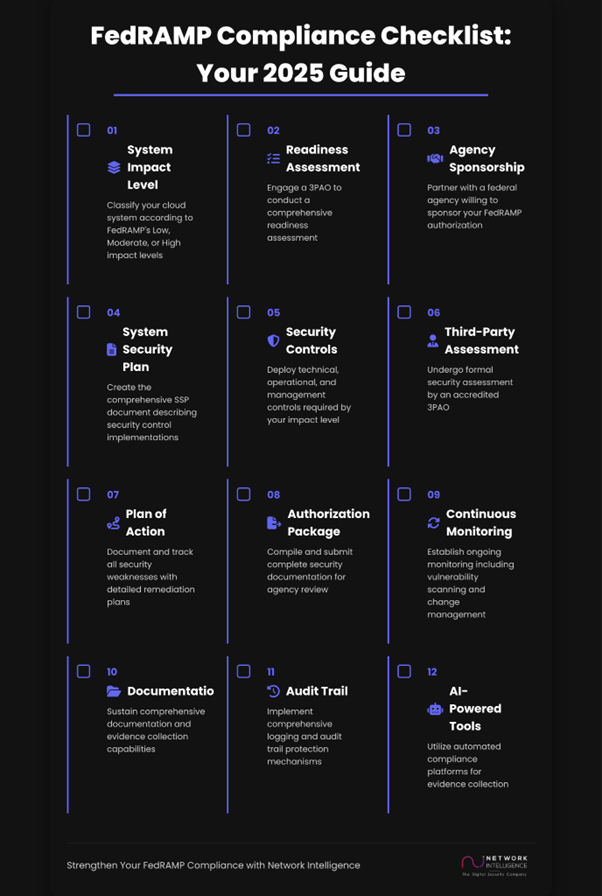
Each step includes specific deliverables, timelines, and best practices derived from successful FedRAMP implementations across diverse cloud service providers.
1. Determine System Impact Level
Classifying your cloud system according to FedRAMP’s Low, Moderate, or High impact levels represents the foundational decision that shapes every subsequent compliance activity. This classification determines the number of security controls you must implement, the depth of documentation required, and the ongoing monitoring obligations that will persist throughout your authorization lifecycle. The impact level assessment requires careful analysis of the data types your system will process, the potential consequences of security breaches, and the specific mission requirements of your federal agency customers.
- Conduct comprehensive data sensitivity analysis to catalog all federal information types your system will process, store, or transmit
- Apply FIPS 199 categorization methodology to determine confidentiality, integrity, and availability impact ratings
- Document detailed rationale for impact level selection with supporting evidence and stakeholder validation
- Engage with potential federal agency customers to confirm alignment between your impact level selection and their operational requirements
2. Complete a Readiness Assessment (Optional but Recommended)
Engaging a FedRAMP-accredited Third Party Assessment Organization (3PAO) to conduct a comprehensive readiness assessment provides invaluable insights into your current security posture and identifies potential gaps before formal authorization activities begin. This optional but highly recommended step can prevent costly delays and rework during the formal assessment process by revealing implementation deficiencies early when they are easier and less expensive to address.
- Select and contract with a qualified 3PAO that has demonstrated experience in your impact level and industry sector
- Undergo comprehensive security control testing and documentation review to identify compliance gaps
- Receive detailed Readiness Assessment Report (RAR) with specific remediation recommendations and timeline estimates
- Submit completed RAR to FedRAMP PMO to achieve “FedRAMP Ready” marketplace listing status
3. Secure Agency Sponsorship and System Categorization
Identifying and partnering with a federal agency willing to sponsor your FedRAMP authorization represents a critical milestone that provides official government endorsement for your compliance efforts. The sponsoring agency serves as your primary stakeholder throughout the authorization process, providing guidance on specific requirements, reviewing security documentation, and ultimately issuing the Authority to Operate (ATO) letter upon successful completion of all compliance activities.
- Engage with federal agencies that have expressed interest in your cloud service offering to secure formal sponsorship commitment
- Collaborate with sponsoring agency to validate system categorization and confirm alignment with FIPS 199 standards
- Document comprehensive data flow analysis showing how federal information enters, processes through, and exits your cloud environment
- Establish regular communication channels and project coordination mechanisms with agency security and procurement personnel
4. Develop the System Security Plan (SSP)
The System Security Plan serves as the cornerstone document of your FedRAMP authorization package, providing comprehensive descriptions of how each required security control is implemented within your specific cloud environment. This extensive document typically exceeds 1,000 pages and must address every applicable NIST SP 800-53 control with sufficient technical detail to enable assessors and agency personnel to understand exactly how security is achieved throughout your infrastructure and operations.
- Document detailed implementation statements for every applicable security control, including technical specifications and operational procedures
- Develop comprehensive appendices covering specialized topics such as contingency planning, incident response, configuration management, and privacy impact assessment
- Include detailed system architecture diagrams, network topology maps, and data flow illustrations that support control implementation descriptions
- Engage subject matter experts across security, operations, and development teams to ensure accurate representation of implemented safeguards
5. Implement Security Controls
Deploying the comprehensive suite of technical, operational, and management controls required by your impact level represents the most resource-intensive phase of FedRAMP compliance. This implementation must address sophisticated access management systems, comprehensive encryption capabilities, detailed audit logging mechanisms, and integration with federal identity systems while maintaining the performance and scalability characteristics that make cloud services valuable to government customers.
- Deploy advanced identity and access management systems that enforce principle of least privilege and integrate with federal PIV/CAC authentication systems
- Implement comprehensive encryption using FIPS 140-2 validated cryptographic modules for data protection at rest, in transit, and during processing
- Establish robust vulnerability management programs including automated scanning, risk assessment, and remediation tracking capabilities
- Deploy comprehensive logging and monitoring systems that capture security-relevant events across all system components and protect audit trails from unauthorized modification
6. Conduct Third-Party Assessment (3PAO)
The formal security assessment conducted by an accredited 3PAO represents the independent validation of your security control implementations and serves as the primary evidence supporting your authorization request. This comprehensive evaluation includes both automated testing using specialized security tools and manual verification of policies, procedures, and technical configurations to ensure that implemented controls are functioning effectively and meeting FedRAMP requirements.
- Coordinate comprehensive security testing activities including penetration testing, vulnerability assessments, and configuration reviews
- Participate in detailed interviews and documentation reviews that validate operational and management control implementations
- Support evidence collection activities that demonstrate ongoing effectiveness of implemented security measures
- Review and validate Security Assessment Report (SAR) findings to ensure accurate representation of your security posture
7. Develop and Maintain Plan of Action & Milestones (POA&M)
The Plan of Action and Milestones document serves as a comprehensive tracking mechanism for all security weaknesses identified during the assessment process and provides detailed remediation plans with specific timelines, responsible parties, and resource requirements. This living document demonstrates your organization’s commitment to addressing identified vulnerabilities and maintaining strong security practices throughout the authorization lifecycle.
- Document every finding identified in the Security Assessment Report with detailed descriptions of the security weakness and potential impact
- Develop specific remediation plans that address root causes and include clear timelines based on finding severity levels
- Assign responsible personnel for each remediation activity and establish accountability mechanisms for tracking progress
- Implement regular review and update processes to ensure POA&M accuracy and demonstrate continuous improvement efforts
8. Submit Authorization Package for Agency and PMO Review
Compiling and submitting the complete security authorization package represents the culmination of all preparation activities and triggers the formal review process by both your sponsoring agency and the FedRAMP Program Management Office. This comprehensive package includes your updated SSP, the 3PAO’s Security Assessment Report, your detailed POA&M, and supporting documentation that collectively demonstrate your readiness for federal cloud operations.
- Ensure all documentation is current, complete, and aligned with the latest FedRAMP templates and requirements
- Provide executive attestation letters that demonstrate organizational commitment to maintaining security practices and continuous compliance
- Submit package through appropriate channels and establish regular communication with agency and PMO reviewers
- Respond promptly to reviewer questions and requests for additional information or clarification
9. Implement Continuous Monitoring
Continuous monitoring requirements begin immediately upon authorization and represent an ongoing commitment that extends throughout the entire operational lifecycle of your cloud service. This comprehensive program includes monthly vulnerability scanning, quarterly change management reviews, annual security control reassessments, and immediate incident reporting obligations that demonstrate sustained compliance with FedRAMP requirements. Modern AI-powered solutions like Transilience can significantly streamline these continuous monitoring activities through automated evidence collection and intelligent gap analysis capabilities.
- Establish automated vulnerability scanning programs that conduct comprehensive monthly assessments and generate detailed remediation reports
- Implement change management processes that evaluate significant system modifications and assess their impact on existing security authorizations
- Schedule annual security control reassessments with your 3PAO to validate ongoing effectiveness of implemented safeguards
- Develop incident response capabilities that ensure immediate notification to federal agency customers and appropriate escalation of security events
10. Maintain Comprehensive Documentation and Evidence Collection
Sustaining comprehensive documentation and evidence collection capabilities represents a critical ongoing requirement that supports continuous monitoring activities and enables rapid response to audit requests or assessment activities. Organizations must establish systematic approaches to organizing, maintaining, and accessing the extensive evidence base required to demonstrate sustained compliance with FedRAMP requirements throughout their authorization lifecycle.
- Implement automated evidence collection systems that continuously gather security-relevant data from across your cloud infrastructure
- Establish centralized documentation repositories with version control and access management capabilities
- Develop regular review processes that ensure documentation accuracy and completeness over time
- Create standardized reporting mechanisms that can quickly generate evidence packages for audit or assessment activities
11. Ensure Audit Trail and Logging Requirements
Implementing comprehensive audit trail and logging capabilities represents a fundamental security requirement that supports incident investigation, compliance monitoring, and forensic analysis activities. FedRAMP mandates specific logging requirements that often exceed commercial best practices, requiring organizations to capture detailed security-relevant events, protect log integrity, and maintain extensive retention periods while ensuring logs remain accessible for analysis and review activities.
- Deploy comprehensive logging systems that capture user authentication events, privileged access activities, data access patterns, and system configuration changes
- Implement log protection mechanisms that prevent unauthorized modification and ensure integrity throughout required retention periods
- Establish regular log review processes that identify suspicious activities and support incident response investigations
- Develop log analysis capabilities that can identify patterns and trends relevant to security monitoring and compliance validation
12. Leverage AI-Powered Compliance Tools (Recommended)
Modern AI-powered compliance platforms represent a transformative approach to FedRAMP implementation and ongoing management, offering automated evidence collection, intelligent gap analysis, and continuous monitoring capabilities that can significantly reduce manual effort and improve compliance outcomes. Advanced solutions like Transilience AI provide LLM-based security agents that can automate complex compliance tasks, reducing vulnerability backlogs by 70% and accelerating certification timelines by months while maintaining the rigor required for federal authorization.
- Evaluate AI-powered platforms that offer automated control implementation tracking and evidence collection across cloud environments
- Implement intelligent monitoring solutions that provide real-time compliance posture visibility and automated gap identification
- Deploy automated reporting capabilities that generate audit-ready documentation and streamline continuous monitoring activities
- Integrate AI-driven vulnerability prioritization systems that focus remediation efforts on issues with actual business impact rather than theoretical risks
Common Mistakes to Avoid in FedRAMP Compliance
- Underestimating the scope and complexity of documentation requirements, leading to incomplete security packages and delayed authorization timelines that can extend implementation efforts by six months or more
- Failing to engage a sponsoring federal agency early in the process, which can result in misaligned expectations, inadequate requirement understanding, and costly rework of security implementations
- Neglecting continuous monitoring obligations and timely vulnerability remediation, which can lead to authorization suspension or revocation despite initial compliance success
- Inadequate evidence collection and organization systems that cannot support the extensive documentation requirements for ongoing compliance validation and audit activities
- Overlooking the critical importance of comprehensive audit trails and log protection mechanisms that are essential for incident investigation and compliance verification
- Attempting to implement FedRAMP requirements without sufficient cybersecurity expertise, leading to ineffective control implementations that fail assessment validation
- Underinvesting in automation capabilities that could streamline evidence collection, monitoring activities, and reporting requirements throughout the authorization lifecycle
Strengthen Your FedRAMP Compliance with Network Intelligence
Achieving and maintaining FedRAMP authorization requires a strategic combination of deep cybersecurity expertise, comprehensive implementation capabilities, and innovative technology solutions that can streamline complex compliance processes. Network Intelligence brings together over two decades of cybersecurity leadership with cutting-edge AI-powered automation through our subsidiary Transilience AI, offering organizations a proven path to successful federal cloud authorization. Our comprehensive ADVISE framework guides clients through every phase of the compliance journey, from initial assessment and design through implementation, sustainment, and evolution of security practices that meet the most demanding federal requirements.
The integration of cybersecurity compliance expertise with advanced AI capabilities represents the future of FedRAMP implementation, where manual documentation processes give way to automated evidence collection, static security assessments evolve into continuous monitoring, and compliance activities become integrated components of operational workflows rather than separate overhead functions. Transilience AI’s revolutionary approach to autonomous compliance demonstrates how LLM-based security agents can transform traditional FedRAMP processes, delivering guaranteed certification outcomes while reducing implementation timelines from 12-18 months to significantly shorter periods without compromising the security rigor that federal agencies demand.
Organizations seeking to navigate the complex FedRAMP landscape can benefit from Network Intelligence’s proven track record of successful implementations across diverse industries, combined with our innovative AI-powered tools that automate routine compliance tasks and provide intelligent insights that accelerate decision-making and risk management. Our approach integrates seamlessly with existing security infrastructures while providing the specialized federal compliance expertise necessary to achieve authorization success. For organizations ready to transform their approach to federal cloud compliance through the power of AI-enhanced cybersecurity services, we invite you to explore how our comprehensive solutions can accelerate your path to FedRAMP authorization while establishing sustainable compliance practices that support long-term federal market success.
Talk to an Expert today to discover how our proven methodology and AI-enhanced tools can streamline your path to federal cloud authorization.