


Security teams rarely wake up one morning and decide to replace their firewall platform. In most organizations, platforms like Fortinet become deeply embedded in the network architecture. They run branch connectivity, remote access, SD-WAN, and traffic inspection across distributed environments.
When companies begin exploring alternatives, it is usually the result of operational friction accumulating over time or infrastructure evolving in new directions.
To understand where these conversations begin, it helps to listen to the operators who manage these systems every day. Across engineering forums and practitioner communities, we found several recurring themes.
What Engineers Think About Fortinet
One network administrator described the operational risk of upgrading remote Fortinet devices across geographically distributed sites:
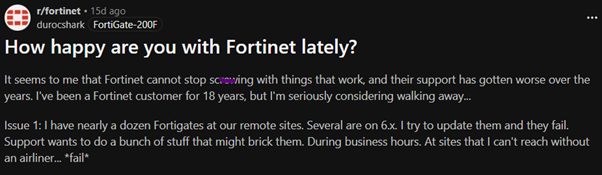
Fortinet user, durocshark, expresses a downturning experience with FortiGate’s upgrade capabilities (Source: Reddit via r/fortinent)
For organizations with branch networks spread across countries or continents, firmware upgrades and device recovery can quickly become logistical challenges.
A user expressed that the vendor support quality for Fortinet had dropped over time, and the prevalence of bugs in updates was such that they could not overlook them.
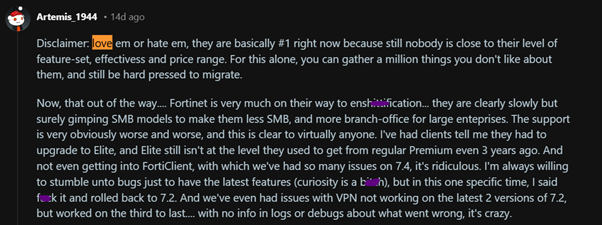
Fortinet user, Artemis_1944, talked about the issues with the brand’s support system and bug frequency (Source: Reddit via r/fortinent)
The practitioner, Artemis_1944, acknowledged Fortinet’s strong capabilities and market position, but then expressed growing frustration with support responsiveness, client stability, and transparency in troubleshooting.
Conversations like this often appear when teams rely heavily on a vendor ecosystem and expect strong support as part of that relationship.
Cost structure also appears in many discussions. One engineer described receiving annual licensing quotes that prompted their team to migrate away from Fortinet appliances entirely.

Alt text/Caption: Fortinet user, BestReeb, did not hold back on the displeasure they got from Fortinet’s pricing quotes (Source: Reddit via r/fortinent)
We found that subscription and licensing models are a common decision point, especially as firewall deployment scales across dozens of sites.
Some practitioners even point to alternative platforms that they have already adopted:
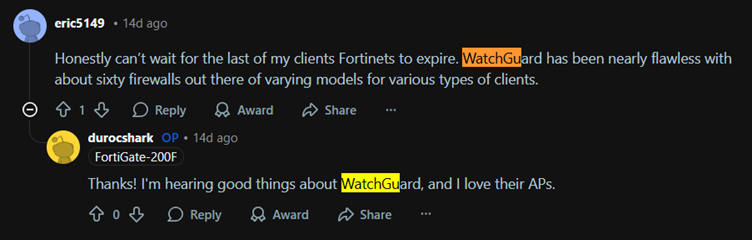
Fortinet user, eric5149, adopts another Fortinet alternative, WatchGuard (Source: Reddit via r/fortinent)
Mentions like this are particularly useful signals during research. In fact, because WatchGuard appears repeatedly in many discussions as a reliable alternative in certain environments, we include it in this guide alongside other Fortinet competitors.
We will examine the top Fortinet competitors in 2026 extensively and show how each option compares to the others.
Beyond feature comparisons, we also consider a broader platform emerging in enterprise security: Network Intelligence. Modern security platforms like Network Intelligence go beyond enforcing firewall rules and surface risk signals, helping teams understand what is actually happening.
Best Fortinet Alternatives
To compile this list, we focused on how security teams actually evaluate platforms when redesigning their network security architecture.
Instead of ranking vendors by popularity alone, we assessed each platform across both technical capability and operational fit.
The research combined several inputs:
- We reviewed practitioner discussions and migration experiences shared by network engineers and security architects.
These conversations often reveal operational realities that formal product documentation does not capture, including upgrade stability, management complexity, licensing friction, and vendor support responsiveness.
- We also considered each vendor’s business reputation and ecosystem maturity.
This included enterprise adoption, product roadmap stability, partner ecosystems, and long-term viability within enterprise security programs.
- We evaluated the technical architecture of each candidate platform.
To be included in this list, vendors needed to demonstrate strength in several critical areas:
- Deep packet inspection and application-aware traffic classification
- Integrated threat prevention capabilities
- Identity-driven access control aligned with zero trust principles
- Centralized policy management across large distributed environments
- Secure remote access and hybrid workforce connectivity
- Compatibility with cloud security architectures and distributed edge environments
1. Network Intelligence
Network Intelligence for cybersecurity protection
Network Intelligence is an AI-driven cybersecurity partner that combines a 500+ person security team with Transilience, its AI platform, to “own” security and compliance outcomes. It offers services and managed programs that leverage advanced threat intelligence, analytics, and automation.
Key features
- MDR services combine 24/7 SOC maturity operations, XDR tooling, and automated response workflows to identify and contain security incidents.
- Cybersecurity mesh architecture advisory that helps organizations design distributed security models.
- Governance, risk, and compliance programs align security controls with frameworks such as SOC 2, HITRUST, and payment security standards.
- Vulnerability management identifies weaknesses across infrastructure and applications while ranking remediation actions by exploitability and business impact.
- Zero trust and identity security architecture integrates IAM, privileged access controls, and device posture verification to enforce least-privilege access.
- Cloud security and digital transformation implementation to support the adoption of cloud infrastructure, SaaS platforms, and modern applications.
- Data privacy and AI security programs protect sensitive data and machine learning systems through discovery, classification, encryption, and governance controls.
- External threat and brand monitoring tracks exposed credentials, dark web activity, impersonation risks, and social media abuse to detect threats outside the organization’s network perimeter.
Pros
- Security operations beyond the firewall layer by combining detection, vulnerability prioritization, and cloud security into a single operational framework.
- AI-driven automation through Transilience reduces manual security triage and compliance evidence collection.
- Expert-led consulting with automated operations so organizations can improve security maturity without building large internal security teams.
Cons
- Services-led model, which may not fit teams seeking only a product deployment.
- Not a firewall or network appliance vendor, meaning organizations still require traditional security platforms for perimeter enforcement.
Gaurav, CTO of a healthcare company, highlighted using Network Intelligence’s Transilience AI platform to replace its manual security and compliance workflows.
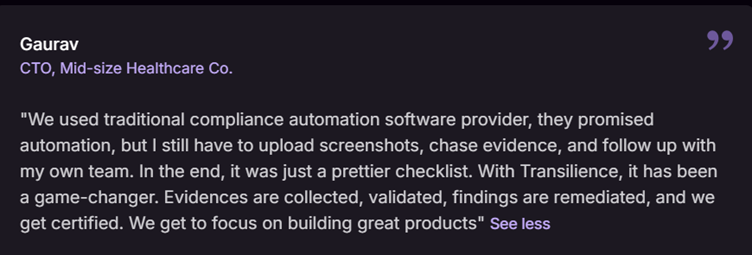
CTO, Gaurav, shared their experience on using Network Intelligence to automate cybersecurity operations (Source: Network Intelligence – Transilience AI)
Pricing
Pricing is custom quote-based, like most other Fortinet alternatives. Fees are defined by the scope of work.
Ideal for
Best suited for organizations that need help operating security across cloud, compliance, and AI governance in a more continuous way.
It is relevant for teams dealing with audit fatigue, vulnerability backlog, immature SOC operations, identity risk, or fragmented security tooling in banking, technology, oil and power, aviation, e-commerce, and retail industries.
2. Palo Alto Networks NGFW
Palo Alto Networks for cybersecurity protection (Source: Palo Alto Networks)
Palo Alto Networks is a common destination when teams want a premium next-generation firewall platform, deep threat prevention, and strong centralized management.
It is often selected when security leadership wants higher confidence in enforcement fidelity and advanced security capabilities, and is willing to pay for it.
Key features
- PA-Series next-generation firewalls inspect traffic at layer seven using application, user, and content awareness for precise security policies.
- Threat Prevention Services detect exploits and vulnerabilities in network traffic to block attacks targeting known software weaknesses.
- WildFire Malware Sandboxing analyzes suspicious files in isolation and distributes threat signatures globally to detect zero-day malware.
- App-ID classifies traffic by application behavior rather than ports, enabling precise policy enforcement and visibility.
- User-ID integration maps network activity to directory users, enabling role-based access control instead of IP-based policies.
- Advanced URL Filtering blocks phishing, malicious domains, and risky websites using real-time threat intelligence and dynamic categorization.
- DNS Security protection detects command-and-control traffic and DNS tunneling to prevent malware communication with the attacker’s infrastructure.
- GlobalProtect remote access platform secures remote workforce connectivity using IPsec and SSL VPN with device posture checks.
- Panorama centralized management provides unified firewall configuration, policy enforcement, logging, and analytics across distributed deployments.
Pros
- Advanced threat analytics and inline machine learning detection capabilities.
- Centralizes network security by consolidating multiple tools, reducing manual administrative work.
- Multi-layered threat prevention, including blocking ransomware and zero-day attacks.
Cons
- Has a steep learning curve, which can slow initial deployments.
- Pricing and licensing complexity can make access to key features costly or confusing, especially for SMEs
On comparing Palo Alto to Fortinet, we found that the latter delivers better price-to-performance hardware efficiency. This is because FortiGate appliances combine firewall, secure SD-WAN, and routing functions in a single platform.
An engineer gave a breakdown of his experience with the two and highlighted that Palo Alto can be significantly more expensive than Fortinet appliances.
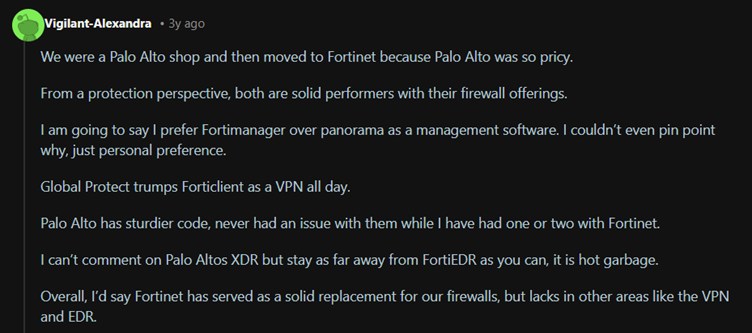
Security engineer notes that Palo Alto’s higher pricing pushed their team to Fortinet (Source: Reddit via r/cybersecurity)
Here’s a breakdown of quantifiable ratings from G2 reviews between the two:
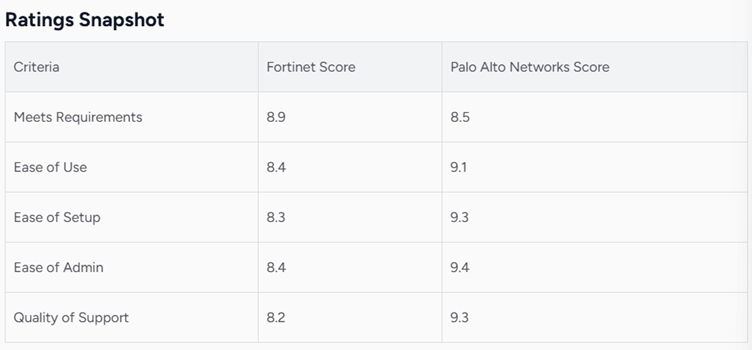
Rating differences between Fortinet and Palo Alto Networks (Source: G2)
Pricing
Services are quote-based and vary by deployment model. However, trusted resellers and distributors like Insight list the PA-220 at $248.99 per license. For higher models, like the PAN-PA-3220, selling licenses for $8,418.99.
Ideal for
Large enterprises and regulated environments that prioritize advanced prevention and can support premium total cost of ownership.
3. Cisco Secure Firewall

Cisco Systems for firewall protection (Source: Cisco)
Cisco Secure Firewall is often chosen when organizations want a tighter fit with their networking, identity, and segmentation strategies. It can be a rational move in Cisco-heavy environments where standardization reduces operational friction.
Key features
- Secure Firewall performs layer-seven inspection, application-aware policy enforcement, and network segmentation for enterprise traffic control.
- Snort-based intrusion prevention system analyzes traffic for exploit signatures and suspicious activity using its widely deployed IPS engines.
- Secure Malware Analytics sandboxing analyzes suspicious files in detonation environments to identify previously unknown malware behavior.
- Application Visibility and Control (AVC) identifies thousands of applications and enables policy enforcement, prioritization, or blocking of risky software.
- Identity Services Engine (ISE) maps network traffic to users and devices, enabling role-based network access policies.
- AnyConnect secure remote access provides IPsec and SSL VPN connectivity with endpoint posture checks for remote workforce security.
- Umbrella DNS-layer security blocks malicious domains, phishing sites, and command-and-control communications before connections occur.
- Secure Firewall Management Center centralizes firewall configuration, event monitoring, and threat analytics across distributed security deployments.
- SD-WAN platform enables intelligent traffic routing, branch connectivity, and automated failover across enterprise-wide area networks.
- SecureX platform integration correlates threat intelligence across Cisco security products and automates incident response actions.
Pros
- Management and configuration are straightforward, especially in data centers and hybrid/cloud setups.
- Good and timely support team seems to meet users’ expectations
Cons
- Integration with non-Cisco products may require specialized expertise and sometimes add cost and a learning curve.
During our research, some practitioners noted that Cisco firewall platforms can require more operational effort to manage compared to Fortinet deployments.
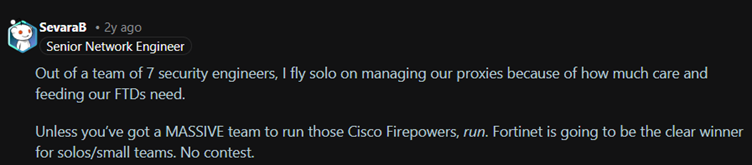
One network engineer, SevaraB, explained that Cisco Firepower environments often demand more administrative effort, which can become difficult for smaller IT teams (Source: Reddit via r/sysadmin)
Here’s how it compares with Fortinet according to G2’s rating:
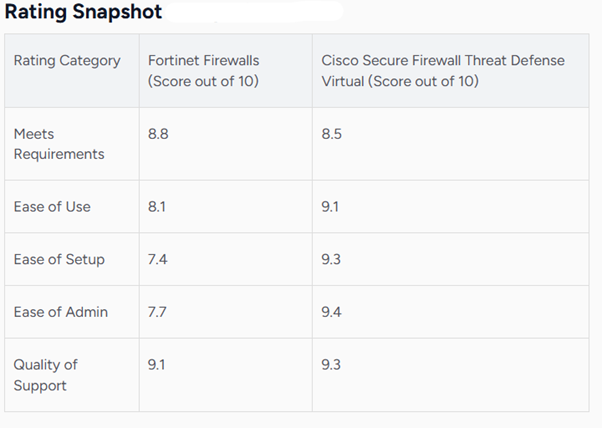
Rating differences between Fortinet and Cisco Secure Firewall (Source: G2)
Pricing
Cisco Secure Firewall pricing varies widely by hardware, virtual, or cloud deployment. Prices range from approximately $400 for entry-level units to over $155,000 for high-end remanufactured models. Common models like the Firepower 1010 cost between $1,000 and $1,500.
Contact the vendor for a custom quote.
Ideal for
Enterprises with a significant Cisco footprint that want aligned security and network operations under a unified vendor strategy.
4. Check Point Quantum
Check Point Quantum firewall for network protection (Source: Check Point)
Check Point is frequently evaluated for its policy management maturity and its broad set of security controls. Many teams choose it when they want centralized management and consistent enforcement across environments.
Key features
- Quantum Security Gateway’s next-generation firewall performs deep packet inspection and identity-aware policies for granular traffic control.
- SandBlast Threat Emulation sandboxing analyzes suspicious files in isolated environments to detect zero-day malware before network execution.
- IPS Software Blade intrusion prevention detects exploits, vulnerabilities, and anomalous network behavior to block real-time attacks.
- Application Control Software Blade identifies thousands of applications and enables application-specific policies for traffic prioritization or blocking.
- URL Filtering Software Blade blocks phishing sites and malicious domains using dynamic categorization and browsing policy enforcement.
- DNS Security threat prevention module detects command-and-control communications and DNS tunneling attempts from compromised devices.
- Remote Access VPN platform provides IPsec and SSL VPN connectivity with endpoint posture checks for secure workforce access.
- SmartConsole centralized management enables unified firewall configuration, log analytics, policy enforcement, and threat monitoring.
- ThreatCloud Intelligence network distributes global threat intelligence feeds and malware signatures to update security defenses.
Pros
- Comprehensive threat prevention capabilities for various business sizes
- Offers scalable performance up to 1.4 Tbps firewall throughput.
- Robust centralized policy management across complex security deployments.
Cons
- Users find lapses in the connection between its firewall software, the OS (Linux), and the network stack.
- Configuration complexity for advanced features may incur additional licensing and support costs.
We found that users reported Check Point environments to be more complex to manage than Fortinet’s.
For example, administrative tasks are split across multiple interfaces. This included the SmartConsole, firewall device, graphical interface, and the command line. FortiGate appliances, in comparison, provide a more unified and intuitive admin experience.

Ex Check Point user, tinuz84, preferred Fortinet because of its reduced complexity (Source: Reddit via r/networking)
Here’s how Check Point compares with Fortinet:
Alt text/caption: Rating differences between Fortinet and Check Point Quantum IPS (Source: G2)
Pricing
Pricing is custom and depends on a few factors, including the number of Check Point instances and the cores required to support the network traffic. Contact the sales team for a quote.
Ideal for
Organizations that need mature centralized policy governance and are comfortable with enterprise procurement cycles.
5. Sophos Firewall
Sophos cybersecurity platform (Source: Sophos)
Sophos is often selected for operational simplicity and value, especially for mid-market organizations that need strong protection without building a large platform engineering function.
Key features
- Firewall XGS firewall performs deep packet inspection and encrypted traffic analysis for application-aware network policy enforcement.
- Application Control identifies thousands of applications and enforces policies to prioritize, restrict, or block risky software.
- Connect VPN platform enables SSL and IPsec VPN connections with multi-factor authentication for secure remote workforce access.
- SophosLabs threat intelligence network delivers continuous malware intelligence, vulnerability research, and automated security updates.
- Web Filtering blocks malicious websites, phishing pages, and inappropriate content using dynamic URL categorization.
- DNS Protection detects malicious domains and command-and-control connections to prevent malware communication with attacker infrastructure.
Pros
- No additional cost for SSL, IPsec VPN, or multi-factor authentication, especially cost-effective for multi-branch environments.
- Seamless integration with Sophos Central enables centralized, global management and automated incident response.
- Application and web filtering, plus endpoint integration, enable real-time blocking of risky apps.
Cons
- Configuration via CLI is limited—bulk configuration typically requires API integration rather than traditional CLI workflows.
- Firmware updates are sometimes revoked and replaced, leading to administrative overhead and occasional confusion.
Compared to Fortinet, we found that some users preferred Sophos’ simpler, sales-friendly approach, with built-in MDR options and free cloud management tools.
They also made points about its weaker command line interface and reported that it does not provide clear-text configuration backups, unlike Fortinet.
One experienced user who works with both platforms noted that Sophos works well for simpler deployments, but for more advanced capabilities, Fortinet may be better.
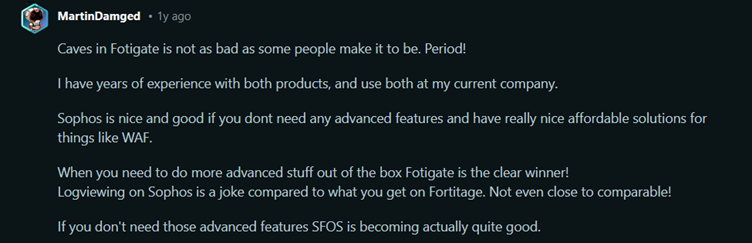
Experience Sophos and Fortinet user, MartinDamged, highlighted Sophos as a go-to for simple, affordable solutions and Fortinet for complex uses (Source: Reddit via r/msr)
Here’s the rating comparison between Fortinet and Sophos Firewall:
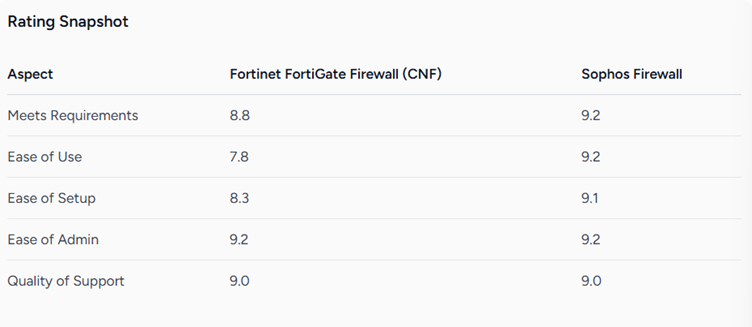
Rating differences between Fortinet and Sophos (Source: G2)
Pricing
Pricing is custom quoted; however, some sources estimate their on-premise pricing tiers to be:
- Intercept X Advanced: $28 per user annually
- Intercept X Advanced with XDR: $48 per user annually
- Sophos Managed Threat Response: $79 per user annually
Note: The pricing above does not cover any discounts for multi-year commitments.
Ideal for
Mid-market organizations that want a pragmatic firewall platform with manageable operational overhead.
6. Barracuda CloudGen Firewall
Barracuda Networks for threat protection (Source: Barracuda)
Barracuda Cloudgen Firewall and related network protection offerings are often evaluated for distributed environments and organizations that want practical remote access and branch connectivity patterns.
Key features
- CloudGen Firewall performs deep packet inspection and layer seven visibility to enforce granular network security policies.
- IPS system that detects exploits, vulnerabilities, and attack signatures to block malicious traffic in real time.
- ATP sandboxes suspicious files to detect zero-day malware before network access occurs.
- Application Visibility and Control identifies thousands of applications and enforces policies to prioritize, throttle, or block risky software.
- Web Security filtering blocks phishing sites and malicious domains through dynamic URL categorization and browsing policy enforcement.
- VPN platform provides SSL and IPsec connectivity with multi-factor authentication for secure remote workforce access.
- Secure SD-WAN enables intelligent traffic routing, automated failover, and optimized branch connectivity across distributed networks.
- Firewall Control Center management centralizes firewall configuration, policy deployment, security monitoring, and log analytics.
Pros
- Observation mode lets admins analyze current data flows and security gaps pre-migration, which is rare among firewalls.
- SD-WAN with TINA Tunnel enables easy, reliable broadband-based branch/central connectivity (not just MPLS)
- Centralized management with a separate management/data plane makes multi-site/admin environments efficient.
Cons
- Frequent firmware/software updates can introduce service inconsistencies or require unplanned admin time.
- Initial configuration, especially SD-WAN and advanced features, can be complex for new admins.
We found that, by proxy, Barracuda may have been favored over Fortinet among users who consider the low number of vulnerabilities recorded by its CloudGen Firewall.
However, this user below shares a view that may be worth looking at:
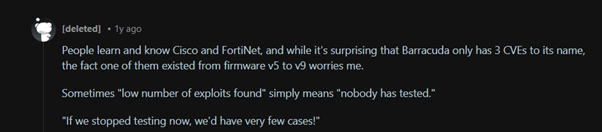
Cautious view by user highlights that lower disclosure numbers do not always reflect deeper real-world testing or scrutiny (Source: Reddit via r/sysadmin)
Here’s the rating comparison between Fortinet and Barracuda CloudGen:
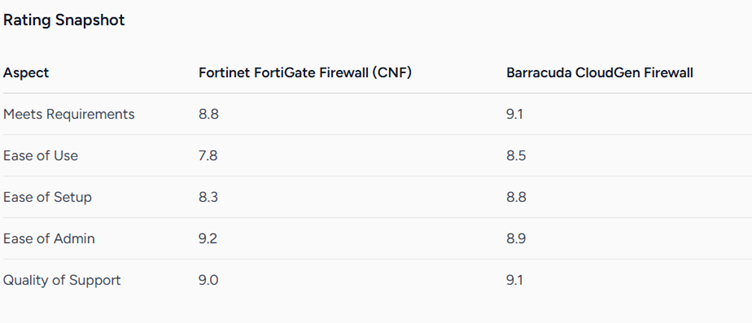
Rating differences between Fortinet and Barracuda CloudGen (Source: G2)
Pricing
Fees are determined by the model and, just like the others, require a custom quote.
However, BarraGuard, an authorized Barracuda reseller, reported subscription renewal prices for different model deployments for the SF100 hardware costing between $197.22 – $1,653.
Ideal for
Best fit SMB and mid-market environments in organizations that want a remote access security model without excessive platform overhead.
7. Zscaler Internet Access
Zscaler – AI security platform (Source: Zscaler)
Zscaler is commonly chosen when organizations want to move away from appliance-centric internet security and adopt secure access service edge patterns for users and devices.
Key features
- Internet Access cloud secure web gateway inspects user traffic in the cloud to block malware, phishing, and risky websites.
- Zero Trust Network Access enables application-level access based on identity instead of exposing internal networks through VPN connections.
- Cloud-native SASE architecture delivers security inspection from globally distributed cloud points instead of on-premise appliances.
- Advanced threat protection engine analyzes traffic and files to detect malware, exploits, and previously unknown threats.
- Cloud sandboxing technology analyzes suspicious files in isolated environments before allowing downloads to user devices.
- Cloud firewall capability enforces network security policies without requiring traditional perimeter firewall hardware.
- Data loss prevention controls monitor sensitive data movement and prevent unauthorized data transfers across web applications.
- Centralized policy management console enables administrators to enforce consistent security policies across distributed users and devices.
Pros
- Globally scalable cloud-native architecture delivers consistent, low-latency security everywhere.
- Eliminates the need for traditional VPNs, providing secure access for remote/hybrid workers.
- Real-time threat protection and web filtering, including strong SSL/TLS inspection
Cons
- False positives in threat detection and limited reporting customization can increase admin workload.
- Integration issues with legacy applications and SSL inspection can affect performance.
Some teams choose Fortinet over Zscaler when they prefer endpoint-level security enforcement rather than routing traffic through a cloud proxy.
This is clear given this user’s reasoning:

User underwear11 highlights that Fortinet may be better off if the goal is endpoint-level security and by inference recommends Zscaler for routing traffic (Source: Reddit via r/fortinent)
Here’s the rating comparison of Fortinet vs Zscaler:
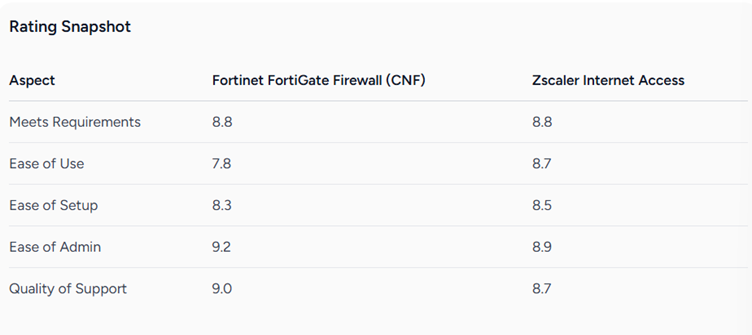
Rating differences between Fortinet and Zscaler (Source: G2)
Pricing
Pricing is divided into two pricing tiers:
- Essentials platform
- Zscaler platform
Charges are custom-based, but sources say costs for mid-sized businesses (100–500 users) often pay $25,000 to $75,000+ annually.
Ideal for
Organizations moving to SASE and zero-trust network access for distributed users and cloud software as a service reliance.
8. WatchGuard
WatchGuard cybersecurity platform (Source: WatchGuard)
WatchGuard provides a unified threat management architecture that combines firewall, IPS, antivirus, web filtering, and VPN services into a single platform. It is often a strong candidate for distributed organizations that want solid security services packages and manageable operations across many sites.
Key cybersecurity consulting services offered
- Firebox next-generation firewall performs deep packet inspection and layer seven traffic analysis to enforce granular network security policies.
- Application Control engine identifies applications on the network and enforces policies to prioritize, throttle, or block risky software.
- WebBlocker web filtering blocks phishing websites, malicious domains, and inappropriate content using dynamic URL categorization.
- DNSWatch DNS-layer protection detects malicious domains and command-and-control infrastructure to prevent malware communication.
- WatchGuard VPN platform enables SSL and IPsec connectivity with multi-factor authentication support for secure remote workforce access.
- AuthPoint multi-factor authentication provides push authentication, biometrics, and hardware tokens to strengthen identity verification.
- WatchGuard Cloud management platform centralizes device configuration, policy deployment, monitoring dashboards, and log analytics.
- ThreatSync threat intelligence and detection correlates security events across multiple tools to detect and respond to threats faster.
Pros
- Well-documented support and rapid patch cycles reduce risk and management drag.
- Smooth integration and deployment, as setup is fast (relative to ongoing admin, though initial setup can still be complex).
- Easy day-to-day administration, ideal for busy IT teams or those with limited resources.
Cons
- Limited customization in reporting analytics.
- The number of physical ports on certain models is low, sometimes necessitating extra purchases (e.g., SFP modules).
In comparing Fortinet and WatchGuard, we found that Fortinet is often perceived as easier to deploy and manage.
According to this user, Fortinet is easier when handling broader network integrations, such as switches and wireless access points.
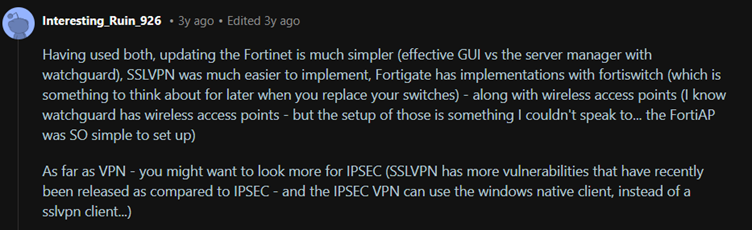
User interesting_ruin_926 highlights that Fortinet SSLVPN may be much simpler to implement than WatchGuard (Source: Reddit via r/fortinent)
See how its ratings compare with Fortinet’s on G2:
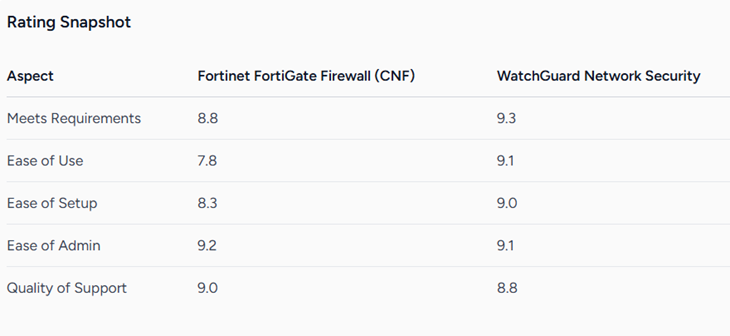
Rating differences between Fortinet and WatchGuard (Source: G2)
Pricing
WatchGuard pricing is custom quote-based and includes hardware, software subscriptions, and support renewals (often sold in 1, 3, or 5-year bundles). Guardsite, an authorized reseller for WatchGuard, pegs the cost for the M5800 models from $32,584 to $83,545, depending on the bundle.
Ideal for
Environments with mixed skill levels among admins or where turnover is high. Ease of use and clear documentation mean less reliance on deeply specialized network security expertise.
Why You Should Use Network Intelligence
Network Intelligence is not a firewall manufacturer. It does not compete with Fortinet, Palo Alto Networks, or Cisco by selling next-generation firewall appliances.
It belongs on this list because it addresses a different but increasingly important part of enterprise security; the gap between owning security tools and actually operating them well.
The services offered are less about perimeter enforcement and more about helping organizations design, implement, monitor, and continuously improve security.
Most firewall organizations try to solve the downstream problems that firewalls do not solve by themselves, like too many findings, weak prioritization, poor audit readiness, immature SOC workflows, and identity risk.
Network Intelligence’s approach is that these problems can be handled through a combined service-and-platform model by complementing firewall-led security instead of replacing the firewall itself.
If you require more than a firewall refresh, and the problem is operational drag, audit and triage overload, then Network Intelligence can help change how the program runs.
Start by evaluating network intelligence as the control-plane upgrade, then select the enforcement layer that best matches your architecture.
Talk to Network Intelligence’s experts to see how the platform fits your security firewall setup.