


Enterprise security leaders face mounting pressure to demonstrate robust information security practices while navigating complex regulatory landscapes. ISO 27001 certification stands as the gold standard for information security management, yet many organizations struggle with implementation complexity, resource constraints, and maintaining continuous compliance. This comprehensive guide transforms ISO 27001’s intricate requirements into an actionable roadmap that security professionals can leverage to achieve certification efficiently while building sustainable security foundations.
Why ISO 27001 Matters for Regulated Industries
ISO 27001 certification delivers strategic advantages beyond mere compliance checkboxes. For regulated industries including financial services, healthcare, and critical infrastructure, certification provides a globally recognized framework that demonstrates security commitment to stakeholders, customers, and regulators. Organizations with ISO 27001 certification report 53% fewer security incidents and recover 27% faster from breaches compared to non-certified peers.
The standard’s systematic approach to information security creates measurable business benefits including:
- Enhanced competitive positioning through demonstrated security diligence
- Streamlined compliance with related regulations including GDPR, HIPAA, and NIS2
- Reduced security incident costs through preventative controls and response preparedness
- Improved vendor management capabilities through standardized security requirements
- Increased stakeholder trust through independent verification of security practices
For enterprises operating across multiple jurisdictions, ISO 27001 provides a unified security framework that addresses diverse regulatory requirements while maintaining operational consistency.
Understanding ISO 27001 Requirements
Clauses 4–10: ISMS Requirements
The foundation of ISO 27001 compliance lies in its mandatory clauses that establish the Information Security Management System (ISMS) framework:
Clause 4: Context of the Organization requires defining ISMS boundaries through a comprehensive scope statement that identifies products, services, data assets, and business processes covered by the certification. Organizations must document internal and external factors affecting security objectives while identifying stakeholder requirements that influence security priorities.
Clause 5: Leadership mandates demonstrable executive commitment through signed security policies, allocated resources, and documented leadership involvement in security governance. Senior management must establish clear security roles and responsibilities while ensuring security objectives align with strategic business goals.
Clause 6: Planning establishes risk management as the cornerstone of effective security implementation. Organizations must develop and document systematic risk assessment methodologies that identify, analyze, and evaluate information security risks. This risk-driven approach ensures security controls address actual organizational threats rather than implementing generic security measures.
Clause 7: Support focuses on resource allocation, competence development, and awareness building. Organizations must ensure personnel understand security policies, their individual responsibilities, and consequences of non-compliance. Documented communication plans must address both internal and external security communications.
Clause 8: Operation requires implementing planned security processes and controls while maintaining documented evidence of operational effectiveness. Organizations must establish change management procedures, supplier security requirements, and incident response capabilities with corresponding documentation and logs.
Clause 9: Performance Evaluation mandates regular monitoring, measurement, and assessment of the ISMS through internal audits and management reviews. Organizations must establish metrics that demonstrate security control effectiveness and ISMS performance against defined objectives.
Clause 10: Improvement requires organizations to identify and address nonconformities through documented corrective actions while continuously improving ISMS suitability and effectiveness. Organizations must maintain records of all improvement activities and resulting changes to security controls.
Annex A: Security Controls
ISO 27001’s Annex A provides 93 security controls organized into 14 domains that address comprehensive information security requirements:
A.5 Information Security Policies establish the foundation for security governance through documented policies approved by management and communicated throughout the organization. These policies define security objectives, principles, and compliance requirements while establishing review cycles that ensure ongoing relevance.
A.6 Organization of Information Security defines security roles, responsibilities, and authorities within the organization. This domain establishes segregation of duties, contact with authorities, and project management security requirements that ensure security considerations are embedded throughout organizational operations.
A.7 Human Resource Security addresses security aspects before, during, and after employment. Controls include background verification, contractual security obligations, disciplinary processes, and termination procedures that protect organizational assets throughout the employment lifecycle.
A.8 Asset Management requires comprehensive inventories of information assets with assigned ownership and acceptable use requirements. Organizations must implement classification schemes that ensure appropriate protection levels for information based on confidentiality, integrity, and availability requirements.
A.9 Access Control establishes requirements for managing user access to information systems through formal access control policies, user registration/deregistration procedures, privilege management, and authentication controls including multi-factor authentication for sensitive systems.
A.10 Cryptography defines requirements for encryption and key management to protect information confidentiality, authenticity, and integrity. Organizations must implement cryptographic policies that address algorithm selection, key management, and compliance with relevant regulations.
A.11 Physical and Environmental Security protects facilities and equipment through physical security perimeters, entry controls, and protection against environmental threats. Controls address both malicious threats and accidental damage that could compromise information systems.
A.12 Operations Security ensures secure operation of information processing facilities through documented operating procedures, change management, capacity management, and malware protection. This domain includes backup requirements, logging standards, and technical vulnerability management.
A.13 Communications Security protects information in networks and supporting systems through network security management, information transfer policies, and messaging security requirements. Organizations must implement network segregation, secure transfer mechanisms, and confidentiality agreements.
A.14 System Acquisition, Development and Maintenance incorporates security throughout the system development lifecycle through security requirements analysis, secure development practices, and test data protection. This domain addresses both in-house development and outsourced development activities.
A.15 Supplier Relationships manages security in supplier relationships through documented security requirements in supplier agreements, supply chain security policies, and supplier service monitoring. Organizations must address third-party access to information assets and cloud service security.
A.16 Information Security Incident Management establishes processes for consistent and effective incident management including detection, reporting, assessment, response, and learning from incidents. Organizations must define responsibilities, procedures, and communication plans for security incidents.
A.17 Information Security Aspects of Business Continuity Management ensures information security continuity during adverse situations through documented continuity plans, redundancies, and regular testing. This domain addresses both disaster recovery and resilience requirements.
A.18 Compliance addresses compliance with legal, regulatory, and contractual requirements through regular compliance reviews, privacy protection measures, and independent information security reviews. Organizations must maintain inventories of applicable laws and regulations while ensuring compliance with intellectual property requirements.
What Changed with ISO/IEC 27001:2022?
The 2022 revision introduced significant changes that organizations must address when implementing or updating their ISMS:
- Restructured Controls: The revision reduced the number of control domains from 14 to 4 (Organizational, People, Physical, and Technological) while increasing the total number of controls from 114 to 93 through consolidation and reorganization.
- New Control Requirements: The revision introduced 11 new controls addressing threat intelligence, cloud security, configuration management, information security for use of cloud services, ICT readiness for business continuity, physical security monitoring, and secure coding.
- Simplified Implementation: The revision eliminated the explicit Plan-Do-Check-Act (PDCA) cycle requirement, allowing organizations more flexibility in ISMS implementation approaches while maintaining outcome-focused requirements.
- Enhanced Integration: The revision improved alignment with other ISO management system standards, facilitating integrated management system implementations that address multiple compliance requirements simultaneously.
Organizations transitioning from the 2013 version must conduct gap assessments against the revised controls, update their Statement of Applicability, and modify security documentation to reflect the new control structure and requirements.
Preparing for ISO 27001 Certification
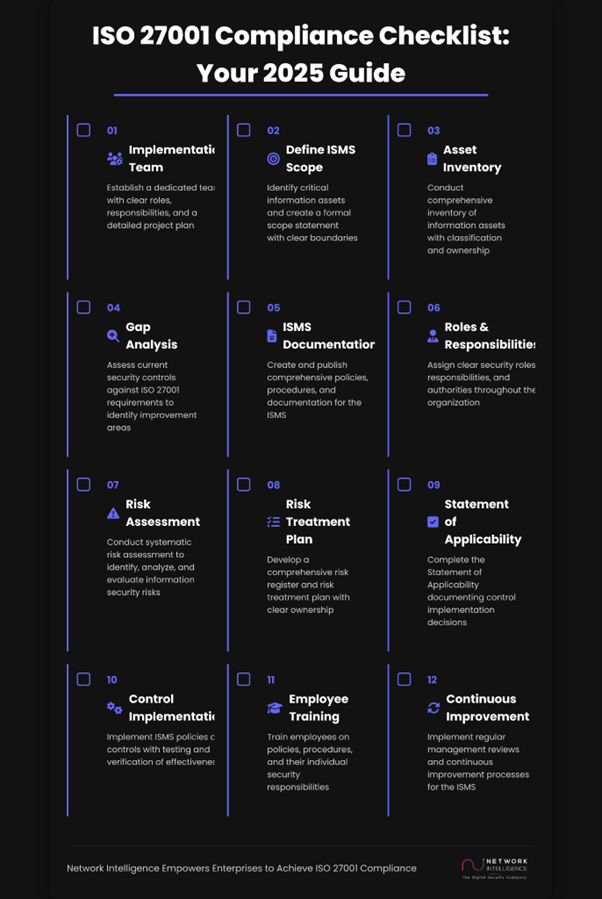
1. Develop an Implementation Team and Project Plan
Successful ISO 27001 implementation requires a dedicated team with clearly defined roles and responsibilities. Organizations should:
- Establish an ISO 27001 Steering Committee comprising senior management representatives from key departments including IT, legal, HR, operations, and finance to provide strategic direction and resource allocation.
- Appoint an Information Security Manager responsible for day-to-day implementation activities, documentation development, and coordination across departments.
- Create a RACI Matrix (Responsible, Accountable, Consulted, Informed) that maps specific implementation tasks to team members, ensuring clear accountability and efficient communication.
- Develop a Detailed Project Plan with realistic timelines, milestones, resource requirements, and dependencies. Most organizations require 9-12 months for initial implementation, though this varies based on organizational size and complexity.
- Secure Executive Sponsorship through formal commitment from senior management, documented in meeting minutes and policy statements that demonstrate leadership support.
Implementation teams should establish regular reporting mechanisms that provide stakeholders with visibility into progress, challenges, and resource requirements throughout the certification journey.
2. Define the Scope of Your ISMS
Defining appropriate ISMS scope represents a critical strategic decision that balances certification complexity against business value. Organizations should:
- Identify Critical Information Assets including systems, applications, databases, and physical locations that store, process, or transmit sensitive information.
- Document Business Processes covered by the ISMS, including core operational processes, support functions, and outsourced activities that affect information security.
- Consider External Factors including regulatory requirements, contractual obligations, and customer expectations that influence scope decisions.
- Create a Formal Scope Statement that clearly defines ISMS boundaries, including any exclusions with justifications that will satisfy certification auditors.
- Develop a Scope Diagram illustrating information flows, system boundaries, and organizational interfaces that provides visual representation of ISMS coverage.
Organizations may choose phased implementation approaches that begin with critical business units or systems before expanding to enterprise-wide coverage, though this requires careful planning to ensure consistent security practices across the organization.
3. Conduct an Inventory of Information Assets
Comprehensive asset management provides the foundation for effective risk assessment and security control implementation. Organizations should:
- Develop Asset Classification Criteria based on confidentiality, integrity, and availability requirements that enable consistent protection levels across similar assets.
- Create and Maintain Asset Registers documenting hardware, software, data, and supporting services with assigned ownership, location, and security classification.
- Identify Critical Dependencies between assets that could create cascading security impacts if compromised, ensuring appropriate protection for supporting infrastructure.
- Document Information Flows showing how information moves between systems, departments, and external entities to identify potential security vulnerabilities at transfer points.
- Establish Asset Management Procedures for ongoing inventory maintenance, including processes for adding, modifying, and retiring assets that maintain accurate asset information.
Modern asset discovery tools can accelerate initial inventory development while providing continuous monitoring capabilities that detect unauthorized or unmanaged assets that could create security vulnerabilities.
4. Perform a Gap Analysis
Gap analysis provides critical insights into existing security capabilities and improvement requirements before significant implementation investments. Organizations should:
- Assess Current Security Controls against ISO 27001 requirements using structured assessment methodologies that evaluate both control existence and effectiveness.
- Identify Documentation Gaps between existing policies, procedures, and records compared to ISO 27001 documentation requirements.
- Evaluate Governance Structures including roles, responsibilities, and reporting relationships against standard requirements for security oversight and accountability.
- Analyze Resource Capabilities including personnel skills, technological tools, and financial resources available for implementation activities.
- Develop Prioritized Remediation Plans that address critical gaps first while establishing realistic timelines for comprehensive compliance achievement.
Gap analysis findings should be documented in a formal report with executive summary highlighting key findings, prioritized recommendations, and resource requirements that support implementation planning and resource allocation decisions.
Building Your Information Security Management System (ISMS)
5. Create and Publish ISMS Policies, Procedures, and Documentation
ISO 27001 requires comprehensive documentation that demonstrates systematic security management. Organizations should develop:
- Information Security Policy approved by senior management that establishes security principles, objectives, and compliance requirements while demonstrating leadership commitment.
- Risk Assessment Methodology documenting approaches for identifying, analyzing, and evaluating information security risks, including assessment frequency and risk acceptance criteria.
- Control Documentation describing implemented security controls, responsible parties, and measurement approaches that demonstrate control effectiveness.
- Operational Procedures providing detailed instructions for security-related activities including access management, incident response, change management, and backup operations.
- Records Management System ensuring retention of required evidence including risk assessments, audit results, training records, and incident reports that demonstrate ongoing compliance.
Documentation should follow a hierarchical structure with high-level policies supported by detailed procedures and work instructions that provide practical guidance for security implementation throughout the organization.
6. Assign Roles and Responsibilities
Clear accountability represents a fundamental requirement for effective security governance. Organizations should:
- Define Security Governance Structure including security committees, working groups, and reporting relationships that establish clear decision-making authorities.
- Document Role Descriptions for key security positions including Chief Information Security Officer, Information Security Manager, System Owners, and Data Custodians.
- Establish Segregation of Duties for sensitive functions to prevent conflicts of interest or excessive privilege concentration that could enable abuse.
- Implement Delegation Procedures ensuring security responsibilities remain fulfilled during personnel absences or organizational changes.
- Communicate Security Responsibilities to all personnel through formal role descriptions, performance objectives, and regular reinforcement in team meetings and communications.
Organizations should consider implementing security responsibility matrices that map specific security controls to responsible individuals, ensuring comprehensive coverage while preventing accountability gaps that could compromise security effectiveness.
7. Conduct a Risk Assessment
Risk assessment provides the foundation for control selection and implementation prioritization. Organizations should:
- Identify Threat Scenarios relevant to the organization’s context, including both external threats (hackers, natural disasters) and internal threats (employee errors, malicious insiders).
- Assess Vulnerabilities in systems, processes, and controls that could be exploited by identified threats, considering both technical and procedural weaknesses.
- Evaluate Potential Impacts of security incidents on confidentiality, integrity, and availability of information assets, including business, legal, and reputational consequences.
- Determine Risk Likelihood based on threat capability, vulnerability exposure, and existing control effectiveness to establish realistic probability estimates.
- Calculate Risk Levels using consistent methodologies that combine impact and likelihood assessments to prioritize risk treatment activities.
Risk assessments should be documented with clear methodologies, assumptions, and limitations to ensure consistency across assessment cycles while providing auditable evidence of risk-based decision making.
8. Develop a Risk Register and Risk Treatment Plan
Effective risk management requires structured approaches for tracking and addressing identified risks. Organizations should:
- Create a Comprehensive Risk Register documenting identified risks, risk owners, current control status, risk ratings, and treatment decisions that provides centralized visibility into organizational risk posture.
- Determine Risk Treatment Options for each identified risk, including risk modification (implementing controls), risk retention (accepting the risk), risk avoidance (eliminating the risk source), or risk sharing (transferring the risk).
- Document Treatment Justifications explaining the rationale for selected treatment approaches, particularly for accepted risks that exceed normal risk appetite thresholds.
- Assign Implementation Responsibilities with clear timelines, resource requirements, and success criteria for each treatment action.
- Establish Monitoring Mechanisms for tracking treatment implementation progress and evaluating treatment effectiveness after implementation.
Risk treatment plans should be reviewed and approved by appropriate management levels based on risk severity, ensuring executive visibility and accountability for significant risk decisions.
9. Complete the Statement of Applicability (SoA)
The Statement of Applicability represents a critical certification document that demonstrates systematic control selection. Organizations should:
- Review All Annex A Controls to determine applicability based on risk assessment results, regulatory requirements, and business objectives.
- Document Implementation Status for each control, indicating whether the control is implemented, partially implemented, planned, or not applicable.
- Provide Justifications for excluded controls, explaining why the control is unnecessary or how equivalent protection is achieved through alternative measures.
- Map Controls to Risks showing how implemented controls address specific risks identified during risk assessment, demonstrating risk-based control selection.
- Obtain Management Approval for the completed SoA, confirming executive acceptance of the control framework and any residual risks from excluded controls.
The SoA should be maintained as a living document that reflects changes in risk assessment results, business requirements, and control implementations throughout the ISMS lifecycle.
10. Implement ISMS Policies and Controls
Effective implementation transforms documented requirements into operational security practices. Organizations should:
- Develop Implementation Plans for each control area, including technical configurations, procedural changes, and resource requirements with realistic timelines.
- Prioritize Implementation Activities based on risk levels, dependencies, and resource availability to address highest-risk areas first while maintaining implementation momentum.
- Establish Testing Procedures to verify control effectiveness before full deployment, ensuring controls achieve intended security objectives without unintended consequences.
- Document Implementation Evidence including configuration settings, procedure documents, and verification results that demonstrate control implementation.
- Conduct Post-Implementation Reviews to confirm controls are operating as intended and achieving expected risk reduction outcomes.
Organizations should consider phased implementation approaches that bundle related controls into implementation sprints, allowing focused effort while demonstrating incremental progress to stakeholders and certification bodies.
11. Train Employees on Policies and Procedures
Human factors significantly influence security effectiveness regardless of technical control strength. Organizations should:
- Develop Role-Based Training Programs tailored to specific security responsibilities, ensuring personnel receive appropriate depth of training for their functions.
- Conduct General Security Awareness Training for all personnel covering basic security practices, incident reporting procedures, and individual security responsibilities.
- Implement Specialized Training for security team members, system administrators, and other technical personnel responsible for security control implementation and maintenance.
- Establish Training Verification Mechanisms including knowledge assessments, practical demonstrations, and performance monitoring that confirm training effectiveness.
- Maintain Comprehensive Training Records documenting training content, completion dates, assessment results, and refresher requirements that demonstrate compliance with training requirements.
Training programs should incorporate real-world scenarios and practical examples relevant to the organization’s context, improving retention and application of security knowledge in daily activities.
Auditing and Certification Process
12. Gather Documentation and Evidence
Comprehensive documentation provides the foundation for successful certification audits. Organizations should:
- Create a Certification Evidence Portfolio organizing required documentation including policies, procedures, risk assessments, the Statement of Applicability, and implementation evidence.
- Implement Document Control Procedures ensuring consistent formatting, version control, approval processes, and distribution methods that maintain documentation integrity.
- Collect Implementation Evidence including system configurations, access control lists, backup logs, training records, and other operational artifacts that demonstrate control effectiveness.
- Prepare Management Reports summarizing ISMS performance, risk status, and improvement activities that demonstrate management oversight and engagement.
- Organize Evidence by Control creating clear mappings between ISO 27001 requirements, organizational documentation, and supporting evidence that facilitates efficient audit reviews.
Evidence collection should be integrated into ongoing operations rather than conducted as a separate pre-audit activity, ensuring documentation remains current and accurately reflects actual security practices.
13. Conduct an Internal Audit
Internal audits provide critical preparation for certification assessments while supporting continuous improvement. Organizations should:
- Establish an Internal Audit Program defining audit scope, frequency, methodologies, and reporting requirements that ensure comprehensive ISMS coverage.
- Ensure Auditor Independence by selecting auditors who are not responsible for the areas being audited, potentially using cross-functional audit teams or external consultants.
- Develop Audit Checklists based on ISO 27001 requirements and organizational policies that ensure consistent and thorough assessments across audit cycles.
- Document Audit Findings including both conformities and nonconformities with clear descriptions, evidence references, and severity classifications.
- Track Corrective Actions for identified nonconformities, including responsible parties, implementation timelines, and verification methods that ensure effective resolution.
Internal audit reports should be presented to senior management, providing visibility into ISMS effectiveness while demonstrating management review and oversight to certification auditors.
14. Undergo a Stage 1 Audit
The Stage 1 audit evaluates ISMS documentation and readiness for detailed assessment. Organizations should:
- Select an Accredited Certification Body with relevant industry experience, appropriate accreditations, and compatible assessment approaches that align with organizational needs.
- Prepare Key Documentation including the scope statement, information security policy, risk assessment methodology, risk treatment plan, Statement of Applicability, and internal audit results.
- Brief Key Personnel on audit objectives, processes, and their specific roles during the assessment to ensure consistent and accurate information provision.
- Address Documentation Gaps identified during pre-audit preparation, ensuring all required policies, procedures, and records are complete and approved.
- Establish Logistics Arrangements including meeting spaces, system access, and personnel availability that support efficient audit execution.
Organizations should view the Stage 1 audit as a valuable learning opportunity, using auditor feedback to strengthen documentation and implementation before proceeding to the more detailed Stage 2 assessment.
15. Undergo a Stage 2 (External) Audit
The Stage 2 audit evaluates ISMS implementation and effectiveness through detailed examination. Organizations should:
- Prepare Operational Evidence demonstrating control implementation and effectiveness, including system configurations, logs, records, and other operational artifacts.
- Brief Operational Personnel on audit objectives and their roles during the assessment, ensuring they can accurately describe security practices and locate supporting evidence.
- Assign Escorts for auditors who understand both the ISMS requirements and organizational operations, facilitating efficient information gathering while ensuring appropriate access controls.
- Document Audit Findings in real-time, including both identified nonconformities and positive observations that provide balanced perspective on ISMS performance.
- Conduct Daily Debriefs with the audit team to clarify findings, address misunderstandings, and prepare for subsequent audit activities.
Organizations should maintain a collaborative approach with auditors, viewing the certification process as a partnership for security improvement rather than an adversarial inspection.
16. Address Any Nonconformities
Effective nonconformity management demonstrates commitment to continuous improvement. Organizations should:
- Analyze Root Causes for identified nonconformities, looking beyond symptoms to identify underlying process, resource, or knowledge deficiencies that require correction.
- Develop Corrective Action Plans with clear responsibilities, timelines, and success criteria that address both immediate issues and prevention of recurrence.
- Implement Corrective Actions promptly, particularly for major nonconformities that could prevent certification if not adequately addressed.
- Verify Effectiveness of implemented corrective actions through testing, monitoring, or focused audits that confirm the nonconformity has been resolved.
- Document Resolution Evidence including implementation artifacts, verification results, and management approvals that demonstrate comprehensive nonconformity closure.
Organizations should maintain transparent communication with certification bodies regarding nonconformity status, providing regular updates on correction progress and requesting clarification when needed.
17. Obtain ISO 27001 Certification
Certification represents formal recognition of ISMS conformity with ISO 27001 requirements. Organizations should:
- Review Certification Reports thoroughly, understanding any observations or improvement opportunities identified during the assessment.
- Distribute Certification Information to relevant stakeholders including customers, partners, and regulators who may require verification of certification status.
- Update Security Documentation to incorporate auditor feedback and improvement opportunities identified during the certification process.
- Celebrate Achievement with implementation team members and the broader organization, recognizing the significant effort required for successful certification.
- Plan for Surveillance Activities including required documentation updates, internal audits, and management reviews that maintain certification status.
Organizations should leverage certification as a marketing and competitive advantage, highlighting their commitment to information security while maintaining focus on the ongoing security improvements that certification requires.
Maintaining and Improving Your ISMS
18. Plan for Ongoing Audits and Surveillance
Certification maintenance requires ongoing verification activities throughout the three-year certification cycle. Organizations should:
- Establish a Surveillance Audit Schedule aligned with certification body requirements, typically including annual surveillance audits and a recertification audit every three years.
- Maintain Continuous Compliance through regular control monitoring, documentation updates, and proactive nonconformity identification that prevents certification issues.
- Prepare Surveillance Evidence demonstrating ongoing ISMS operation including management reviews, internal audits, corrective actions, and control monitoring results.
- Track Certification Requirements including standard revisions, certification body policies, and accreditation requirements that may affect ongoing compliance.
- Budget for Certification Activities including surveillance audit fees, potential consulting support, and internal resource requirements that ensure adequate resources for certification maintenance.
Organizations should view surveillance audits as opportunities for independent feedback rather than compliance hurdles, using auditor insights to strengthen security practices and identify improvement opportunities.
19. Conduct Regular Management Reviews
Management reviews demonstrate leadership engagement while ensuring ISMS alignment with organizational objectives. Organizations should:
- Schedule Regular Reviews at planned intervals, typically quarterly or semi-annually, with additional reviews following significant security incidents or organizational changes.
- Prepare Comprehensive Inputs including audit results, performance metrics, risk status, corrective actions, and external factors that provide complete perspective on ISMS performance.
- Document Review Outcomes including decisions, actions, and resource allocations that demonstrate management commitment and oversight.
- Track Action Implementation from previous reviews, ensuring management directions are implemented effectively and providing closure evidence for subsequent reviews.
- Communicate Review Results to relevant stakeholders, ensuring security priorities and directions are understood throughout the organization.
Management reviews should balance compliance verification with strategic security direction, ensuring the ISMS remains aligned with evolving business objectives and threat landscapes.
20. Commit to Continuous Improvement
Effective security management requires ongoing enhancement beyond minimum compliance requirements. Organizations should:
- Establish Improvement Mechanisms including suggestion programs, lessons learned reviews, and benchmarking activities that identify enhancement opportunities.
- Monitor Security Trends through threat intelligence, industry forums, and vendor advisories that provide insights into emerging threats and defensive capabilities.
- Conduct Regular Assessments beyond certification requirements, including penetration testing, red team exercises, and security architecture reviews that identify improvement opportunities.
- Implement Security Metrics measuring both compliance status and security effectiveness, providing data-driven insights for improvement prioritization.
- Foster Security Culture through ongoing awareness activities, recognition programs, and leadership messaging that encourages security ownership throughout the organization.
Improvement activities should be documented and tracked through formal processes, providing evidence of continuous enhancement for certification audits while delivering tangible security benefits.
21. Consider Automation for Streamlining Compliance
Technology enablement significantly reduces compliance overhead while improving security effectiveness. Organizations should consider:
- Compliance Management Platforms that centralize documentation, track control status, and generate compliance reports that reduce manual effort while improving visibility.
- Security Automation Tools for continuous control monitoring, configuration verification, and vulnerability management that provide real-time compliance insights.
- Integrated Risk Management Systems connecting risk assessments, control implementations, and compliance requirements that demonstrate risk-based security approaches.
- Evidence Collection Automation capturing system logs, configuration settings, and access reviews that provide comprehensive compliance evidence with minimal manual effort.
- Workflow Automation for approval processes, exception management, and corrective action tracking that ensures consistent process execution while maintaining audit trails.
Automation investments should be evaluated based on both compliance efficiency improvements and broader security effectiveness benefits, ensuring technology enablement delivers comprehensive value beyond certification requirements.
Common Challenges in Achieving ISO 27001 Compliance
Lack of Internal Expertise
Many organizations struggle with limited internal knowledge of ISO 27001 requirements and implementation approaches. Common challenges include:
- Misinterpreting Requirements leading to inappropriate control implementations or documentation that fails to satisfy certification criteria.
- Inefficient Implementation approaches that consume excessive resources or create unnecessary operational disruption during security enhancement.
- Inadequate Documentation that fails to demonstrate compliance despite effective security practices being operational within the organization.
- Inconsistent Application of security principles across different organizational units, creating compliance gaps and security vulnerabilities.
- Limited Audit Preparation resulting in unnecessary nonconformities that could have been addressed proactively with better understanding of audit expectations.
Organizations can address expertise gaps through targeted training programs, external consultant engagement, certification body guidance, and participation in ISO 27001 implementation communities that provide practical implementation insights.
Resource Allocation Challenges
Balancing ISO 27001 implementation with other business priorities presents significant challenges for many organizations. Common issues include:
- Competing Priorities between security improvements and operational initiatives, particularly when security benefits appear less tangible than business enhancements.
- Insufficient Budget Allocation for technology investments, consulting support, or dedicated personnel needed for effective implementation.
- Unrealistic Timelines that fail to account for implementation complexity, existing workloads, and organizational change management requirements.
- Inadequate Executive Support resulting in resource constraints, implementation delays, and limited organizational adoption of security requirements.
- Implementation Fatigue during extended certification journeys, particularly when visible progress appears limited despite significant effort investment.
Successful organizations address resource challenges through phased implementation approaches, clear business case development, executive sponsorship cultivation, and integration of security improvements with broader business initiatives that create implementation synergies.
Documentation Gaps
Maintaining comprehensive documentation across all ISMS requirements proves challenging for many organizations. Common documentation issues include:
- Inconsistent Documentation across different control areas, creating confusion about security requirements and implementation approaches.
- Outdated Policies that no longer reflect actual security practices, creating compliance gaps despite effective operational controls.
- Missing Procedural Details that prevent consistent security implementation across different personnel or organizational units.
- Inadequate Evidence Retention failing to maintain records that demonstrate control operation and effectiveness over time.
- Excessive Documentation creating maintenance burdens and potential inconsistencies without delivering proportional security or compliance benefits.
Organizations can address documentation challenges through structured document hierarchies, template standardization, document management systems, and regular review cycles that maintain documentation accuracy and relevance throughout the ISMS lifecycle.
Helpful ISO 27001 Implementation Tips
Successful ISO 27001 implementation requires both technical expertise and effective project management. Organizations benefit from these practical approaches:
Start with Clear Scope Definition that balances certification ambition with implementation practicality. Many organizations achieve initial certification for critical business units before expanding to enterprise-wide coverage, reducing implementation complexity while delivering early certification benefits.
Leverage Existing Controls rather than implementing entirely new security measures. Most organizations have significant security capabilities that can be formalized and documented to satisfy ISO 27001 requirements without extensive operational changes.
Integrate with Existing Management Systems including quality management (ISO 9001), IT service management (ISO 20000), or business continuity management (ISO 22301) that may share common requirements and documentation approaches.
Develop Implementation Phases with clear milestones, deliverables, and success criteria that maintain implementation momentum while providing regular achievement recognition for implementation teams.
Establish Documentation Templates ensuring consistent formatting, content structure, and approval processes across all ISMS documentation that improves both development efficiency and usability.
Focus on Practical Security rather than documentation exercises, ensuring security controls deliver genuine protection while satisfying compliance requirements rather than creating paper-based security that fails under actual threat conditions.
Communicate Implementation Benefits beyond certification achievement, highlighting improved risk management, reduced incident impacts, enhanced customer trust, and competitive advantages that maintain organizational support throughout the implementation journey.
How Network Intelligence Empowers Enterprises to Achieve and Sustain ISO 27001 Compliance
Network Intelligence transforms ISO 27001 implementation from complex compliance exercises into strategic security enablement through our comprehensive approach combining expert consulting services with innovative technology solutions.
Transilience AI Platform revolutionizes ISO 27001 compliance through autonomous capabilities that dramatically reduce implementation overhead while improving security effectiveness:
- Automated Evidence Collection continuously gathers compliance artifacts across 100+ control points without manual intervention, eliminating traditional documentation burdens while providing comprehensive audit trails.
- Continuous Control Monitoring delivers real-time compliance visibility through 24/7 surveillance of security configurations, access controls, and system settings that identifies compliance drift immediately rather than during periodic assessments.
- Intelligent Risk Assessment leverages advanced analytics to identify, prioritize, and track information security risks, providing data-driven insights that support risk-based control selection and implementation prioritization.
- Compliance Dashboards provide executive visibility into certification readiness, control effectiveness, and improvement opportunities through intuitive visualizations that transform complex compliance data into actionable insights.
- Automated Remediation Guidance delivers contextual recommendations for addressing compliance gaps, accelerating remediation activities while ensuring alignment with ISO 27001 requirements.
Expert Advisory Services complement our technology platform with specialized expertise that guides organizations through the certification journey:
- Gap Assessment Services evaluate existing security capabilities against ISO 27001 requirements, identifying improvement priorities and developing realistic implementation roadmaps tailored to organizational context.
- Documentation Development creates comprehensive policy frameworks, procedures, and records that satisfy certification requirements while reflecting actual organizational practices and security objectives.
- Implementation Support provides hands-on assistance with control deployment, evidence collection, and certification preparation that accelerates implementation timelines while reducing internal resource requirements.
- Audit Preparation delivers mock assessments, nonconformity remediation support, and certification body coordination that maximizes certification success probability while minimizing audit stress.
- Continuous Improvement Guidance identifies enhancement opportunities beyond minimum compliance requirements, ensuring the ISMS delivers ongoing security value throughout its lifecycle.
Our integrated approach delivers measurable benefits including:
- 40% faster certification achievement compared to traditional consulting approaches
- 65% reduction in ongoing compliance maintenance effort through automation
- 83% improvement in real-time compliance visibility through continuous monitoring
- 92% of clients achieving certification on their first attempt with our comprehensive support
Network Intelligence’s unique combination of deep security expertise and innovative compliance automation transforms ISO 27001 from a compliance checkbox into a strategic security foundation that delivers lasting organizational value.Talk to an expert