


1. Understanding NERC CIP: Framework and Importance
1.1 What is NERC CIP?
NERC CIP (North American Electric Reliability Corporation Critical Infrastructure Protection) is a comprehensive regulatory framework designed to protect the cybersecurity and physical security of bulk electric systems. The standards employ a risk-based strategy that focuses on identifying critical assets, assessing threats, and implementing proportional security measures to safeguard the nation’s electrical grid.
These mandatory standards establish minimum security requirements for digital and physical assets deemed critical to the reliable operation of North America’s bulk electric system. The framework addresses both cybersecurity and physical security through a comprehensive set of requirements that organizations must implement and maintain.
1.2 Historical Overview and Evolution
Version 5 of NERC CIP marked a significant transformation in the regulatory landscape, introducing mandatory, enforceable standards that moved beyond voluntary guidelines. The framework has continued to evolve with regulatory directives, including FERC Order No. 887, which represents a significant tightening of oversight for grid security.
Most recently, on March 11, 2025, NERC announced modifications to its Critical Infrastructure Protection standards in response to escalating cybersecurity threats facing the Bulk Power System (BPS). These updates reflect the evolving threat landscape and incorporate lessons learned from recent security incidents affecting critical infrastructure.
1.3 The 14 Core Standards of NERC CIP
The NERC CIP framework encompasses multiple core standards addressing different aspects of critical infrastructure protection:
- CIP-002: Asset identification and categorization
- CIP-003: Security management controls and policies
- CIP-004: Personnel and training
- CIP-005: Electronic security perimeters
- CIP-006: Physical security of BES cyber systems
- CIP-007: System security management
- CIP-008: Incident reporting and response planning
- CIP-009: Recovery plans for BES cyber systems
- CIP-010: Change management and vulnerability assessments
- CIP-011: Information protection
- CIP-012: Communications between control centers
- CIP-013: Supply chain risk management
- CIP-014: Physical security
- CIP-015: Electronic Security Perimeter Communications (proposed)
These standards collectively address cybersecurity, physical security, operational best practices, access control, continuous monitoring, and risk-based protection.
1.4 Latest Developments and Regulatory Updates
The 2025 NERC CIP updates introduce expanded and clarified cybersecurity requirements for all Bulk Electric System (BES) Cyber Systems. The revised standards—CIP-003-9, CIP-005-7, CIP-010-4, and CIP-013-2—increase cybersecurity resilience across the industry.
These modifications include stricter requirements for access control, network segmentation, incident response, and new mandates for supply chain risk management to address ransomware and nation-state attacks. The updates reflect growing concerns about sophisticated threat actors targeting critical infrastructure and the need for enhanced protection measures.
1.5 The Role of Compliance in Cybersecurity Enhancement
NERC CIP compliance directly strengthens grid security through several enforcement mechanisms. The Compliance Monitoring and Enforcement Program (CMEP) conducts regular audits, self-assessments, and onsite reviews to verify that protections are in place.
Non-compliance can result in substantial fines reaching millions, with a 20% increase in penalties compared to 2024, indicating a stricter enforcement stance. Lessons learned from enforcement feed back into refining CIP standards, creating a dynamic cycle of continuous improvement.
Beyond regulatory compliance, implementing NERC CIP standards establishes a robust security foundation that protects critical infrastructure from evolving threats while ensuring operational resilience and reliability.
2. Identification and Categorization of BES Cyber Assets
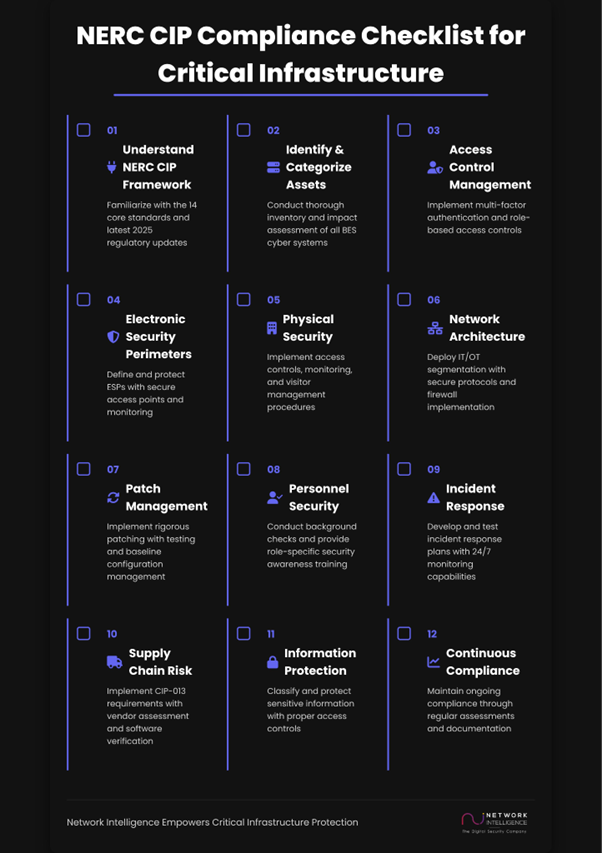
2.1 Step 1: Identify Systems
Begin by conducting a thorough inventory of all Bulk Electric System (BES) cyber assets and cyber systems within your organization’s operational environment. This identification phase is foundational and requires mapping every device—virtual and physical—that is capable of impacting BES operations. Modern compliance demands granular inventory crossing the IT/OT (Information Technology/Operational Technology) divide, making network visibility essential.
Key identification activities include:
- Defining all BES Cyber Systems per CIP-002 requirements
- Mapping assets and communication pathways between IT and OT domains
- Documenting and justifying all interconnections
- Creating network diagrams showing system boundaries and data flow mappings
- Identifying systems that support critical functions
This comprehensive identification process establishes the scope of your NERC CIP compliance program and ensures no critical systems are overlooked in subsequent security implementations.
2.2 Step 2: Inventory Assets
Once systems are identified, conduct asset scans that capture:
- IP/MAC addresses
- Hostnames
- Operating system versions
- Patch history
- Installed applications
- Communication protocols
- Hardware specifications
Export this inventory data (e.g., to CSV) for inventory management and analysis in SIEMs (Security Information and Event Management) or Rsyslog servers. This detailed intelligence underpins impact assessment and risk evaluation. Maintain an accurate and current asset register that includes all critical documentation.
Effective asset inventory management requires automated tools that can discover and track assets continuously rather than relying on periodic manual assessments that may miss critical systems or configuration changes.
2.3 Step 3: Categorizing Risk
Perform a thorough impact assessment aligned with NERC’s current guidance to categorize assets into risk levels:
- High-impact BES Cyber Systems: Systems with the potential to cause severe operational impact
- Medium-impact BES Cyber Systems: Systems requiring enhanced protections following recent directives
- Low-impact systems: Systems with lower operational impact
Proper asset categorization is foundational for determining the appropriate type of security measures and risk mitigation strategies for BES cyber systems. This categorization directly informs which specific CIP controls apply to each asset.
Document your categorization methodology and maintain evidence of the assessment process, including any criteria used to determine impact levels and the justification for each categorization decision.
3. Asset Management and Access Control
3.1 Asset Identification & Categorization
Under CIP-002, organizations must establish comprehensive asset identification and classification. This includes identifying Critical Cyber Assets (CCAs) and their associated Electronic Security Perimeters (ESPs), documenting each asset’s function, criticality level, and interconnections with other systems. A gap analysis should pinpoint where current practices fall short of NERC CIP requirements and prioritize risks accordingly.
Key implementation activities include:
- Developing and maintaining a BES Cyber System Information (BCSI) inventory
- Documenting the methodology used for asset identification
- Establishing processes for updating the inventory when changes occur
- Conducting periodic reviews to validate inventory accuracy
- Mapping dependencies between systems to understand cascading impacts
3.2 Access Control and Identity Management
CIP-005 and related standards mandate robust access controls. Key implementation elements include:
- Multi-factor authentication for accessing critical systems
- Role-based access control limiting personnel to necessary system access
- Conduct personnel risk assessments, including criminal background checks and employment history verification for all control room operators and those with third-party access
- Periodic access reviews to ensure access remains appropriate and justified
- Privileged account management with enhanced monitoring
- Secure remote access procedures with session monitoring
Effective access control requires both technical controls and administrative processes that ensure access rights are regularly reviewed and updated based on personnel changes and evolving operational requirements.
3.3 Risk and Access Control Management
Organizations must implement layered defenses that combine multiple security approaches. Access should be continuously monitored, with real-time alerts for suspicious endpoint activity on controllers and workstations. Network activity logging, protocol usage documentation, and device impact tracking ensure accountability.
Organizations should also establish policies for transient devices, requiring mandatory malware scanning before network access. Additional risk management activities include:
- Implementing least privilege principles across all systems
- Establishing account management procedures for provisioning and deprovisioning
- Documenting all access control exceptions with business justifications
- Conducting regular access control audits and reviews
- Implementing automated monitoring for access control violations
4. Security Controls and System Hardening
4.1 Electronic Security Perimeters
Electronic Security Perimeters (ESPs) define the logical boundary around critical cyber systems. Under CIP-005, organizations must:
- Clearly define and document all ESPs
- Implement protective measures for data flows entering and exiting the perimeter
- Monitor and control all connections to and from critical systems
- Maintain current network diagrams reflecting ESP boundaries
- Implement secure access points (Electronic Access Points or EAPs)
- Document and protect all interactive remote access sessions
ESP implementation requires careful planning to ensure critical systems are properly isolated while maintaining necessary operational connectivity. All access points must be identified, protected, and continuously monitored for unauthorized access attempts.
4.2 Physical Security
Beyond cybersecurity, NERC CIP requires physical security measures protecting critical infrastructure. This includes:
- Access controls limiting physical entry to critical facilities
- Monitoring and logging of physical access
- Secure handling of sensitive information
- Environmental controls protecting equipment
- Visitor management procedures
- Physical security incident response plans
- Regular testing of physical security controls
Physical security measures must be documented, tested, and regularly reviewed to ensure they provide adequate protection for critical cyber assets and associated infrastructure.
4.3 Network Architecture & Secure Connectivity
Modern compliance drives network segmentation separating critical systems from less critical infrastructure. Key architectural considerations include:
- Separation of IT and OT domains with documented justification for interconnections
- Secure communication protocols for data transmission
- Firewall implementation and configuration management
- Documentation of all network pathways and data flows
- Implementation of intrusion detection/prevention systems
- Network traffic monitoring and analysis
- Secure remote access solutions
Network architecture should be designed with defense-in-depth principles, providing multiple layers of protection for critical systems and limiting the potential impact of security breaches.
4.4 Patch Management and System Hardening
Organizations must implement rigorous patch management programs that:
- Identify applicable patches for all systems
- Test patches in non-production environments before deployment
- Document all patch deployments with timestamps
- Maintain baseline configurations for all critical systems
- Mandate authentication of software sources and integrity checks before deployment to counter supply chain threats
- Establish mitigation plans for systems that cannot be patched
- Conduct regular vulnerability assessments to verify patch effectiveness
System hardening should include removing unnecessary services, implementing secure configurations, and regularly validating security settings against industry best practices and compliance requirements.
4.5 Configuration and Vulnerabilities Management
CIP-010 requires comprehensive configuration management and vulnerability assessment. This includes:
- Change management processes requiring approval before system modifications
- Configuration baseline documentation
- Regular vulnerability assessments identifying weaknesses
- Penetration testing and security audits
- Remediation tracking for identified vulnerabilities
- Verification of security controls after changes
- Documentation of all configuration changes
Effective configuration management requires automated tools that can detect unauthorized changes and alert security personnel to potential security issues or compliance violations.
5. Personnel Security and Training
5.1 Background Checks and Training
All personnel with access to critical systems must undergo criminal background checks and employment history verification. Organizations should:
- Define roles with access to critical systems
- Conduct background checks before granting access
- Maintain records of all personnel with system access
- Implement periodic recertification processes
- Document access grants and terminations
- Establish criteria for evaluating background check results
- Implement procedures for handling adverse findings
Personnel security measures should be documented in formal policies and procedures, with clear responsibilities assigned for implementation and oversight.
5.2 Cybersecurity Awareness and Training
Organizations must provide regular, role-specific training focused on compliance, social engineering risks, and operational procedures. Effective training programs include:
- Initial security awareness training for all personnel
- Role-specific training for system operators and administrators
- Annual recertification and updates
- Testing and validation of training effectiveness
- Documentation of all training activities
- Specialized training for incident response teams
- Simulated phishing exercises and security drills
Training should be updated regularly to address emerging threats and changes to security policies and procedures, ensuring personnel maintain current knowledge of security requirements and best practices.
5.3 Policy Enforcement, Personnel Training, & Documentation
Policy publication requires that all personnel be aware of and periodically attest to essential cybersecurity policies and roles under CIP requirements. Organizations should:
- Develop comprehensive security policies covering cybersecurity, physical security, and incident response
- Specify handling of unauthorized access and system change tracking
- Include policies addressing network activity logging, protocol usage, and device impacts
- Require regular review and updates of policies to align with evolving standards
- Maintain meticulous documentation—if it’s not documented, it didn’t happen in an auditor’s eyes
- Automate, centralize, and periodically test all evidentiary records
Effective policy enforcement requires clear communication, regular training, and accountability mechanisms that ensure personnel understand and follow established security requirements.
6. Incident Response and Recovery
6.1 Incident Management
CIP-008 establishes requirements for incident reporting and response planning. Organizations must:
- Develop incident response plans defining roles and responsibilities
- Establish procedures for detecting and responding to cyber incidents
- Maintain 24/7 incident monitoring and detection capabilities
- Document all incidents with timestamps and details
- Report incidents to NERC as required
- Conduct post-incident analysis and lessons learned
- Test incident response plans through tabletop exercises and simulations
Incident response capabilities should be regularly tested and updated based on lessons learned from actual incidents and simulated exercises, ensuring the organization can respond effectively to security events.
6.2 Recovery Plans for BES Cyber Systems
CIP-009 requires comprehensive recovery plans addressing “getting back online after an incident.” Recovery planning includes:
- Documented recovery procedures for critical systems
- Recovery time objectives (RTO) and recovery point objectives (RPO)
- Testing and validation of recovery procedures
- Backup systems and redundancy where appropriate
- Personnel training on recovery procedures
- Regular plan updates reflecting system changes
- Documentation of recovery test results
Recovery plans should be integrated with broader business continuity planning to ensure critical operations can be maintained or quickly restored following security incidents or other disruptions.
6.3 Evidence Collection and Documentation
Organizations must maintain auditable records of incident reports and compliance assessments. This includes:
- Incident logs with detailed descriptions
- Timeline documentation
- Root cause analysis
- Corrective action tracking
- Evidence preservation for potential investigations
- Chain of custody documentation for digital evidence
- Lessons learned and process improvements
Evidence collection procedures should be established before incidents occur, ensuring personnel know how to properly document and preserve information that may be needed for investigations or compliance reporting.
7. Supply Chain and Third-Party Risk Management
7.1 Supply Chain Risk Management (CIP-013)
The latest NERC CIP updates emphasize supply chain risk management with new mandates for supply chain risk management protocols. CIP-013 requires organizations to:
- Identify and manage risks from hardware, software, and services
- Develop supplier security requirements
- Assess third-party security postures
- Implement verification procedures for software and hardware
- Establish procurement controls for critical systems
- Monitor vendor compliance with security requirements
- Maintain documentation of supply chain risk assessments
Supply chain security has become increasingly important as threat actors target vendors and service providers as potential entry points into critical infrastructure systems.
7.2 Verify Authenticity and Validity
Organizations must implement rigorous authentication of software sources and integrity checks before deployment. This includes:
- Obtaining software only from authorized, trusted vendors
- Verifying digital signatures and certificates
- Validating software source authenticity
- Documenting all verification activities
- Implementing secure software development practices
- Conducting code reviews for custom applications
- Establishing secure software update processes
Software verification procedures should be documented and consistently applied to all software deployed in critical environments, reducing the risk of malicious code or unauthorized modifications.
7.3 Scan for Malware and Vulnerabilities
Deploy malware protection systems on all critical workstations. For example, install endpoint protection on all Human-Machine Interface (HMI) workstations with real-time scanning enabled and daily signature updates from an air-gapped update server. Organizations should:
- Implement malware scanning on all devices before network access
- Maintain current malware signatures
- Conduct regular vulnerability scans
- Test for known vulnerabilities
- Implement automated scanning for new systems
- Document scanning results and remediation actions
- Establish procedures for handling detected malware
Malware protection should be implemented in layers, with multiple detection mechanisms to identify and block malicious code before it can affect critical systems.
7.4 Keep an Updated Baseline
Maintain detailed baseline configurations including:
- Hardware specifications
- Software versions
- System patches
- Configuration settings
- Access controls
- Documentation of all changes from baseline
- Justification for deviations from standard configurations
Baseline configurations should be documented, securely stored, and regularly updated to reflect authorized changes to systems and applications, providing a reference point for security assessments and change management.
8. Information Protection and Privacy Assurance
8.1 Information Protection
CIP-011 addresses information protection requirements. Organizations must:
- Classify information by sensitivity level
- Implement controls protecting sensitive information
- Define authorized personnel for information access
- Document information handling procedures
- Maintain secure storage and transmission protocols
- Implement information retention and destruction procedures
- Conduct periodic reviews of information protection measures
Information protection measures should address both electronic and physical information, ensuring sensitive data is properly secured throughout its lifecycle from creation to destruction.
8.2 Privacy Assurance
Organizations should develop policies addressing:
- Personal information protection
- Privacy impact assessments for new systems
- Data retention limits
- Personnel access to sensitive information
- Incident response procedures for potential data breaches
- Compliance with applicable privacy regulations
- Regular privacy training for personnel
Privacy considerations should be integrated into security planning and system design, ensuring that personal information is properly protected while meeting operational and compliance requirements.
9. Compliance Strategies and Continuous Improvement
9.1 Step-by-Step Guide to Achieve NERC CIP Compliance
The four main compliance steps are:
- Step 1: Establish comprehensive asset identification and classification of all BES cyber assets and systems
- Step 2: Implement robust access controls and personnel security measures including multi-factor authentication and background checks
- Step 3: Deploy continuous monitoring and incident response capabilities with 24/7 oversight
- Step 4: Maintain ongoing compliance through comprehensive documentation, regular testing, and formal compliance management programs
These steps should be implemented in a systematic manner, with clear milestones and deliverables to track progress toward full compliance with applicable NERC CIP standards.
9.2 Developing Quality Evidence
Effective compliance requires creating comprehensive documentation of all security policies, procedures, and technical measures implemented to meet NERC requirements. This includes:
- Policy documentation with approval dates
- Procedure descriptions with implementation details
- Configuration baselines with change history
- Access logs and audit trails
- Training records and attestations
- Incident logs and responses
- Vulnerability assessment reports
- Penetration testing results
Evidence should be organized and indexed to facilitate retrieval during audits, with clear linkages between specific requirements and the evidence demonstrating compliance.
9.3 Compliance Assessment and Audit Preparation
Organizations must conduct regular vulnerability assessments, penetration testing, and security audits to identify and remediate potential weaknesses. Audit preparation includes:
- Self-assessment against all applicable CIP standards
- Corrective action tracking for identified gaps
- Mock audit exercises
- Evidence organization and indexing
- Stakeholder training on audit procedures
- Preparation of documentation packages for auditors
- Designation of subject matter experts for specific requirements
Proactive assessment and preparation can significantly reduce the stress and uncertainty associated with formal compliance audits while improving overall security posture.
9.4 Compliance as an Ongoing, Organizational Discipline
NERC CIP compliance is not a one-time project but an ongoing, organizational discipline. Continuous improvement strategies include:
- Regular review and updates of security policies
- Annual compliance assessments
- Lessons learned from audit findings
- Industry trend monitoring
- Regulatory update tracking
- Periodic training refreshers
- System architecture reviews
Define roles, responsibilities, and timelines for compliance activities. Establish clear governance structures ensuring accountability for compliance implementation and maintenance.
10. How Network Intelligence Empowers NERC CIP Compliance
10.1 AI-Driven Detection and Response for Critical Infrastructure
Network Intelligence’s advanced AI-driven security solutions provide continuous monitoring and automated threat detection specifically designed for critical infrastructure environments. Our platform enables:
- Real-time threat detection across IT and OT environments
- Automated correlation of security events to identify complex attack patterns
- Continuous monitoring of critical system configurations
- Immediate alerts on potential security violations
- Automated documentation of security events for compliance reporting
Our AI-driven approach significantly reduces detection time for potential security incidents while providing comprehensive visibility across complex infrastructure environments.
10.2 Continuous Threat Exposure Management
Network Intelligence’s Continuous Threat Exposure Management (CTEM) framework provides a systematic approach to identifying, prioritizing, and remediating security vulnerabilities in critical infrastructure environments:
- Automated asset discovery and classification
- Continuous vulnerability scanning and assessment
- Risk-based prioritization of remediation activities
- Automated compliance mapping to NERC CIP requirements
- Real-time visibility into compliance status and potential gaps
Our CTEM approach ensures organizations maintain continuous awareness of their security posture while efficiently allocating resources to address the most critical vulnerabilities.
10.3 Governance, Risk Management, and Compliance Expertise
Network Intelligence brings deep expertise in governance, risk management, and compliance (GRC) for critical infrastructure environments. Our team of certified professionals provides:
- Comprehensive NERC CIP compliance assessments
- Gap analysis and remediation planning
- Policy and procedure development aligned with regulatory requirements
- Compliance documentation and evidence collection support
- Audit preparation and representation
Our GRC expertise helps organizations establish effective compliance programs while reducing the administrative burden associated with maintaining complex regulatory requirements.
10.4 Secure Digital Transformation and Zero Trust Frameworks
Network Intelligence supports secure digital transformation initiatives for critical infrastructure organizations through our Zero Trust implementation framework:
- Secure architecture design for IT/OT integration
- Implementation of least privilege access controls
- Micro-segmentation strategies for critical systems
- Continuous authentication and authorization
- Comprehensive visibility across hybrid environments
Our Zero Trust approach ensures organizations can modernize their infrastructure while maintaining strict security controls aligned with NERC CIP requirements.
10.5 The ADVISE Framework: End-to-End Cybersecurity Lifecycle
Network Intelligence’s proprietary ADVISE framework provides a comprehensive approach to cybersecurity management across the entire security lifecycle:
- Assess: Comprehensive security and compliance assessments
- Design: Security architecture and control design
- Validate: Testing and validation of security controls
- Implement: Efficient deployment of security solutions
- Sustain: Ongoing management and optimization
- Evolve: Continuous improvement and adaptation
The ADVISE framework ensures organizations establish and maintain effective security programs that address both compliance requirements and evolving security threats.
10.6 Trusted by Leading Organizations in Regulated Industries
Network Intelligence has established a proven track record supporting critical infrastructure organizations across multiple sectors:
- Electric utilities and power generation companies
- Oil and gas operators
- Transportation and logistics providers
- Financial institutions with critical infrastructure dependencies
- Healthcare organizations with life-critical systems
Our experience across regulated industries ensures we understand the unique challenges facing critical infrastructure operators and can provide tailored solutions that address specific compliance and security requirements.
Ready to transform your NERC CIP compliance program? Network Intelligence’s team of certified security and compliance experts is ready to help you establish a comprehensive, efficient approach to critical infrastructure protection.
Contact us today to schedule a consultation and learn how our AI-driven security solutions and compliance expertise can help your organization achieve and maintain NERC CIP compliance while enhancing your overall security posture.
Schedule a Consultation
Speak with our NERC CIP compliance experts to assess your current security posture and identify opportunities for improvement.