


Organizations across Europe face mounting pressure to navigate the complex landscape of cybersecurity compliance as the Network and Information Security Directive 2 (NIS2) deadline approaches. Security professionals and compliance teams struggle with translating broad regulatory requirements into actionable technical implementations while managing resource constraints and evolving threat landscapes. This comprehensive guide transforms NIS2’s complex regulatory framework into a practical, step-by-step compliance checklist that empowers organizations to achieve certification efficiently while building robust cybersecurity foundations that extend beyond mere regulatory compliance.
Understanding NIS2 Requirements
The Network and Information Security Directive 2 (NIS2) represents a transformative evolution in European cybersecurity legislation, expanding the original NIS framework to encompass over 160,000 organizations across essential and important entity categories. This directive fundamentally reshapes cybersecurity obligations by establishing comprehensive requirements that extend far beyond traditional security measures to encompass organizational resilience, supply chain security, and executive accountability.
NIS2 creates a two-tiered classification system distinguishing between essential entities—organizations whose services are fundamental to maintaining key societal functions such as energy, transport, banking, healthcare, and water supply—and important entities that support vital economic activities including postal services, waste management, chemicals, and manufacturing. Essential entities face the most stringent security obligations due to the potentially catastrophic consequences of security failures affecting critical national infrastructure.
The directive’s risk-based approach requires organizations to implement systematic cybersecurity measures proportional to the risks they face, moving beyond compliance checkbox exercises to establish genuine security cultures. This methodology emphasizes understanding and prioritizing risks within specific operational contexts rather than applying generic security controls. Organizations must evaluate likelihood and impact scenarios for various cyber risks, map system dependencies that could amplify incident impacts, and allocate security resources to protect the most critical assets supporting essential business functions.
Unlike previous frameworks, NIS2 emphasizes continuous monitoring and assessment requirements, creating operational challenges for organizations that lack automated capabilities for detecting configuration changes and identifying emerging vulnerabilities. The NIST Cybersecurity Framework provides complementary guidance that organizations can integrate with NIS2 requirements to establish comprehensive security programs.
NIS2 Implementation Deadlines
Organizations subject to NIS2 requirements must achieve full compliance by October 17, 2024, with member states having already transposed the directive into national legislation. This compressed timeline creates significant project management challenges for organizations that must balance compliance activities with ongoing business operations and competing resource requirements.
The absence of transition periods in many national implementations creates additional pressure for organizations that must achieve compliance while maintaining operational continuity. Initial implementation estimates suggest minimum timelines of 12 to 18 months for organizations previously not subject to NIS regulations, requiring immediate action for organizations that have not yet initiated compliance programs.
Member states have implemented varying approaches to supervision and enforcement, with some establishing new regulatory bodies while others expanding existing authorities’ mandates. Organizations must understand specific national requirements and supervisory frameworks that apply to their operations, as penalties and enforcement mechanisms vary significantly across different jurisdictions.
The directive’s emphasis on executive accountability creates governance challenges where senior management faces potential personal liability for willful neglect of security responsibilities. Organizations must establish clear lines of responsibility while maintaining operational flexibility and decision-making efficiency that enables rapid response to emerging threats.
Scope of NIS2: Who Must Comply?
NIS2 significantly expands the scope of regulated entities compared to the original NIS directive, covering organizations based on size thresholds and sector classifications rather than purely criticality assessments. Medium and large entities in essential sectors are automatically subject to NIS2 requirements, while important entities may be subject to regulation based on specific national implementations and size criteria.
Essential entities include energy suppliers, transport providers, banking institutions, financial market infrastructures, healthcare organizations, water suppliers, digital service providers, and public administration entities that support critical governmental functions. These organizations face comprehensive supervision requirements including ongoing compliance demonstration through both technical measures and transparent reporting mechanisms.
Important entities encompass postal services, waste management companies, chemical manufacturers, food production and distribution organizations, manufacturing companies producing critical products, digital service providers below essential entity thresholds, and research organizations handling sensitive information. The inclusion of important entities reflects the directive’s recognition that cybersecurity vulnerabilities in supporting sectors can create cascading effects across larger critical infrastructure networks.
Size thresholds generally apply to organizations with more than 50 employees for essential sectors and more than 250 employees for important sectors, though specific implementations vary by member state. Organizations operating across multiple member states must understand overlapping requirements and coordinate compliance approaches across different national frameworks.
Cross-border service providers face particular complexity in determining applicable requirements and supervisory authorities, requiring careful legal analysis to ensure comprehensive compliance across all operational jurisdictions. The official European Commission guidance provides authoritative clarification on scope determinations and cross-border obligations.
Key NIS2 Requirements for Organizations
Risk Management Measures
Organizations must establish systematic risk management processes that identify, assess, and mitigate cybersecurity risks across all critical assets and operations. This requirement extends beyond technological solutions to encompass ongoing assessment, planning, and integration with broader business processes that ensure security considerations are embedded throughout organizational operations.
Comprehensive asset inventories form the foundation of effective risk management, requiring organizations to maintain current records of all hardware, software, data, and network components supporting essential and important services. This process must extend to cloud services, mobile devices, and remote endpoints, ensuring complete visibility into digital landscapes that support critical business functions.
Access control frameworks represent critical implementations that enforce identity and access management controls, including multi-factor authentication and least privilege principles. Organizations must conduct regular access reviews, maintain audit trails, and implement role-based access controls that demonstrate compliance with security policies throughout operational lifecycles.
Supply chain security requires organizations to apply security requirements to third-party providers and suppliers, conduct supplier audits, and maintain registries of direct suppliers. ENISA’s implementation guidance provides detailed recommendations for establishing comprehensive vendor management frameworks that extend security requirements throughout supplier ecosystems.
Environmental and physical security controls protect information systems and infrastructure from physical threats and unauthorized facility access. Organizations must implement appropriate physical access controls, environmental monitoring systems, and security measures that protect against both intentional and accidental damage to systems supporting critical operations.
Accountability and Governance
Clear accountability frameworks define and document security roles and responsibilities, ensuring executive oversight and regular policy updates that reflect evolving threat landscapes and operational changes. Organizations must establish governance structures that align cybersecurity activities with broader business objectives while ensuring compliance with regulatory requirements.
Regular security awareness and training programs must extend beyond traditional cybersecurity awareness to encompass specific NIS2 requirements and organizational responsibilities. Leadership teams must undergo mandatory cybersecurity training that addresses their specific obligations under the directive, including potential personal liability for willful neglect of security responsibilities.
NIS2 Compliance Checklist: 10 Essential Measures
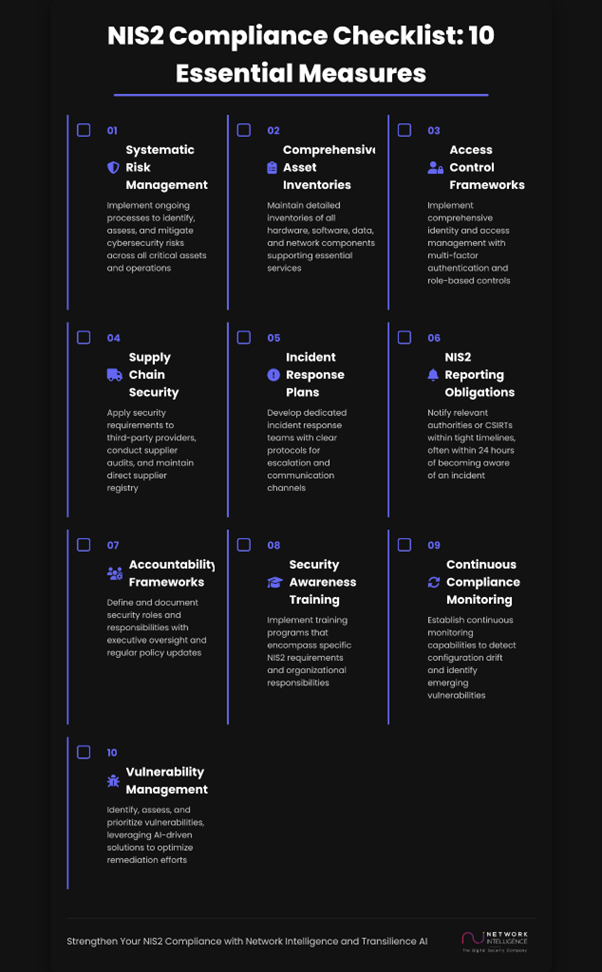
- Establish Systematic Risk Management Processes: Implement ongoing processes to identify, assess, and mitigate cybersecurity risks across all critical assets and operations. This systematic approach must integrate with broader business processes rather than operating as isolated security functions. Organizations should establish regular risk assessment schedules, document risk treatment decisions, and maintain evidence of ongoing risk monitoring activities that demonstrate proactive security management.
- Maintain Comprehensive Asset Inventories: Regularly update inventories of all hardware, software, data, and network components supporting essential and important services. Effective asset management extends beyond simple cataloging to include vulnerability status, configuration baselines, and ownership information that supports rapid incident response and ongoing security management. [Learn more about our Compliance Services for cybersecurity regulations](https://www.networkintelligence.ai/services/compliance-3/) to understand how comprehensive asset management integrates with broader compliance frameworks.
- Implement Access Control Frameworks: Enforce identity and access management controls, including multi-factor authentication and least privilege principles, to protect critical systems and data. Organizations must conduct regular access reviews, implement role-based controls, and maintain audit trails that demonstrate consistent application of security policies. Transilience AI’s automated compliance monitoring capabilities can significantly reduce the manual overhead associated with ongoing access control verification and documentation.
- Ensure Supply Chain Security: Apply security requirements to third-party providers and suppliers, conduct supplier audits, and maintain a registry of direct suppliers. Supply chain security extends organizational security responsibilities throughout vendor ecosystems, requiring contractual security requirements, regular assessments, and ongoing monitoring of supplier security practices that could affect organizational security postures.
- Develop Incident Response Plans: Create and maintain incident response procedures, including escalation protocols and defined communication channels. Effective incident response requires dedicated teams with clear protocols, communication procedures that address both internal stakeholders and external authorities, and business continuity capabilities that minimize impact while restoring normal operations rapidly.
- Meet NIS2 Reporting Obligations: Ensure timely notification to authorities or CSIRTs within required timelines, typically within 24 hours after becoming aware of significant security incidents. Reporting obligations require detailed incident information, impact assessments, and mitigation measures taken, driving organizations toward higher levels of preparedness and documentation that supports regulatory coordination during major cybersecurity events.
- Implement Continuous Compliance Monitoring: Move beyond periodic audits by establishing real-time monitoring for configuration changes, vulnerabilities, and compliance status. Transilience AI’s autonomous monitoring capabilities provide 24/7 surveillance that can detect configuration drift, identify emerging vulnerabilities, and maintain compliance documentation throughout operational lifecycles without requiring dedicated security personnel.
- Conduct Regular Vulnerability Management: Identify, assess, and prioritize vulnerabilities, leveraging AI-driven solutions where possible to optimize remediation efforts. Traditional vulnerability management approaches often overwhelm security teams with extensive vulnerability lists that cannot be addressed with available resources. Advanced platforms like Transilience AI can reduce critical vulnerability backlogs by up to 62% by providing real-world context and prioritization that focuses limited resources on highest-impact risks.
- Establish Clear Accountability Frameworks: Define and document security roles and responsibilities, ensuring executive oversight and regular policy updates. Accountability frameworks must address the directive’s emphasis on executive responsibility while maintaining operational flexibility and decision-making efficiency that enables rapid response to emerging threats and changing operational requirements.
- Maintain Up-to-Date Security Policies and Documentation: Ensure all security policies, procedures, and compliance documentation remain current and aligned with NIS2 requirements. Policy management extends beyond simple documentation to include regular review processes, version control, and integration with operational procedures that ensure policies remain practical and achievable within organizational contexts.
Step-by-Step Guide to Achieving NIS2 Compliance
Successful NIS2 implementation requires a structured approach that begins with comprehensive gap assessments comparing current security postures against directive requirements. Organizations should engage experienced compliance consultants or leverage automated assessment tools that can identify specific areas requiring attention while providing prioritized recommendations for addressing identified gaps.
Initial risk assessments must evaluate threats and vulnerabilities relevant to specific operational contexts, considering both technical risks and business impacts that could result from security incidents. The ISO 27001 framework provides complementary methodologies that organizations can integrate with NIS2 requirements to establish comprehensive risk management approaches.
Policy development phases should focus on creating practical, implementable policies that address NIS2 requirements while remaining achievable within organizational contexts and resource constraints. Policies must cover data handling procedures, access control requirements, incident response protocols, and vendor management frameworks that extend security responsibilities throughout organizational operations.
Technical implementation phases require careful planning to minimize operational disruption while establishing security controls that address identified risks. Organizations should prioritize implementations based on risk assessments, available resources, and operational dependencies that could affect business continuity during implementation activities.
Training and awareness programs must address both general cybersecurity awareness and specific NIS2 requirements that affect individual roles and responsibilities. Explore the NIST Cybersecurity Framework 2.0 for integrated risk management strategies that complement NIS2 requirements with proven implementation methodologies.
Continuous monitoring implementation represents a fundamental shift from periodic assessment approaches to ongoing compliance verification that provides real-time visibility into organizational security postures. Organizations should establish monitoring capabilities that can detect configuration changes, identify emerging vulnerabilities, and maintain documentation that supports ongoing compliance demonstration.
Simplifying NIS2 Compliance with Automation and Security Platforms
Modern compliance platforms offer transformative capabilities for organizations struggling with NIS2 implementation complexity and resource constraints. Automated evidence collection systems can monitor compliance across 100+ control points while providing real-time gap identification and remediation guidance that eliminates traditional manual compliance overhead.
Transilience AI’s autonomous compliance platform delivers industry-first capabilities including fully automated certification processes that require zero human intervention while maintaining comprehensive audit trail documentation. Organizations implementing these solutions typically redirect $150,000 or more in annual compliance overhead to core business development activities while achieving certifications 2+ months faster than traditional consulting approaches.
Integration capabilities enable organizations to incorporate automated compliance monitoring into existing security operations and incident response procedures. Advanced platforms provide API access that supports integration with existing security tools while providing enriched analysis and prioritization that enhances overall security program effectiveness.
Continuous monitoring features provide 24/7 automated surveillance that can detect security incidents, monitor compliance postures, and optimize security metrics including time-to-detection and time-to-response capabilities. These automated capabilities ensure organizations maintain compliance throughout operational lifecycles rather than relying on periodic assessments that may miss emerging risks or configuration changes.
Real-time reporting and dashboard capabilities provide executive visibility into compliance status while supporting ongoing risk management and strategic decision-making processes. Advanced platforms offer customizable reporting that aligns with business objectives while providing detailed evidence that supports audit and assessment activities.
Consequences of Non-Compliance with NIS2
NIS2 establishes significant financial penalties for non-compliance, with maximum fines reaching €10 million or 2% of global annual turnover for essential entities, and €7 million or 1.4% of global turnover for important entities. These penalties represent substantial financial risks that extend beyond simple regulatory costs to encompass reputational damage and operational disruption that can affect long-term business viability.
Executive liability provisions create personal accountability for senior management who demonstrate willful neglect of cybersecurity responsibilities. This personal liability extends beyond corporate penalties to encompass potential individual sanctions that could affect executive careers and personal financial situations.
Operational consequences of non-compliance include potential service restrictions, mandatory security audits, and enhanced supervisory oversight that can significantly increase operational costs and complexity. Regulatory authorities may impose additional requirements or restrictions that limit business operations until compliance deficiencies are addressed.
Market consequences include potential exclusion from supply chains that require demonstrated cybersecurity compliance, loss of customer confidence that could affect revenue and growth prospects, and increased insurance costs that reflect elevated risk profiles associated with non-compliant organizations.
Read our guide on Cybersecurity Compliance: What It Is & Why It Matters to understand broader compliance implications and strategic approaches to managing regulatory requirements across multiple frameworks.
NIS2 vs. Other Cybersecurity Regulations
NIS2 represents a comprehensive approach to cybersecurity regulation that differs significantly from sector-specific frameworks like HIPAA or PCI DSS, focusing on critical infrastructure protection rather than data protection or payment security. While these frameworks share common security objectives, their implementation approaches and oversight mechanisms vary considerably.
Compared to the GDPR, NIS2 emphasizes operational security and incident response capabilities rather than data privacy and individual rights protection. Organizations subject to both frameworks must coordinate compliance approaches to address overlapping requirements while avoiding conflicting implementations that could compromise either compliance objective.
ISO 27001 provides complementary methodology that can support NIS2 implementation, though direct translation approaches are insufficient to address the directive’s specific requirements for incident reporting, supply chain security, and executive accountability. Organizations with existing ISO 27001 implementations may require only limited adjustments to achieve NIS2 compliance, provided they address directive-specific requirements systematically.
The NIST Cybersecurity Framework offers additional implementation guidance that organizations can integrate with NIS2 requirements to establish comprehensive security programs. Understanding the National Information Assurance Policy V2.0 – Qatar for regional compliance alignment demonstrates how organizations can coordinate multiple regulatory frameworks while maintaining operational efficiency.
SOC 2 and other attestation frameworks focus on control effectiveness and audit evidence rather than the broader organizational resilience emphasized by NIS2. Organizations can leverage existing SOC 2 implementations to support NIS2 compliance, though additional requirements for incident reporting and supply chain security must be addressed through supplementary implementations.
Ensuring and Sustaining NIS2 Compliance
Long-term compliance sustainability requires organizations to establish continuous improvement processes that adapt to evolving threat landscapes and regulatory expectations. Organizations must move beyond initial implementation to establish ongoing compliance verification processes that provide real-time visibility into security postures and emerging risks.
Governance frameworks must align cybersecurity activities with broader business objectives while ensuring ongoing compliance with regulatory requirements that may change over time. Organizations should establish compliance committees that include senior management, technical staff, and relevant business units to ensure compliance activities remain practical and achievable within available resources.
Monitoring for policy drift and configuration changes represents critical ongoing activities that prevent gradual degradation of security controls over time. Traditional manual assessment approaches cannot provide the continuous visibility required for effective compliance maintenance, creating dependencies on automated monitoring capabilities that can detect changes as they occur.
Regular training and awareness updates ensure personnel understand evolving compliance requirements and their specific roles in maintaining organizational compliance postures. Organizations must establish training programs that address both initial compliance requirements and ongoing changes that could affect individual responsibilities or organizational procedures.
Vendor management processes require ongoing attention to ensure supply chain security requirements continue to be met as vendor relationships evolve and new suppliers are added to organizational ecosystems. Review our HITRUST Assessment Checklist for comprehensive compliance insights that demonstrate effective approaches to maintaining complex compliance frameworks over time.
Efficient Strategies for Achieving NIS2 Requirements
Organizations can optimize NIS2 implementation by adopting phased approaches that prioritize highest-risk areas while maintaining operational continuity throughout implementation processes. Risk-based prioritization ensures limited resources address the most critical vulnerabilities first while establishing foundations for comprehensive compliance achievement.
Leveraging existing security investments and frameworks can significantly reduce implementation costs and timelines by building upon established security practices rather than implementing entirely new programs. Organizations should conduct thorough assessments of current capabilities before investing in additional tools or services that may duplicate existing functionality.
Automation technologies offer significant opportunities for reducing ongoing compliance overhead while improving compliance effectiveness and accuracy. Transilience AI’s multi-agent architecture provides specialized automation for different security domains, enabling organizations to maintain comprehensive compliance coverage without dedicated security personnel for routine monitoring and documentation activities.
Cross-training security and compliance teams ensures organizations maintain compliance capabilities despite personnel changes while building internal expertise that reduces dependencies on external consultants or service providers. Organizations should establish knowledge management processes that capture compliance expertise and ensure continuity during staff transitions.
Partnership approaches with experienced compliance providers can accelerate implementation while reducing risks associated with complex regulatory requirements. Organizations should evaluate service providers based on their specific expertise with NIS2 requirements rather than generic cybersecurity or compliance capabilities that may not address directive-specific needs.
Act Now—Preparing for NIS2 Enforcement
Organizations that have not yet initiated NIS2 compliance programs face significant challenges in achieving compliance within available timeframes, requiring immediate action to assess current security postures and identify priority implementation areas. Delayed implementation increases both compliance risks and implementation costs as organizations must compress normal development timelines to meet regulatory deadlines.
Immediate assessment activities should focus on identifying critical gaps that could expose organizations to significant penalties or operational risks during initial enforcement phases. Organizations should prioritize incident response capabilities, reporting procedures, and basic security controls that demonstrate good faith compliance efforts while more comprehensive implementations are developed.
Resource allocation decisions made during initial implementation phases will significantly affect long-term compliance sustainability and costs. Organizations should carefully evaluate build-versus-buy decisions for compliance capabilities, considering both immediate implementation costs and ongoing operational requirements that could affect total cost of ownership over time.
Executive engagement represents critical success factors for effective NIS2 implementation, particularly given the directive’s emphasis on senior management accountability. Organizations must ensure executive leadership understands specific obligations and consequences associated with non-compliance while providing necessary resources and authority to support comprehensive implementation efforts.
Documentation and evidence collection processes should be established immediately to support ongoing compliance demonstration, even if full technical implementations are not yet complete. Early establishment of compliance monitoring and documentation capabilities provides foundations for demonstrating good faith efforts while supporting more comprehensive implementations as they are completed.
How Network Intelligence Empowers Your NIS2 Compliance Journey
Network Intelligence transforms NIS2 compliance challenges into strategic advantages through innovative AI-driven solutions that combine 23+ years of global cybersecurity expertise with cutting-edge automation capabilities delivered through Transilience AI. Our comprehensive approach addresses both immediate compliance requirements and long-term security program development needs, enabling organizations to achieve regulatory compliance while building robust cybersecurity foundations that extend far beyond mere checkbox exercises.
Transilience AI’s autonomous compliance platform revolutionizes traditional compliance approaches by delivering guaranteed certification outcomes through advanced AI agents that operate continuously without human intervention. This breakthrough technology has already achieved industry-first milestones, including fully automated SOC2 certifications that require zero dedicated security staff while maintaining comprehensive audit trail documentation and evidence collection across 100+ control points.
Our integrated solution addresses critical NIS2 requirements through intelligent automation that maintains human oversight while eliminating routine manual tasks that traditionally consume significant organizational resources. Real-time configuration monitoring, automated policy compliance verification, and continuous vulnerability assessment capabilities ensure organizations maintain compliance postures throughout operational lifecycles rather than relying on periodic assessments that may miss emerging risks.
The platform’s advanced vulnerability prioritization capabilities address one of the most persistent challenges facing organizations implementing comprehensive security programs within resource constraints. By reducing critical vulnerability backlogs by up to 62% while providing real-world context for vulnerability assessments, Transilience AI enables security teams to focus limited resources on highest-impact risks rather than attempting to address all identified vulnerabilities equally.
Network Intelligence’s ADVISE framework (Assess, Design, Visualize, Implement, Sustain, Evolve) provides proven methodologies for implementing NIS2 requirements systematically while ensuring ongoing compliance sustainability. Our approach integrates regulatory requirements with broader business objectives, creating security programs that enhance operational efficiency rather than creating operational burden.
Don’t let NIS2 compliance challenges overwhelm your organization or divert critical resources from core business objectives. Contact Network Intelligence today to discover how our proven methodologies and breakthrough AI technologies can accelerate your compliance timeline while reducing costs and improving your overall security posture.