


Robust cybersecurity is crucial in this digital era. At the heart of a strong defense is a reliable firewall. While many organizations rely on well-known brands like Palo Alto Networks, it’s wise to explore the market for Palo Alto alternatives and other enterprise firewalls.
Why Consider Palo Alto Alternatives?
Palo Alto Networks is known for advanced threat prevention, deep application visibility (App-ID), and a centralized management platform (Panorama).
However, they can be complex to deploy and manage, and the Palo Alto firewall price can be a significant investment, especially when you factor in additional licensing for features like WildFire, Threat Prevention, and URL Filtering. This is where exploring Palo Alto alternatives becomes critical. Other vendors offer compelling solutions that may provide a better fit for your specific budget, technical expertise, and security requirements.
Key Features of Next-Generation Firewalls (NGFWs)
- Before we dive into the comparison, it’s essential to understand the core functionalities of a modern NGFW (Next-Generation Firewall). A traditional firewall simply filters traffic based on IP addresses and ports, but an NGFW goes much further. Here are the main features mentioned below.
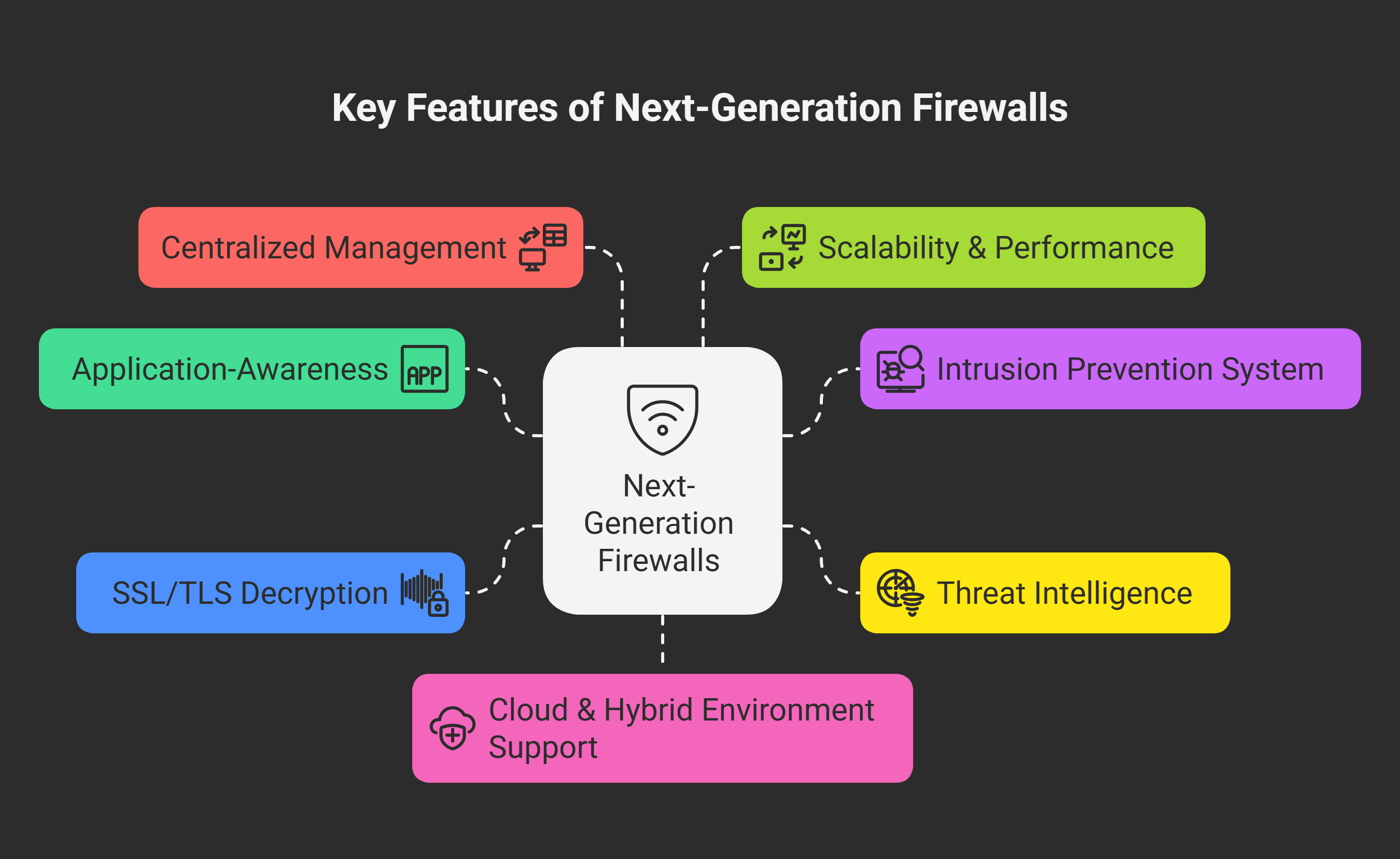
- Application-Awareness (App-ID): Related to identifying and controlling applications.
- Intrusion Prevention System (IPS): A system that actively monitors for malicious activity or policy violations and can block or report them in real-time.
- Threat Intelligence: The firewall should be able to leverage shared, real-time threat intelligence to block known and unknown threats.
- SSL/TLS Decryption: A crucial capability to inspect encrypted traffic, which is where a large percentage of modern threats are hidden.
- Centralized Management: A single, unified console to manage and monitor multiple firewalls across your network.
- Scalability & Performance: The firewall should be able to handle your current network traffic and scale to meet future growth without performance degradation.
- Cloud & Hybrid Environment Support: Seamlessly integrate security policies across on-premises, public, and private cloud environments.
Enterprise Firewall Comparison: Palo Alto and its Top Alternatives
To help you navigate the complex world of enterprise firewalls, we’ve put together a detailed firewall comparison table. We’ll examine some of the leading Palo Alto alternatives and key players in the market, focusing on their strengths, target audience, and key differentiators.
Network Intelligence
While not a traditional hardware firewall manufacturer, Network Intelligence offers a unique proposition that is particularly relevant in the modern cybersecurity landscape.
Their focus is on a comprehensive, AI-driven security platform. Instead of just selling a box, they provide a managed security service that leverages advanced threat intelligence, analytics, and automation. This makes them a strong contender for businesses that want to offload the complexities of managing their own firewalls and security infrastructure.
Key Strengths:
- AI-Powered Threat Detection: Proactive threat hunting and adaptive learning to combat new and unknown threats.
- Managed Services: Their model is built around a fully managed service, which reduces the burden on an internal IT team.
Best For: Organizations that need a managed security service to handle their entire security posture, from firewall management to incident response.
Fortinet
Fortinet is one of the most prominent Palo Alto alternatives, known for its powerful FortiGate series. They have a strong reputation for offering high-performance, cost-effective firewalls with an extensive feature set. Fortinet’s solutions are driven by custom-built security processors (ASICs) that accelerate threat detection without slowing down network traffic.
Key Strengths:
- Performance: FortiGate firewalls are known for their high throughput and low latency, making them ideal for high-traffic environments.
- Built-in SD-WAN: A comprehensive, integrated SD-WAN solution to secure and optimize multi-location connectivity.
- Cost-Effective: Often a more budget-friendly option compared to Palo Alto, especially when considering the total cost of ownership.
Best For: Companies that prioritize a balance of high performance and cost-effectiveness, particularly those with a distributed network infrastructure.
Cisco
Cisco Secure Firewall series is a strong competitor to Palo Alto, providing robust security with deep integration into the broader Cisco ecosystem. Cisco’s firewalls are a natural choice for organizations that already have a significant investment in Cisco networking equipment.
Key Strengths:
- Ecosystem Integration: Seamlessly integrates with other Cisco products, such as ISE (Identity Services Engine) for network access control.
- Trust and Reliability: A globally recognized brand with a reputation for reliable, enterprise-grade hardware.
Best For: Large enterprises that are already deeply integrated into the Cisco networking ecosystem.
Check Point
Check Point is a popular and formidable Palo Alto alternative. They have a long history of innovation, focusing on comprehensive, multi-layered security. Their “Infinity” architecture offers unified threat prevention. It helps in security and threat intelligence.
Key Strengths:
- Advanced Threat Prevention: Known for its strong security posture and ability to stop sophisticated attacks.
- Unified Management: A single management console for managing security policies across the entire network.
- Scalability: Solutions designed to scale from small businesses to the largest enterprises.
Best For: Organizations that demand the highest level of security and are looking for a platform-based approach to threat prevention.
Comparison Table: Palo Alto vs. Top Alternatives
Feature | Network Intelligence | Fortinet | Cisco | Check Point | Palo Alto Networks |
Core Offering | Managed Security Service with AI-powered firewalls | High-Performance NGFW (Next-Generation Firewall) | Integrated Networking & Security | Unified Security Platform | |
Strengths | AI-driven threat detection, fully managed, low operational overhead | High throughput, integrated SD-WAN, cost-effective | Strong ecosystem integration, reliable hardware | Advanced threat prevention, unified management | Application visibility, threat intelligence, and centralized management |
Best For | Organizations seeking a managed security service to simplify operations | Businesses needing high-performance firewalls at a competitive price | Companies with existing Cisco infrastructure | Enterprises prioritizing comprehensive, multi-layered security | Large enterprises requiring deep application and user visibility |
Key Differentiator | AI-powered security as a service, not just a product | Custom-built security processors for high performance | Deep integration with a vast networking ecosystem | Pioneering security and advanced threat intelligence | Industry-leading App-ID and centralized Panorama management |
Pricing Model | Service-based, often a subscription per user or device | Hardware and subscription licenses | Hardware and software licenses, tiered | Subscription licenses, per gateway or user | Hardware and subscription licenses, per feature |
Choosing the Right Firewall for Your Business
Selecting the right enterprise firewall is a critical decision that requires a thorough evaluation of your organization’s specific needs. Here are some factors to consider:
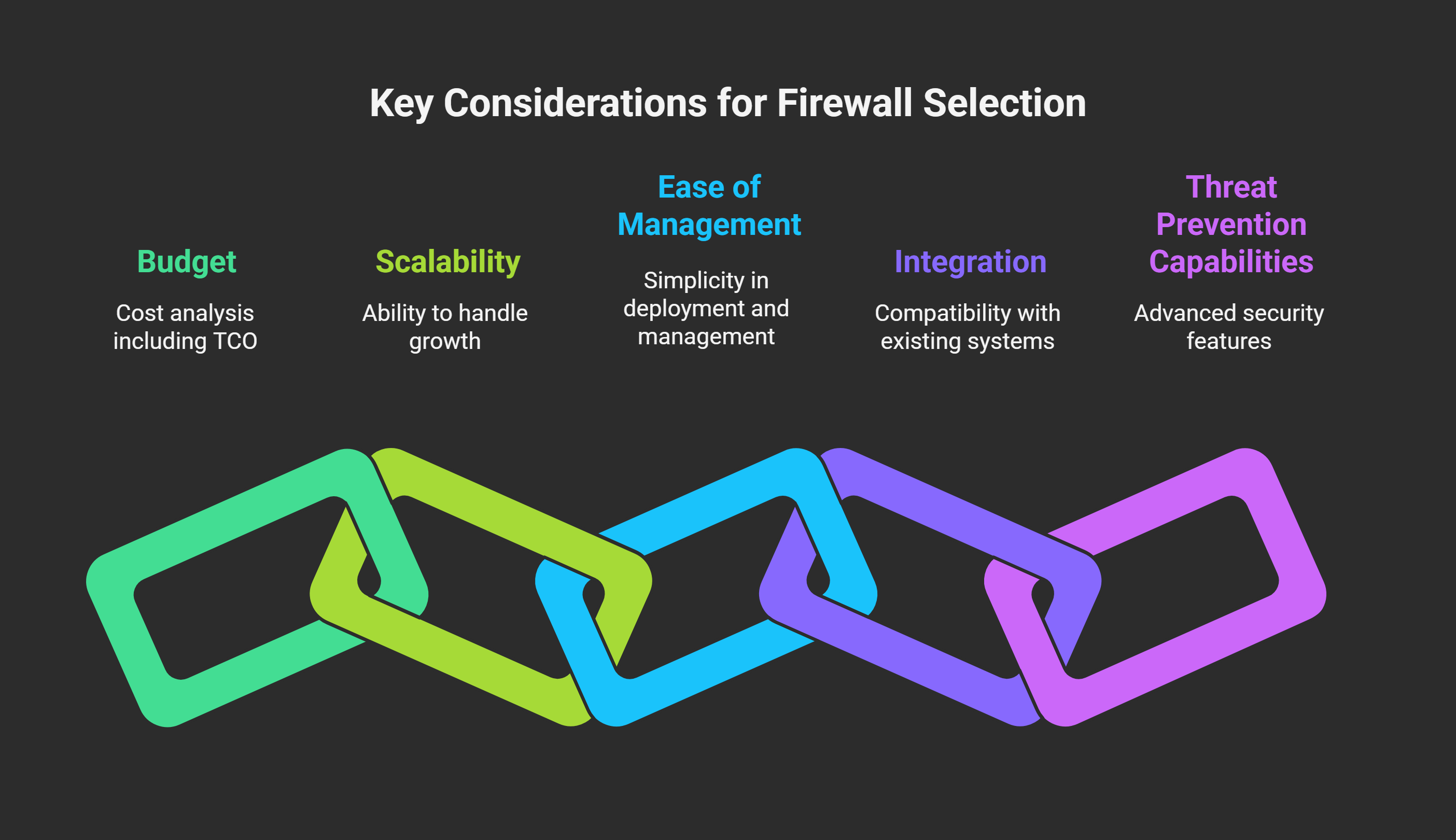
- Budget: The firewall cost is often a major factor. While a solution might have a high initial price, consider the total cost of ownership (TCO), including licensing fees, support costs, and the operational effort required to manage it.
- Scalability: Will the firewall grow with your business? Choose a solution that can handle increasing traffic, new applications, and a growing number of users without a complete rip-and-replace.
- Ease of Management: How complex is the solution to deploy and manage? If you have a small IT team, a fully managed service or a user-friendly interface may be more beneficial.
- Integration: Does the firewall integrate with your existing security tools and networking infrastructure? A solution that plays well with your current environment can save you time and money.
- Threat Prevention Capabilities: Go beyond basic packet filtering. Look for a firewall that offers advanced threat prevention, including sandboxing, AI-powered analytics, and real-time threat intelligence.
For many businesses, the sheer power and features of a Palo Alto firewall are a perfect fit. However, for those with different priorities, whether it’s a tighter budget, a need for simplified management, or a preference for high-performance hardware, there are excellent Palo Alto alternatives available. By doing your research and carefully considering the factors above, you can find the ideal enterprise firewall to protect your network and data.
Frequently Asked Questions (FAQ)
Q1: How long does a typical firewall migration take?
A: Simple deployments: 2-8 weeks. Complex enterprise migrations: 3-12 months. Network Intelligence’s proven methodologies typically reduce timelines by 30-50% through parallel workstreams and automated tools.
Q2: What’s the biggest mistake organizations make when switching firewalls?
A: Underestimating the complexity of policy migration and not planning for adequate testing time. Many organizations also fail to account for staff training needs and ongoing management complexity.
Q3: How do I calculate the true TCO of a firewall solution?
A: Include all costs over 5 years: hardware, software, subscriptions, staff time (often $150K-$300 annually), training, professional services, and hidden costs like downtime and false positive management.
Q4: Should I prioritize security effectiveness or ease of management?
A: Both are critical. The best approach is partnering with a managed security provider like Network Intelligence that delivers top-tier security effectiveness while eliminating management complexity.
Q5: How do I know if my current firewall is adequate?
A: Key indicators: frequent security incidents, compliance failures, performance bottlenecks, high management overhead, or inability to provide visibility into modern threats like encrypted attacks.