


Organizations struggling with Payment Card Industry Data Security Standard (PCI DSS) requirements face a complex maze of over 200 technical and operational controls that can overwhelm even experienced security teams. This comprehensive PCI compliance checklist guide provides a structured, step-by-step approach to achieving and maintaining compliance, helping you navigate the intricate requirements while avoiding costly penalties and security breaches that can devastate your business reputation.
What is PCI Compliance?
PCI compliance refers to adherence to the Payment Card Industry Data Security Standard (PCI DSS), a comprehensive security framework designed to protect cardholder data for any organization that stores, processes, or transmits payment card information.
Established by major credit card companies including Visa, MasterCard, American Express, Discover, and JCB, the PCI Security Standards Council governs this framework to ensure consistent security measures across the payment ecosystem. Organizations of all sizes must comply with PCI DSS requirements, from global enterprises processing millions of transactions to small retailers accepting occasional card payments. The standard applies universally regardless of transaction volume, making it one of the most comprehensive compliance frameworks in the cybersecurity landscape.
Non-compliance can result in severe consequences, including financial penalties ranging from $5,000 to $100,000 per month, increased processing fees, and potential loss of the ability to accept credit card payments. More critically, PCI non-compliance often indicates security vulnerabilities that can lead to costly data breaches, with average breach costs exceeding $4 million according to recent industry studies. Modern AI-driven solutions like those offered by Transilience AI are revolutionizing compliance management by automating evidence collection and providing continuous monitoring capabilities that reduce the manual burden traditionally associated with maintaining PCI compliance.
PCI Compliance Requirements
The PCI DSS framework consists of 12 core requirements organized into six primary control objectives, covering:
- Network security: Building and maintaining secure networks
- Data protection: Protecting stored cardholder data
- Access controls: Maintaining robust access control measures
- Vulnerability management: Implementing strong vulnerability management programs
- Monitoring capabilities: Regularly monitoring and testing networks
- Comprehensive policy governance: Maintaining comprehensive information security policies
Each objective contains specific requirements with detailed testing procedures that organizations must implement and validate.
The recent release of PCI DSS version 4.0.1 (mandatory as of March 31, 2025) introduced significant updates, including:
- Enhanced encryption requirements
- Expanded multi-factor authentication mandates
- New client-side security controls for payment pages
These updates reflect the evolving threat landscape and address emerging attack vectors that have become prevalent in modern payment processing environments. Organizations must now address requirements such as:
- Maintaining comprehensive inventories of payment page scripts
- Implementing automated monitoring for unauthorized changes to security headers and client-side code
Implementation complexity varies significantly based on:
- Organizational size
- Technology architecture
- Processing methods
Detailed compliance calendars help organizations manage the various assessment and maintenance activities required throughout the year.
Advanced AI-driven platforms like those developed by Network Intelligence are increasingly essential for managing this complexity, providing:
- Automated vulnerability prioritization
- Continuous compliance monitoring
- Intelligent orchestration of security controlsThis enables organizations to maintain compliance while focusing resources on strategic business initiatives.
PCI Compliance Checklist
This comprehensive PCI compliance checklist provides detailed implementation guidance for each critical requirement, with actionable steps that security teams can follow to achieve and maintain compliance across their payment card environments.
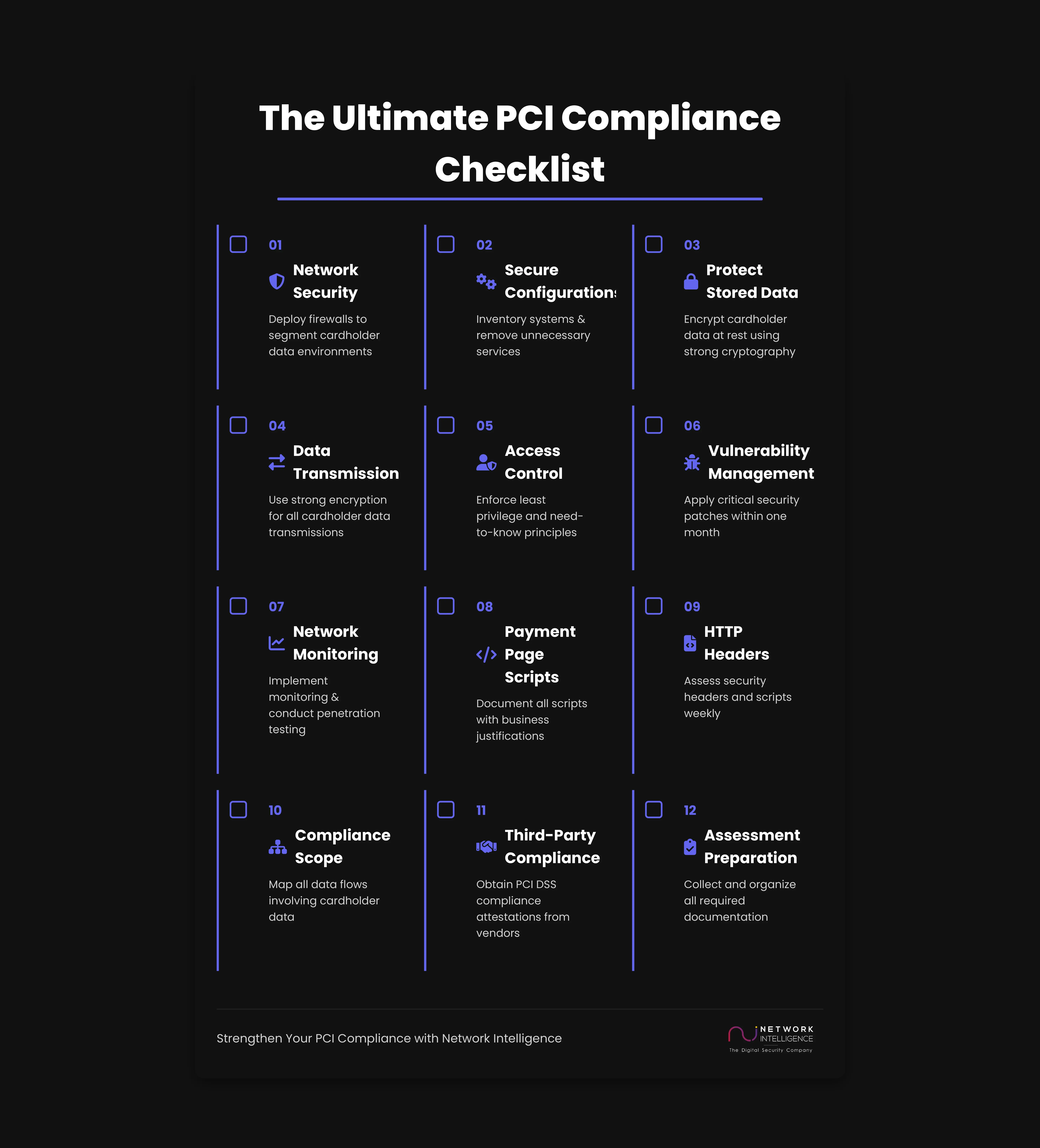
1. Install and Maintain Network Security Controls
Establishing robust network security controls forms the foundation of any effective PCI compliance checklist, ensuring that cardholder data environments remain isolated from untrusted networks and protected against unauthorized access attempts. This critical first step requires organizations to implement comprehensive network segmentation strategies that create secure perimeters around payment processing systems while maintaining operational efficiency for legitimate business communications.
- Deploy firewalls and network security controls to segment cardholder data environments (CDE) from other networks
- Document and maintain up-to-date network diagrams showing all connections and data flows
- Implement default-deny firewall rules, allowing only necessary business communications
- Regularly review and test firewall configurations for effectiveness
- Maintain change management procedures for network security changes
2. Apply Secure Configurations and Remove Defaults
Default settings and unnecessary services represent significant vulnerabilities that attackers routinely exploit to gain unauthorized system access. Secure configuration of all system components is vital for reducing attack surfaces within any comprehensive PCI DSS compliance checklist framework, requiring organizations to maintain detailed inventories and implement standardized security configurations across their entire payment processing infrastructure.
- Maintain an inventory of all system components in the CDE
- Remove or disable all unnecessary services, functions, and default accounts
- Document and justify all enabled services and applications
- Regularly review configurations after updates or changes
3. Protect Stored Cardholder Data
Protecting stored cardholder data represents one of the most critical components of any PCI compliance checklist, as this requirement directly addresses the primary target of most payment card industry attacks. Strong encryption, tokenization, and comprehensive data retention policies work together to ensure that even if attackers successfully breach system perimeters, the stolen data remains unusable and provides no value to malicious actors.
- Encrypt cardholder data at rest using strong cryptography
- Do not store sensitive authentication data after authorization (except for issuers with documented exceptions)
- Maintain and enforce data retention and disposal policies
- Document cryptographic key management procedures
4. Encrypt Transmission of Cardholder Data Across Open, Public Networks
Cardholder data transmission over open or public networks creates significant interception opportunities for malicious actors, making strong encryption protocols essential for maintaining data confidentiality and integrity during transit. This requirement ensures that payment information remains protected as it moves between systems, applications, and organizations within the payment processing ecosystem.
- Use strong encryption protocols (e.g., TLS) for all transmissions of cardholder data
- Document all transmission channels and encryption methods
- Regularly test and verify encryption effectiveness
5. Implement Strong Access Control Measures
Restricting access to cardholder data based on business need-to-know principles and implementing robust authentication mechanisms are essential elements of any effective PCI security compliance checklist. These controls prevent unauthorized personnel from accessing sensitive payment information while ensuring that legitimate business users can perform their required functions without unnecessary barriers or security friction.
- Define and document roles and responsibilities for data access
- Enforce least privilege and need-to-know principles
- Implement multi-factor authentication for all access to the CDE
- Review and update access rights regularly
6. Maintain a Vulnerability Management Program
Continuous vulnerability management is required to identify, prioritize, and remediate security weaknesses in systems and applications, representing a cornerstone of modern PCI compliance requirements checklist implementations. Organizations must implement systematic approaches to vulnerability discovery and remediation that address the rapidly evolving threat landscape while managing resource constraints and operational requirements.
- Maintain a software asset register documenting all libraries, tools, and components (Requirement 6.1)
- Classify vulnerabilities by risk level (critical, high, medium, low)
- Apply critical security patches within one month of vendor release (Requirement 6.2)
- Monitor for new vulnerabilities and updates continuously
7. Monitor and Test Networks Regularly
Ongoing monitoring and testing capabilities are crucial for detecting unauthorized activities and ensuring that security controls maintain their effectiveness over time as threats and business requirements evolve. Regular network testing validates the continued operation of implemented security measures and identifies potential weaknesses before malicious actors can exploit them.
- Implement automated monitoring of network and system activities
- Conduct regular penetration testing and vulnerability assessments
- Review logs and alerts for signs of suspicious activity
8. Maintain an Inventory of Payment Page Scripts and Monitor Client-Side Security
With the dramatic increase in client-side attacks targeting payment processing systems, maintaining a comprehensive inventory of all scripts running on payment pages has become a mandatory requirement in PCI DSS 4.0.1 (requirement 6.4.3). This new obligation addresses the growing threat of web skimming and malicious script injection attacks that compromise payment forms through client-side vulnerabilities.
- Document all scripts running on payment pages, including business justifications
- Implement integrity verification mechanisms for scripts
- Set up detection and alerting for unauthorized script changes
9. Evaluate HTTP Headers and Payment Page Scripts Regularly
Regular evaluation of HTTP security headers and payment page scripts (Requirement 11.6.1) helps prevent client-side manipulation attacks and strengthens browser-based security protections that defend against sophisticated web-based threats. This requirement complements script inventory management by ensuring ongoing monitoring of client-side security configurations.
- Assess HTTP security headers and payment page scripts at least weekly, or more frequently based on risk analysis
- Automate monitoring and alerting for unauthorized changes to headers or scripts
10. Define and Document PCI Compliance Scope
Accurately defining the scope of the cardholder data environment represents one of the most critical yet frequently overlooked aspects of PCI compliance network checklist implementations. Proper scope definition ensures that all relevant systems, processes, and personnel are included in compliance efforts while avoiding unnecessary inclusion of systems that do not impact cardholder data security.
- Map all data flows involving cardholder data across systems and third-party services
- Document all in-scope assets, processes, and personnel
- Review and update scope documentation regularly
11. Manage Third-Party and Vendor Compliance
Organizations must ensure that all third-party service providers and vendors with access to cardholder data maintain appropriate PCI DSS compliance, particularly in shared responsibility environments such as cloud computing platforms. This requirement has become increasingly complex as organizations adopt multi-cloud strategies and rely on numerous third-party services for payment processing capabilities.
- Obtain and review PCI DSS compliance attestations from all relevant vendors
- Define and document shared responsibility models for cloud services
- Monitor vendor compliance status and address gaps promptly
12. Prepare for PCI Compliance Assessment and Validation
Formal assessment and validation represent the culmination of PCI compliance checklist implementation efforts, requiring comprehensive documentation and evidence collection to demonstrate adherence to all applicable requirements. Organizations must prepare for either Report on Compliance (ROC) assessments by Qualified Security Assessors or Self-Assessment Questionnaires (SAQ) depending on their merchant level and processing methods.
- Collect and organize all required documentation and evidence
- Conduct internal readiness reviews prior to formal assessment
- Complete and submit the appropriate SAQ or ROC as required by your merchant level
- Maintain an Attestation of Compliance (AoC) signed by the appropriate authority
Common Mistakes to Avoid in PCI Compliance
Organizations frequently encounter predictable pitfalls during PCI compliance checklist implementation that can lead to failed assessments, security gaps, and unnecessary costs that could be avoided with proper planning and execution strategies.
- Underestimating Scope Complexity: Failing to identify all systems, applications, and processes that store, process, or transmit cardholder data, leading to incomplete security controls and potential compliance failures during assessment
- Relying on Default Configurations: Neglecting to implement secure configurations and remove default settings across system components, creating easily exploitable vulnerabilities that attackers routinely target
- Inadequate Documentation Management: Failing to maintain current, comprehensive documentation of security controls, policies, and procedures, making it difficult to demonstrate compliance during assessments and hampering ongoing security management
- Third-Party Responsibility Gaps: Overlooking shared responsibility models in cloud environments and failing to verify vendor compliance status, creating dangerous gaps in security controls that may not be discovered until security incidents occur
- Delayed Vulnerability Remediation: Postponing critical security patching and vulnerability remediation beyond required timeframes, exposing organizations to known attack vectors that could be easily prevented with timely updates
- Manual Process Dependencies: Over-relying on manual processes for compliance monitoring and evidence collection, leading to inconsistent implementation and increased risk of human error in critical security functions
Strengthen Your PCI Compliance with Network Intelligence
Network Intelligence delivers comprehensive PCI compliance solutions that combine 23+ years of cybersecurity expertise with cutting-edge AI-powered automation, enabling organizations to achieve and maintain compliance while focusing resources on strategic business growth initiatives.
Our proven ADVISE framework (Assess, Design, Visualize, Implement, Sustain, Evolve) provides structured guidance through every stage of PCI compliance implementation, from initial scoping and gap assessment through ongoing monitoring and continuous improvement. With specialized expertise in Payment Security Services and comprehensive understanding of complex regulatory requirements, our certified professionals help organizations navigate the intricate requirements of modern PCI DSS compliance while building robust security foundations that support long-term business objectives.
Transilience AI, our revolutionary autonomous compliance platform, transforms traditional compliance management through LLM-based security agents that automate complex tasks previously requiring manual effort. Our AI-powered solutions provide automated evidence collection across 100+ control points, real-time compliance gap identification, and continuous monitoring capabilities that reduce vulnerability backlogs by 70% while eliminating wasted development effort. Organizations using Transilience AI achieve compliance certifications 2+ months faster than traditional approaches while maintaining guaranteed outcomes and predictable costs that replace traditional $150,000+ annual compliance overhead.
Whether you need comprehensive PCI DSS segmentation assessment, ongoing compliance monitoring, or complete program development, our integrated approach combines human expertise with AI capabilities to deliver superior results. Contact our team today to discover how Network Intelligence can streamline your PCI compliance journey and strengthen your organization’s security posture through innovative technology solutions that evolve with your business needs.
Frequently Asked Questions
What is the difference between PCI DSS and PCI SAQ?
PCI DSS is the comprehensive security standard that applies to all organizations handling cardholder data, while PCI SAQ (Self-Assessment Questionnaire) is a validation method for smaller merchants who meet specific criteria. SAQs provide a streamlined compliance path with questionnaires tailored to different business models, whereas larger organizations must undergo formal Report on Compliance (ROC) assessments by qualified security assessors.
How often must organizations complete PCI compliance assessments?
PCI compliance assessments must be completed annually, with additional assessments required after any significant changes to the cardholder data environment. Organizations must also maintain continuous compliance through ongoing monitoring, quarterly vulnerability scans, and regular penetration testing as specified in updated PCI DSS requirements.
What are the penalties for PCI non-compliance?
PCI non-compliance penalties include monthly fines ranging from $5,000 to $100,000, increased transaction processing fees, and potential loss of ability to accept credit card payments. Organizations may also face liability for breach-related costs, regulatory fines, and reputational damage that can significantly impact business operations and customer trust.
How does cloud computing affect PCI compliance requirements?
Cloud computing introduces shared responsibility models where organizations must ensure both their cloud providers maintain PCI compliance and implement additional controls for their specific configurations. Organizations must understand the division of security responsibilities, implement cloud-native security controls, and maintain proper documentation of their cloud PCI compliance approach.
Can AI and automation help with PCI compliance management?
Yes, AI-powered platforms like Transilience AI significantly streamline PCI compliance through automated evidence collection, continuous monitoring, and intelligent vulnerability prioritization. These solutions reduce manual effort by up to 80% while improving compliance accuracy and enabling organizations to maintain continuous compliance posture rather than relying on periodic assessments.
What are the main business and security benefits of PCI compliance?
PCI compliance reduces the risk of costly data breaches by enforcing strong security controls and encryption standards. It also builds customer trust by showing commitment to payment security, which can increase conversions and loyalty—especially for e-commerce and subscription-based businesses. In addition, being PCI compliant creates a competitive edge, as many enterprise clients and partners require it before doing business.
How does PCI compliance support operations and financial stability?
Beyond security, PCI compliance streamlines operations through standardized processes, automation, and efficient incident response procedures. It also aligns with other regulatory frameworks like ISO/IEC 27001 and SOC 2, reducing overall compliance workload. Financially, compliance helps organizations avoid fines, lowers processing fees, and can even reduce cyber insurance premiums, providing long-term cost savings.