


“Red team” and “penetration test” get used interchangeably often enough that a lot of organizations buy one when they actually needed the other. Both involve people, or increasingly AI agents, attacking systems the way a real adversary would. The similarity mostly ends there. They’re built to answer different questions, and confusing them usually means paying for the wrong engagement.
What a penetration test actually answers
A penetration test asks a bounded question: within this defined scope, what vulnerabilities exist, and can they be exploited? The engagement has a clear start and end, a defined target list, like a specific application, network segment, or cloud environment, and a goal of finding and demonstrating as many exploitable issues as possible within that scope and timeframe.
A pentest is thorough within its boundaries. It’s not trying to be stealthy or to simulate a specific adversary’s behavior, it’s trying to be comprehensive about what’s exploitable in the systems it’s been pointed at. The output is a prioritized list of vulnerabilities with proof of exploitability and remediation guidance.
What a red team exercise actually answers
A red team exercise asks a different question: can a realistic adversary achieve a specific objective, and would our detection and response actually catch them doing it? The scope isn’t a target list, it’s a goal, like reaching a specific crown-jewel system or exfiltrating a specific category of data, and the red team is free to use whatever path gets them there: phishing, physical access, a misconfigured cloud identity, a chained set of lower-severity issues a pentest might treat as individually minor.
Stealth is part of the exercise. A red team engagement is often run without the defending team’s knowledge, specifically to test whether detection and response processes work under real conditions, not conditions everyone knows are a drill. The output isn’t just a vulnerability list, it’s an honest answer to whether the SOC noticed, how long it took, and what broke down in the response.
The core differences, side by side
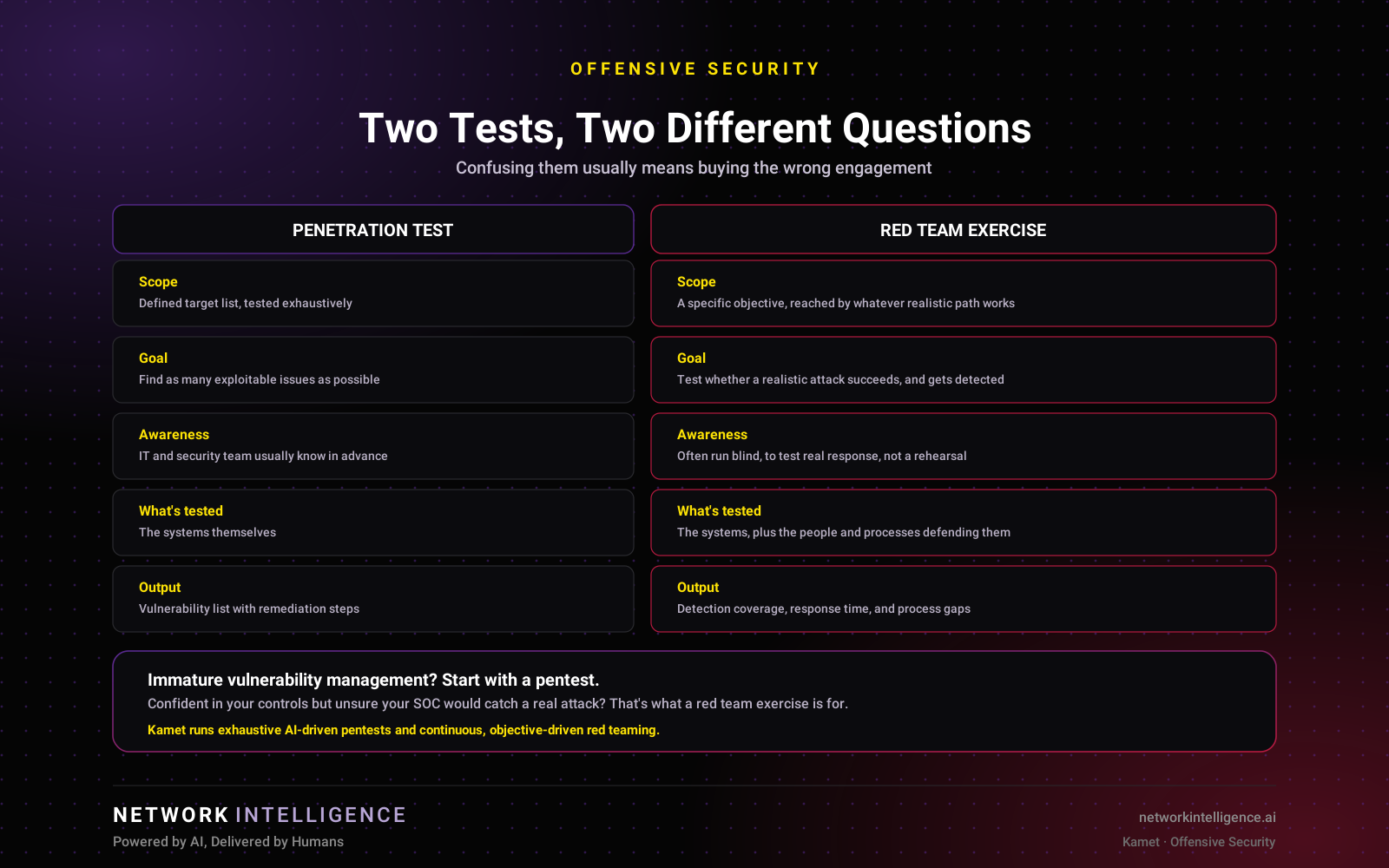
Scope. A pentest covers a defined target list exhaustively. A red team exercise pursues a specific objective by whatever realistic path works, often across a much wider surface.
Goal. A pentest finds as many exploitable vulnerabilities as possible. A red team exercise tests whether a specific attack path succeeds and whether it gets detected.
Awareness. A pentest is usually known to the IT and security team in advance. A red team exercise is frequently run blind, testing real-world detection and response, not a rehearsed one.
What gets tested. A pentest tests the systems themselves. A red team exercise tests the systems and the people and processes meant to catch an attacker using them.
Output. A pentest produces a vulnerability list with remediation steps. A red team exercise produces an assessment of detection coverage, response time, and process gaps, alongside whatever vulnerabilities were used along the way.
Frequency. A pentest is often a point-in-time or periodic exercise against a defined scope. A red team program works best as a recurring or continuous exercise, since its real value is testing whether defenses have actually improved since the last one.
Why this distinction matters for what you actually buy
An organization with a reasonably mature vulnerability management program, but no real sense of whether their SOC would catch an actual intrusion, needs a red team exercise, not another pentest. A pentest will likely just confirm vulnerabilities the team already suspected existed. Conversely, an organization that hasn’t had its applications or infrastructure tested for exploitable vulnerabilities in a defined scope needs a pentest first, running a red team exercise before establishing that baseline tends to surface the same low-hanging issues a focused pentest would have found faster and cheaper.
Neither replaces continuous validation. Our post on continuous versus annual penetration testing covers why point-in-time testing of either kind goes stale quickly, the same logic applies whether the engagement is scoped as a pentest or a red team exercise.
Where AI changes the economics of both
Running red team exercises quarterly, as is common practice, still leaves long windows where posture drifts unobserved between engagements. An AI-driven approach, whether applied to exhaustive pentesting or to adversary-objective-driven red teaming, makes more frequent testing economically realistic, because the marginal cost of running another exercise doesn’t scale the same way a fully human-staffed engagement does. That doesn’t replace human judgment on either side, skilled red teamers and pentesters still design the objectives and interpret nuance an agent might miss, but it changes how often an organization can realistically validate both its vulnerabilities and its detection capability.
What to ask before scoping either engagement
- Are we trying to find exploitable vulnerabilities in a defined scope, or test whether our SOC catches a realistic attack?
- Should the defending team know this is happening, or does the exercise need to be blind to be meaningful?
- Is our vulnerability management mature enough that a red team exercise would test something beyond what a pentest already would have found?
- How will detection and response gaps actually get fixed afterward, not just documented?
- Is this a one-time engagement, or does it need to repeat often enough to track whether defenses are actually improving?
Where Kamet fits
Kamet runs real exploitation on a live Kali Linux attack box, chaining findings into actual attack paths rather than reporting a flat list of vulnerabilities, which makes it well suited to the exhaustive, scope-driven work of a penetration test. The same agentic approach extends to continuous red teaming, an AI-managed capability built to pursue realistic objectives across a broader surface, at a cadence a fully manual program can’t sustain. For organizations weighing which engagement actually fits their current maturity, our practices team can help scope the right starting point. Learn more about the technical depth behind this in our post on what AI pen-testing with Kamet actually does.
Not sure whether a pentest or a red team exercise fits where you are right now? Talk to Network Intelligence.