


Navigating SOX compliance requirements can feel overwhelming for compliance professionals managing complex financial reporting processes across multiple business units. The challenge of maintaining continuous oversight, coordinating cross-functional teams, and ensuring audit readiness while keeping pace with evolving regulatory interpretations creates significant operational burden. This comprehensive SOX compliance checklist provides a structured, step-by-step approach to implementing, monitoring, and maintaining compliance with the Sarbanes-Oxley Act, offering practical guidance that transforms complex regulatory requirements into manageable, actionable tasks.
What is SOX Compliance?
The Sarbanes-Oxley Act (SOX) is a comprehensive federal law enacted in 2002 that establishes stringent requirements for financial reporting, internal controls, and corporate governance for all publicly traded companies in the United States. SOX compliance is mandatory for these organizations and their subsidiaries, ensuring transparency, accuracy, and accountability in financial disclosures to protect investors and maintain market confidence.
The legislation emerged as a direct response to major corporate scandals including Enron, WorldCom, and Arthur Andersen, which devastated public trust in financial markets. SOX fundamentally transformed corporate governance by introducing personal accountability for executives, mandating comprehensive internal control assessments, and establishing strict audit independence requirements. The official SEC resource on the Sarbanes-Oxley Act provides authoritative guidance on all SOX requirements and regulatory updates.
Beyond regulatory compliance, SOX serves as a foundation for building robust risk management frameworks that enhance operational efficiency, reduce fraud risk, and strengthen stakeholder confidence. Organizations subject to SOX must implement comprehensive internal controls over financial reporting (ICFR), maintain detailed documentation of all control activities, and undergo regular independent audits to verify compliance effectiveness.
SOX Compliance Requirements
The core SOX compliance requirements center around three critical sections that define the operational framework for publicly traded companies. Section 302 establishes executive certification requirements, Section 404 mandates internal control assessments, and Section 401 addresses comprehensive disclosure obligations that collectively ensure financial reporting integrity.
Section 302 requires CEOs and CFOs to personally certify the accuracy and completeness of quarterly and annual financial reports filed with the SEC. These certifications carry significant legal liability, as executives must attest that financial data contains no material misstatements and that effective internal controls have been reviewed within the past 90 days. Any significant control deficiencies must be disclosed to audit committees and external auditors, creating transparency in remediation efforts.
Section 404 is the most operationally intensive requirement of SOX compliance. It mandates annual management assessments of internal controls over financial reporting. Key requirements include:
- Annual management assessments of internal controls over financial reporting (ICFR)
- Evaluation of control systems using recognized frameworks such as COSO
- Comprehensive testing of control effectiveness
- Independent external auditor attestation of management’s assessment
- Use of AICPA resources for best practices in internal control assessments
- Implementation of vendor risk management processes, especially for SOC 1 and SOC 2 compliance audits, to ensure third-party service providers meet control standards
SOX Compliance Checklist
This comprehensive sox compliance checklist provides step-by-step implementation guidance for achieving and maintaining SOX compliance. Each checklist item includes detailed implementation requirements, evidence collection procedures, and best practices derived from leading compliance frameworks and audit standards.
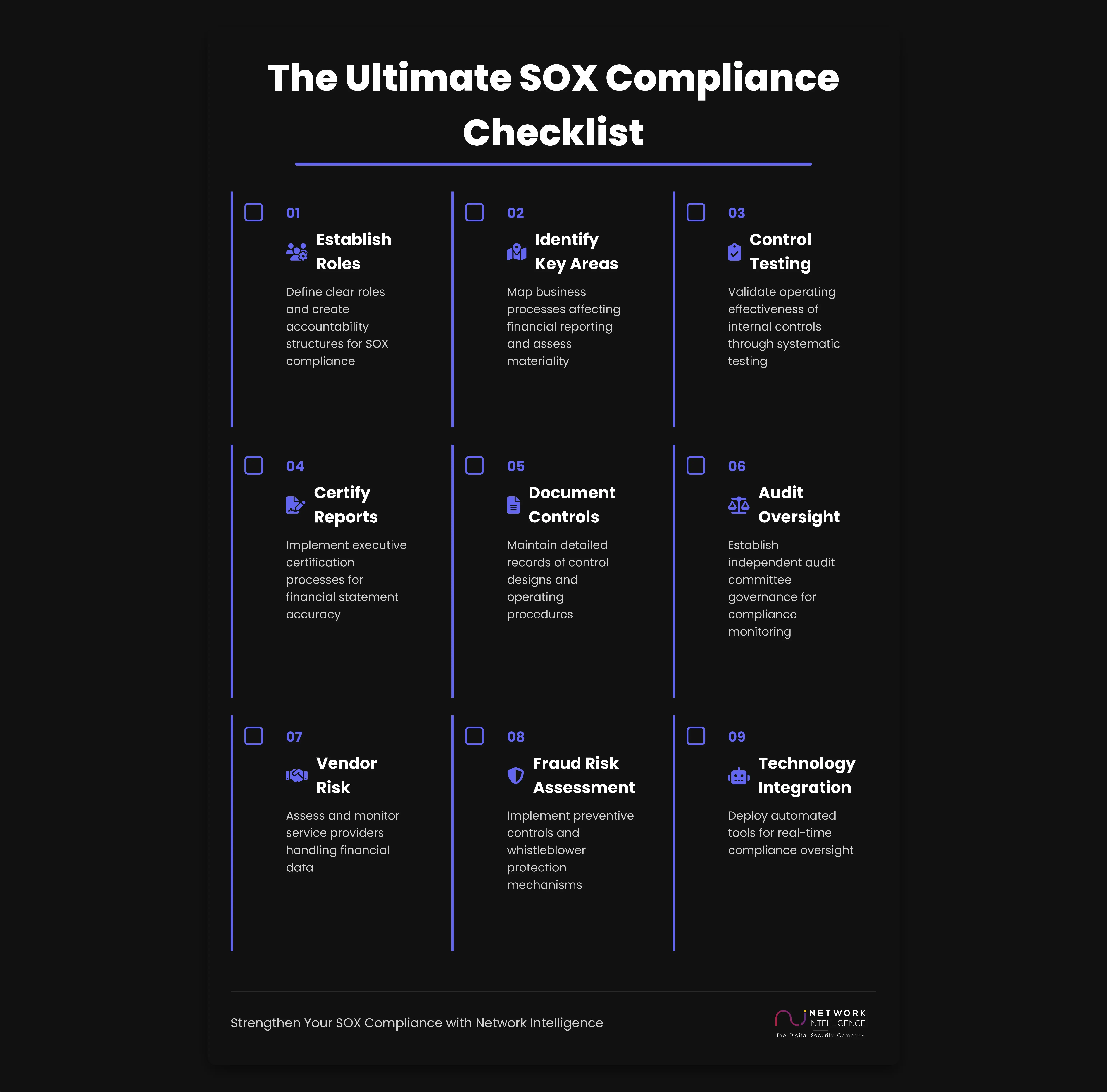
1. Establish Roles and Responsibilities
Defining clear roles and responsibilities creates the foundational governance structure necessary for effective SOX compliance, ensuring accountability and proper oversight across all financial reporting processes while preventing conflicts of interest that could compromise control effectiveness.
- Assign executive sponsorship to CEO and CFO with documented accountability for overall compliance program
- Designate SOX program managers responsible for coordinating compliance activities across business units
- Establish control owners for each significant business process with clear testing and monitoring responsibilities
- Document organizational charts showing reporting relationships and segregation of duties matrices
- Create role-based access controls that limit system access to authorized personnel only
- Evidence: Organizational charts, responsibility assignment matrices, signed role acknowledgments, access control reports
2. Identify Key Areas and Processes for SOX Compliance
Comprehensive process mapping enables organizations to identify all business processes that impact financial reporting, establish appropriate scoping decisions, and prioritize resources on the most critical risk areas through systematic evaluation of materiality and complexity factors.
- Conduct comprehensive inventory of all business processes affecting financial statement preparation
- Perform materiality assessments to determine significance thresholds for each process area
- Map process flows showing integration points between systems and handoff procedures
- Identify key control points where material misstatements could occur without detection
- Document scoping rationale including quantitative and qualitative risk factors
- Evidence: Process flowcharts, materiality analysis documentation, scoping memorandums, risk assessment matrices
3. Perform Key Control Testing
Systematic control testing validates the operating effectiveness of internal controls by evaluating both design adequacy and implementation success, providing the evidentiary foundation necessary to support management assertions and external auditor evaluations of control reliability.
- Develop standardized test plans specifying testing procedures, sample sizes, and evaluation criteria
- Execute control tests using appropriate methodologies including observation, inquiry, and reperformance
- Document test results with clear pass/fail determinations and exception analysis
- Perform root cause analysis for any identified control deficiencies or failures
- Implement remediation procedures for failed controls with timeline tracking and validation testing
- Evidence: Control test workpapers, exception reports, remediation tracking logs, validation test results
4. Certify Financial Reports (Section 302)
Executive certification processes under Section 302 require robust review and approval workflows that enable CEOs and CFOs to provide personal attestations regarding financial statement accuracy and internal control effectiveness with appropriate legal protection and evidentiary support.
- Establish quarterly certification workflows with defined review checkpoints and approval authorities
- Implement disclosure controls and procedures for identifying material information requiring disclosure
- Create certification questionnaires capturing key control assessments and material changes
- Develop representation letters from business unit leaders supporting executive certifications
- Maintain certification evidence files with supporting documentation for all assertions
- Evidence: Signed certification statements, disclosure committee meeting minutes, representation letters, certification checklists
5. Document Internal Controls and Evidence
Comprehensive documentation of internal controls provides the foundation for ongoing compliance monitoring and external audit support by creating detailed records of control designs, operating procedures, and testing evidence that demonstrate sustained control effectiveness over time.
- Prepare detailed control descriptions including control objectives, procedures, and responsible parties
- Maintain current process narratives and flowcharts reflecting actual operating procedures
- Create standardized documentation templates ensuring consistency across all business processes
- Establish evidence collection procedures that capture appropriate support for control performance
- Implement document retention policies that preserve audit trails for required retention periods
- Evidence: Control documentation, process narratives, testing workpapers, evidence collection protocols
6. Ensure Audit Committee and Governance Oversight
Effective audit committee governance provides independent oversight of the SOX compliance program by establishing appropriate expertise, independence, and authority necessary to evaluate management’s compliance efforts and provide objective assessment of control effectiveness and risk management practices.
- Establish audit committee with independent directors possessing appropriate financial expertise
- Develop audit committee charter defining oversight responsibilities and authority
- Implement regular communication protocols between audit committee and internal/external auditors
- Create management reporting procedures for significant control deficiencies and material weaknesses
- Establish oversight procedures for external auditor selection, evaluation, and compensation
- Evidence: Audit committee charter, meeting minutes, independence confirmations, oversight reports
7. Manage Vendor and Third-Party Risk
Third-party risk management addresses the extended compliance obligations that arise when organizations rely on external service providers for processes that impact financial reporting, requiring comprehensive due diligence, ongoing monitoring, and appropriate contractual protections to ensure vendor compliance with SOX requirements.
- Conduct SOX compliance assessments of all service organizations handling financial data
- Obtain and evaluate SOC 1 Type II reports for critical service providers annually
- Include SOX compliance clauses in vendor contracts with specific performance requirements
- Implement ongoing monitoring procedures for vendor control performance and changes
- Develop contingency plans for vendor compliance failures or service disruptions
- Evidence: SOC reports, vendor assessments, contract clauses, monitoring reports, contingency plans
8. Conduct Fraud Risk Assessment and Implement Prevention Controls
Fraud risk assessment and prevention controls address SOX’s fundamental objective of preventing fraudulent financial reporting by identifying potential fraud scenarios, implementing appropriate preventive and detective controls, and creating reporting mechanisms that encourage the identification of fraudulent activities while protecting whistleblowers from retaliation.
- Perform comprehensive fraud risk assessments identifying potential fraud scenarios and vulnerabilities
- Implement segregation of duties controls preventing single-person transaction processing
- Establish anonymous whistleblower hotlines with appropriate investigation and protection procedures
- Deploy continuous monitoring analytics to detect unusual patterns or unauthorized activities
- Conduct periodic surprise audits and management testing to validate control effectiveness
- Evidence: Fraud risk assessments, segregation matrices, hotline reports, analytics results, surprise audit reports
9. Integrate Technology and AI for Continuous Monitoring
Technology integration and AI-driven monitoring capabilities transform traditional SOX compliance from periodic assessment cycles to continuous, real-time oversight that enhances accuracy, reduces manual effort, and provides proactive identification of control failures and emerging risks through intelligent automation and analytics.
- Deploy automated monitoring tools that continuously assess control performance and generate exception reports
- Implement AI-powered platforms for automated evidence collection from source systems
- Utilize machine learning algorithms to identify patterns indicative of control failures or fraud risks
- Create real-time dashboards providing management visibility into compliance status and key risk indicators
- Establish automated alerting systems that notify responsible parties of control exceptions or policy violations
- Evidence: System logs, automated reports, AI analytics results, dashboard screenshots, alert notifications
Common Mistakes to Avoid in SOX Compliance
- Treating SOX as a one-time project rather than establishing ongoing compliance programs with continuous monitoring
- Underestimating resource requirements and implementation timelines, leading to inadequate staffing and rushed implementation
- Failing to properly assess and monitor third-party vendor risks that could impact financial reporting integrity
- Maintaining inadequate documentation that cannot support management assertions or withstand external auditor scrutiny
- Overlooking the importance of technology integration and automation opportunities that could enhance efficiency and accuracy
- Neglecting to establish appropriate tone at the top and control environment factors that influence overall compliance culture
- Focusing solely on compliance requirements while missing opportunities to leverage SOX investments for broader business improvements
Strengthen Your SOX Compliance with Network Intelligence AI-Driven Solutions
Modern SOX compliance demands more than traditional manual approaches—it requires intelligent, automated solutions that can keep pace with evolving business operations and regulatory expectations. Network Intelligence delivers cutting-edge AI-driven cybersecurity and compliance solutions that transform how organizations approach SOX compliance, combining advanced technology with expert human insight to create robust, efficient, and future-ready compliance programs.
Our comprehensive Governance Risk Management & Compliance practice provides end-to-end SOX compliance support, from initial gap assessments through ongoing monitoring and audit preparation. We leverage proprietary AI technologies to automate evidence collection, perform continuous control testing, and provide real-time visibility into compliance status across your entire organization. Our expert team brings deep regulatory knowledge and practical implementation experience to help you navigate complex SOX requirements while optimizing operational efficiency.
Through our integrated approach combining HITRUST compliance expertise and advanced PCI DSS compliance methodologies, we help organizations build comprehensive compliance frameworks that address multiple regulatory requirements simultaneously. Our AI-powered platforms provide continuous monitoring, automated reporting, and intelligent risk assessment capabilities that significantly reduce compliance costs while improving accuracy and effectiveness. Whether you’re implementing SOX compliance for the first time or seeking to modernize your existing program, Network Intelligence provides the expertise, technology, and support you need to achieve sustained compliance success.
Ready to transform your SOX compliance program with AI-driven solutions? Talk to an Expert today to learn how Network Intelligence can help you build a more efficient, accurate, and future-ready compliance framework.