


Achieving SOC 2 compliance can feel overwhelming for cybersecurity professionals juggling complex requirements, tight deadlines, and limited resources. Organizations struggle with fragmented compliance processes, manual evidence collection, and maintaining continuous monitoring between audits.
This comprehensive SOC 2 compliance checklist provides a systematic roadmap to streamline your certification journey, eliminate common pitfalls, and leverage AI-powered solutions to transform compliance from a burden into a strategic advantage.
What is SOC 2?
SOC 2 (Service Organization Control 2) is an auditing standard developed by the American Institute of Certified Public Accountants (AICPA) that evaluates how service organizations manage and protect customer data. This framework focuses on five Trust Services Criteria: Security, Availability, Processing Integrity, Confidentiality, and Privacy. SOC 2 compliance is essential for SaaS companies, cloud service providers, data centers, and any organization that stores, processes, or transmits sensitive customer information.
Unlike other compliance frameworks that prescribe specific technical controls, SOC 2 operates on a principles-based approach, allowing organizations to implement controls tailored to their specific operational context and risk profile. The framework serves as a critical bridge between service providers and their clients, offering independent verification that sensitive data handling meets established security standards. Organizations typically pursue SOC 2 compliance to meet customer requirements, demonstrate security maturity, and gain competitive advantages in enterprise sales processes.
The framework distinguishes between Type 1 and Type 2 reports. Type 1 audits assess the design effectiveness of controls at a specific point in time, while Type 2 audits evaluate both design and operating effectiveness over a period of three to twelve months. Type 2 reports provide greater assurance to stakeholders about an organization’s ongoing commitment to security and operational integrity, making them the preferred choice for most enterprise customers.
SOC 2 Requirements
SOC 2 requirements are structured around the Trust Services Criteria, which provide a comprehensive framework for evaluating information security and operational controls. Security serves as the mandatory criterion for all SOC 2 audits, while the other four criteria are optional based on business needs and customer requirements.
- Security: Mandatory for all SOC 2 audits, covering access controls, system operations, change management, and risk mitigation
- Availability: Ensures systems remain accessible and usable according to agreed-upon service levels
- Processing Integrity: Addresses the accuracy, completeness, and timeliness of system processing
- Confidentiality: Protects information designated as confidential through access and transmission controls
- Privacy: Specifically addresses personally identifiable information protection and privacy principles
| Criterion | Key Focus Areas | Typical Industries |
| Security | Access controls, monitoring, change management | All service organizations |
| Availability | System uptime, capacity planning, backup procedures | SaaS, hosting providers, cloud services |
| Processing Integrity | Data accuracy, completeness, timeliness | Financial services, payment processors |
Organizations must define their audit scope carefully, identifying which systems, processes, and Trust Services Criteria will be included in their SOC 2 evaluation. This scoping decision significantly impacts the complexity, timeline, and cost of compliance efforts. Many organizations begin with Security-only audits before expanding to include additional criteria as their compliance programs mature and business requirements evolve.
SOC 2 Compliance Checklist
This comprehensive SOC 2 compliance checklist provides a systematic approach to achieving certification. Each step includes detailed implementation guidance and leverages insights from leading cybersecurity experts to ensure thorough preparation and successful audit outcomes.
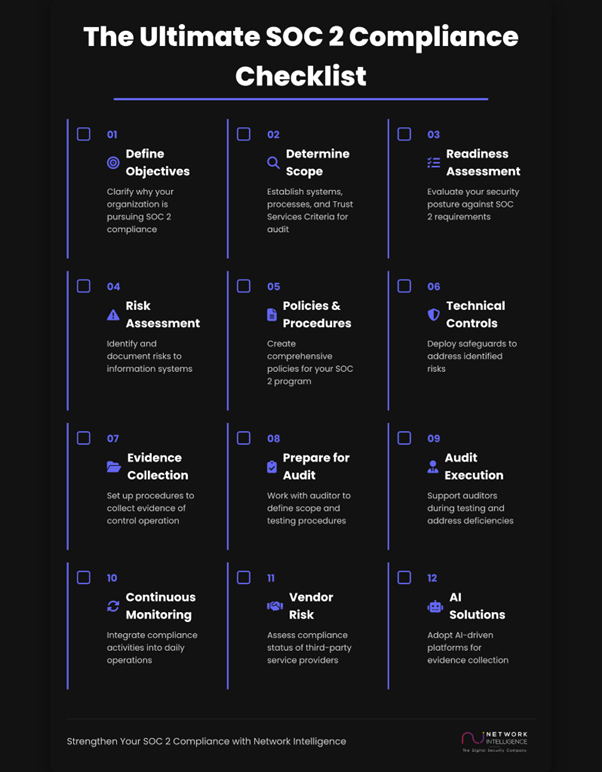
1. Define SOC 2 Compliance Objectives
Clarify why your organization is pursuing SOC 2 compliance and what you aim to achieve. This step sets the foundation for the entire compliance program and influences scope, resource allocation, and stakeholder buy-in. Clear objectives help organizations maintain focus throughout the lengthy compliance process and ensure that investments align with business priorities.
- Document business drivers and customer requirements for SOC 2 compliance
- Identify expected outcomes (e.g., customer trust, market access, risk reduction)
- Communicate objectives to executive leadership and key stakeholders
- Establish success metrics and key performance indicators for the compliance program
- Align compliance objectives with broader organizational risk management goals
2. Determine SOC 2 Audit Scope
Establish which systems, processes, and Trust Services Criteria will be included in your SOC 2 audit. Proper scoping is critical to ensure audit relevance while managing compliance costs and complexity. Organizations must balance comprehensive coverage with practical considerations around resources and timelines.
- Identify in-scope systems, applications, and data flows
- Select applicable Trust Services Criteria (Security is mandatory; others as needed)
- Map customer and regulatory requirements to audit scope
- Document boundaries and interfaces between in-scope and out-of-scope systems
- Consider future business growth and expansion plans in scope decisions
3. Conduct a SOC 2 Readiness Assessment
Perform a comprehensive gap analysis to evaluate your current security posture against SOC 2 requirements. This assessment identifies areas needing remediation before the formal audit and helps organizations prioritize their compliance efforts. A thorough readiness assessment prevents costly delays and audit failures.
- Review existing controls and documentation against Trust Services Criteria
- Identify gaps relative to SOC 2 requirements and industry best practices
- Prioritize remediation activities based on risk and resource availability
- Estimate timeline and budget requirements for compliance preparation
- Engage external consultants or leverage Expert SOC 1 & SOC 2 Compliance Audits for objective assessment
4. Perform Risk Assessment
Identify, analyze, and document risks to information systems and business operations. A robust risk assessment underpins effective control selection and resource allocation, ensuring that compliance efforts address the most significant threats to organizational security and operational integrity.
- Document internal and external risk factors (cybersecurity, operational, compliance, business continuity)
- Implement risk scoring and prioritization methodologies
- Review and update risk assessments regularly to reflect changing threat landscape
- Consider emerging risks related to cloud adoption, remote work, and digital transformation
- Integrate risk assessment findings with broader organizational risk management processes
5. Develop and Document Policies & Procedures
Create comprehensive policies and procedures covering all aspects of your SOC 2 program. Well-documented processes support consistent control implementation, facilitate staff training, and demonstrate organizational commitment to security and compliance during audits.
- Develop policies for access management, change control, incident response, vendor management, and business continuity
- Assign roles and responsibilities for policy maintenance and enforcement
- Ensure policies are reviewed and approved by management
- Implement version control and change management for policy documents
- Create detailed procedures that translate policies into actionable steps for staff
- Establish regular policy review cycles to ensure ongoing relevance and effectiveness
6. Implement Technical and Administrative Controls
Deploy safeguards to address identified risks and support SOC 2 compliance objectives. Controls should be appropriate for your risk profile and operational environment, providing effective protection while minimizing operational disruption. Implementation must consider both immediate compliance needs and long-term scalability.
- Implement multi-factor authentication, encryption, and network security controls
- Establish access review and change approval processes
- Conduct regular security awareness training for staff
- Deploy monitoring and logging systems for security and operational events
- Implement backup and recovery procedures with regular testing
- Consider leveraging Best Security Audit Software for Compliance to automate control implementation
7. Establish Evidence Collection and Documentation Processes
Set up systematic procedures to collect and maintain evidence of control operation. Reliable documentation is essential for demonstrating SOC 2 compliance during audits and supporting ongoing compliance monitoring. Evidence collection should be automated where possible to reduce manual effort and improve accuracy.
- Collect log files, access reports, change records, training certificates, and incident documentation
- Organize evidence in a centralized, secure repository with appropriate access controls
- Ensure evidence is complete, accurate, and readily accessible for auditors
- Implement automated evidence collection tools to reduce manual effort
- Establish retention policies and procedures for compliance documentation
- Create evidence collection calendars and checklists to ensure consistency
8. Prepare for SOC 2 Audit (Type 1 or Type 2)
Work with a qualified auditor to define audit scope, establish testing procedures, and develop evidence protocols. Proper preparation ensures a smooth and efficient audit process, reducing the likelihood of findings and minimizing business disruption during the audit engagement.
- Select an AICPA-authorized auditor with relevant experience in your industry
- Define audit period (point-in-time for Type 1, 3-12 months for Type 2)
- Coordinate pre-audit meetings and walkthroughs with audit team
- Prepare audit schedules and stakeholder availability
- Review and finalize system descriptions and control descriptions
- Conduct mock audits or internal assessments to identify potential issues
9. Undergo Audit Execution and Remediation
Support auditors during testing of controls and promptly address any deficiencies. Timely remediation of identified issues is critical for successful SOC 2 certification and demonstrates organizational commitment to continuous improvement and security excellence.
- Provide requested evidence and documentation promptly and completely
- Respond to auditor inquiries and observations professionally and transparently
- Remediate identified control gaps and document corrective actions
- Maintain open communication channels with audit team throughout the process
- Document lessons learned and process improvements for future audits
10. Maintain Continuous Monitoring and Ongoing Compliance
Integrate SOC 2 compliance activities into daily operations to ensure controls remain effective between audits. Ongoing monitoring reduces the risk of compliance gaps and provides early warning of potential issues that could impact certification status.
- Implement automated monitoring tools for system configurations and access logs
- Schedule regular internal audits and access reviews
- Update policies, procedures, and controls as business needs evolve
- Maintain compliance dashboards and reporting mechanisms
- Establish continuous improvement processes based on monitoring findings
- Consider SOC Maturity Assessment Services to optimize your compliance program
11. Manage Vendor and Third-Party Risk
Assess and monitor the compliance status of vendors and third-party service providers. Effective vendor management is essential for maintaining SOC 2 compliance across your supply chain and ensuring that third-party relationships do not introduce unacceptable risks to your security posture.
- Conduct due diligence and risk assessments for new vendors
- Monitor third-party compliance status on an ongoing basis
- Document vendor management activities and contractual agreements
- Implement vendor performance monitoring and regular reviews
- Develop contingency plans for critical vendor dependencies
- Ensure vendor contracts include appropriate security and compliance requirements
12. Leverage AI-Powered Compliance Solutions
Adopt AI-driven platforms to automate evidence collection, continuous monitoring, and gap remediation. These solutions streamline SOC 2 compliance processes, reduce manual effort, and provide organizations with real-time visibility into their compliance posture while addressing the shortage of qualified compliance professionals.
- Implement AI tools for automated evidence gathering and documentation
- Utilize continuous monitoring for real-time compliance status visibility
- Leverage AI for risk assessment, policy management, and training optimization
- Deploy autonomous agents for vulnerability prioritization and management
- Consider platforms that guarantee compliance outcomes rather than just providing tools
- Integrate AI solutions with existing security and IT infrastructure for seamless operation
Common Mistakes to Avoid in SOC 2 Compliance
Learning from common pitfalls can significantly improve your chances of successful SOC 2 certification. These mistakes often lead to audit delays, additional costs, and compliance gaps that could impact business operations.
- Inadequate user access reviews and excessive privileged access: Failing to implement regular access reviews or granting excessive privileges creates significant security risks and common audit findings
- Poor asset inventory management and lack of IT asset visibility: Organizations cannot demonstrate complete control over their technology infrastructure without accurate, comprehensive asset inventories
- Insufficient encryption and insecure external communications: Inadequate protection of data in transit and at rest, particularly for cloud services and remote work scenarios
- Treating SOC 2 as a one-time project instead of an ongoing process: Compliance requires continuous attention and maintenance, not just periodic certification efforts
- Neglecting vendor and third-party risk management: Failing to assess and monitor the security posture of critical service providers and business partners
- Underestimating resource and expertise requirements: Organizations often underestimate the time, personnel, and financial resources required for successful compliance implementation
- Insufficient documentation and evidence collection: Poor documentation practices lead to scrambling during audits and potential compliance gaps
- Lack of executive leadership and organizational commitment: Successful compliance requires strong leadership support and adequate resource allocation
Strengthen Your SOC 2 Compliance with Network Intelligence and Transilience AI
Modern SOC 2 compliance demands more than traditional approaches can deliver. Cybersecurity Compliance Program Guidance from Network Intelligence demonstrates how organizations can transform their compliance programs through innovative AI-powered solutions and expert consulting services.
Network Intelligence brings over two decades of cybersecurity expertise to help organizations navigate complex compliance requirements through their proven ADVISE framework (Assess, Design, Visualize, Implement, Sustain, Evolve). Their comprehensive approach combines traditional security consulting with cutting-edge AI capabilities through Transilience AI, offering organizations a complete solution for SOC 2 compliance challenges.
Transilience AI revolutionizes SOC 2 compliance through autonomous agents that handle end-to-end compliance processes with minimal human intervention. The platform recently achieved the industry’s first fully AI-powered SOC 2 certification, demonstrating the maturity and effectiveness of autonomous compliance management. Unlike traditional compliance tools that merely assist human operators, Transilience’s approach moves to fully autonomous systems that can manage entire compliance programs, addressing the critical shortage of qualified compliance professionals.
The platform’s integrated approach eliminates the fragmentation that characterizes traditional compliance programs, where organizations must coordinate multiple tools, vendors, and internal teams. Transilience’s LLM-based security agents automate complex tasks including vulnerability prioritization, evidence collection, continuous monitoring, and policy management. Organizations can redirect $150,000+ annual compliance overhead to strategic initiatives while achieving enterprise-ready certifications with guaranteed results.
By combining Network Intelligence’s proven cybersecurity expertise with Transilience AI’s autonomous compliance technology, organizations gain access to comprehensive solutions that manage risk, compliance, and audit requirements while reducing costs by 70-80% compared to traditional approaches. This innovative approach accelerates certification timelines by 2+ months and provides 24/7 monitoring versus periodic assessments.
Talk to an Expert to discover how Network Intelligence and Transilience AI can transform your SOC 2 compliance journey from a resource-intensive burden into a strategic advantage that accelerates business growth and customer trust.
Frequently Asked Questions
What are the main benefits of implementing the SOC 2 compliance checklist?
Implementing a comprehensive SOC 2 compliance checklist builds customer trust by demonstrating security maturity, reduces operational and security risks through systematic control implementation, ensures alignment with regulatory requirements, and streamlines audit preparation processes. Organizations also gain competitive advantages in enterprise sales and improved security posture.
How can AI-powered solutions improve SOC 2 compliance?
AI-driven platforms like Transilience AI automate evidence collection, enable continuous monitoring, facilitate faster remediation of compliance gaps, and provide real-time visibility into compliance status. These solutions eliminate manual effort, reduce human error, and address the shortage of qualified compliance professionals while guaranteeing certification outcomes.
What is the difference between SOC 2 Type 1 and Type 2 audits?
SOC 2 Type 1 audits assess the design effectiveness of controls at a specific point in time, while Type 2 audits evaluate both the design and operating effectiveness of controls over a period (typically 3-12 months). Type 2 audits provide greater assurance to stakeholders and are generally preferred by enterprise customers.
Why is continuous monitoring important for SOC 2 compliance?
Continuous monitoring ensures ongoing control effectiveness, reduces the risk of compliance gaps between audits, provides early detection of security incidents, and maintains audit readiness as an ongoing state rather than a periodic effort. This approach significantly improves security posture while reducing compliance costs and audit preparation time.
How long does it typically take to achieve SOC 2 compliance?
Traditional SOC 2 compliance timelines range from 6-18 months depending on organizational readiness, scope, and available resources. However, AI-powered solutions like Transilience AI can accelerate this timeline by 2+ months through automated evidence collection, continuous monitoring, and expert guidance, as demonstrated in their successful 3-month certification delivery for client organizations.
What are the key cost considerations for SOC 2 compliance?
SOC 2 compliance costs typically include auditor fees ($15,000-$50,000+), internal personnel time, technology investments, and consultant fees. Traditional approaches often require $150,000+ annually in compliance overhead. AI-powered solutions can reduce these costs by 70-80% through automation and guaranteed outcome models that transfer risk from the organization to the compliance provider.