


You know how most companies still rely on traditional penetration tests once or twice a year?
Well, the problem is… attackers don’t wait for the next scheduled test. They’re using automation and AI right now, and companies that stick to old-school pentesting are basically playing defense in slow motion.
This is why you need AI-enabled pentest tools. These tools can scan entire networks or cloud setups in hours. AI-enabled pen testing analyzes patterns, predicts exploit paths, and generates intelligent attack scenarios in real time.
And good pentesters are always hard to find. In such cases, AI tools can automate the heavy, repetitive stuff so your human team can focus on the more challenging problems.
In this article, we explore the top AI pentesting tools of 2026 and how they help businesses stay ahead of evolving attacks.
Why do we say legacy pen testing tools are limiting, and why are organizations turning to AI for penetration testing?
As development cycles accelerate and AI becomes embedded in software delivery, security testing must evolve beyond traditional methods. Legacy penetration testing tools, designed for slower release cycles and simpler architectures, now create critical gaps in modern security programs.
- Adapting to Dynamic and Complex Attack Surfaces: Traditional pentesting tools rely on predefined scripts and known vulnerability databases, making them effective only against catalogued threats. They struggle with modern multi-cloud environments, microservices architectures, and continuously deployed code where the attack surface changes daily. AI-powered pentesting adapts in real time, learning from the environment to discover novel attack paths and zero-day vulnerabilities that rule-based tools would never detect.
- Scaling Security to Match Development Velocity: Legacy tools require extensive manual configuration and human interpretation of results, creating bottlenecks that can’t keep pace with DevOps pipelines deploying code multiple times per day. Security teams become overwhelmed with false positives and outdated findings. AI pentesting automates discovery, validation, and prioritization at machine speed, enabling continuous security assessment that matches the tempo of modern development without multiplying headcount.
- Uncovering Business Logic Flaws and Contextual Vulnerabilities: Signature-based tools excel at finding technical vulnerabilities like SQL injection or buffer overflows, but they miss business logic flaws, privilege escalation chains, and context-dependent weaknesses that require understanding application behavior. AI pentesting analyzes how systems actually function, identifying vulnerabilities that emerge from the interaction of multiple components or unusual usage patterns that human testers might take weeks to uncover.
How to evaluate AI Pen Testing Tools: 7 Things To Look For
The right AI pen testing tool depends on how your organization approaches security, your existing infrastructure, and whether you need point-in-time assessments or continuous coverage.
Here we break down the key evaluation criteria and cost factors that should inform your decision.
1. Continuous Testing vs. Point-in-Time Assessments
The most fundamental question when evaluating AI pen testing tools is whether you need continuous security monitoring or periodic assessments.
Point-in-time tools run tests on demand or on a scheduled basis, delivering reports that reflect your security posture at a specific moment. This approach works well for compliance audits or pre-launch assessments, but it leaves gaps between tests, allowing new vulnerabilities to emerge undetected.
Continuous testing tools monitor your attack surface constantly, identifying new exposures as your infrastructure changes. This approach catches security regressions immediately after deployments and maintains visibility into your security posture around the clock. For organizations with frequent releases or dynamic cloud environments, continuous testing provides significantly better coverage than periodic scans.
When evaluating tools, ask vendors whether their platform supports always-on monitoring or only scheduled assessments. If you deploy code weekly or more frequently, continuous testing delivers substantially more value than tools that only run on demand.
2. Vulnerability Prioritization and Context
Finding vulnerabilities is only half the battle. The real challenge is knowing which ones to fix first. The average enterprise security team faces thousands of potential vulnerabilities at any given time, making intelligent prioritization essential.
Basic tools report vulnerabilities with generic severity scores based on CVSS ratings. More sophisticated platforms analyze the actual exploitability in your specific environment, considering factors such as network accessibility, existing controls, and potential business impact. This context-aware prioritization helps security teams focus remediation efforts where they matter most.
Look for tools that provide exploitability validation rather than just theoretical risk scores. A critical-severity vulnerability behind multiple security controls may pose less actual risk than a medium-severity issue that’s directly exploitable from the internet. The best AI pen testing tools model these attack paths and prioritize accordingly.
3. Integration with Development Workflows
Security testing delivers the most value when it’s integrated into your development and deployment processes rather than bolted on afterward. Evaluate how each tool fits into your existing workflows.
Key integration points to consider include CI/CD pipeline compatibility for automated testing during builds, API availability for custom integrations, alerting and notification options for security teams, and ticketing system connections for seamless remediation tracking. Tools that support regression testing after deployments are particularly valuable for catching security issues before they reach production.
If your organization practices DevSecOps or wants to shift security left, prioritize tools with native CI/CD integration over those designed primarily for manual operation.
4. Scope and Coverage
AI pen testing tools vary significantly in what they can test. Some focus exclusively on web applications, while others cover network infrastructure, cloud environments, APIs, or mobile applications. Before committing to a platform, map your attack surface and ensure the tool covers your critical assets.
Consider both breadth and depth of coverage. A tool might claim to test web applications but lack support for modern technologies like single-page applications, GraphQL APIs, or WebSocket connections. Request specific information about supported protocols, authentication mechanisms, and application architectures.
For organizations with hybrid environments spanning on-premises infrastructure and multiple cloud providers, verify that the tool can test across all environments without requiring separate deployments or licenses.
5. Compliance and Reporting
Many organizations purchase AI pen testing tools partly to support compliance requirements. If this applies to you, evaluate each tool’s compliance capabilities carefully.
Look for platforms that generate audit-ready reports aligned with frameworks like SOC 2, ISO 27001, PCI DSS, or HIPAA. The best tools provide continuous evidence collection rather than point-in-time compliance snapshots, making audit preparation significantly less painful.
Report customization is equally essential. Security teams, executives, and auditors need different levels of detail. Tools that offer role-based reporting save time and improve communication across stakeholders.
6. True Cost of Ownership
Sticker price tells only part of the cost story. When comparing AI pen testing tools, factor in the complete cost of ownership.
Licensing models vary widely. Some tools charge per test, others per IP address or application, and some offer unlimited testing for a flat annual fee. For organizations that need frequent testing, per-test pricing can become expensive quickly. Calculate your expected testing volume and compare total annual costs rather than per-unit prices.
Implementation and training costs also matter. Complex tools may require dedicated personnel or professional services for deployment. Simpler platforms that integrate with existing workflows minimize these hidden costs.
Consider the cost of false positives as well. Tools that generate excessive noise waste security team time on investigation and validation. Ask vendors about their false positive rates and request references from organizations with similar environments.
Finally, evaluate the cost of coverage gaps. A cheaper tool that only runs periodic assessments may leave your organization exposed between tests. Continuous monitoring platforms often deliver greater value, even at higher price points, because they eliminate these coverage gaps.
7. Questions to Ask Vendors
Before selecting an AI pen testing tool, get clear answers to these questions:
How does the platform handle newly discovered vulnerability classes? AI models trained on historical data may miss emerging attack techniques without regular updates.
What is the typical time from vulnerability discovery to alert? For continuous monitoring tools, this latency directly impacts your ability to respond quickly.
Can the tool validate that remediations actually work? One-click fix verification saves significant time compared to manual retesting.
How does the platform complement human penetration testers? The best tools enhance rather than replace expert judgment, particularly for business logic testing and complex authentication flows.
What ongoing support and updates are included in the license? Security tools require continuous updates to remain effective against evolving threats.
Note: Regardless of which tool you choose, remember that AI pen testing works best as part of a layered security strategy. Use automated tools for broad coverage and continuous baseline security, then supplement with human expertise for deep-dive assessments on your most critical systems.
8 Best AI Pen Testing Tools of 2026: A Detailed Comparison
1. Transilience AI
Best for: Continuous attack surface monitoring, vulnerability prioritization, and compliance readiness
Transilience takes a different approach than traditional AI pen testing tools. Rather than focusing solely on point-in-time exploitation, it provides continuous attack surface testing that runs alongside your development and deployment cycles. This makes it ideal for organizations that need always-on security monitoring rather than periodic assessments.
Key Capabilities:
- Continuous attack surface testing that identifies exposures as your infrastructure changes
- Regression testing after code changes and deployments to catch security regressions immediately
- AI-powered vulnerability prioritization that ranks findings by actual exploitability and business impact
- Compliance and audit readiness with continuous evidence collection for SOC 2, ISO 27001, and similar frameworks
- Always-on baseline security that maintains visibility into your security posture between manual pentests
When to Use Transilience vs. Human Pentesters:
Transilience excels at continuous monitoring and regression testing, but it’s designed to complement rather than replace human expertise. Use Transilience for day-to-day security coverage, then bring in human pentesters for annual deep dives, business logic testing, authentication flow analysis, high-risk pre-launch assessments, and red team exercises.
Pricing: Contact for custom pricing based on scope and requirements
Bottom Line: If you need continuous security coverage that bridges the gaps between annual pentests, Transilience provides the always-on monitoring that traditional point-in-time tools can’t match.
2. XBOW
Best for: Fully autonomous web application penetration testing at enterprise scale
XBOW made headlines in 2025 by becoming the first AI tool to reach the top spot on HackerOne’s US leaderboard, outperforming thousands of human ethical hackers. Founded by former GitHub engineers, including Semmle creator Oege de Moor, XBOW deploys hundreds of specialized AI agents that work in parallel to discover, validate, and exploit vulnerabilities.
Key Capabilities:
- Fully autonomous exploitation with no human intervention required
- Custom exploit generation tailored to specific vulnerabilities
- Proven track record with 1,092+ real vulnerabilities discovered across major platforms, including Amazon, Disney, and PayPal
- Compliance-ready reports for SOC 2, ISO 27001, and other frameworks
- Comprehensive reports delivered within 5 business days
Pricing: Starting at $4,000 per test for web application pentesting with API coverage. Custom enterprise plans available for ongoing testing needs.
Limitations: Currently focused on web applications. Standalone API and mobile testing coming in 2026.
Bottom Line: XBOW represents the cutting edge of autonomous pen testing. Its real-world performance on HackerOne demonstrates that AI can now match top human bug hunters for web vulnerability discovery.
3. Horizon3.ai NodeZero
Best for: Continuous network penetration testing across internal, external, and hybrid environments
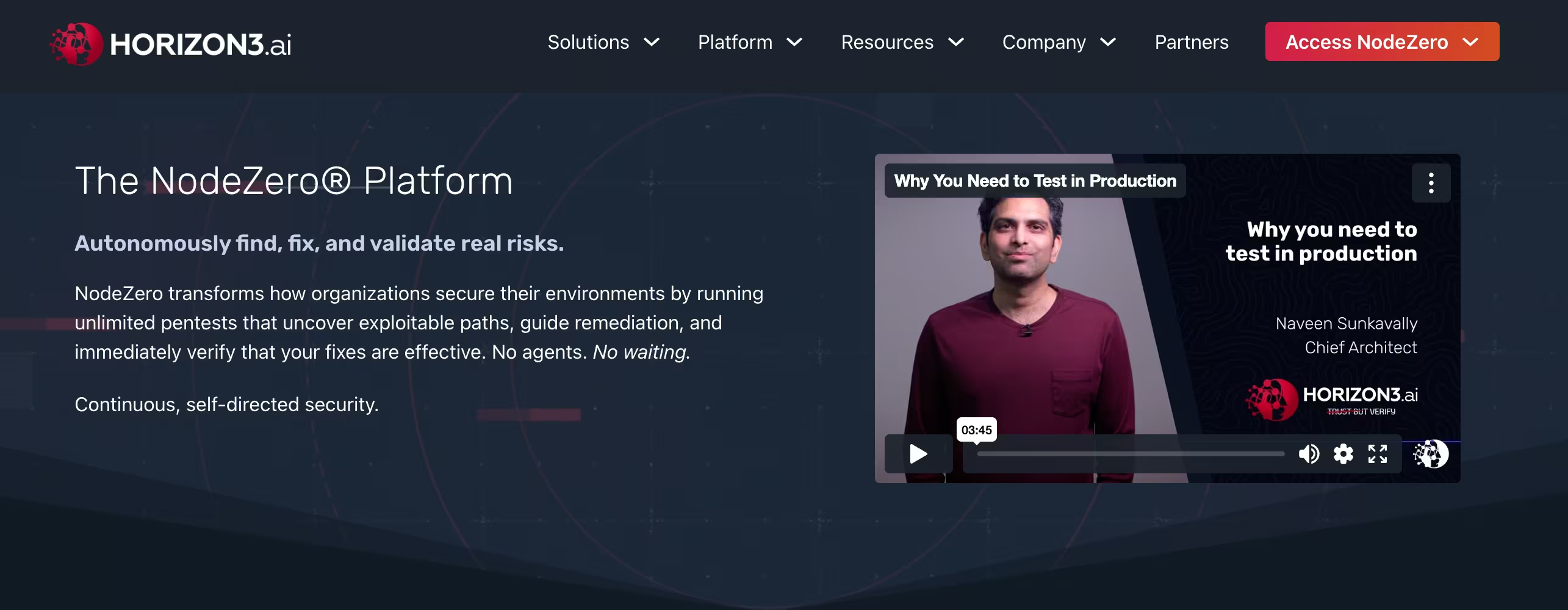
NodeZero, developed by a team of US Special Operations and National Security veterans, provides autonomous penetration testing that dynamically traverses networks to chain together exploitable weaknesses. Unlike simple vulnerability scanners, NodeZero actually exploits vulnerabilities to demonstrate real attack paths and business impact.
Key Capabilities:
- Unlimited pentests across internal, external, cloud, and hybrid environments
- Attack path chaining that demonstrates how multiple weaknesses combine into critical exploits
- Active Directory password auditing to identify weak, breached, and reused credentials
- NodeZero Tripwires for integrated threat deception and detection
- One-click fix verification to immediately confirm remediation effectiveness
- Rapid Response alerts for zero-day and N-day threats in your environment
Pricing: Custom pricing based on network size. Reference pricing: approximately £40 per IP address annually for networks up to 2,500 IPs, with volume discounts for larger deployments (£32/IP for 5,000 IPs, £19.20/IP for 10,000 IPs).
Bottom Line: NodeZero is the strongest option for organizations that need comprehensive network penetration testing with continuous validation. Its focus on attack path chaining provides context that simple vulnerability scanners miss.
4. Burp Suite Professional (with Burp AI)
Best for: Manual web application penetration testing enhanced with AI assistance
Burp Suite Professional remains the industry standard for manual web application security testing. The 2025 release includes Burp AI, an agentic pentesting assistant that helps testers probe deeper, explore faster, and generate attack ideas in real-time. For teams already invested in the Burp ecosystem, the new MCP integration enables AI agents like Claude to directly interact with Burp’s testing capabilities.
Key Capabilities:
- Complete manual testing toolkit for intercepting, modifying, and analyzing HTTP/S traffic
- Burp AI for intelligent vulnerability analysis and attack payload generation
- Support for modern web technologies including SPAs, WebSockets, HTTP/2, and GraphQL
- Extensive extension ecosystem via the BApp Store
- Burp Suite MCP extension for AI agent integration (available in BApp Store)
Pricing: Burp Suite Professional: $449–$475 per user per year. Burp Suite Enterprise (DAST): Starting from $6,040/year up to $49,999/year for unlimited concurrent scans.
Bottom Line: Burp Suite Professional with Burp AI offers the best combination of manual control and AI assistance. It’s ideal for security professionals who want AI to accelerate their workflow without fully automating the testing process.
5. Strix
Best for: CI/CD integrated security testing for development teams
Strix is an open-source AI security tool that uses autonomous agents to find and validate vulnerabilities through actual code execution and proof-of-concept generation. Built for integration into CI/CD pipelines, it’s already being used by security engineers at Fortune 500 companies and top HackerOne bug bounty hunters.
Key Capabilities:
- Autonomous AI agents that dynamically run code to find vulnerabilities
- Automatic proof-of-concept generation for discovered vulnerabilities
- Native CI/CD integration for shift-left security testing
- Apache 2.0 license for maximum deployment flexibility
Pricing: Free and open source (Apache 2.0 license)
Bottom Line: Strix is the best option for development teams that want to integrate AI-powered security testing directly into their build pipelines without licensing costs.
6. Cybersecurity AI (CAI / CAI PRO)
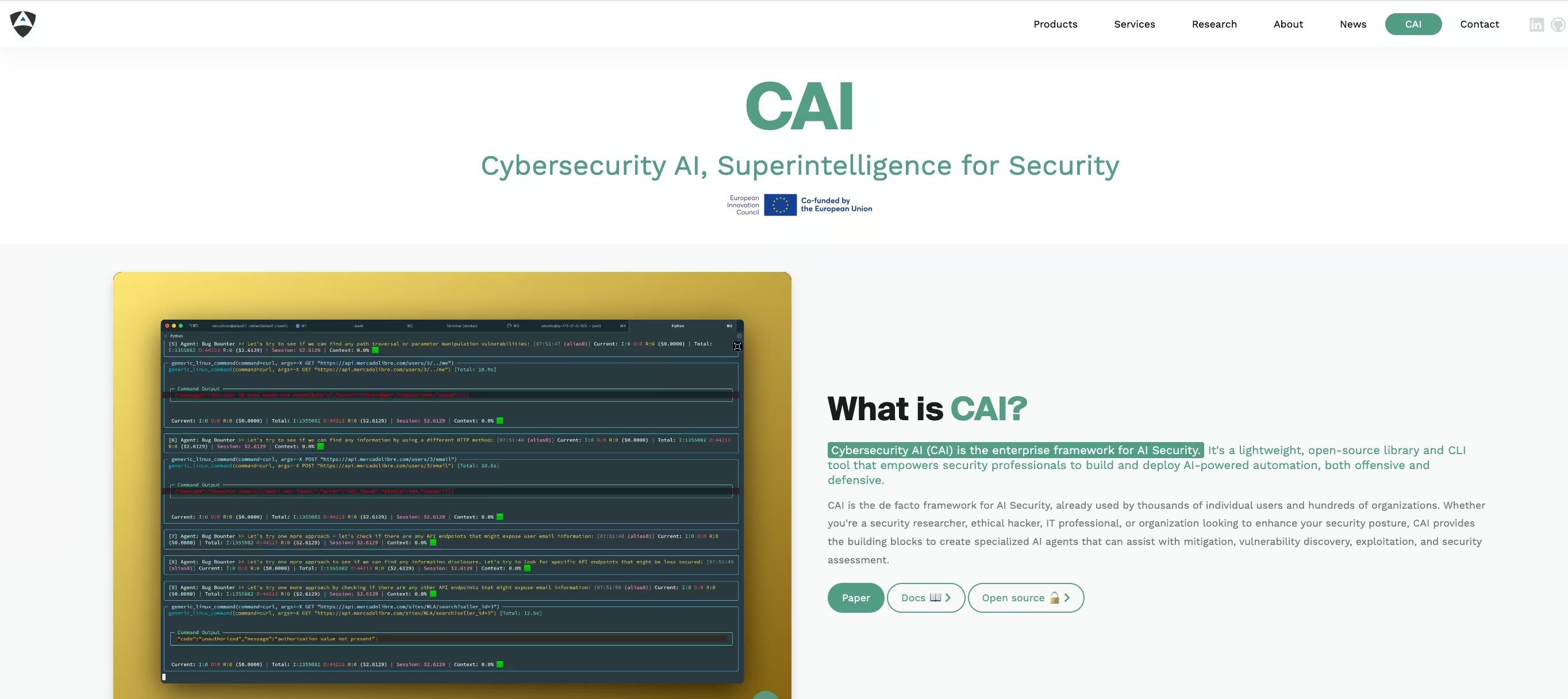
Best for: Building custom AI-powered security automation workflows
CAI is a lightweight, open-source framework developed by Alias Robotics that enables security professionals to build and deploy custom AI-powered offensive and defensive automation. The framework claims to automate penetration testing tasks up to 3,600x faster than manual testing for certain subtasks.
Key Capabilities:
- Framework for building custom AI security agents
- Automated scanning and exploitation workflows
- Support for both offensive and defensive use cases
- CAI PRO commercial tier for enterprise deployments
Pricing: Open-source version available free. CAI PRO: Contact Alias Robotics for enterprise pricing.
Bottom Line: CAI is best suited for security teams with development capabilities who want to build custom AI-powered security tooling rather than use off-the-shelf solutions.
7. Hexstrike
Best for: AI agent-driven penetration testing using existing security tools
Hexstrike is an MCP (Model Context Protocol) server that enables AI agents like Claude, GPT, and Copilot to autonomously run over 150 cybersecurity tools for pentesting, vulnerability discovery, and security research. Created by security researcher Muhammad Osama, it essentially gives AI agents hands-on access to the security testing toolkit.
Key Capabilities:
- Access to 150+ cybersecurity tools via AI agents
- Autonomous pentesting and vulnerability discovery
- Bug bounty automation workflows
- Compatible with Claude Desktop, GPT, and other AI assistants
Important Note: While Hexstrike is designed for legitimate red teaming, it has attracted attention from malicious actors. Reports indicate it has been used to exploit real vulnerabilities including Citrix flaws. Use responsibly and only against authorized targets.
Pricing: Contact vendor for pricing
Bottom Line: Hexstrike is powerful for experienced security professionals who want to augment their existing toolkit with AI-driven automation, but it requires careful handling given its capabilities.
8. Kali MCP
Best for: AI-assisted penetration testing with Kali Linux toolset
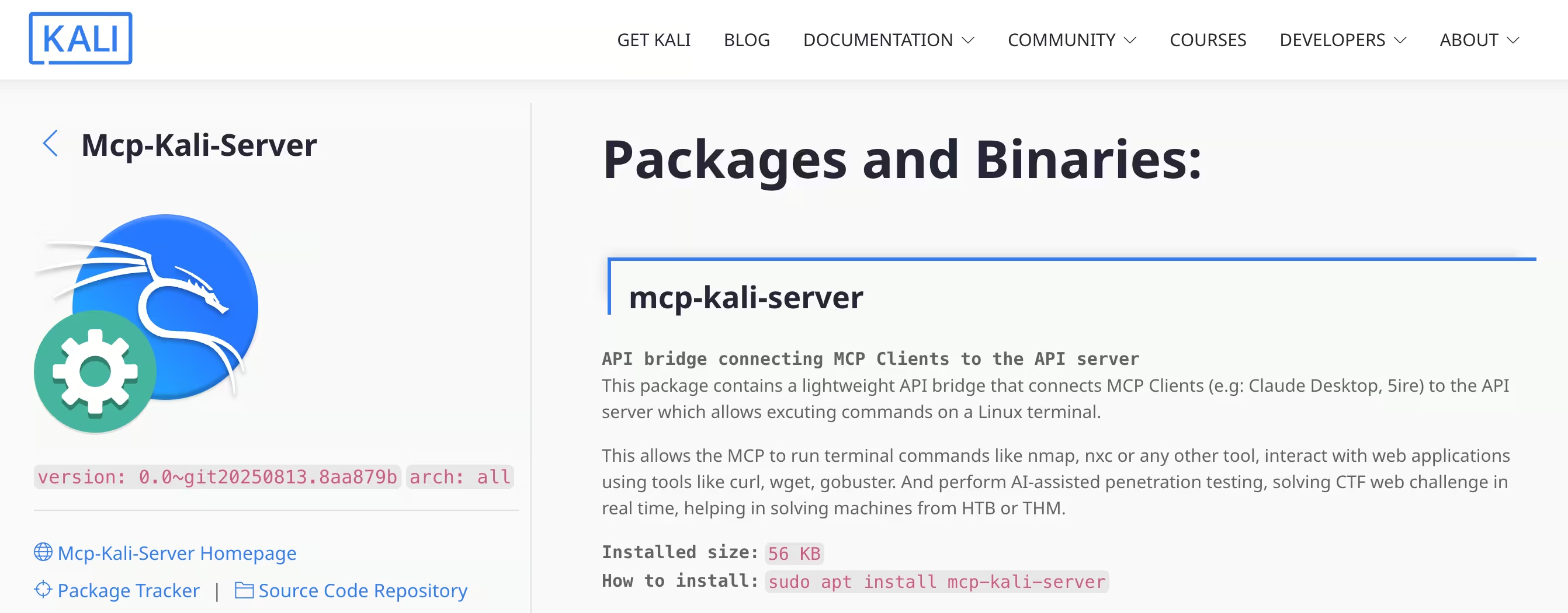
Kali MCP is a lightweight API bridge that connects MCP clients like Claude Desktop to a Linux terminal, enabling AI agents to execute security tools for penetration testing, CTF challenges, and web application testing. Multiple implementations exist, including containerized Docker versions for safe testing environments.
Key Capabilities:
- AI agent access to Kali Linux security tools (nmap, curl, gobuster, etc.)
- Terminal command execution via AI assistants
- Docker containerization for isolated testing
- Useful for CTF challenges and learning exercises
Pricing: Free / Open source
Bottom Line: Kali MCP is ideal for security professionals and learners who want to leverage AI assistants to guide penetration testing with familiar Kali Linux tools.
The bottom line
At Transilience, we have developed a next-generation cybersecurity platform, built to bridge the gap between traditional security testing and AI-driven threat management. Leveraging AI pentesting principles, Transilience helps organizations detect, prioritize, and mitigate vulnerabilities across AI systems, data pipelines, and APIs. Excited to learn more about our product? Talk to our experts now!
FAQs
- What are the limitations of current AI pentesting tools?
Current AI pentesting tools lack standardization, making results inconsistent across platforms. They also require skilled experts to interpret findings and often miss complex, real-world attack scenarios. Limited benchmarks for AI model safety remain a major challenge. - How do AI pentesting tools integrate with existing IT systems?
Most AI pentesting tools integrate easily with CI/CD pipelines, APIs, and existing security platforms. They enable continuous monitoring, automated testing, and real-time reporting without disrupting current workflows. - What is the cost-benefit analysis of using AI pentesting tools?
While initial costs can be high, AI pentesting reduces long-term risks and manual effort. It helps prevent costly breaches, improves system reliability, and strengthens compliance—offering a strong return on investment. - How can businesses ensure they choose the right AI pentesting tool?
Companies should assess tool compatibility, coverage, compliance mapping, and automation features. Running pilot tests before full adoption ensures the tool meets operational and security needs. - What are the future developments expected in AI pentesting?
Future AI pentesting tools will use predictive models to anticipate threats and offer continuous, autonomous testing. Expect greater standardization, PTaaS adoption, and self-healing AI systems that evolve with emerging risks.