

When you’re researching solutions for Secure Access Service Edge (SASE) or Security Service Edge (SSE), Zscaler initially strikes a chord. And why wouldn’t it? Its global edge network, cloud-native design, and out-of-the-box threat management have made it popular. With its Zero Trust Exchange, you can secure your cloud workloads and distributed workforces.
However, the reality is far from simple. Achieving a true SASE architecture that unifies deep security checks with agile network routing is rarely a one-size-fits-all endeavor.
While Zscaler provides cloud-native security, it only recently expanded into SASE. And organizations choose a vendor not because of its reputation, but based on their infrastructure, network topology, SOC capacity, and budget. Looking for Zscaler competitors does not mean it’s unworthy; rather, it’s about how different vendors’ deployment models, integrations, and support align with your business’s operational and financial realities.
With this in mind, let’s see what makes CISOs/CTOs evaluate Zscaler alternatives, and a list of the top 6 Zscaler competitors.
Why Look for Zscaler Alternatives in 2026?

Here’s why organizations dig deep into assessing Zscaler’s competitors:
1. Managed vs. DIY SASE
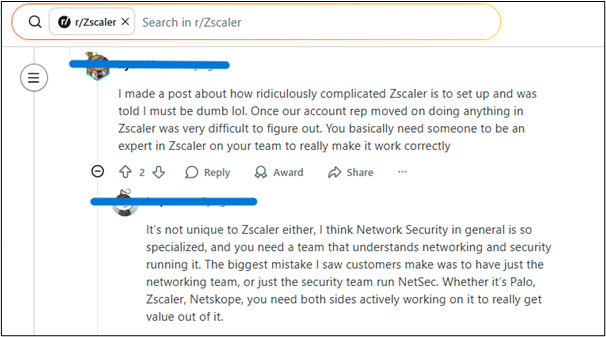
While Zscaler offers a powerful platform, it relies heavily on your internal team for daily monitoring and management. Organizations lacking internal SOC bandwidth often pivot toward other solutions that offer a managed, “Do-It-For-Me” SASE approach, combining technology with expert human integration. And it’s not just for one vendor; it’s an issue across the board.
Here’s how users reflect this sentiment on Reddit:
2. Unpredictable costs and complex licensing
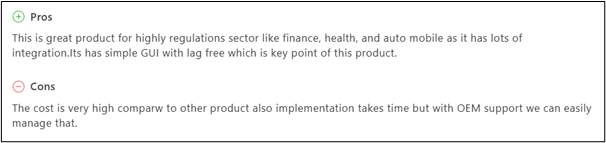
Zscaler’s enterprise-tier pricing and complex licensing models with additional costs for advanced modules can quickly strain the budgets of mid-market companies and startups. Companies frequently seek the best Zscaler alternatives that deliver transparent, outcome-based pricing without compromising on security.
Here’s a recent Zscaler review posted by a user on Capterra:
3. Friction in deployment and configuration
The design and initial configuration of Zscaler’s highly granular routing rules require specialized expertise. Smaller IT teams often look for platforms that prioritize intuitive setup and faster time-to-value to reduce configuration errors and administrative overhead.
Here’s how another user expresses concerns about this on Capterra:

4. Responsive, white-glove support
When legitimate traffic is blocked, resolving issues via standard ticketing queues causes costly user downtime. Administrators increasingly prioritize vendors that offer deeply integrated, highly responsive human support to instantly resolve friction.
5. Unified threat detection and response
Zscaler excels at access control, but managing active threats often requires purchasing add-ons or bridging the gap with separate tools or expert support. Organizations pick a solution that pairs threat management with AI-driven MDR to drastically reduce mean time to response (MTTR).
6. Streamlined compliance and governance
Navigating frameworks such as SOC 2 or ISO 27001 when deploying a complex SASE architecture is a heavy lift. Companies often look for Zscaler’s top competitors that not only secure the network edge but also actively manage and automate the continuous compliance and audit-readiness processes.
7. Ecosystem flexibility and integration
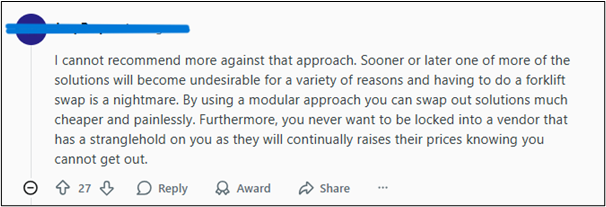
Zscaler’s push toward a single-vendor proprietary stack (ZIA, ZPA) can sometimes lead to vendor lock-in. Many IT/InfoSec leaders prefer a flexible, agnostic approach that integrates best-of-breed SASE technologies with their existing infrastructure rather than forcing a complete replacement.
A user brilliantly summarizes this on a Reddit thread titled “Is it practical to consolidate all network security into one SASE solution?”
What Are the Top Zscaler Competitors in 2026? A Detailed Overview
Before diving into our list of the top Zscaler alternatives for 2026, it’s important to know how to evaluate the platforms by considering their features, engagement model, pricing, support, and user reviews. The SASE/SSE domain is crowded with vendors claiming zero-trust capabilities, so we filtered our recommendations based on the attributes that matter most to IT and security leaders in 2026:
- Deployment and management model: We evaluated whether the vendor offers a purely Do-It-Yourself (DIY) software platform or provides managed implementation and continuous support.
- SASE convergence: We looked at how well the solution unifies networking (SD-WAN) and security (SSE) without introducing excessive vendor sprawl.
- Pricing transparency: We evaluated vendors based on their pricing models to see if they offer rigid bundled plans or more flexible, predictable costing, and whether they charge for advanced capabilities.
- Customer support and usability: We analyzed verified user feedback across review aggregators (Gartner, G2, Capterra, Reddit) to gauge satisfaction with deployment ease, user-friendliness, and support response times.
- Integration Capabilities: We assessed how easily the solution integrates with existing IT assets, cloud, and endpoint security tools, and whether the vendor offers multiple technology partnerships to avoid vendor lock-in.
Based on these criteria, here are Zscaler’s biggest competitors to consider:
1. Network Intelligence
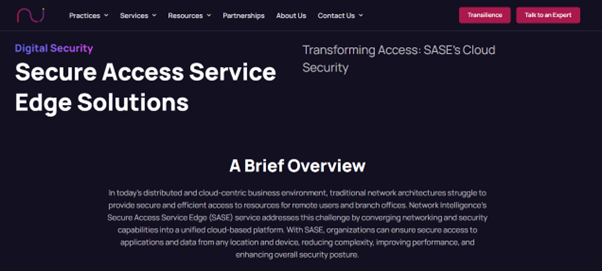
While traditional vendors sell SASE as a standalone software product that your internal team must deploy and manage, Network Intelligence takes a fundamentally different approach among Zscaler competitors.
As a comprehensive cybersecurity consulting and managed security service provider with decades of experience, Network Intelligence addresses a primary hurdle to adopting SASE: the sheer complexity of execution. Rather than forcing you into a proprietary software ecosystem, they deliver a managed, vendor-agnostic SASE architecture tailored to your infrastructure and business needs.
Key features that make Network Intelligence stand out:
- Managed SASE: End-to-end architectural design, gap identification, and deployment of Zero Trust Network Access (ZTNA).
- Technology partnerships: Integrates leading SASE technologies (SD-WAN, SWG, CASB, etc.) with your existing network infrastructure for rapid deployment and interoperability with other security tools.
- Unified cybersecurity mesh: Pairs SASE security with its Transilience agentic AI for automated MDR, threat remediation, and compliance management.
- Enhanced threat protection: Secures your data against sophisticated threats through integrated security capabilities, including next-gen firewalls (NGFWs), secure web gateways (SWGs), and ZTNAs.
- AI-powered SOC: Uses AI agents for 24/7 continuous SOC monitoring, automated policy enforcement, accelerated alert triage, and AI-driven proactive threat hunting.
- Data security and DLP: Provides accurate classification and protection of sensitive data at rest/transit across your cloud environments to prevent unauthorized exfiltration.
- Cloud-native protection (CNAPP/CWPP): Leverages Transilience AI agents for continuous CSPM (misconfigurations), CWPP (workload risks), CTEM (vulnerability prioritization), and automated remediation across multi-cloud setups.
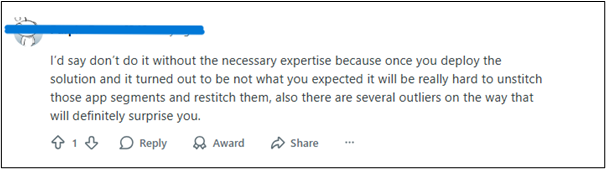
Network Intelligence solves exactly the kind of problem a DIY solution creates, as a user describes it on Reddit:
Network Intelligence in action (case study):
A fast-growing B2B SaaS company managing 500+ enterprise customers needed to scale its security and SOC 2 compliance without absorbing the $30,000+/month cost of legacy MDR solutions. By implementing Network Intelligence’s Agentic AI-powered MDR, they achieved full protection in under 7 days and saw immediate, measurable results:
- Drastic cost savings: Cut security costs by 60%, reducing their spend to $12,000/month.
- 28x faster detection: Reduced mean time to detect (MTTD) threats from 4-7 days to less than 15 minutes.
- 85% alert noise reduction: Dropped frustrating false positives from up to 80% to just 12%.
- Proven incident response: For a credential-based attack, NI’s AI agents analyzed 2.3 million log entries and contained the breach within just 2 days.
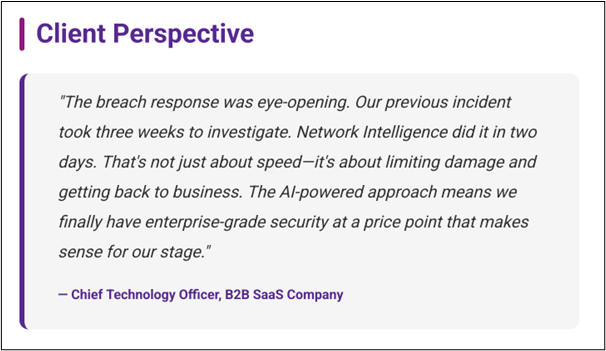
Read the entire case study on how Network Intelligence helped the SaaS company slash security costs while delivering enterprise-grade protection.
Pros
- Eliminates the steep learning curve by offloading deployment and management to experts and AI agents.
- Drastically reduces troubleshooting times with highly responsive, expert human support, bypassing the ticketing queues of legacy software vendors.
- Replaces unpredictable costs of enterprise software bundling with transparent, outcome-centric pricing.
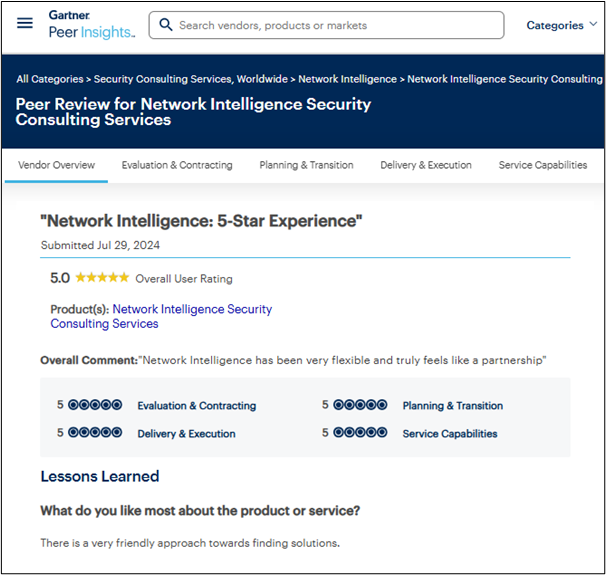
Here’s how a Network Intelligence customer reviewed it on Gartner Peer Insights:
Cons
- It does not provide a DIY software tool; if an organization wants to purchase raw software licenses to manage its proprietary stack in-house, the managed service model may not fit its procurement strategy.
Best for: Mid-market companies that lack an internal SOC team to deploy/manage a modern SASE architecture and need enterprise-grade security without an enterprise-level price tag.
Pricing
Custom, quote-based pricing. Because it is a tailored managed service rather than a rigid software tier, pricing scales predictably with the exact scope of your environment and integration needs, often resulting in a lower Total Cost of Ownership (TCO) than procuring rigid platforms and hiring dedicated internal SASE engineers.
2. Netskope
Netskope One SASE is a leading cloud-native SaaS platform that combines networking and security for hybrid workforces. It’s known for its unified SSE capabilities, borderless SD-WAN, and AI-driven orchestration across several global data centers.
Key features:
- CASB and DLP: Provides highly granular visibility and control over data movement within thousands of cloud applications.
- Borderless SD-WAN: Uses an integrated networking approach with context-aware routing and zero-touch provisioning to connect remote users, offices, and multi-cloud environments natively.
- NewEdge network: A privately managed, globally distributed cloud network designed for low latency and high performance.
Pros
- Exceptional app coverage and performance without compromising security posture.
- Reduces operational overhead with rapid deployment and unified management.
Cons
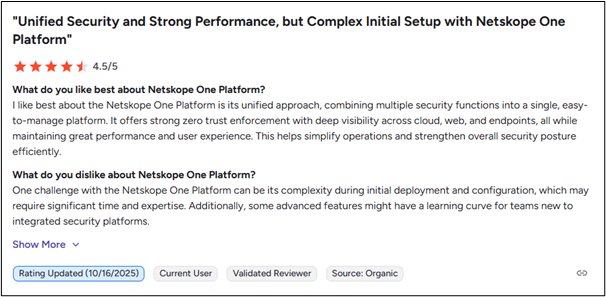
- The overwhelming admin console, due to the depth and granularity of the data controls, often requires dedicated, highly trained experts.
- Requires an internal team to deploy, write complex policies, and manage daily alert noise.
Here’s what users are saying on G2:
Best for: Large enterprises with distributed workforces needing converged SASE for high-performance Zero Trust, especially those replacing VPNs and legacy WANs.
Pricing
Enterprise-tier, subscription-based pricing. Costs scale based on user count and the specific modules (CASB, SWG, ZTNA, SD-WAN) adopted. It generally commands a premium price point similar to Zscaler.
3. Palo Alto Networks
If Zscaler excels at SSE, Palo Alto Networks leads in the Next-Generation Firewall (NGFW) space. It delivers SASE capabilities primarily through a combination of Prisma Access and Prisma SD-WAN (collectively termed Prisma SASE), which provides security by distributing its firewall OS (PAN-OS) across the cloud.
Prisma essentially spins up cloud-hosted firewalls for your organization. This provides unparalleled security granularity, but it also imposes a heavy administrative burden for managing enterprise firewalls in the cloud.
Key features:
- Firewall-as-a-service: Delivers the same robust threat protection and URL filtering found in Palo Alto’s hardware appliances.
- Autonomous Digital Experience Management (ADEM): Provides deep visibility into endpoint performance, helping pinpoint whether latency is caused by the device, the Wi-Fi, or the network.
- Panorama centralized management: Uses Palo Alto’s legacy console to unify policies across both on-premise hardware and cloud SASE deployments.
Pros
- Simplified operations via single-pane management, reducing MTTR by automating diagnostics and remediations.
- Offers industry-leading security, including ZTNA 2.0, AI-driven threat prevention, and data loss prevention (DLP).
Cons
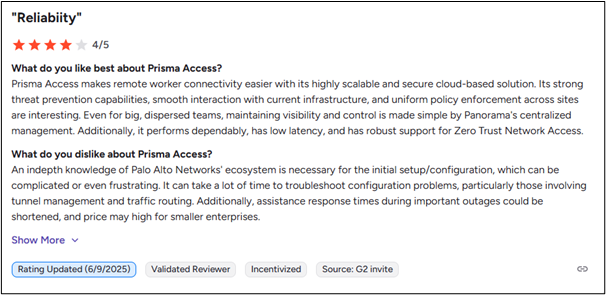
- Initial setup and configuration are challenging, requiring Prisma expertise.
- Premium pricing suits enterprises but might overwhelm SMBs with small budgets.
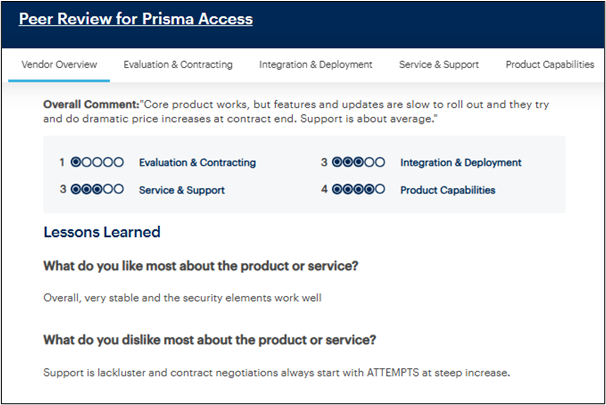
- Several users report challenges with support, as can be gathered from multiple reviews.
Here’s what users are saying on G2 and Gartner:
G2:
Gartner:
Best for: Large, resource-rich enterprises that already use Palo Alto hardware and have a dedicated, highly trained team of NetSec engineers.
Pricing
Offers premium, tiered pricing models. Costs are based on user counts, bandwidths, and add-on modules (AppSec, DLP). The TCO may get high, especially when factoring in the cost of hiring internal engineers.
4. Cloudflare
Best known for operating one of the world’s largest Content Delivery Networks (CDNs), Cloudflare has entered the SASE market with its Cloudflare One. Through its massive global edge network, Cloudflare delivers ZTNA, SWGs, and cloud routing closer to the end user than most vendors.
Cloudflare started natively in the cloud and built security on top of it, delivering blazing-fast performance. At the same time, their security inspection capabilities (such as DLP) are still maturing compared to those of other dedicated cybersecurity vendors.
Key features:
- Zero-trust access: Replaces traditional VPNs by verifying user identity and device posture before granting access to internal applications.
- Secure Web Gateway (SWG): Protects users and critical assets from malware, ransomware, and phishing by filtering internet-bound traffic.
- Integrations: Connects to third-party tools (SaaS, cloud, identity providers) and provides a unified dashboard to manage policies across different environments.
Pros
- Garners high praise for its exceptional global performance, with edge-native single-pass and no-chaining latency.
- Offers a completely cloud-native architecture that requires no physical appliances.
Cons
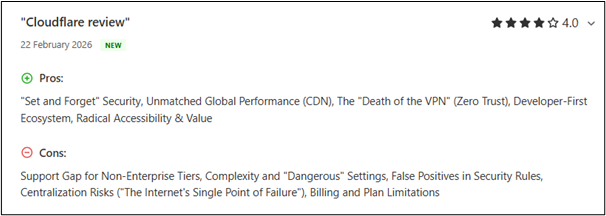
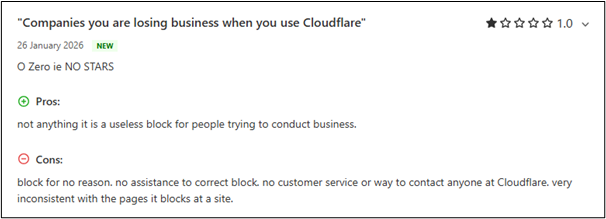
- Less mature deep security features and generates too many false positives compared to legacy SASE vendors.
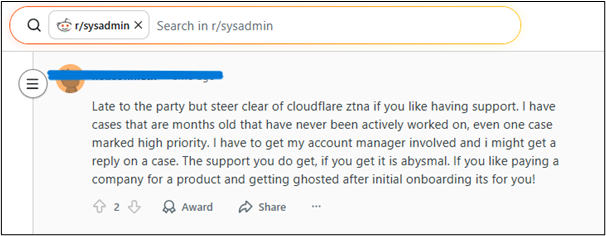
- Customer support is notoriously difficult to reach unless you’re paying for a massive, multi-million-dollar enterprise contract.
- Initial setup requires deep technical knowledge and time to learn the confusing features, as several users note on G2.
Here are recent user comments from other sites, such as Reddit and Capterra:
Reddit:
Capterra:
Best for: Cloud-native startups, developer-heavy orgs, and mid-market companies that prioritize network speed and latency reduction over defense-in-depth security checks.
Pricing
Cloudflare offers a freemium model that is free for basic access (up to 50 users). From there, it transitions to a transparent, pay-as-you-go per-user model ($7/user/month), scaling up to custom Enterprise contracts for advanced SASE features (DLP, network services).
5. Fortinet
Fortinet is another legacy vendor in the networking hardware space, famous for its FortiGate firewalls. Its SASE offering, FortiSASE, combines security with networking using FortiOS to deliver a cloud edge.
Designed to merge their physical SD-WAN devices with cloud security, their single-vendor approach extends security to thin edges, microbranches, and remote workers via distributed PoPs and FortiBranch integrations.
Key features:
- Unified FortiOS engine: Uses the same OS and policy engine as their physical firewalls, enabling consistent policy management across environments.
- SD-WAN integration: Pairs with Fortinet’s hardware to secure branch connectivity using app-aware traffic routing, thin edge support, and comprehensive DEM.
- Single-agent architecture: Uses FortiClient to consolidate endpoint protection, ZTNA, and VPN capabilities into one lightweight agent.
Pros
- Users familiar with FortiGate and FortiManager can easily adopt FortiSASE as a natural extension to their Fortinet ecosystem.
- Offers simplified procurement for large enterprises with a single bundle that includes security hardware, SD-WAN, and SSE capabilities—a complete SASE package.
Cons
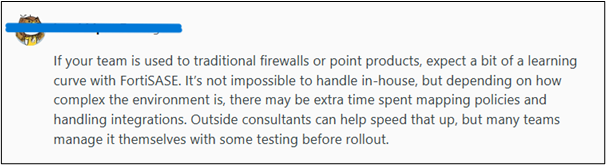
- Requires a steep learning curve and takes longer for new Fortinet users to set up initially and configure policies.
- Some users feel its SSE capabilities (CASB, DLP) are stitched-together legacy stacks rather than truly cloud-native.
- Heavier reliance on the Fortinet ecosystem limits multi-vendor flexibility.
- While it integrates well with other Fortinet tools, third-party, non-Fortinet product integration is limited, according to some users.
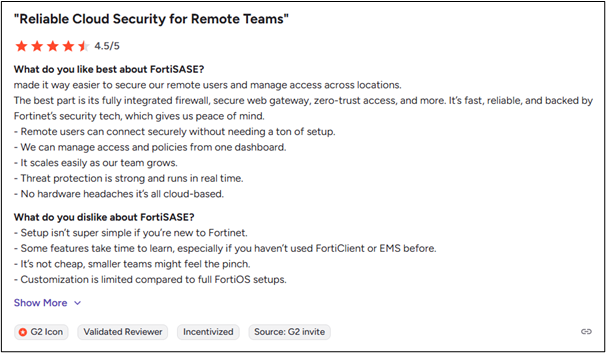
Here’s how users gauge it in their reviews/comments on sites like Reddit and G2:
This is what a Reddit user replies to another asking, “How difficult is it to configure FortiSASE?”
And here’s how a G2 user reviews it:
Best for: Organizations already using Fortinet products that want to extend their security perimeter to remote users.
Pricing
Subscription-based, per-user pricing model (minimum 10 users). While the baseline cost is competitive, the licensing structure can become complex, often requiring add-ons for dedicated IPs, advanced features, and hardware integration.
6. Check Point
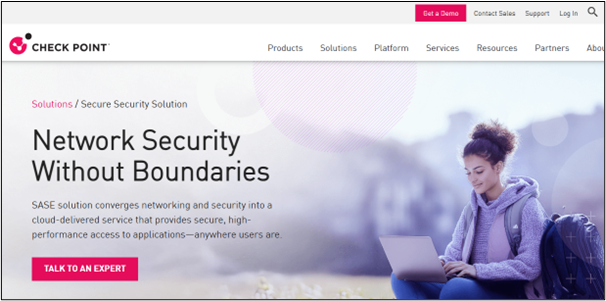
Check Point’s Harmony SASE provides a cloud-native, zero-trust security platform designed for hybrid workforces, featuring ZTNA, FWaaS, SWG, and SD-WAN.
The platform combines a user-friendly UI for daily management with robust threat-prevention engines, though integrating it into complex environments can still present challenges.
Key features:
- Global private backbone: Leverages a globally distributed network of POPs to optimize routing and reduce latency for remote teams.
- Hybrid internet access: Conducts on-device inspection for fast browsing, web/DNS filtering, malware prevention, and privacy.
- Unified console: Offers a single, centralized dashboard to manage users, access, network, and threats.
Pros
- Offers an intuitive UI that simplifies routine tasks and user access once the initial architecture is rolled out.
- Enables streamlined management to reduce complexity for hybrid/remote setups.
Cons
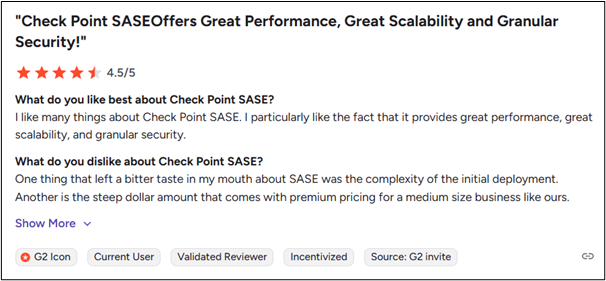
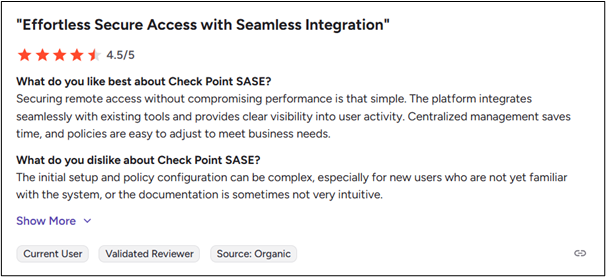
- The initial setup and policy configuration require a steep learning curve for new users, according to recent G2 reviews.
- Users report slow response from tech support, especially during complex setups.
- Some users report specific technical glitches, such as tunnel failures in multi-ISP setups.
- The higher price point may not be suitable for all small to mid-sized businesses.
Here’s how users are reviewing it on G2:
Best for: Mid-market to enterprise organizations (especially Check Point customers) that need a zero-trust enabled, single-vendor SASE solution to quickly replace legacy VPNs.
Pricing
Subscription-based, per-user pricing with a minimum user count commitment. Custom pricing available on request for large enterprises, with per-user licensing for advanced features.
Why Network Intelligence Is A Better Zscaler Alternative?
While most vendors claim to provide comprehensive SASE (SD-WAN + SSE) functionality, their solutions are not truly unified; they are often separate products bolted on through acquisitions, rather than a truly integrated, cloud-native platform.
In addition, relying on a single vendor means that if their system experiences a breach or major disruption (e.g., frequent outages or large-scale incidents like CrowdStrike in 2024), your entire network may be disrupted or exposed to hackers.
What’s worse is that unexpected renewal hikes may trap you in a no-win scenario: pay the exorbitant fees, or endure a painful switch that burns valuable engineering hours testing and reconfiguring thousands of complex policies.
For mid-sized businesses and lean IT teams, the best way forward is managed SASE. That’s where Network Intelligence shines the brightest among Zscaler’s top competitors. What makes it unique is its blend of:
- Highly experienced and certified experts who guide you throughout your SASE deployment and beyond.
- An AI-powered platform, Transilience, which automates key security and compliance workflows.
- A holistic ADVISE framework (Assess, Design, Visualize, Implement, Sustain, Evolve) that facilitates end-to-end cybersecurity solutions.
At Network Intelligence, we offer a comprehensive approach to security and compliance, focusing on owning outcomes rather than just managing them.
Key unique aspects of our SASE offering include:
- Tailored, flexible deployment: We partner with leading SASE vendors to offer customized solutions that fit your business’s unique needs and security objectives.
- Integration over replacement: Complete “rip-and-replace” often threatens business continuity. Instead, we integrate SASE solutions with your current infrastructure, designing a step-by-step roadmap to minimize business disruption.
- Managed approach: We provide strategic support, acting as a CISO-as-a-service to help with security strategy, budgeting, and tech partnerships.
- Continuous security monitoring: Transilience’s AI agents automate 24/7 monitoring of your SASE deployments (SD-WAN, ZTNA, SWG, CASB, and FWaaS) to ensure their effectiveness against evolving threats.
- Focus on compliance: Complying with regulatory requirements (GDPR, HIPAA, PCI DSS) is not optional. We integrate compliance automation directly into the SASE implementation, rather than treating it as an afterthought.
- Excellent support: Our team of experts promptly resolves ongoing issues and trains your employees to optimize the use of your SASE infrastructure.
Finding the right SASE solution doesn’t mean burdening your team with complex setup and management. Request a demo today to see how we stand by your side at every step of your security journey.