

Organizations in highly regulated industries face unique challenges when implementing quality management systems. This comprehensive ISO 9001 compliance checklist provides security-sensitive organizations with a structured framework to achieve certification while strengthening operational resilience and meeting stringent regulatory requirements.
1. Understanding ISO 9001 Requirements
1.1 What is ISO 9001?
ISO 9001 is the internationally recognized standard for quality management systems (QMS), providing a systematic framework for organizations to consistently deliver products and services that meet customer requirements and regulatory obligations. For security-sensitive sectors, ISO 9001 certification demonstrates commitment to quality excellence while establishing foundational processes that support broader compliance initiatives.
The standard employs a process-based approach that emphasizes risk-based thinking, enabling organizations to identify, manage, and mitigate potential issues before they impact operations or customer satisfaction. This proactive methodology aligns particularly well with the risk management requirements prevalent in highly regulated industries.
1.2 Key Principles of ISO 9001
ISO 9001 is built upon seven quality management principles that guide implementation:
- Customer Focus: Understanding current and future customer needs, meeting requirements, and exceeding expectations
- Leadership: Establishing unity of purpose, direction, and creating conditions for people to contribute to quality objectives
- Engagement of People: Recognizing competent, empowered individuals at all levels as essential to creating value
- Process Approach: Managing activities as interrelated processes functioning as a coherent system
- Improvement: Maintaining a permanent focus on continuous improvement
- Evidence-based Decision Making: Analyzing data and information to achieve desired results
- Relationship Management: Managing relationships with interested parties to optimize impact on performance
For regulated industries, these principles provide a structured approach to quality that complements existing compliance frameworks while enhancing operational effectiveness.
1.3 ISO 9001 Clauses and Structure
The ISO 9001:2015 standard follows the High-Level Structure (HLS) used across all ISO management system standards, facilitating integration with other frameworks like ISO 27001 for information security. The standard comprises ten sections:
- Scope
- Normative References
- Terms and Definitions
- Context of the Organization: Understanding organizational context and stakeholder needs
- Leadership: Management commitment, quality policy, and organizational roles
- Planning: Actions to address risks and opportunities, quality objectives
- Support: Resources, competence, awareness, communication, documented information
- Operation: Operational planning and control, product/service requirements
- Performance Evaluation: Monitoring, measurement, analysis, internal audit, management review
- Improvement: Nonconformity management and continuous improvement
Sections 4-10 contain the auditable requirements that organizations must implement to achieve certification.
1.4 Applicability in Security-Sensitive Sectors
For organizations in security-sensitive sectors, ISO 9001 provides several strategic advantages:
- Creates a structured foundation for integrating multiple compliance requirements
- Establishes systematic processes for managing risks and opportunities
- Demonstrates due diligence to regulators, customers, and stakeholders
- Improves operational consistency and reliability
- Reduces errors and associated security vulnerabilities
- Supports evidence-based decision making through documented processes
The standard’s flexibility allows security-sensitive organizations to tailor implementation to their specific regulatory environments while maintaining alignment with industry-specific requirements.
2. Preparation for ISO 9001 Implementation
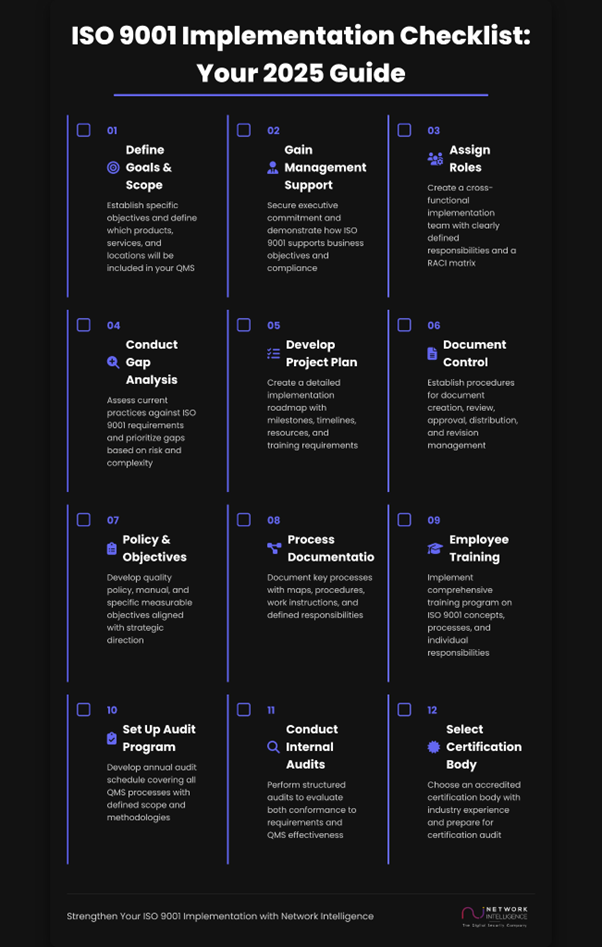
2.1 Define Organizational Goals and Scope
Begin your ISO 9001 implementation by clearly defining what you aim to achieve beyond certification itself. Establish specific, measurable objectives that align with your organization’s strategic direction:
- Identify which products, services, and locations will be included in your QMS
- Determine applicable regulatory requirements specific to your industry
- Document any exclusions from the standard (limited to requirements in Section 8)
- Define the boundaries and applicability of your QMS
- Identify interfaces between different departments and external providers
For regulated industries, carefully document how ISO 9001 implementation will support compliance with sector-specific requirements and standards.
2.2 Gain Senior Management Support
Executive commitment is critical for successful ISO 9001 implementation. Secure leadership buy-in by:
- Presenting the business case highlighting ROI, risk reduction, and competitive advantages
- Demonstrating how ISO 9001 supports existing compliance requirements
- Clarifying leadership’s responsibilities under the standard
- Establishing clear accountability for quality objectives
- Securing necessary resources for implementation
- Ensuring quality considerations are integrated into strategic decision-making
Document management commitment through a formal quality policy signed by the CEO or equivalent executive, demonstrating visible leadership support for the QMS.
2.3 Assign Roles and Responsibilities
Create a cross-functional implementation team with clearly defined responsibilities:
- QMS Representative: Coordinates implementation activities and reports to top management
- Process Owners: Responsible for specific processes within the QMS
- Document Controllers: Manage documentation and records
- Internal Auditors: Conduct systematic evaluations of the QMS
- Department Representatives: Ensure implementation within their functional areas
Develop a RACI matrix (Responsible, Accountable, Consulted, Informed) to clarify roles throughout the implementation process and ongoing QMS maintenance.
2.4 Conduct a Gap Analysis
Perform a comprehensive assessment of your current practices against ISO 9001 requirements:
- Review existing documentation and processes
- Identify areas of compliance and non-compliance
- Evaluate the maturity of current quality practices
- Assess integration with existing management systems
- Identify resource requirements for addressing gaps
- Prioritize gaps based on risk and implementation complexity
Document findings in a structured gap analysis report that will serve as the foundation for your implementation plan.
2.5 Develop a Project Plan
Create a detailed implementation roadmap with:
- Clearly defined milestones and deliverables
- Realistic timelines (typically 6-12 months for initial implementation)
- Resource allocation and budget requirements
- Risk assessment for the implementation project itself
- Communication strategy for stakeholders
- Training requirements for staff at all levels
- Metrics to measure implementation progress
For highly regulated industries, ensure the project plan accounts for integration with existing compliance frameworks and regulatory requirements.
3. Documentation and Process Development
3.1 Document Control Procedures
Establish robust document control procedures that ensure:
- All documents are created following a standardized template
- Documents undergo appropriate review and approval before release
- Version control is maintained with clear revision history
- Documents are accessible to relevant personnel
- External documents (regulations, standards) are identified and controlled
- Obsolete documents are prevented from unintended use
- Changes to documents are tracked and communicated
Implement a document management system that supports these requirements while maintaining appropriate security controls for sensitive information.
3.2 High-Level Policy and Objectives
Develop foundational documentation including:
- Quality Policy: A concise statement of commitment to quality that provides a framework for setting objectives
- Quality Manual: An overview of your QMS structure and key processes (optional but recommended for complex organizations)
- Quality Objectives: Specific, measurable targets aligned with the quality policy
- Scope Statement: Clear definition of what is included in your QMS
- Process Interaction Map: Visual representation of how processes interact within your QMS
Ensure these high-level documents reflect your organization’s context and strategic direction while addressing regulatory requirements specific to your industry.
3.3 Process and Procedure Documentation
Document key processes following a consistent approach:
- Process Maps: Visual representations of process flows
- Procedures: Step-by-step instructions for completing activities
- Work Instructions: Detailed guidance for specific tasks
- Process Metrics: Measurements to evaluate process performance
- Process Owners: Assigned responsibility for process effectiveness
- Risk Assessments: Identification of potential process failures and controls
For each process, clearly define:
- Inputs and outputs
- Sequence and interaction with other processes
- Criteria and methods for effective operation
- Resources required
- Responsibilities and authorities
- Risks and opportunities
- Evaluation methods
3.4 Forms, Checklists, and Records Management
Develop supporting documentation to ensure consistent implementation:
- Forms: Standardized templates for data collection
- Checklists: Step-by-step verification tools
- Records Retention Schedule: Defining what records must be maintained and for how long
- Records Access Controls: Procedures for protecting sensitive information
- Storage Requirements: Physical and electronic storage specifications
- Retrieval Procedures: Methods for accessing archived records
For regulated industries, ensure records management procedures comply with industry-specific requirements for retention, security, and accessibility.
4. Implementation of the Quality Management System
4.1 Manager and Employee Training
Develop a comprehensive training program addressing:
- Awareness Training: General introduction to ISO 9001 and quality concepts for all staff
- Process-Specific Training: Detailed instruction on new or revised processes
- Internal Auditor Training: Specialized training for audit team members
- Management Training: Focus on leadership responsibilities under ISO 9001
- Documentation Training: How to create and maintain QMS documentation
Document all training activities, including:
- Training content and materials
- Attendance records
- Competency assessments
- Training effectiveness evaluations
Establish ongoing training requirements to maintain competence as processes evolve.
4.2 Communication and Employee Buy-In
Create a communication strategy that:
- Explains the purpose and benefits of ISO 9001 implementation
- Clarifies how the QMS affects daily operations
- Addresses concerns and resistance to change
- Recognizes and celebrates implementation milestones
- Provides regular updates on implementation progress
- Creates channels for employee feedback and suggestions
Engage employees through:
- Departmental meetings
- Town halls and Q&A sessions
- Internal newsletters and communication platforms
- Visual management boards
- Recognition programs for quality contributions
4.3 Process Improvement Initiatives
Implement structured approaches to continuous improvement:
- PDCA Cycle: Plan-Do-Check-Act methodology for process improvement
- Root Cause Analysis: Techniques for identifying underlying issues
- Corrective Action Procedures: Systematic approach to addressing nonconformities
- Preventive Measures: Proactive identification of potential problems
- Improvement Projects: Targeted initiatives to enhance specific processes
- Suggestion Systems: Mechanisms for capturing employee improvement ideas
Document improvement activities, including:
- Baseline measurements
- Improvement objectives
- Implementation plans
- Results achieved
- Standardization of successful improvements
4.4 Maintaining Records and Evidence
Establish systematic approaches to record-keeping:
- Implement consistent naming conventions and file structures
- Create templates for common record types
- Define responsibilities for record creation and maintenance
- Establish verification procedures to ensure record accuracy
- Implement appropriate security controls for sensitive records
- Conduct periodic reviews of record completeness and accuracy
For each ISO 9001 requirement, identify what records must be maintained as evidence of compliance, ensuring particular attention to records that also support regulatory requirements in your industry.
5. Internal Audit and Performance Evaluation
5.1 Setting Up the Audit Program
Develop a comprehensive internal audit program:
- Create an annual audit schedule covering all QMS processes
- Define audit scope and objectives for each audit
- Allocate appropriate resources for audit activities
- Establish audit methodologies and procedures
- Develop standardized audit documentation
- Implement mechanisms for tracking audit findings and corrective actions
Ensure the audit program addresses both compliance with ISO 9001 requirements and the effectiveness of the QMS in achieving quality objectives.
5.2 Auditor Training and Responsibilities
Establish requirements for internal auditors:
- Define minimum qualifications and competencies
- Provide formal auditor training (internal or external)
- Conduct auditor evaluation and qualification processes
- Establish continuing education requirements
- Define auditor code of ethics emphasizing objectivity and confidentiality
- Create mentoring programs for new auditors
Document auditor qualifications and maintain records of audit participation to demonstrate auditor competence.
5.3 Conducting Internal Audits
Implement structured audit processes:
- Audit Planning: Define scope, criteria, and methodology
- Document Review: Examine relevant documentation before fieldwork
- Opening Meeting: Establish expectations with auditees
- Evidence Collection: Interviews, observations, document review
- Finding Documentation: Clear description of conformities and nonconformities
- Closing Meeting: Present preliminary findings
- Audit Reporting: Formal documentation of results
- Follow-up Activities: Verification of corrective actions
Ensure audits evaluate both conformance to requirements and effectiveness of implementation, with particular attention to processes critical to regulatory compliance.
5.4 Management Review and Corrective Actions
Establish formal management review processes:
- Schedule regular reviews (at least annually, quarterly recommended)
- Define required inputs including audit results, customer feedback, process performance
- Document review outputs including improvement opportunities and resource needs
- Assign responsibility for action items with clear deadlines
- Track implementation of management review decisions
Implement structured corrective action processes:
- Document nonconformities with clear description of the issue
- Conduct root cause analysis to identify underlying factors
- Develop action plans addressing root causes
- Implement and verify effectiveness of actions
- Document results and lessons learned
5.5 Performance Measurement and Analysis
Develop comprehensive measurement systems:
- Key Performance Indicators: Metrics aligned with quality objectives
- Customer Satisfaction Measurement: Surveys, feedback analysis, complaints
- Process Metrics: Efficiency and effectiveness measures
- Product/Service Quality Metrics: Conformance to requirements
- Trend Analysis: Identification of patterns and emerging issues
- Benchmarking: Comparison with industry standards or best practices
Implement data analysis techniques that provide actionable insights:
- Statistical process control
- Pareto analysis
- Trend charts and dashboards
- Correlation analysis
- Predictive analytics where appropriate
6. Certification and Continuous Improvement
6.1 Selecting a Certification Body
Choose an accredited certification body considering:
- Industry experience and expertise
- Reputation and credibility
- Geographic coverage matching your operations
- Understanding of your regulatory environment
- Certification approach and philosophy
- Value-added services beyond certification
- Cost structure and total investment
Request proposals from multiple certification bodies and conduct interviews before making your selection.
6.2 Preparing for the Certification Audit
Conduct thorough preparation activities:
- Perform a comprehensive pre-certification internal audit
- Address all identified nonconformities
- Conduct a management review focused on certification readiness
- Brief key personnel on the certification process
- Prepare and organize documentation for efficient review
- Conduct mock interviews with staff likely to interact with auditors
- Review recent internal audit findings and corrective actions
Develop a certification audit plan including logistics, schedules, and resource requirements.
6.3 Passing the Certification Audit
Navigate the certification process effectively:
- Stage 1 Audit: Documentation review and evaluation of QMS readiness
- Gap Correction: Addressing any issues identified in Stage 1
- Stage 2 Audit: Comprehensive evaluation of QMS implementation
- Nonconformity Management: Prompt response to any findings
- Certification Decision: Final determination by the certification body
Prepare for common certification challenges:
- Demonstrating process effectiveness beyond documentation
- Providing evidence of management commitment
- Showing how risk-based thinking is implemented
- Demonstrating continuous improvement
6.4 Marketing Your Certification
Leverage your certification for maximum benefit:
- Update marketing materials to include certification status
- Communicate achievement to customers and stakeholders
- Train customer-facing staff on the significance of certification
- Include certification in proposals and tenders
- Display certification marks according to certification body guidelines
- Share certification journey and benefits through case studies
Develop specific messaging for regulated industry customers highlighting how your QMS supports their compliance requirements.
6.5 Ongoing Compliance and System Maintenance
Establish mechanisms for sustaining certification:
- Maintain the internal audit program with regular assessments
- Conduct periodic management reviews (at least quarterly)
- Monitor changes in ISO 9001 requirements and interpretations
- Continuously evaluate and improve QMS effectiveness
- Prepare for surveillance audits (typically annual)
- Plan for recertification (every three years)
Implement a change management process to ensure QMS documentation remains current as operations evolve.
How Network Intelligence Empowers ISO 9001 Compliance
Expert Guidance Across the Cybersecurity Lifecycle
Network Intelligence provides specialized expertise for regulated industries implementing ISO 9001:
- Industry-Specific Implementation: Tailored approaches for financial services, healthcare, critical infrastructure, and other regulated sectors
- Regulatory Alignment: Mapping ISO 9001 requirements to industry-specific regulations
- Implementation Coaching: Expert guidance throughout the certification journey
- Audit Preparation: Comprehensive readiness assessment and remediation
- Continuous Improvement Facilitation: Structured methodologies for ongoing enhancement
Our consultants average 15+ years of experience in quality management for regulated industries, providing practical guidance that addresses your specific challenges.
Supporting Secure Innovation and Digital Transformation
Network Intelligence enables organizations to maintain ISO 9001 compliance while embracing digital transformation:
- Digital Quality Management: Cloud-based QMS solutions with appropriate security controls
- Process Automation: Intelligent workflows maintaining quality while increasing efficiency
- Analytics-Driven Improvement: Data-based insights identifying optimization opportunities
- Mobile Quality Tools: Secure applications extending QMS access to remote workers
- Integration Capabilities: Connecting quality management with enterprise systems
Our solutions ensure quality management evolves with your digital transformation initiatives while maintaining security and compliance.
This forward-looking methodology ensures your quality management system remains aligned with evolving requirements and industry expectations.
Ready to transform your approach to ISO 9001 compliance? Network Intelligence’s compliance specialists can help you develop a tailored implementation strategy that addresses your specific industry requirements while optimizing resource utilization.
Contact our team to schedule a consultation and discover how our AI-powered solutions can streamline your ISO 9001 certification journey.