

As attack surfaces expand in complex, hybrid environments and modern threats evolve too quickly, traditional security hits a dead end. If you only conduct periodic or reactive vulnerability checks, you can’t catch up.
That’s where Continuous Threat Exposure Management (CTEM) comes in.
The best CTEM solutions provide AI-driven real-time monitoring and automated attack simulations, prioritizing risks based on potential exploitability and business impact. They surface the few threats that pose the greatest risk to your business, so your team can focus on fixing what matters most.
However, not all CTEM platforms are the same. Different vendors offer varying security approaches, features, scalability, and pricing structures.
That’s why we have identified the top 7 CTEM vendors in an overcrowded market, where most providers overpromise and underdeliver.
But, before we get on with the list, we must answer the following questions:
Who Needs a CTEM Vendor and Why?
The short answer: Any organization lacking the dedicated internal resources to manage its bloated attack surfaces and minimize data exposure to sophisticated, AI-powered cyber threats.
Here’s a more detailed answer:
As we navigate 2026, organizations with complex, hybrid IT environments (cloud, remote workforce, third-party SaaS apps, shadow IT tools) are finding it physically impractical to manually connect the dots between fragmented security tools. They need to partner with dedicated CTEM vendors to shift from fragmented, reactive patching to continuous, proactive, and automated risk reduction.
Analysts at Gartner predict that by 2026, organizations that prioritize their security investments based on a CTEM program will be 3 times less likely to suffer a breach.
Reinforcing this, a 2026 study reveals an acute divide forming between organizations based on their CTEM adoption:
- The chasm: The 16% of organizations that have implemented it are gaining a competitive edge, while the remaining 84% are actively losing ground.
- The risk multiplier: As an organization’s digital footprint grows to 100+ public-facing domains, attack rates rise exponentially, proving that complexity itself is a critical vulnerability.
Managing these vast, often hidden attack surfaces is no longer just a technical headache to be solved by point-in-time pen testing. It’s a strategic imperative to prioritize and remediate vulnerabilities in real time. But building a continuous exposure management pipeline in-house is a logistical nightmare.
Partnering with a specialized CTEM vendor is the fastest way to bridge these gaps and stop attackers before they break through. It’s an essential strategy if you need to:
- Manage an exploding, fluid attack surface and unseen data exposure.
- Eliminate alert fatigue caused by legacy vulnerability scanners.
- Stop wasting resources on patching low-impact or unexploitable vulnerabilities.
- Prioritize remediation of real, exploitable gaps that can severely impact your business.
- Align technical risk management with boardroom decisions and business objectives.
- Navigate mounting regulatory pressure amidst rapidly evolving threats.
- Overcome severe resource constraints that hinder operational efficiency.
- Enable machine-speed security to fight AI-enabled cyber threats.
How to Evaluate a CTEM Vendor in 2026
The cybersecurity market is currently flooded with legacy vulnerability scanners and ASM tools hastily rebranding as CTEM platforms. Separating genuine frameworks that offer end-to-end, expert-led, deeply automated services from marketing hype requires rigorous evaluation.
To make it easy for you, we picked the leading CTEM security vendors based on the following attributes, categorized into operational capabilities and business value:
Operational capabilities
- Continuous attack surface discovery & mapping: The best CTEM vendors build platforms that go beyond known CVEs to dynamically discover and map your live digital footprint. It must expose unmanaged assets, ephemeral cloud workloads, IoT devices, and shadow IT to eliminate blind spots and provide continuous visibility into your entire infrastructure.
- Exploitability & risk-based prioritization: Moving beyond generic CVSS scores, top CTEM solutions leverage real-world threat intelligence and automated attack-path simulation. This intelligent prioritization scores vulnerabilities based on actual exploitability and business-impact metrics (e.g., EPSS, CISA KEV), isolating the 5% that pose 95% of the risk.
- Adversarial exposure validation (AEV): The best CTEM service providers leverage automated red teaming and breach-and-attack simulation (BAS) to securely emulate live attacks. These AI-driven, realistic drills confirm the true exploitability and the effectiveness of security controls (EPP, XDR, WAF, etc.), ensuring you’re not wasting resources on false positives.
- 24/7 adaptive testing & automation: Because threat actors now use AI to find and exploit vulnerabilities within hours, platforms must keep pace with continuous, around-the-clock monitoring. Top CTEM vendors offer systems that dynamically adapt to environmental changes (new code or attack surface) and automatically trigger remediation workflows when critical new threats are discovered.
- Collaboration and vendor-agnostic integration: Discovery is easy; mobilization is where most organizations hit a brick wall. The best CTEM platforms feature a vendor-agnostic architecture that breaks down the silos among SecOps, IT, and DevSecOps. By deeply integrating with the existing tech stack, including CI/CD pipelines, VM tools, SIEMs, and ITSM tools (such as Jira), they provide automated remediation workflows while maximizing ROI from your current investments and preventing expensive vendor lock-in.
Business value
- Human-in-the-loop AI integration: Top CTEM security vendors intentionally combine rapid AI-driven automation for continuous data correlation and complex threat pattern recognition with deep human cybersecurity expertise. This hybrid approach enables you to mitigate complex threats with confidence by ensuring that prioritization and remediation efforts align with expert judgment and accountability.
- Actionable, executive-ready reporting: Top CTEM platforms translate technical exposure data into clear, executive-level intelligence to support informed decision-making. This ensures your SecOps team receives step-by-step remediation workflows while providing the C-suite with the financially quantified risk metrics necessary for strategic oversight.
- Regulatory compliance mapping: As global cybersecurity regulations become increasingly stringent, CTEM service companies must help you demonstrate that your organizational security posture is actively managed. Integrating regulatory updates as soon as they are announced into your security workflows enables you to meet compliance requirements for evolving frameworks and laws, such as GDPR, HIPAA, SOC 2, PCI DSS, DORA, and NIS2.
- Accelerated time-to-value (TTV): One of the most common user concerns is the friction in deployment and daily management. A powerful CTEM platform is useless if it takes months to set up and immediately overwhelms your team with clunky interfaces. We evaluated vendors based on the complexity of their platforms’ implementation, support for initial deployment issues, and expert guidance for edge cases.
Top CTEM Vendors in 2026 (Detailed Overview)
1. Network Intelligence
Many CTEM vendors only sell you a software platform, requiring you to hire expensive specialists to handle integration and alert tuning. Network Intelligence solves this by offering a fully managed, vendor-independent CTEM service.
Driven by its flagship Transilience AI platform combined with human expertise, Network Intelligence bridges the gap between automated scale and expert-led validation. Transilience AI handles data processing, correlation, and scale, while seasoned security experts verify findings and drive remediation decisions aligned with business objectives and compliance requirements.
This approach effectively eliminates the deployment friction and mobilization bottlenecks that plague CTEM adoption.
Key features and services offered by Network Intelligence:
- Automated ASM: Identifies and maps your external, internal, and cloud assets in real time (including shadow IT and forgotten assets), detecting misconfigurations, vulnerabilities, and attack paths while adapting to environment changes.
- Transilience AI risk prioritization: Instead of relying on generic CVSS scores, Transilience’s AI agents calculate risk across four critical factors: exploitability, automatability, business impact, and asset criticality, surfacing the few high-risk vulnerabilities that need immediate attention.
- Attack path mapping: Visualizes the many ways attackers can exploit a chain of linked vulnerabilities to gain access to sensitive data, surfacing exposures that analysts might otherwise miss.
- Continuous validation engine: Enables continuous red teaming and automated BAS to empirically test your defenses against simulated real-world attacks in a safe environment, confirming whether the risk is real or just a distraction.
- Automated remediation workflows: Directly feed validated findings into ITSM tools, which automatically assign remediation tasks to their respective owners, accelerating risk mitigation.
- Real-time adaptability: Uses advanced behavioral baselines and unsupervised machine learning to continuously detect anomalies and adapt to evolving threats. No more blind spots between quarterly scans.
- Compliance automation: Aligns CTEM implementation with your regulatory needs and streamlines audit preparation through automated risk assessments, control validation/improvement, and evidence mapping to the compliance requirements of HIPAA, GDPR, SOC 2, ISO 27001, and PCI DSS.
Pros
- Eliminates deployment frustration and months-long learning curve with expert guidance from day one.
- Offer tailored, vendor-agnostic, and AI-driven CTEM services that integrate with your existing systems, such as SIEM, SOAR, EDR/XDR, IAM, ITDR, and ASM tools.
- Provides a unified view of exposure risks across your digital ecosystem, enabling accurate, data-driven decision-making.
Cons
- The comprehensive managed CTEM service may be overkill for micro businesses with simple, static IT environments and minimal compliance requirements.
Proven impact: Case study and client testimonials
Here’s how Network Intelligence proved itself as one of the best CTEM vendors:
When a leading enterprise cybersecurity provider in Massachusetts needed to transform its manual, time-intensive VM processes, it turned to Network Intelligence. By integrating an intelligent, API-driven Continuous Threat Exposure Management solution, powered by real-time threat correlation, the organization completely modernized its security operations. Following deployment, the client achieved:
- 95% reduction in manual CVE lookup and mapping, enabling threat response at machine speed.
- 75% reduction in false positives through context-aware vulnerability prioritization and active threat actor tracking.
- >90% sustained accuracy and match quality compared to their rigorous manual baseline, proving that AI-driven scale does not have to sacrifice precision.
This is how the company’s COO admired Network Intelligence’s solution:
“The automation delivered not only met but exceeded our expectations, particularly in preserving our core accuracy while scaling at speed. The team was proactive, responsive, and aligned with our operational needs from day one.”
— Chief Operating Officer, Leading Cybersecurity Company
Here’s what Network Intelligence’s other customers are saying:
| “Working with Network Intelligence has helped us not only with security operations, but with strategy as well. CISO as a service model has helped us with security strategy, budgeting, secure partner collaboration and as a business enabler as we scale. Their inputs have helped us clearly understand risk and compliance and helped us with a well-structured operations. Network intelligence’s support and operations services have helped us cover operations seamlessly across different touchpoints including managing security and access across cloud, M365, EDR and BYOD device management, coupled with physical asset management – it has helped us ensure single point of responsibility covering hardware and software.”
— Pranshu Jain, Chief Enterprise Architect, Navikenz |
| “Having worked together for 10+ years, Network Intelligence has been instrumental in delivering top-tier technical assessments and compliance advisory services to Kotak Securities. Their deep insights into the cybersecurity landscape are evident. They have proactively addressed vulnerabilities, thereby enhancing the security of our applications. Their ability to swiftly navigate evolving threats and regulations makes them an invaluable partner in Kotak Securities’ cybersecurity journey. Accessibility to their top management and dedicated involvement played a big role in all these.”
— Anil Kumar Nair, Head IT Infrastructure and Security, Kotak Securities |
Best for
Mid-market to enterprise organizations with complex hybrid and cloud environments that seek proactive risk reduction without the additional headcount to manage deployments, integrations, and daily security operations.
It’s the overall best CTEM service provider for businesses that struggle with frustrating alert overloads, vast attack surfaces, talent gaps, or CTEM’s mobilization step.
Pricing
Network Intelligence offers custom, outcome-based pricing based on the scope of your environment and required compliance modules. Their managed service allows you to shift heavy cybersecurity CapEx into predictable OpEx.
2. Palo Alto Networks
Alt text/Caption: Cortex Exposure Management platform by Palo Alto Networks (Source: Palo Alto Networks)
Palo Alto Networks enables a CTEM pipeline by combining two products within its Cortex portfolio: Cortex Xpanse and Cortex XSIAM.
While Xpanse acts as an EASM tool to discover unknown, internet-facing assets from an outside-in perspective, XSIAM acts as the AI-driven central nervous system. XSIAM ingests this exposure data alongside internal endpoint, network, and cloud telemetry to automate threat detection, prioritize risks, and drive remediation.
Key features:
- Asset discovery (Xpanse): Continuously scans the internet to uncover and map your unmanaged and shadow IT assets, providing a unified view of your external attack surface.
- AI-driven prioritization (XSIAM): Uses AI analytics to prioritize high-risk, exploitable weaknesses that face the outside world without security controls.
- Unified security operations: Cortex consolidates SIEM, SOAR, EASM, and XDR capabilities into a centralized data lake, eliminating security tool sprawl.
Pros
- Xpanse provides deep visibility into the external attack surface and auto-finds at-risk assets.
- XSIAM acts as an all-in-one data lake, successfully correlating logs from diverse applications and third-party tools.
- Provides native integrations with other Palo Alto Networks products (firewalls, Prisma Access).
Cons
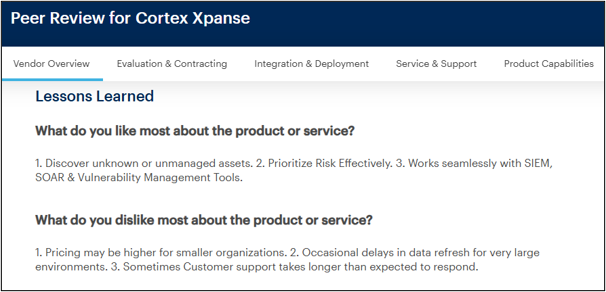
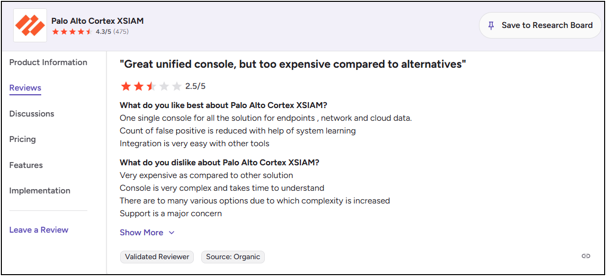
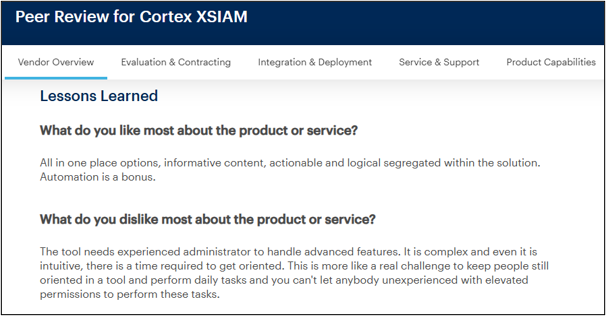
- Several users point out that the initial deployment for both tools can be cumbersome, requiring significant manual tuning and configuration.
- Cortex’s solutions require a steep learning curve, and specialized expertise and training are needed to use them effectively.
- Many users find the platform too expensive for small and even mid-sized organizations.
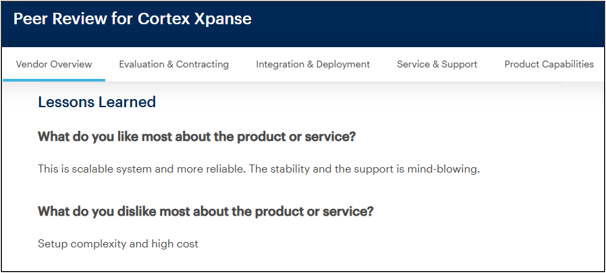
Below are some snapshots of user reviews for Xpanse on Gartner, XSIAM on Gartner, and XSIAM on G2:
Best for
Large enterprise organizations with high security maturity, especially those already heavily invested in the broader Palo Alto Networks ecosystem.
Pricing
Custom, enterprise-tier pricing. Xpanse is typically priced based on the number of discovered assets, whereas XSIAM requires a significant investment in log storage, ingestion volume, and additional capabilities.
3. XM Cyber
XM Cyber’s CTEM solution focuses on attack-path management, predicting how an attacker could move laterally through your network to breach your assets. It continuously maps how vulnerabilities, misconfigurations, and overly permissive identities interoperate to simulate possible attack paths.
This platform is valuable for security teams seeking to shift from traditional, list-based VM to a proactive, path-based approach.
Key features:
- Attack graph analysis: Maps complete attack paths to show how seemingly minor issues can be chained to compromise “crown jewel” assets.
- Choke point identification: Automatically identifies intersections where multiple attack paths converge (choke points), allowing teams to disrupt dozens of attacks.
- Remediation workflows: Provides step-by-step guidance and alternative fix paths, integrating directly with ITSM tools to align security and dev teams.
Pros
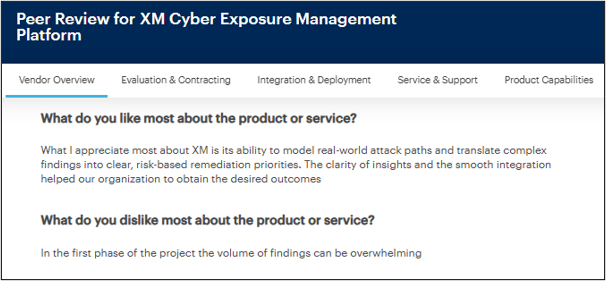
- Users highly value the ability to see real-time attack paths, which provides a unique vision that standard vulnerability scanners or EDRs cannot match.
- Multiple reviews highlight the user-friendly interface and intuitive menus that make navigation and investigation straightforward.
Cons
- Initially, the alert overload can be troublesome, and it takes time and a learning curve to tune the system to the specific environment.
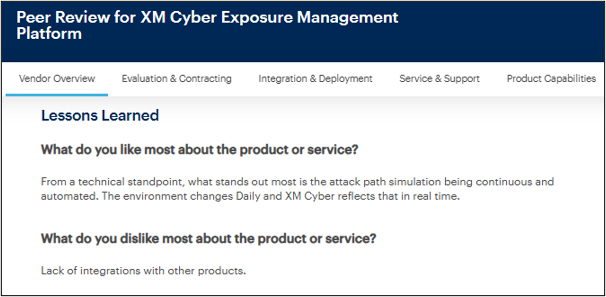
- Some users found integrating the platform into their existing security stacks and protection systems complicated.
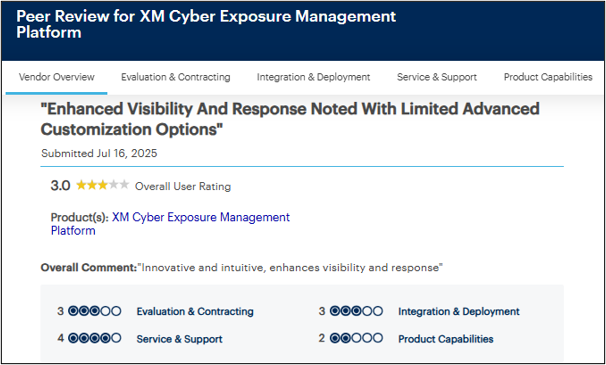
Here’s how users gauge it in their reviews on Gartner Peer Insights:
Best for
Mid-to-large enterprises with complex, hybrid infrastructures that need a visual, intelligence-driven way to sever attack paths to their most critical data.
Pricing
Custom, subscription-based pricing that scales depending on the number of assets monitored, scope of deployment (cloud vs. on-premise), and required support.
4. IONIX
IONIX is an External Attack Surface Management (EASM) and CTEM platform that zeroes in on the external attack surface and the digital supply chain.
Using a robust mapping system, IONIX discovers and monitors not only your direct internet-facing assets but also deeply nested third-, fourth-, and fifth-party vendor connections, benefitting organizations that rely heavily on third-party applications.
Key features:
- Asset discovery: Automatically scans and identifies all internet-facing assets, including shadow IT tools, forgotten domains, and cloud properties, without manual entry.
- Connective intelligence: Maps the relationships between assets and third-party digital supply chains to identify unapparent and deeply rooted risks.
- Active protection: Proactively neutralizes certain external threats (such as potential domain hijacking) before threat actors can exploit them.
Pros
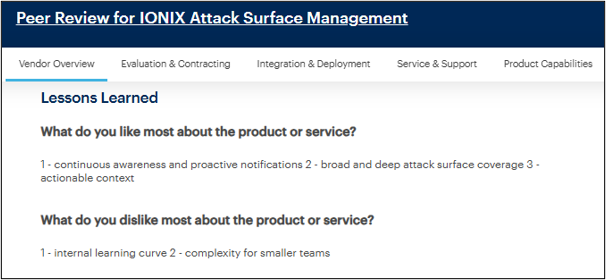
- Frequently praised by users for finding unknown assets and providing deep visibility into the external perimeter.
- Users consistently highlight the incredibly fast deployment and time-to-value.
Cons
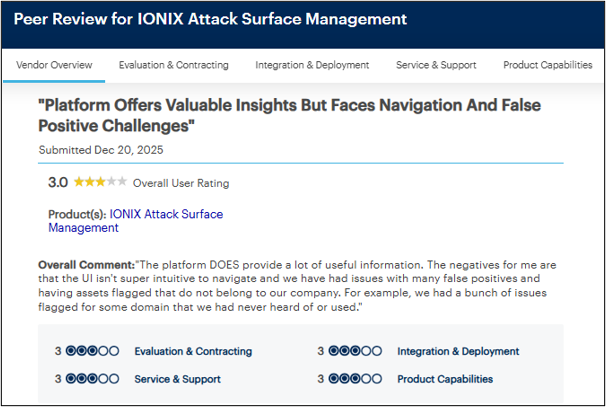
- Some reviews on Gartner Peer Insights describe the interface as not intuitive and somewhat difficult to navigate for complex investigations.
- While many find it accurate, some users report that assets are incorrectly flagged as belonging to their company.
Here’s what users are saying about IONIX on Gartner Peer Insights:
Best for
Mid-market to large enterprises that have a massive external footprint, including complex digital supply chains.
Pricing
IONIX offers a custom, subscription-based pricing model that scales based on the volume of assets tracked and the specific modules your organization requires.
5. Cymulate
Cymulate is a unified exposure management and security validation platform that shifts security from reactive vulnerability scanning to a proactive, evidence-based approach.
Cymulate bridges the gap between theoretical risk and actual exploitability through its robust Breach-and-Attack Simulation (BAS) capabilities.
Key features:
- Breach-and-attack simulation (BAS): Uses an extensive library of production-safe attack simulations mapped to the MITRE ATT&CK framework to test defenses against real-world techniques.
- Threat intelligence: Provides daily updates on emerging global campaigns, allowing teams to test their resilience against new threats in one click.
- Exposure analytics: Ingests data from Cymulate and third-party tools (vulnerability scanners, EDR, cloud) to provide a centralized view of risk with business context.
Pros
- Users often acknowledge its intuitive, user-friendly interface, which enables quick setup.
- Frequently cited in user reviews for proactive, responsive customer support.
Cons
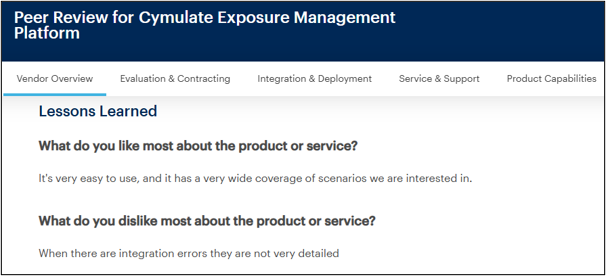
- Some users find that it lacks detailed error messages when troubleshooting integrations.
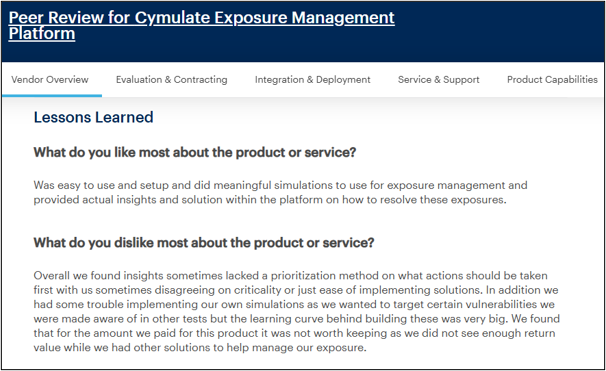
- Some reviewers note that the platform’s insights can occasionally lack granular vulnerability ranking, leading to confusion about prioritizing remediation.
- As many users have noted on G2, its reporting feature lacks customization, especially when communicating with the executives.
Check out below how users are reviewing it on Gartner Peer Insights:
Best for
Mid-market to enterprise organizations that need to validate their security stack effectiveness through real-world attack simulations.
Pricing
Subscription-based pricing that typically scales based on the number of endpoints, IP addresses, and the specific assessment modules (like BAS, EASM, or CART) you choose to license.
Why Choose Network Intelligence as Your Top CTEM Service Provider
For many organizations, security investments have hit the ceiling. Deploying another pricey CTEM platform that forces you to hire expensive specialists to manage it skyrockets your TCO.
What’s worse, most CTEM solutions generate more noise than signals. From initial false-positive floods to a lack of granular prioritization, security teams are already stretched too thin to manage them.
In a market teeming with such tools, Network Intelligence stands out as the top choice overall because it delivers CTEM as a fully managed, end-to-end service.
Instead of handing your team another dashboard to monitor and tune, our experts take complete ownership of your exposure management lifecycle.
Here’s why security leaders trust us as their strategic partner:
- Eliminate talent gap: Gain access to seasoned cybersecurity professionals who guide you throughout your CTEM journey, eliminating the need to recruit a costly in-house team.
- Achieve faster time-to-value: Offload your time-consuming deployments and integrations burden to us. Our managed CTEM service starts assisting from day one.
- Avoid vendor lock-in: Implementing CTEM should maximize ROI for your existing systems, not replace them with a big-ticket platform. Our technology partnerships allow you to remain flexible without forcing you into a single-vendor ecosystem.
- Human-AI collaboration: Transilience’s AI agents automate tedious, repetitive security processes, while experts validate prioritized findings and address complex edge cases.
- Streamline communication: Vulnerabilities often bounce between IT, DevOps, and SecOps. We integrate security and ticketing tools to automate remediation workflows, decongesting mobilization bottlenecks.
- Lower your TCO: Consolidate your continuous threat exposure management program into a single managed service to eliminate the hidden costs of tool sprawl and endless training.
Ready to join the CTEM club and mature your security? Schedule a demo with us today to see how we can future-proof your cybersecurity.