

In our introduction to the platform, What Is an Agentic SOC? Inside Rainier, we described Rainier’s four core pillars. This post goes deeper on the one that removes the most daily work: Alerts & Triage.
Most SOCs do not have a detection problem. They have a volume problem. SIEM rules, EDR sensors, firewalls, identity providers, and cloud posture tools all raise alerts, and every one of those alerts lands on a queue that a human has to read, compare with the alerts around it, look up, and decide on. The first tier of that work is repetitive by nature, and it is where analyst time quietly disappears.
Rainier treats triage as an automation problem first and a staffing problem second.
One funnel for every source
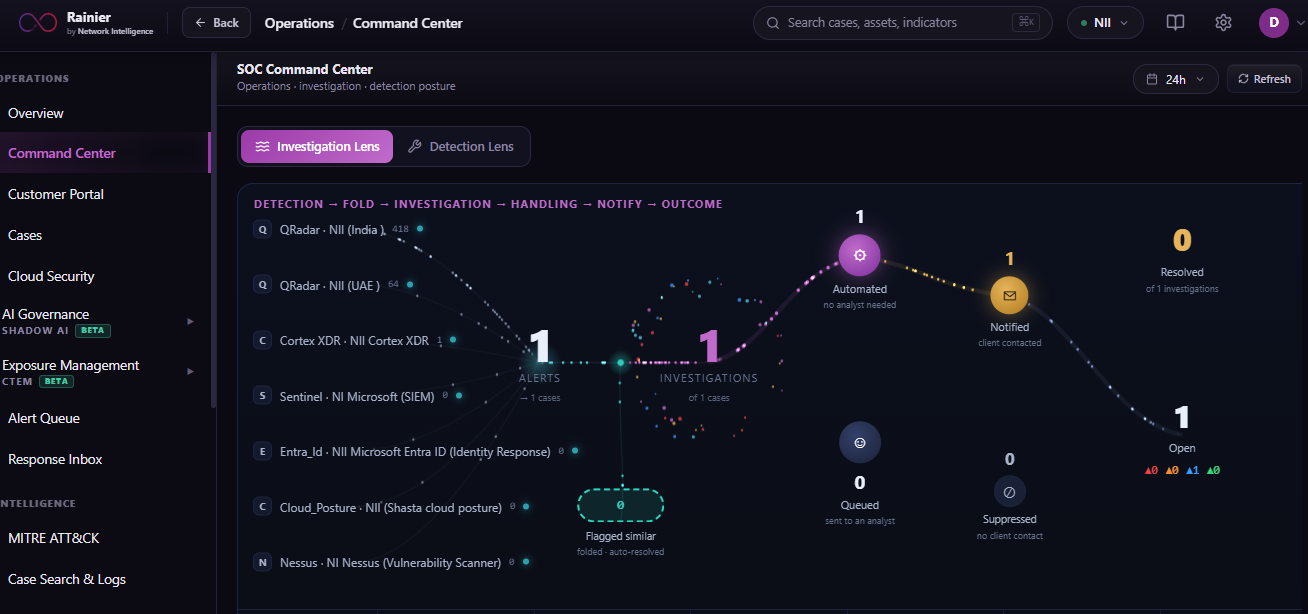
Alerts from the SIEM, EDR/XDR, cloud posture, identity, and vulnerability tools a customer already runs flow into a single alert stream. Rainier connects to that existing stack, including platforms such as IBM QRadar, Microsoft Sentinel, Splunk, SentinelOne, CrowdStrike Falcon, Microsoft Defender, FortiGate, and Palo Alto, rather than replacing any of it. Analysts work one queue instead of switching between consoles to piece together what a single incident looks like.
Inside the platform, each alert moves through a visible sequence: Detection, Fold, Investigation, Handling, Notify, and Outcome. The Command Center’s Investigation Lens shows where any alert currently sits and what happened at each step.
Fold: grouping related alerts instead of multiplying cases
A single underlying event routinely produces many alerts. A brute-force attempt, for example, can trip several rules across several tools within minutes. Handled naively, that becomes a stack of near-identical tickets.
Rainier’s “Flagged Similar” logic groups related alerts together instead of opening a new case for each one. The analyst sees one coherent picture of what happened, and the queue reflects real issues rather than the number of rules that fired.
Suppression that learns from confirmed false positives
Some alert types are noisy in a specific environment and benign every time: a scheduled scanner, a known admin script, a backup job. Investigating them again and again is the definition of wasted effort.
Persistent-rule suppression handles this. Once a use case is confirmed as a false positive, the suppression rule persists, so that already-understood pattern stops flooding the queue on its own. The important design point is that suppression follows confirmation. It is a decision recorded against a specific use case, not a blanket filter that hides alert types nobody has reviewed.
Automated disposition, gated by confidence
This is where the agentic approach differs most from a static playbook. For each alert, Rainier’s agents reason about the alert in its own context, using the enrichment and correlation gathered around it, and reach a disposition.
- Where confidence is high, the alert is resolved without analyst involvement.
- Where it is not, the alert is queued for an analyst, with the enrichment, correlation, and AI-written investigation narrative already attached.
Analysts are not removed from the loop. They are moved to the part of the loop where judgment matters: genuine escalations, high-risk approvals, and edge cases.
What “handled” actually covers
Triage in Rainier is not only a yes-or-no decision on whether an alert is real. The same pipeline takes on the surrounding L1 work, which is why the effort reduction is meaningful. Representative reductions by activity, based on internal testing and production use, look like this:
| SOC activity | Traditional (manual) | With Rainier | Representative effort cut |
|---|---|---|---|
| Alert triage and false-positive suppression | Analyst reviews each alert | AI auto-triage and suppression | ~80% |
| IOC and entity enrichment | Manual lookups across tools | Auto-enriched inline | ~90% |
| Correlation and de-duplication | Manual, error-prone | Automatic, with Flagged Similar | ~85% |
| Investigation and root cause | Slow, inconsistent | AI narrative per case | ~70% |
| Disposition and closure | Manual decisioning | Risk-based auto-close | ~75% |
| Containment and response | Console-hopping | One-click or autonomous | ~70% |
| Client notification | Hand-written emails | Automated, with LLM reply handling | ~85% |
| Reporting and KPIs | Manual compilation | Auto-generated | ~90% |
Across the whole L1 tier, the net effect is roughly 70% less repetitive work. These figures are representative and will vary with environment, tuning, and the data sources connected.
Response that is enforced, verified, and reversible
When triage ends in containment, Rainier’s enforcement layer applies the action across firewall and proxy block feeds, endpoint controls, and identity. Each block is time-bounded and expires on its own. Each block is verified by reading back from the device rather than trusting an API’s success response. And each block can be undone from a queue instead of by digging through an audit log. Automation that acts on a live network needs exactly these properties, or teams will not trust it.
Measured automatically
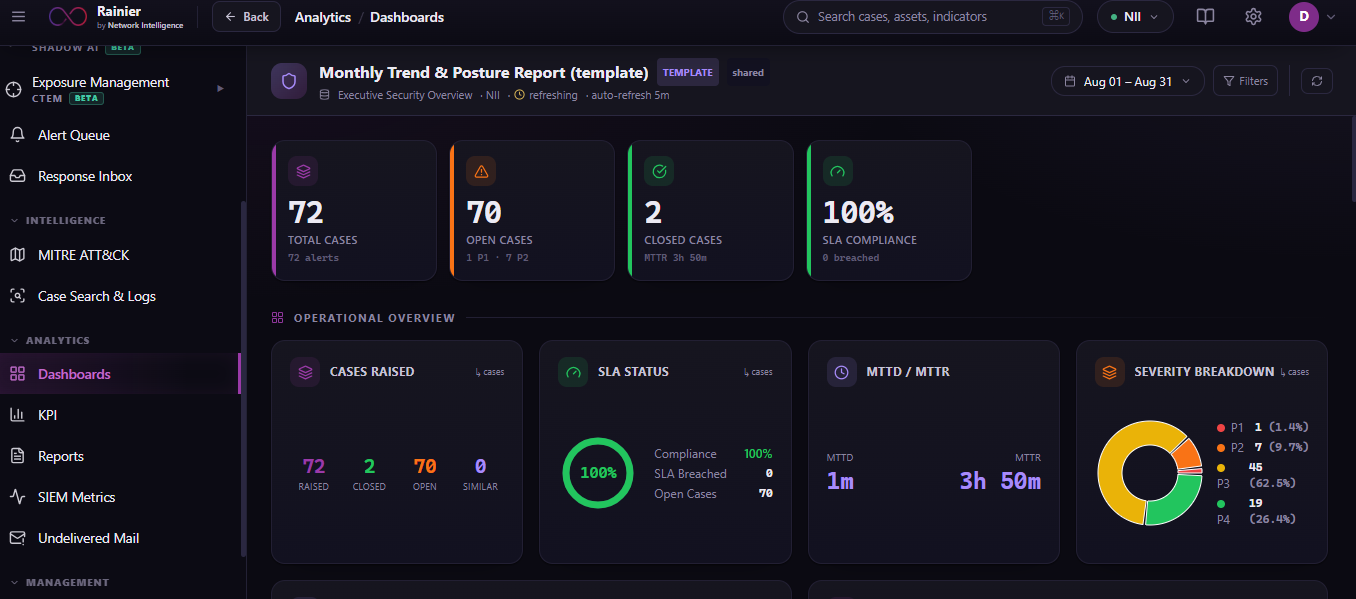
Because every alert and case moves through one pipeline, the platform tracks the metrics a SOC is judged on without anyone compiling them by hand: mean time to detect (MTTD), acknowledge (MTTA), respond (MTTR), and contain or close (MTTC).
Who benefits most
- SOC managers who need alert volume to stop dictating headcount and shift coverage.
- L1 and L2 analysts who would rather spend their time on investigation than on repeated lookups and duplicate tickets.
- MSSPs running the same triage discipline across many client environments around the clock.
- CISOs who want response-time metrics that come from the system of record, not a monthly spreadsheet.
Want to see an alert queue go from noise to real cases? Book a Rainier walkthrough.