

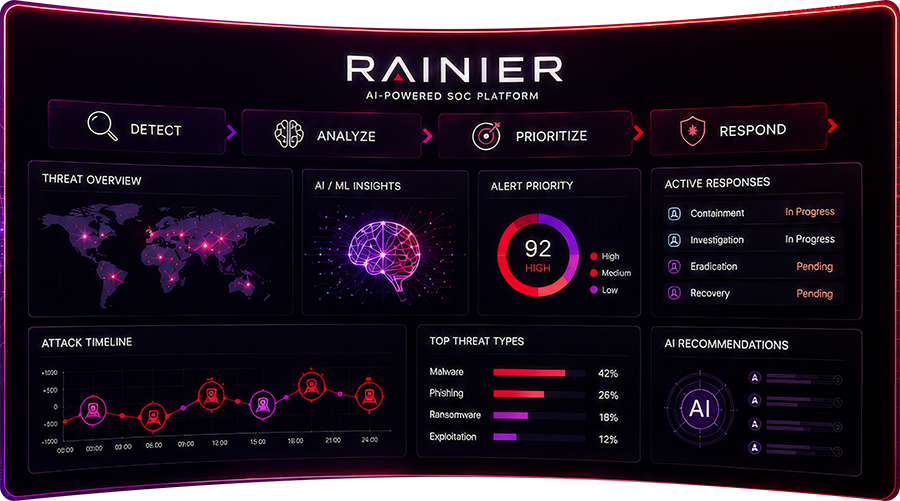
Ask most SOC teams what’s actually hard about their job, and the answer usually isn’t detection. Modern SIEMs and EDR tools are good at generating alerts. The hard part is everything that happens after: triaging noisy alerts, pulling context from five different consoles, enriching indicators by hand, deciding what’s real, and closing the loop — one ticket at a time, around the clock.
That’s the problem Rainier, Network Intelligence’s agentic AI-powered SOC platform, was built to solve.
What “agentic” actually means here
“Agentic” gets used loosely in security marketing, so it’s worth being precise. Rainier isn’t a rules engine with more if-then branches, and it isn’t a chatbot bolted onto a SIEM. It runs independent AI agents that reason about each alert in its own context — pulling in related evidence, checking it against threat intelligence, and deciding what should happen next — rather than executing a brittle, hand-authored playbook that breaks the moment an attacker does something the playbook’s author didn’t anticipate.
In practice, that means the workflow looks less like “alert fires → ticket opens → analyst manually investigates” and more like “alert fires → agents triage, correlate, investigate, and either resolve it or hand a fully-enriched case to a human.” Analysts still make the calls that need judgment. They just stop being the ones doing the repetitive lookup work to get there.
The core pipeline
Rainier’s day-to-day operation runs on four connected pillars:
1. Vendor-neutral integration. Rainier sits on top of the SIEM, EDR/XDR, and firewall stack a customer already owns — IBM QRadar, Microsoft Sentinel, Splunk, SentinelOne, CrowdStrike Falcon, Microsoft Defender, FortiGate, Palo Alto, and more — connected read-only by default, with credentials held per-instance in an encrypted vault. Adding a vendor is configuration, not a coding project, and there’s no rip-and-replace conversation required to get started.
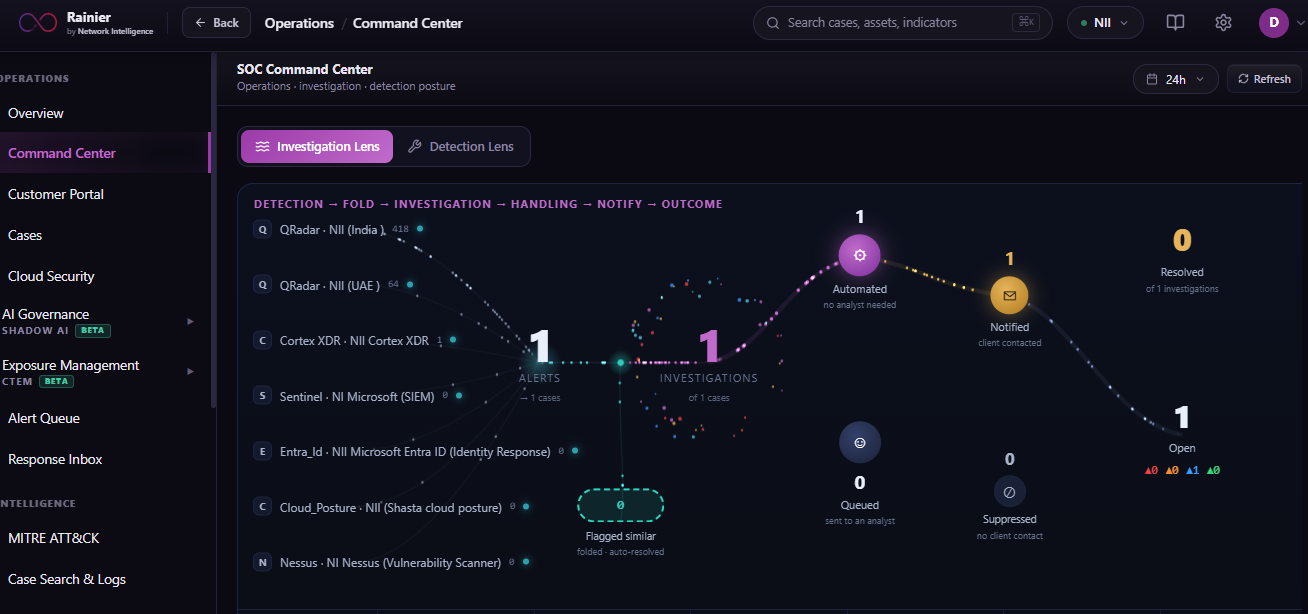
2. Alerts & triage. This is the core automation layer. Alerts from every connected source fold into one stream, related alerts get grouped instead of duplicated (“Flagged Similar”), and a persistent-rule suppression system learns from confirmed false positives so a noisy, already-understood alert type stops flooding the queue on its own. High-confidence alerts get resolved automatically; everything else gets routed to an analyst with the context already attached.
3. Investigate & detect. Every case that does reach an analyst comes with an AI-written executive summary, entity enrichment (IPs, hashes, emails, endpoints checked against threat intel automatically), and a MITRE ATT&CK technique mapping — assembled without anyone manually stitching it together. Response actions like isolating an endpoint, blocking a hash, or disabling a user are available directly from the case, not in a separate console.
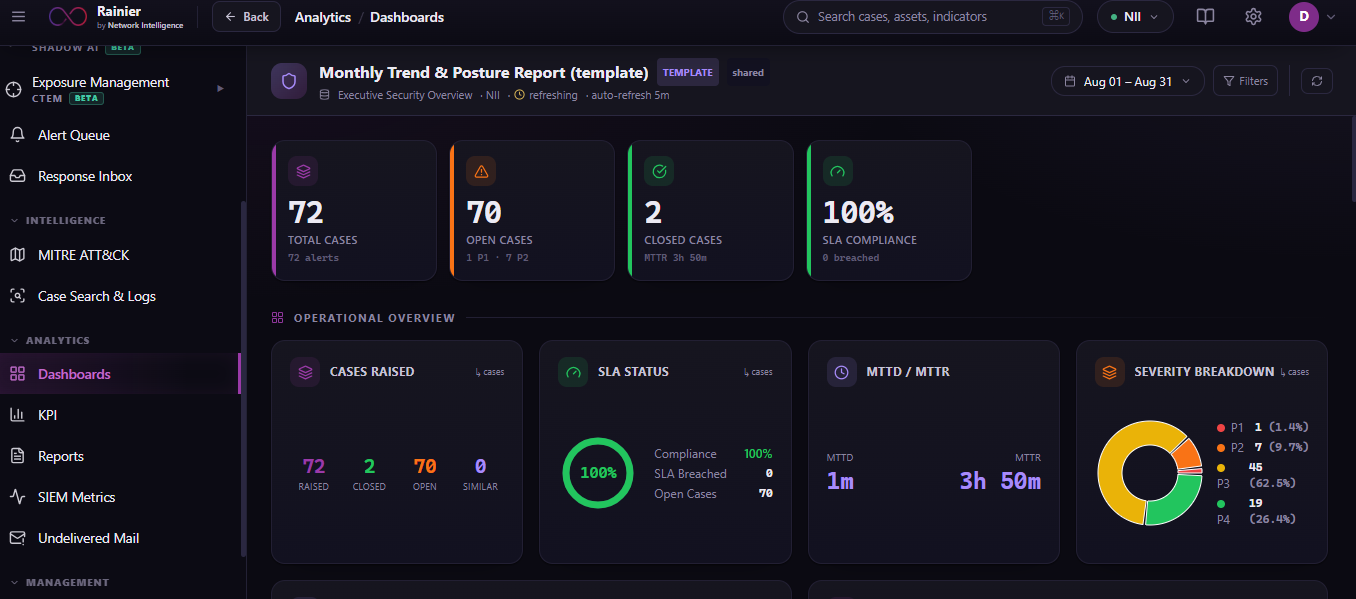
4. Dashboards & reporting. Every metric a SOC or client needs — posture, MITRE heatmaps, threat and priority charts — lives in configurable, auto-refreshing boards, with branded PDF reports that can be scheduled and shared per client.
What this changes in practice
In representative internal testing and production use, this pipeline has cut L1 triage effort by roughly 70%, with detection-to-disposition typically measured in minutes rather than hours, running continuously. Scaled to a mid-size SOC processing around 2,000 alerts a day, that works out to an illustrative ~230 analyst-hours freed up daily — time that goes back into the investigations that genuinely need a human. (These figures are representative and will vary by environment, tuning, and the data sources connected — treat them as a directional model, not a guarantee.)
Why this matters beyond speed
Three design choices separate an agentic SOC platform from a traditional SOAR deployment:
- No playbook maintenance treadmill. Agents reason about context rather than executing pre-written scripts, so there’s no library of playbooks to keep updating as attacker behavior shifts.
- Data-sovereign AI. Rainier runs on a self-hosted AI stack — client data doesn’t get sent to an external LLM to get an alert triaged.
- MSSP-native from the ground up. Multi-tenancy is enforced at the database layer, not bolted on with access controls, which matters for any provider running the platform across multiple client environments.
Where this is going
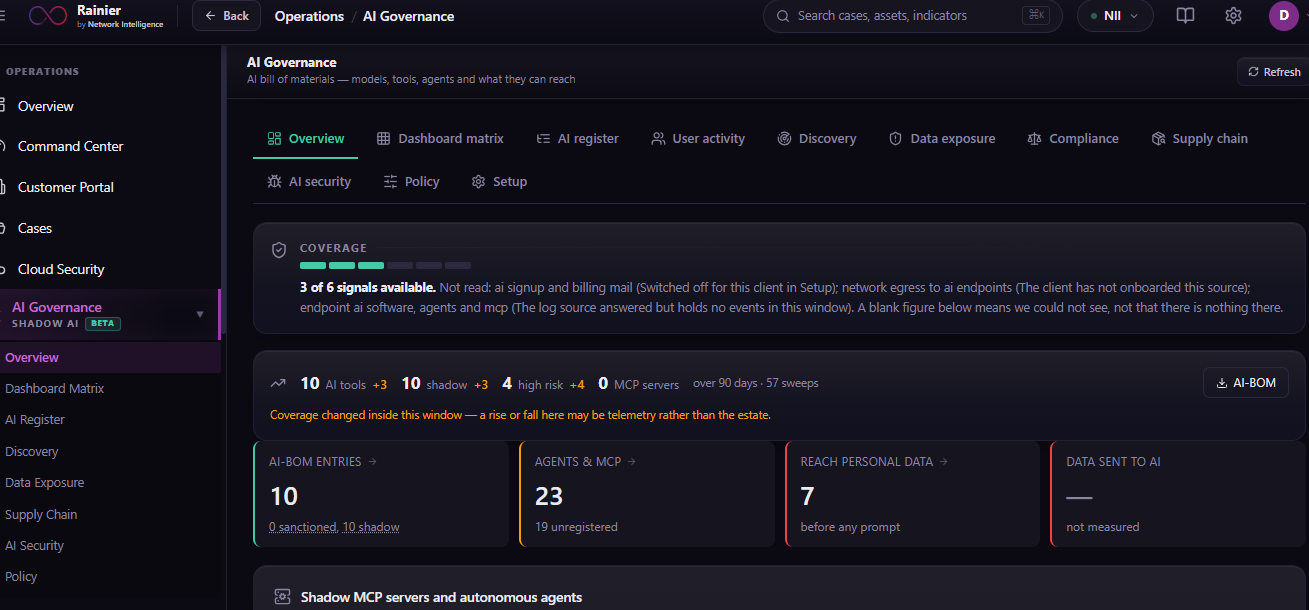
Rainier’s core SOC pipeline above is the foundation. On top of it, Network Intelligence has been shipping platform modules that extend the same agentic approach into adjacent problems — AI Governance (mapping shadow AI usage across the enterprise), Cloud Security (folding cloud posture findings into the same case pipeline as SIEM alerts), Exposure Management/CTEM (prioritizing what’s actually reachable, not just what has a CVSS score), and PhishSim (turning a reported phishing email into a real SOC case). We’ll cover each of those in depth in upcoming posts.
Want to see Rainier triage a real alert queue end to end? Book a walkthrough.