

Most security teams run two parallel worlds. One is the SOC: alerts from SIEM and EDR, triaged, correlated, and escalated around the clock. The other is cloud posture: a CSPM console somewhere else, producing its own findings, reviewed on its own schedule, usually by a different person entirely.
The split made sense when cloud posture management was a newer, bolted-on discipline. It makes much less sense now that cloud is where most of the infrastructure actually lives, and a misconfigured S3 bucket or an over-permissioned IAM role is every bit as exploitable as a phishing email that lands in an inbox.
What the split actually costs
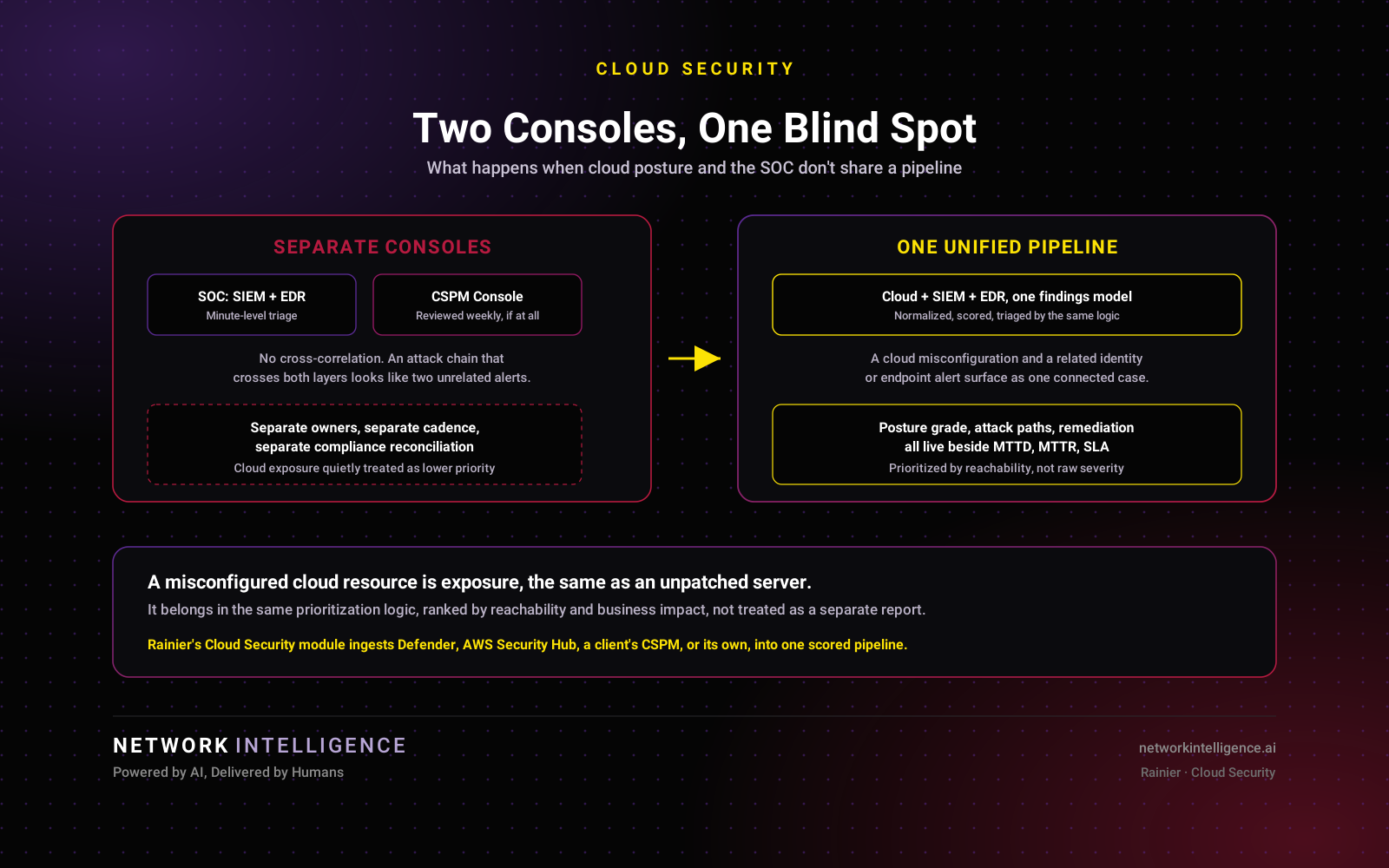
Cloud findings don’t get triaged with the same urgency as SOC alerts. A CSPM console producing hundreds of findings, most of them low-severity noise, trains the same instinct a noisy SIEM does: people stop looking closely. The difference is a SOC has triage built around that problem. A standalone CSPM tool often doesn’t.
Correlation gets lost. An attacker rarely stays inside one layer. Initial access might come through a phished credential, lateral movement through a misconfigured cloud identity, and impact through a database the posture tool already flagged as publicly reachable. When SOC alerts and cloud findings live in separate consoles, nobody sees that whole chain in one place, they see two unrelated alerts in two different tools.
A separate console means a separate owner, and often a slower one. If cloud posture findings go to a cloud team that reviews them weekly while SOC alerts get minute-level triage, the organization has quietly decided that cloud exposure matters less than endpoint exposure. That’s rarely a deliberate decision, it’s just what happens when the tooling is split.
Compliance reporting duplicates effort. Frameworks like ISO 27001, SOC 2, and DPDP expect a coherent picture of risk and control effectiveness. Reconciling a SOC’s findings against a separate CSPM’s findings for one compliance report is manual work that a unified model makes unnecessary.
What a unified pipeline actually looks like
The fix isn’t a dashboard that shows both tools side by side, that’s just a nicer-looking version of the same split. It’s cloud posture findings flowing through the same pipeline SIEM and EDR alerts already use.
Ingestion through a common findings format. Cloud posture data, whether from a built-in CSPM, Microsoft Defender, AWS Security Hub, or a client’s existing tool, gets normalized into the same shape as every other alert source, usually something OCSF-aligned, so it can be scored and triaged by the same logic.
Posture grading alongside case metrics. Instead of a separate CSPM scorecard nobody checks, a plain-letter posture grade, attack-path count, and severity breakdown sit in the same console as MTTD, MTTR, and SLA compliance.
Cross-correlation with SIEM and EDR alerts. A cloud misconfiguration that’s also showing related identity or endpoint activity should surface as one connected case, not two unrelated tickets a human has to notice are related.
Risk register and remediation in the same workflow. Guided remediation, compliance mapping, and a risk register live where the rest of the SOC’s casework lives, not in a tool only the cloud team opens.
Why this matters for exposure management, not just alerting
A misconfigured cloud resource is exposure in exactly the sense an unpatched server is, and it belongs in the same prioritization logic. Not every finding deserves equal urgency. A storage bucket that’s technically public but has no route to anything sensitive is a different problem than one sitting next to a crown-jewel database. Reachability and business impact, not just severity labels, should decide what gets worked first. This is the same reachability-based thinking our CTEM post covers in more depth, cloud posture is one of the inputs into a real exposure management program, not a parallel track.
What to ask before trusting a “unified” security platform
- Do cloud findings actually flow through the same triage and scoring logic as SIEM and EDR alerts, or just appear next to them in a dashboard?
- Can a cloud misconfiguration and a related identity or endpoint alert surface as one connected case?
- Is there a plain-language posture grade alongside the usual SOC KPIs, or is cloud posture still its own separate scorecard?
- Does remediation guidance live in the same console as the rest of casework, or does it route to a different tool entirely?
- Does the platform support ingestion from your existing CSPM and cloud-native tools, or does it force a rip-and-replace?
- Is prioritization based on reachability and business impact, or does everything get treated as equally urgent?
Where Rainier fits
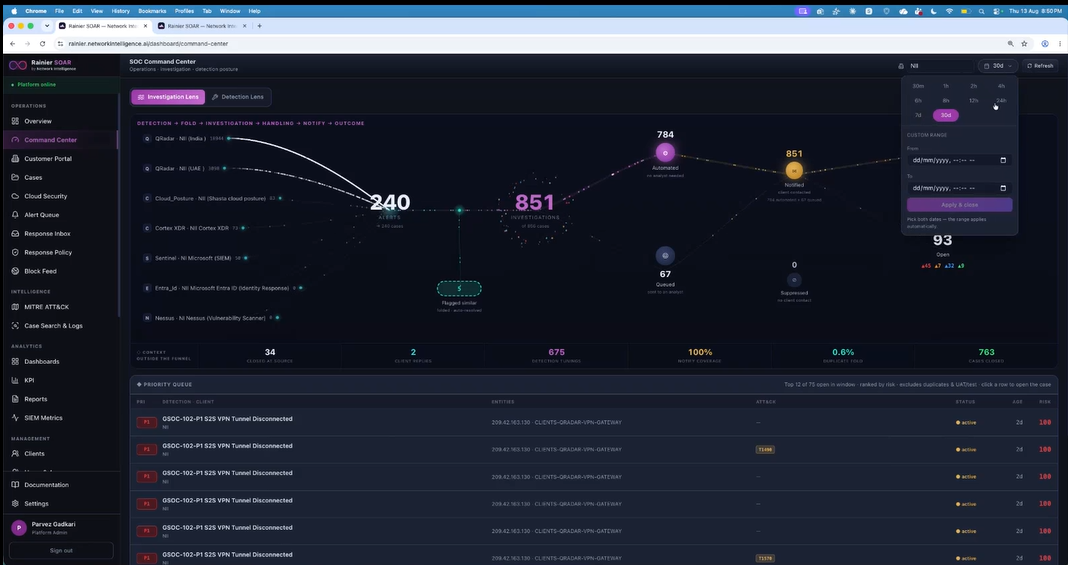
Rainier’s Cloud Security module runs cloud posture findings through the same AI pipeline as every SIEM and EDR alert, scored, triaged, and assigned like any other case rather than siloed in a separate CSPM console nobody checks. It ingests OCSF-shaped findings from Microsoft Defender, AWS Security Hub, a client’s existing CSPM, or Rainier’s own built-in CSPM, and shows a plain-letter posture grade, attack-path count, and severity breakdown alongside the same case metrics tracked everywhere else in the platform. Cloud findings correlate directly with SIEM and EDR alerts instead of sitting in a separate report nobody cross-references, and a risk register, compliance mapping, and guided remediation all live in the same console as the rest of the SOC’s casework.
Want to see cloud posture findings triaged in the same pipeline as your SOC alerts? Talk to Network Intelligence.