

Most security teams already have more findings than they can fix. Every scanner, every pentest, every cloud posture tool adds to a backlog that was never realistic to clear in the first place. The instinct is to sort that backlog by CVSS score and work top-down. The problem is that CVSS measures a vulnerability’s theoretical severity, not whether an attacker can actually reach it, or what it would cost the business if they did.
Continuous Threat Exposure Management, or CTEM, is the industry’s answer to that mismatch. It isn’t a product category you buy off a shelf. It’s a five-stage program, originally defined by Gartner in 2022, for deciding what’s actually worth fixing, in what order, on an ongoing cycle rather than a point-in-time assessment.
The five stages of CTEM
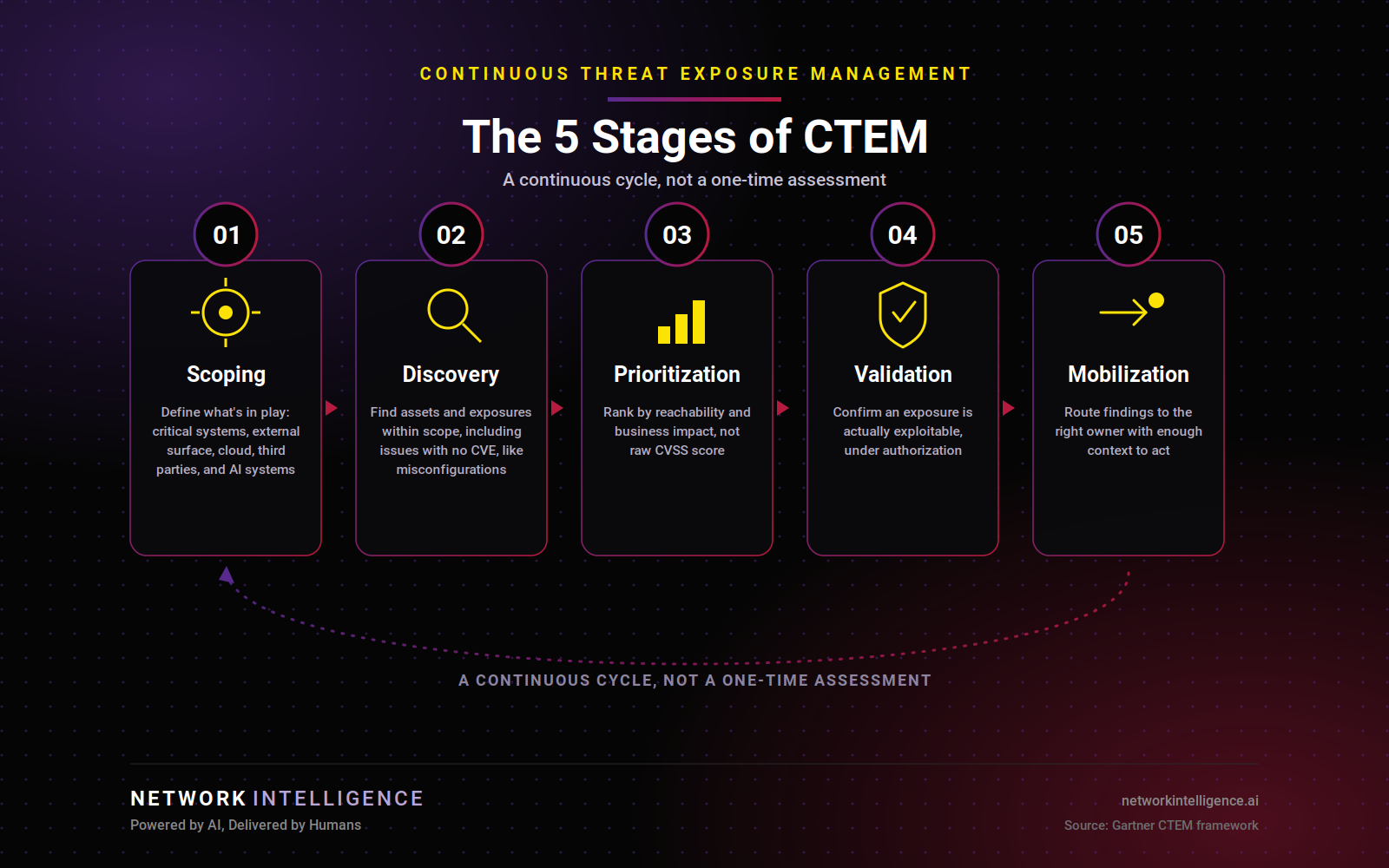
1. Scoping. Define what’s actually in play: business-critical systems, external attack surface, cloud environments, third parties, and increasingly, AI systems and agents. Scoping is a business conversation before it’s a technical one; it decides what the rest of the program will and won’t cover.
2. Discovery. Find the assets and exposures within that scope: misconfigurations, exposed services, identity weaknesses, vulnerable software, and increasingly, the AI agents and MCP servers that never went through a formal review. Discovery is deliberately broader than a vulnerability scan; it includes things that never had a CVE assigned in the first place.
3. Prioritization. This is where most CVSS-only approaches fall apart. Reachability, and business impact matter more than raw severity. A critical-rated vulnerability with no path from the internet and no route to a crown-jewel asset is a very different problem than a medium-rated misconfiguration sitting directly in an attacker’s path. A program that scores by CVSS alone often ends up defending things that don’t matter and missing things that do.
4. Validation. Confirm that an exposure is actually exploitable, and understand what an attacker could do next if they reached it. This is where a scanner’s output stops being enough. Validation means someone (or something) actually attempts the exploit path, under authorization, the way a real adversary would chain it.
5. Mobilization. Get the finding to the right owner with enough context to act. A validated, reachable exposure with clear business impact moves through a remediation workflow far faster than a raw line item in a spreadsheet, because the person fixing it can see why it matters.
Why “reachability” is the concept that changes everything
A finding without a CVE, a misconfigured storage bucket, an over-permissioned service account, doesn’t fit neatly into a CVSS-based queue, so it often gets deprioritized by default, not because it’s unimportant but because the scoring model has nowhere to put it. A reachability-based approach asks a different question for every finding: can this actually be reached, and does it lead anywhere that matters? “Not reachable from outside” and “no route to a crown jewel” are legitimate reasons to deprioritize something. They’re very different from “we didn’t look.”
This is also where an exposure program has to be honest about its own blind spots. A mature program distinguishes between what’s actually been measured and what’s simply unscored, because treating an unscored asset as safe is how real exposure gets missed.
Where pentesting fits: validation, not a once-a-year event
The Validation stage is traditionally where an annual penetration test lives, and it’s usually the least continuous part of a CTEM program by design: a point-in-time snapshot in a process meant to be ongoing. Newer approaches to Automated Security Validation and agentic pentesting close that gap by making validation something that can run far more often than a once-a-year engagement allows, without needing a large team to execute it manually.
(If your team is evaluating what continuous, agent-driven validation actually looks like day to day, Kamet is Network Intelligence’s answer to that stage.)
Where SOC and detection fit: Mobilization and beyond
CTEM doesn’t end at “here’s what to fix.” A finding that hasn’t been remediated yet still needs to be watched, and a genuinely urgent exposure often needs a detection and response layer in the meantime, not just a ticket in a backlog. This is where exposure management programs increasingly connect into the same detection stack a SOC already runs, so exposure findings and SOC alerts aren’t managed as two disconnected data sets by two different teams looking at two different dashboards.
(For a look at how detection, response, and exposure management can share one platform instead of a stitched-together workflow, see Rainier.)
Where third parties fit: your exposure surface doesn’t stop at your perimeter
Scoping a CTEM program around owned infrastructure alone misses a real category of exposure: vendors and suppliers with access to systems or data. A critical vendor with weak controls is exposure the same way an unpatched internet-facing server is, and a mature program treats third-party risk as part of the same exposure surface rather than a separate compliance exercise running on its own calendar.
(For how vendor risk assessment fits into an ongoing exposure picture rather than a once-a-year questionnaire cycle, see AI-Powered TPRM.)
Where compliance fits: evidence, not a separate project
A well-run CTEM program produces something a compliance function actually wants: evidence of what was found, how it was prioritized, and what was done about it, organized in a way that maps to a framework an auditor will ask about. Treating exposure management and compliance as two unconnected workstreams usually means someone re-doing the same evidence-gathering twice.
(For governance, risk, and compliance work that connects to the same underlying exposure data, see our practices page.)
Common mistakes when building a CTEM program
- Scoring everything by CVSS and stopping there. It misses unscored findings entirely and over-weights vulnerabilities that aren’t actually reachable.
- Treating validation as an annual event. A once-a-year pentest validates a moment in time, not the environment as it exists six months later.
- Running exposure management and the SOC as separate functions. An exposure that’s known but unremediated still needs active monitoring.
- Scoping out third parties. Vendor access is exposure, and leaving it out of the program creates a blind spot the rest of CTEM was built to close.
- Confusing “unscored” with “safe.” An asset nobody has measured yet is not the same thing as a clean asset, and a program that doesn’t distinguish the two will eventually get surprised by something it assumed was fine.
Building or maturing a CTEM program? Talk to Network Intelligence.