


Ask almost anyone who has owned a SOC 2 or ISO 27001 audit what the hardest part actually is, and the answer is rarely the controls themselves. It’s the weeks beforehand spent taking screenshots, exporting configuration reports, chasing down the right person for the right document, and dropping it all into a shared folder an auditor will spot-check anyway.
That process hasn’t changed much in years, even as the systems being audited have become far more dynamic. A cloud environment that changes daily is still being evidenced with a point-in-time screenshot taken once a quarter.
Why manual evidence collection breaks down
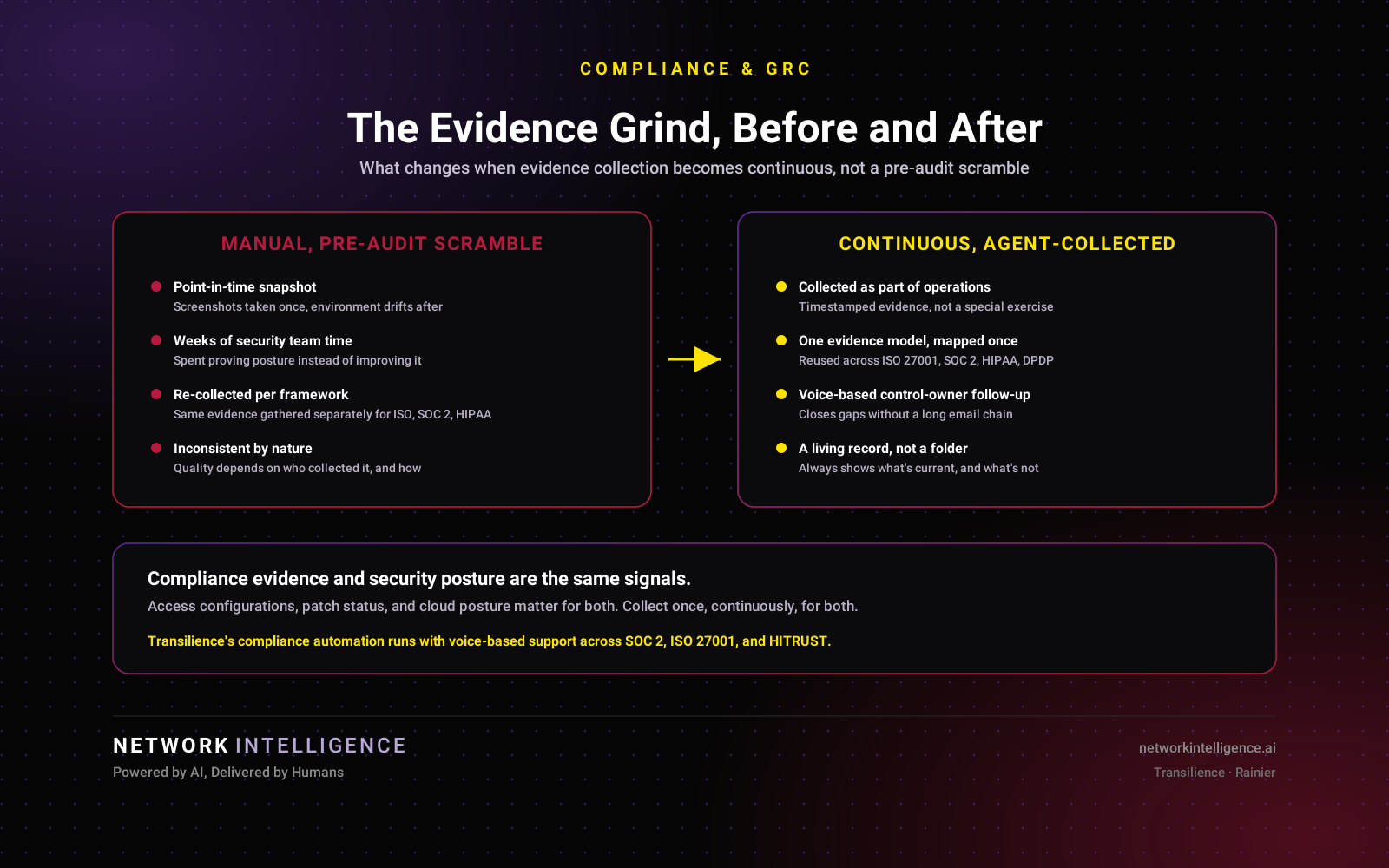
It’s a snapshot of a moving target. A screenshot of an access control list taken in March says nothing about what that list looked like in July. Between audits, the actual state of a control can drift significantly from what was last evidenced.
It consumes time that should go to actual security work. Security and IT teams routinely lose weeks before an audit window pulling together evidence manually, time that isn’t spent improving posture, it’s spent proving posture that may already be stale by the time it’s reviewed.
It doesn’t scale across frameworks. An organization carrying ISO 27001, SOC 2, HIPAA, and a regional requirement like DPDP ends up collecting overlapping evidence multiple times for multiple frameworks, because nobody built a single evidence model that maps once and reuses everywhere.
It’s inconsistent by nature. Manual evidence collection depends on whoever happens to be doing it that quarter, which control owner remembered to export what, and how thoroughly. That inconsistency is exactly what auditors are trained to probe.
It creates audit anxiety instead of audit readiness. When evidence is gathered right before an audit rather than continuously, the organization is effectively hoping nothing has drifted since the last collection cycle, rather than knowing it hasn’t.
What compliance automation actually changes
Continuous evidence collection instead of periodic snapshots. Agents monitoring cloud configurations, identity systems, and security tooling can collect and timestamp evidence as part of normal operation, not as a special pre-audit exercise. By the time an audit window opens, most of what’s needed is already gathered.
One evidence model, mapped across frameworks. A control that satisfies part of ISO 27001 often satisfies part of SOC 2 or HIPAA too. Automating the mapping means evidence gets collected once and applied everywhere it’s relevant, instead of being re-gathered framework by framework.
Voice and conversational interfaces for control owners. Chasing a control owner for a document is often the actual bottleneck, not the evidence itself. Voice-based automation that can ask a control owner a direct question and log the answer removes a surprising amount of the back-and-forth that normally eats audit-prep time.
A living record, not a folder. Instead of a shared drive full of inconsistently named screenshots, evidence lives in a system that knows which control it maps to, when it was collected, and whether it’s still current.
Less internal resourcing required to stay audit-ready. Organizations that have automated this well describe freeing up security and engineering time that used to go entirely into evidence-gathering, redirecting it toward actually building and shipping, while compliance work continues in the background.
Why this matters beyond the audit itself
A compliance program built on continuous, automated evidence collection isn’t just faster at audit time, it’s a more honest picture of risk year-round. The same signals that satisfy an auditor, who has access to what, how cloud resources are configured, what’s been patched and what hasn’t, are the same signals that matter for actual security posture. Treating compliance evidence as a byproduct of continuous monitoring, rather than a separate pre-audit scramble, connects the compliance program to the same reality the security team is already tracking. Our cloud security post covers the same principle from the posture side, findings and evidence both live better inside one continuous pipeline than in a separate exercise run once a year.
What to ask before trusting a compliance automation claim
- Is evidence collected continuously, or only generated right before an audit window?
- Does one piece of evidence map to multiple frameworks automatically, or does each framework require separate collection?
- Is there a way to resolve evidence gaps with control owners without a long email chain?
- Can an auditor see when evidence was collected and whether it’s still current, not just that it exists?
- Does the system distinguish a control that’s actually been verified from one that’s simply unscored?
- Does automating evidence collection actually reduce the internal hours spent on audit prep, or just move the screenshots somewhere else?
Where this fits across NI and Transilience
Transilience AI’s compliance automation runs with voice-based support across frameworks including SOC 2, ISO 27001, and HITRUST, collecting and organizing evidence as agents monitor the underlying systems rather than as a separate pre-audit project. Rainier contributes directly to this by covering compliance frameworks including ISO 27001, SOC 2 Type II, NIST, PCI DSS, HIPAA, India’s DPDP Act, and GDPR as a property of the platform itself, not a bolt-on report. For the third-party side of a compliance program, our vendor risk post covers how the same evidence-over-attestation thinking applies to vendor assessments. For the broader GRC and risk advisory side of this work, see our practices.
Curious how much of your next audit could already be evidenced before the window even opens? Talk to Network Intelligence.