


A supplier breach rarely starts with the organization that gets breached. It starts with a vendor, or a vendor’s vendor, somewhere down a chain nobody mapped end to end. The irony is that most companies already run a vendor risk program. They send a questionnaire, collect a SOC 2 report, file both away, and consider the vendor assessed for the next twelve months.
That model was designed for a slower world. It is increasingly the weakest link in otherwise mature security programs, and the gap between what it produces and what it needs to produce is why third-party risk management is changing faster than almost any other GRC discipline right now.
Why the annual questionnaire model is breaking down
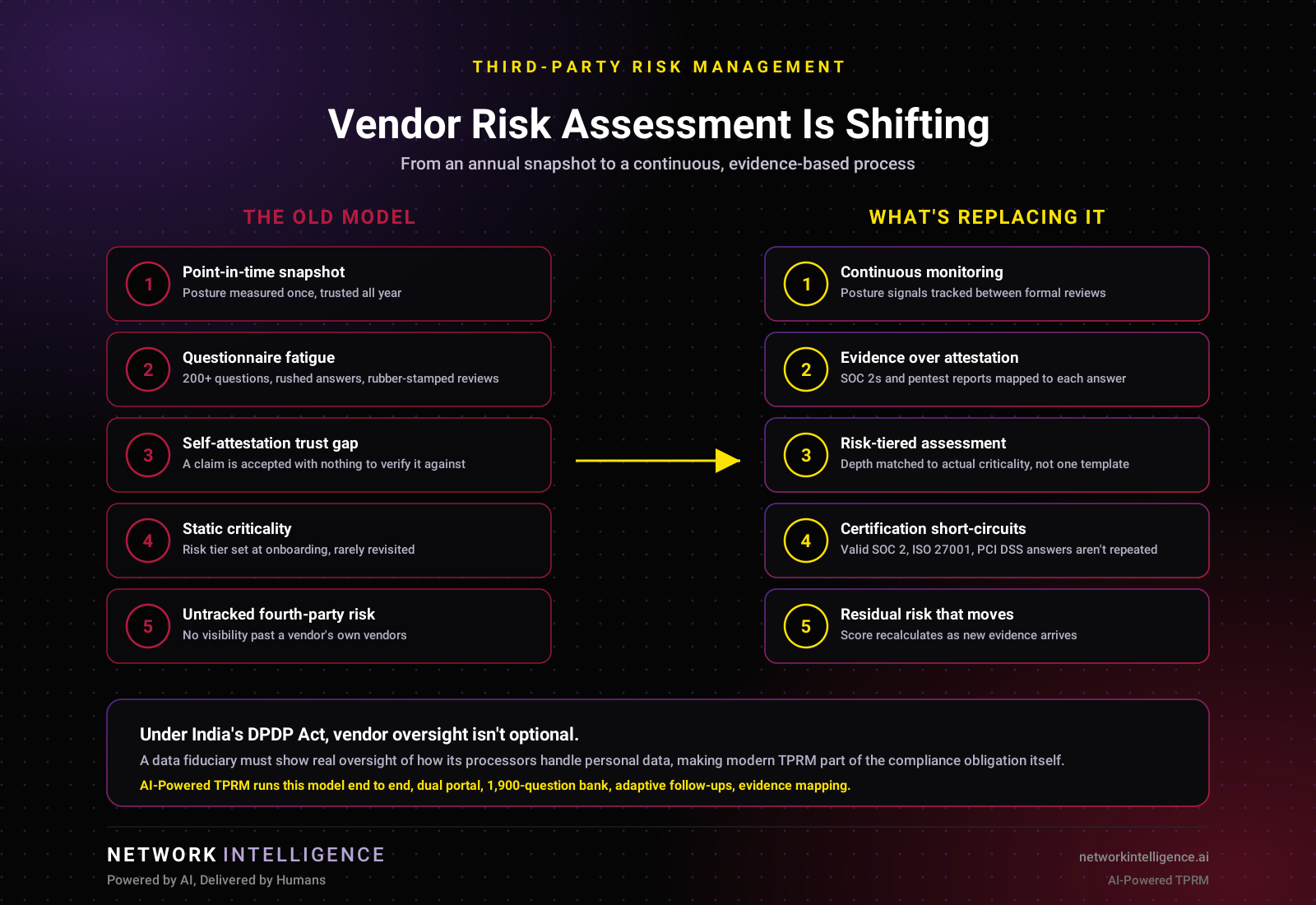
It measures a moment, not a relationship. A vendor’s security posture on the day they filled out a questionnaire says little about their posture eleven months later, after a leadership change, an acquisition, or a quietly deprioritized patching cycle.
Questionnaire fatigue cuts both ways. Vendors answering dozens of near-identical, 200-plus question surveys from different customers rush through them. Customers reviewing hundreds of vendor responses rubber-stamp more than they verify. Neither side is getting what they need from the exercise.
Self-attestation is trusted more than it should be. A questionnaire answer is a claim, not evidence. Without something to verify it against, risk teams are often making decisions based on what a vendor says about itself.
Criticality isn’t static. A vendor that was low-risk at onboarding can become critical a year later simply because the relationship grew, more data flowed through it, or new integrations were added, without anyone updating the risk tier.
Fourth-party risk goes largely untracked. Your vendor’s vendors carry real risk into your environment, and almost no traditional program has visibility past the first tier of the supply chain.
What’s replacing it
Continuous monitoring instead of point-in-time snapshots. Pairing periodic deep assessments with ongoing signals, such as external posture scanning, breach disclosures, and certification status changes, keeps a vendor’s risk profile current between formal reviews rather than frozen at the last one.
Evidence over self-attestation. Instead of just asking a vendor whether they have a control, mapping an uploaded SOC 2 report, pentest result, or policy document directly to the relevant questionnaire item turns a claim into something verifiable.
Risk-tiered, not one-size-fits-all, assessment. A critical vendor handling sensitive data warrants a deep, frequent assessment. A low-risk vendor providing a commodity service doesn’t need the same 300-question treatment every cycle. Tailoring assessment depth to actual criticality, rather than applying one template to every vendor, is both more accurate and more sustainable for both sides.
Certification short-circuits. When a vendor already holds a current SOC 2, ISO 27001, or PCI DSS certification, the questions that certification already answers shouldn’t need re-answering from scratch. Recognizing existing certifications saves real time on both sides without lowering the bar.
Residual risk that moves. A risk score calculated once and left untouched for a year isn’t risk management, it’s a historical record. A score that recalculates as new answers, evidence, or criticality changes arrive is something a risk team can actually act on in real time.
Regulatory specificity. Generic, Western-framework-based questionnaires increasingly fall short for vendors operating under RBI, SEBI, MAS, or DPDP requirements. Programs are shifting toward questionnaire content built directly from the relevant regulation rather than a generic template retrofitted with a compliance mapping afterward.
Why this matters more under DPDP
Vendor oversight isn’t a side benefit of good TPRM anymore, under India’s Digital Personal Data Protection Act, it’s part of the compliance obligation itself. A data fiduciary is expected to exercise real oversight over how its processors handle personal data, which means the vendor risk program and the DPDP compliance program increasingly need to be the same effort, not two separate tracks run by two different teams. For the current state of DPDP’s phased rollout, see our DPDP Act compliance timeline.
Third-party risk as part of exposure management
A critical vendor with weak controls is exposure, in exactly the same sense an unpatched internet-facing server is. Treating vendor risk as a separate compliance checkbox, rather than part of the same exposure surface an organization is already managing, is a scoping mistake. For the fuller model of how exposure programs should account for this, see our guide to continuous threat exposure management.
What to look for in a modern TPRM approach
- Does it tailor assessment depth to actual vendor criticality, or send the same questionnaire to everyone?
- Does it recognize existing certifications, or make a certified vendor answer everything again?
- Can it map uploaded evidence to questionnaire items automatically, or does a person manually cross-reference a PDF against a spreadsheet?
- Does the residual risk score update as new information arrives, or only at renewal?
- Does the questionnaire content reflect the specific regulations that matter to you, such as RBI, SEBI, MAS, or DPDP, rather than a generic global template?
- Is there a dual-sided workflow that makes the vendor’s side of the process efficient too, not just the assessor’s?
Where AI-Powered TPRM fits
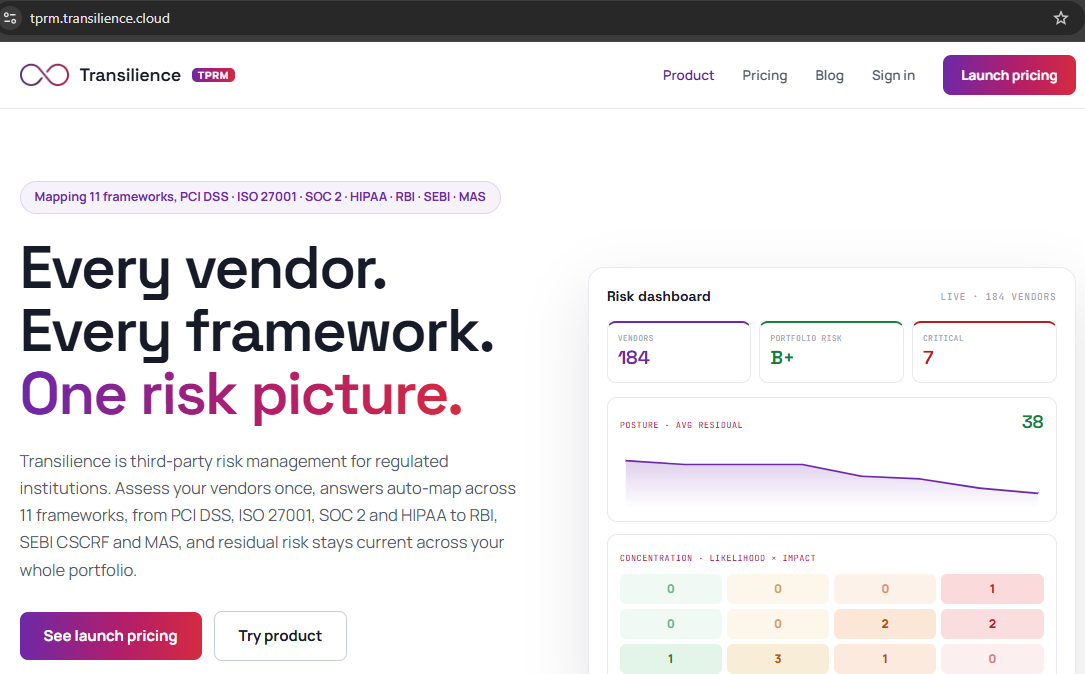
AI-Powered TPRM is built around this shift. It runs on a dual-portal design, tailors questionnaires from a roughly 1,900-question bank based on vendor criticality, short-circuits questions already answered by valid SOC 2, ISO 27001, or PCI DSS certifications, uses adaptive AI follow-ups when an answer reveals a gap, and reads uploaded evidence to auto-fill matching questionnaire items with a cited passage and confidence level. Its residual risk score recalculates as new information arrives, and its questionnaire content is built directly from RBI, SEBI, MAS, and DPDP requirements alongside global frameworks. For the full breakdown, read What Is AI-Powered TPRM?. For broader governance and compliance support, see our practices.
Ready to modernize how you assess vendor risk? Talk to Network Intelligence.