

Managed detection and response exists to solve a staffing problem: most organizations can’t hire, train, and retain enough analysts to run genuine 24/7 coverage themselves, so they bring in a provider who can. That’s a sound idea. The problem is that a lot of MDR, in-house SOCs too, is still built on the same model it was ten years ago: more human analysts watching more alerts, just now someone else’s analysts instead of yours. That model was already straining before AI made the alternative possible, and an agentic platform underneath MDR is what actually fixes what the staffing-only approach can’t.
What the staffing-only model keeps running into
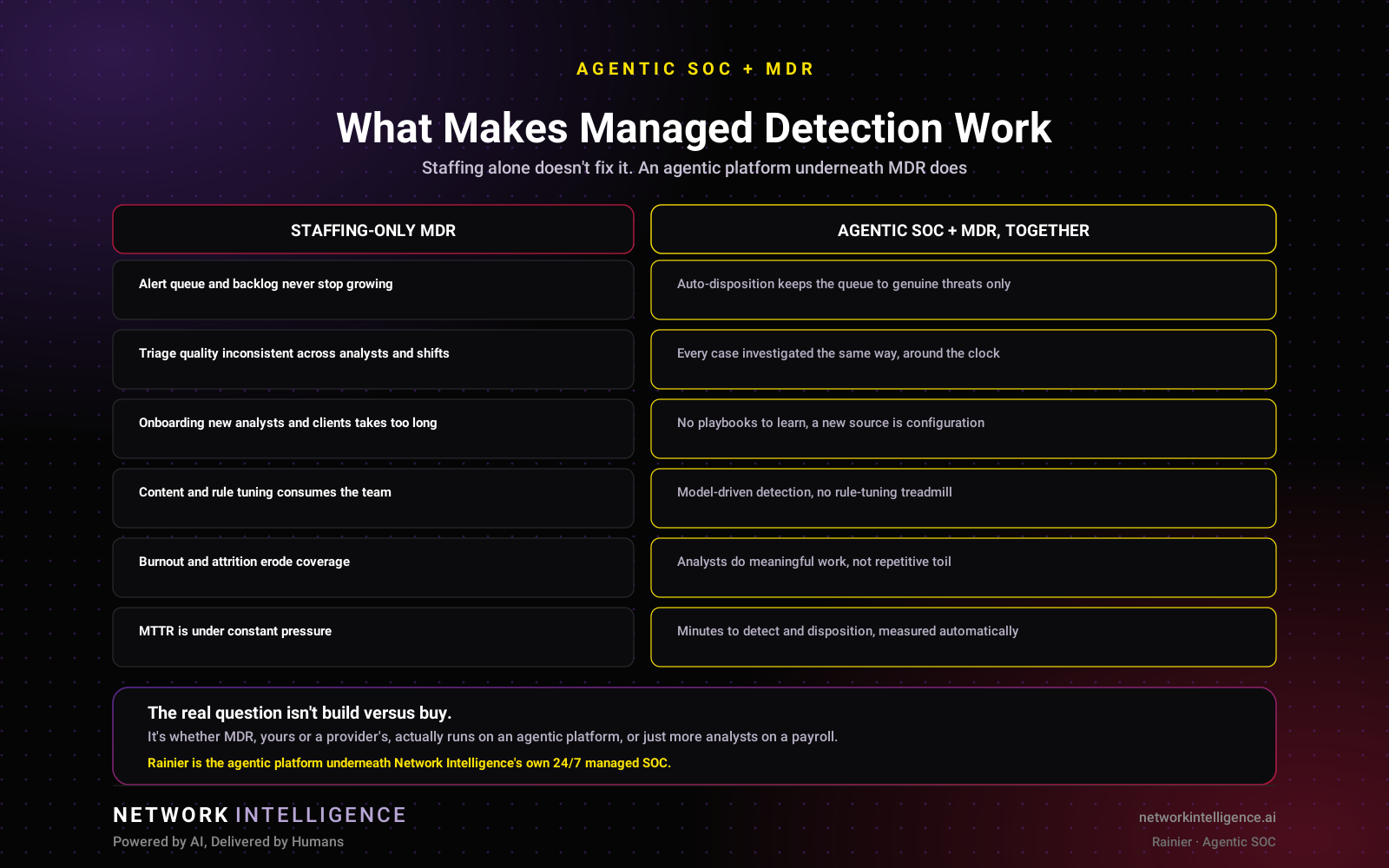
The alert queue and backlog never stop growing. Every new tool, integration, and data source adds more volume to triage, and headcount has to grow roughly in proportion to alert volume, which rarely matches how security budgets actually grow, whether that headcount sits in-house or at a provider.
Triage quality varies by analyst and by shift. A seasoned analyst on day shift and a junior analyst covering a 3am alert often reach different conclusions about the same kind of incident. That inconsistency isn’t a training failure, it’s what happens when judgment-heavy work is spread across different people with different experience levels and different levels of fatigue, a structural issue MDR inherits unless the underlying platform solves it.
Onboarding new analysts, and new clients, takes real time. Every analyst has to learn the playbooks, the environment, and the escalation paths before they’re fully productive, and every new client or data source added to scope means more of that ramp-up, which is exactly what makes scaling a purely human-staffed MDR operation expensive.
Content and rule tuning quietly consumes the team. Keeping detection rules relevant, not too noisy, not missing real threats, is ongoing work that competes directly with the team’s actual incident response capacity, at a provider just as much as in-house.
Burnout and attrition erode coverage over time. Repetitive triage work, especially across odd-hour shifts, is a well-documented driver of analyst burnout. Losing an experienced analyst doesn’t just create a staffing gap, it resets the organizational knowledge that made triage consistent in the first place, and a provider isn’t immune to this just because it’s their staffing problem instead of yours.
What an agentic platform actually changes
An agentic SOC platform doesn’t remove analysts from MDR, it changes what they spend their time on and removes the structural bottlenecks above.
Auto-disposition keeps the queue to genuine threats. High-confidence alerts get resolved automatically instead of consuming analyst attention, which addresses the growing-queue problem at its source rather than requiring proportionally more headcount.
Every case gets investigated the same way, around the clock. Automated, consistent investigation removes the shift-to-shift and analyst-to-analyst variability that’s baked into a purely human-staffed triage process.
Model-driven detection removes the rule-tuning treadmill. Detection that doesn’t depend on a human team constantly hand-tuning rules frees that capacity for actual investigation and response instead of content maintenance.
Analysts do meaningful work, not repetitive toil. When the repetitive first pass is automated, the people doing triage are doing the part of the job that actually requires judgment, which is also the part that keeps experienced analysts from burning out and leaving.
New sources are configuration, not months of ramp-up. Onboarding a new client or data source becomes a configuration step rather than a retraining exercise, which is what actually lets an MDR provider scale without scaling headcount at the same rate.
Why this makes the “build vs. buy” question the wrong one
The real question isn’t whether to build a SOC in-house or buy MDR, it’s whether either option is actually running on a platform that solves the structural problems above, or just moving the same staffing-dependent model to someone else’s payroll. An MDR provider running on a legacy, headcount-scaled model will eventually hit the same growing-queue, inconsistent-triage, and burnout problems an in-house team does, just with a service contract on top. An agentic platform changes that math regardless of who operates it. Our post on SOC alert fatigue covers why the staffing-dependent model breaks down in more detail, and it applies to a managed provider’s operation just as directly as it applies to an internal team.
What to ask an MDR provider before signing
- Is detection and triage running on an agentic platform, or on a larger team of analysts doing the same manual process we’d run ourselves?
- How is alert volume actually kept manageable as our environment grows, automation, or just more analysts added to the account?
- Does every case get investigated the same way regardless of shift or analyst, and how is that consistency actually achieved?
- How much of detection content relies on continuous manual rule tuning versus model-driven detection that adapts on its own?
- What’s the actual time to detect and disposition, in minutes, or in hours, and how is that measured?
- If we eventually want to bring this in-house, does the platform transfer, or are we locked into the provider’s staffing model indefinitely?
Where Rainier fits
Rainier is the agentic platform underneath Network Intelligence’s own 24/7 managed SOC, which is exactly why this isn’t an in-house-versus-MDR argument for us, it’s the same platform either way. Auto-disposition keeps the alert queue to genuine threats rather than growing unchecked, every case gets investigated the same way around the clock instead of varying by analyst or shift, model-driven detection removes the constant rule-tuning treadmill, and analysts spend their time on meaningful investigation rather than repetitive toil. Organizations can run Rainier as their own platform, bring in Network Intelligence’s managed SOC running on that same agentic foundation, or start with one and move to the other without starting over.
Want to see what an agentic approach to managed detection and response actually looks like? Talk to Network Intelligence.