


Ask a SOC manager what keeps them up at night, and detection coverage is rarely the first answer. It is usually the queue. Alerts arrive faster than a team can read them, most turn out to be benign, and somewhere in the pile is the one that matters.
That condition has a name: alert fatigue. It is one of the most persistent operational problems in security, and it is the main reason many SOCs are rethinking how triage works.
What alert fatigue is
Alert fatigue is the gradual erosion of an analyst’s attention and judgment caused by a constant stream of low-value alerts. When most of what arrives is noise, people adapt. They skim, they close alerts faster, and they start to assume that the next one is probably nothing too.
The danger is not that analysts become careless. It is that a rational response to volume produces exactly the conditions in which a real incident gets missed.
What causes it
Too many tools, each with its own alerts. SIEM rules, EDR sensors, firewalls, identity providers, email security, and cloud posture tools all raise alerts independently, often about the same underlying event.
Duplicate and related alerts. One brute-force attempt can trip several rules across several tools. Without grouping, each one becomes its own ticket.
Rules that nobody trusts. Rule bases accumulate over years. Some fire constantly and are always benign. Others have not fired in ages, and nobody remembers why they exist.
Known false positives that keep returning. A scheduled scanner, a backup job, or an admin script can generate the same benign alert every day, and each time someone has to look.
Manual enrichment. Even a clearly benign alert takes time when the analyst must look up an IP, check a hash, and pull context from several consoles before deciding.
Limited context at the moment of decision. Analysts triage with whatever the alert contains, which is often not enough to decide quickly.
What it costs
- Missed or delayed detection. Real incidents hide in volume, and time to detect and respond grows.
- Analyst burnout and turnover. Repetitive first-tier work is a common reason experienced people leave, and replacing them is slow and expensive.
- Inconsistent decisions. Tired analysts and different shifts handle the same alert type differently.
- Rising cost. When volume drives staffing, headcount and shift coverage grow with alert count rather than with risk.
Why the usual fixes plateau
Tuning rules. Necessary, but it is ongoing work that competes with investigations, and every suppression carries the risk of hiding something real.
SOAR playbooks. Playbooks automate known sequences well. They also have to be written, tested, and maintained, and they break when an attacker or an environment does something the author did not anticipate. Over time the playbook library becomes a maintenance burden of its own.
Adding people. Hiring helps temporarily, but volume tends to grow faster than headcount, and the work remains repetitive.
Outsourcing triage. A provider can add coverage hours, but the underlying volume and the repetitive process remain unless the provider has changed how triage works.
What “agentic” changes
An agentic SOC replaces fixed scripts with AI agents that reason about each alert in its own context. Instead of following a pre-written branch, an agent gathers related evidence, checks indicators against threat intelligence, compares the alert with similar past cases, and decides what should happen next.
In practice that changes four things.
- Related alerts are grouped. One underlying event becomes one case, not a stack of tickets.
- Confirmed false positives stay suppressed. Once a use case is confirmed benign, the pattern stops returning to the queue.
- Enrichment happens automatically. Entities are checked and context is attached before an analyst sees the case.
- Disposition is gated by confidence. High-confidence alerts are resolved automatically. Everything else reaches an analyst with a written summary, enrichment, and a MITRE ATT&CK mapping already attached.
The playbook maintenance treadmill disappears because agents reason about context rather than executing branches someone has to keep updating.
What should stay human
Automation does not remove people from the loop. It moves them to where judgment matters.
- Escalations that carry real risk
- Approvals for high-impact response actions, such as isolating critical systems
- Edge cases where context decides the outcome
- Tuning decisions and reviewing what the automation closed
- Communication with stakeholders during significant incidents
A trustworthy agentic SOC makes those boundaries explicit, keeps every automated action auditable, and makes containment time-bounded, verifiable, and reversible.
Metrics that show whether it is working
Measure the effect on outcomes, not on alert counts alone.
- MTTD, MTTA, MTTR, and MTTC. Time to detect, acknowledge, respond, and contain or close.
- Share of alerts auto-dispositioned and the rate at which those decisions are later overturned.
- Analyst hours spent on repetitive triage. The direct measure of fatigue.
- False positive rate over time, and whether suppressions are tied to confirmed use cases.
- Detection coverage. A rule audit that shows which rules earn their place and where nothing is watching.
Questions to ask when evaluating an AI SOC platform
- Does it work on top of the SIEM, EDR, and firewall tools you already run, or does it require replacing them?
- Does it reason about each alert, or execute a library of playbooks?
- Where does the AI run, and does alert data leave your environment?
- How are automated actions governed, verified, and reversed?
- What happens to alerts it is not confident about?
- Can it support multiple clients with real tenant isolation, if you are a provider?
- What do analysts receive with an escalated case?
Where Rainier fits
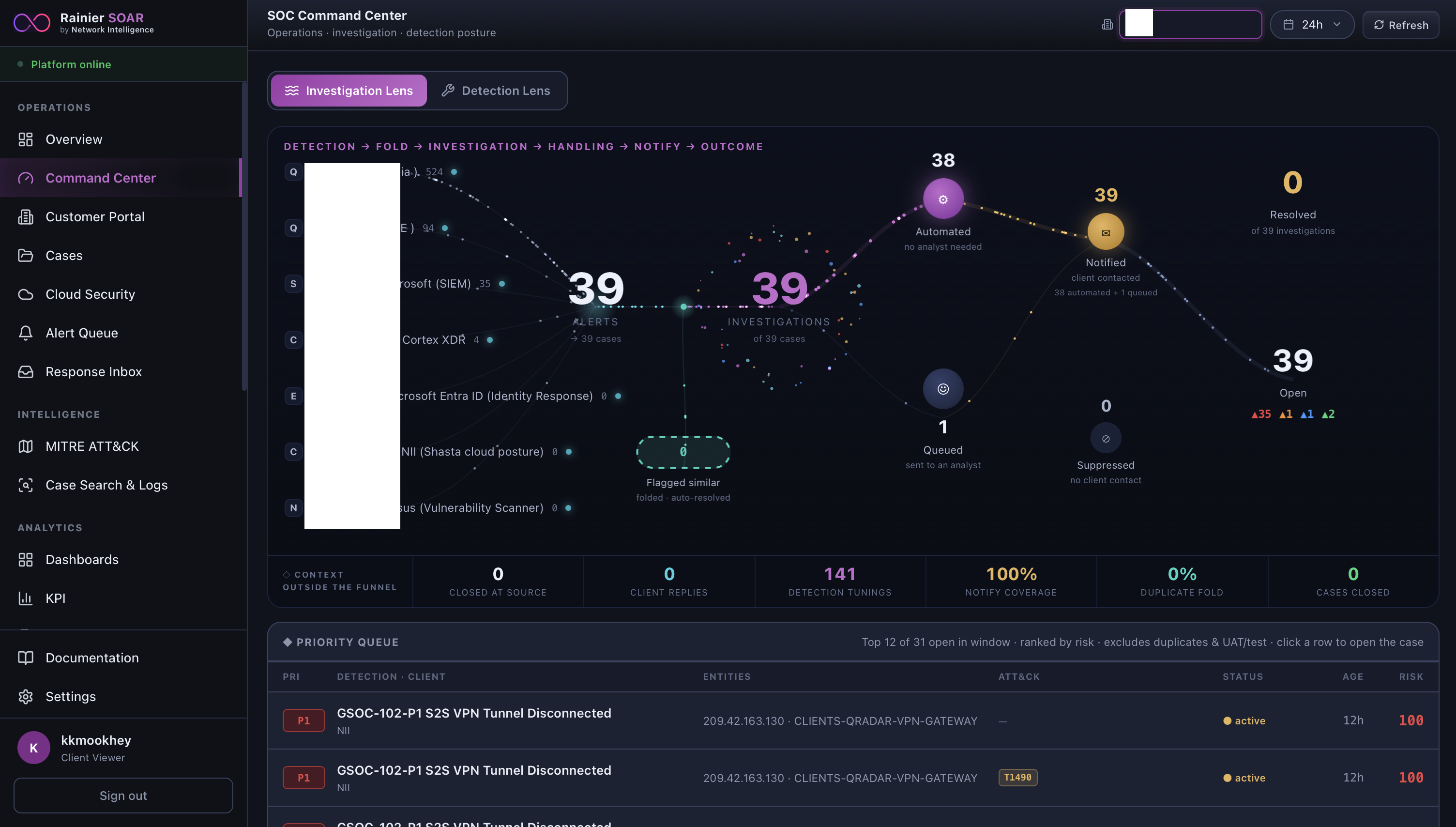
Rainier is Network Intelligence’s agentic AI-powered SOC platform. It connects read-only to the SIEM, EDR/XDR, and firewall tools an organization already runs, folds related alerts together, suppresses confirmed false positives, resolves high-confidence alerts automatically, and hands analysts cases that arrive with an AI-written summary, enrichment, and MITRE mapping. It runs on a self-hosted AI stack so alert data stays in the environment.
In representative internal testing and production use, this approach has reduced repetitive L1 effort by roughly 70%. For a mid-size SOC handling about 2,000 alerts a day, that is an illustrative saving of around 230 analyst hours daily. Actual results vary with environment, tuning, and connected data sources.
For a closer look, read What Is an Agentic SOC? Inside Rainier, the deep dive on how AI alert triage works, and our piece on AI case investigation and Detection Lens. For managed detection and response, explore our services.
Want to see an alert queue go from noise to real cases? Talk to Network Intelligence.