

The moment a breach is confirmed, a different clock starts running. Up to that point, the work was detection, figuring out whether something is actually wrong. After that point, the work is digital forensics and incident response, DFIR, and it has a different job: contain the damage, reconstruct exactly what happened, and get the organization back to a known-good state without destroying the evidence needed to understand the attack or support a legal, insurance, or regulatory response.
Most people outside security operations have a vague sense that “someone investigates” after a breach. What that investigation actually involves, and how much the outcome depends on speed, is worth walking through.
What “confirmed” actually means
A breach isn’t confirmed the moment an alert fires. It’s confirmed after triage has ruled out the benign explanations, a planned maintenance window, a known test, a false positive from a noisy rule, and concluded that unauthorized access or activity actually occurred. That distinction matters because a surprising number of real intrusions get missed at exactly this step.
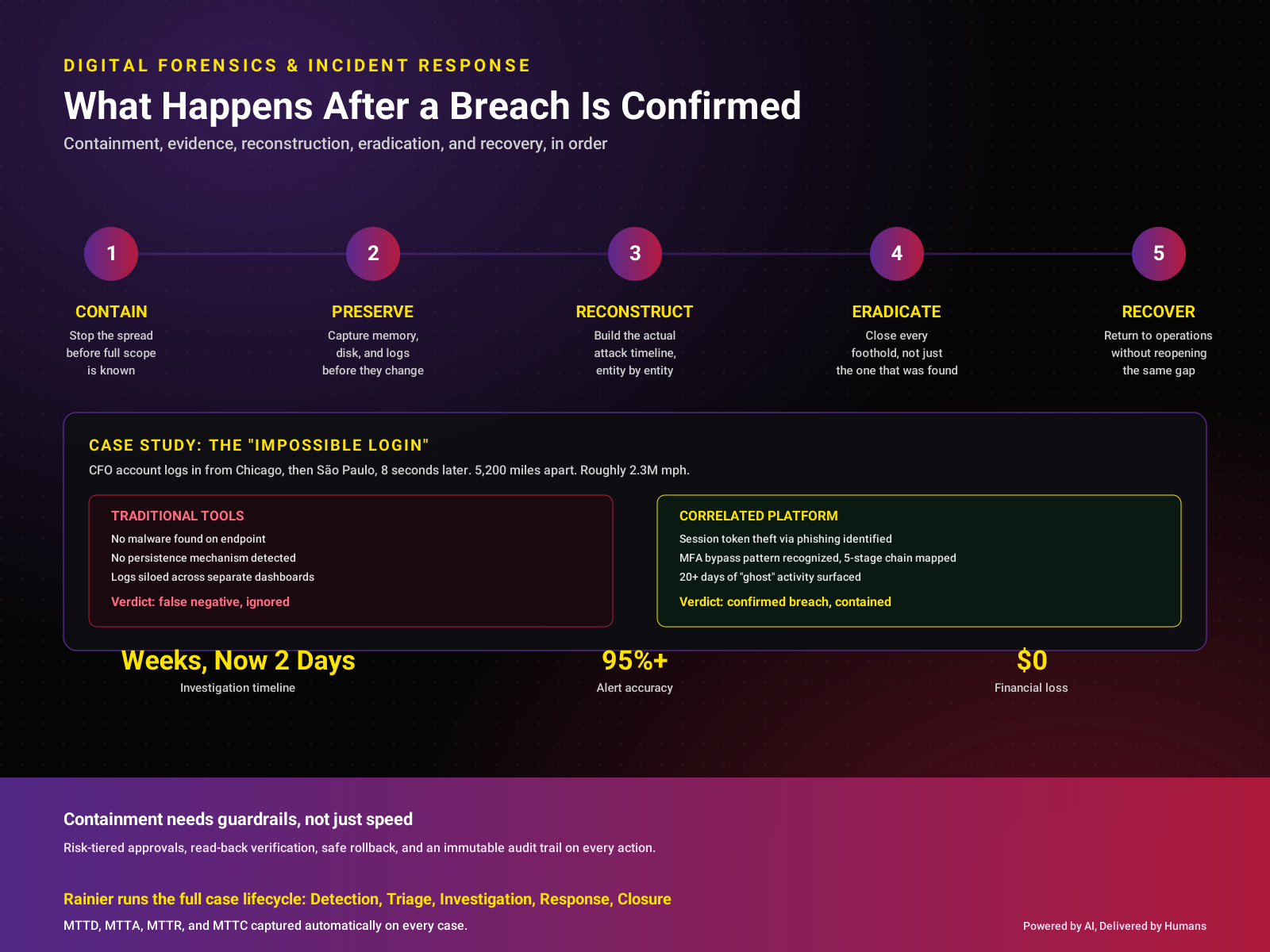
Consider a case where a CFO’s account shows a login from Chicago, then a second login eight seconds later from São Paulo, 5,200 miles away, a physically impossible travel speed of roughly 2.3 million miles per hour. Checked against traditional tools, the endpoint shows no malware, no persistence mechanism, and the relevant logs sit siloed across different dashboards. Verdict: false negative, ignored. The same anomaly, checked against a platform that correlates identity, session, and endpoint signals together, identifies session token theft via phishing, recognizes an MFA bypass pattern, maps a five-stage attack chain, and surfaces over twenty days of activity the organization didn’t know was happening. Verdict: confirmed breach, moving straight to containment. Same data. Different conclusion, because the data was actually connected instead of sitting in separate places.
The stages, once a breach is confirmed
Containment comes first, before full understanding. The immediate priority is stopping the damage from spreading, isolating an endpoint, disabling a compromised account, blocking a malicious IP or file hash, even before the full scope of what happened is understood. Waiting for complete clarity before containing anything just gives an attacker more time.
Evidence has to be preserved before it’s disturbed. Forensic investigation depends on evidence that hasn’t been altered, memory captures, disk images, log snapshots, taken in a way that preserves their integrity. A well-intentioned but rushed cleanup step that wipes a compromised endpoint before it’s imaged can destroy the only record of how an attacker actually got in.
Reconstruction is about building a timeline, not just listing facts. The real output of a forensic investigation is a timeline: initial access, how the attacker moved, what they touched, what they took, and when each step happened. A pile of disconnected log entries isn’t an investigation. A sequence that shows the actual attack chain is.
Eradication has to remove every foothold, not just the one that was found. An attacker who established multiple ways back in gets to keep at least one of them if the response only closes the door that was initially discovered. This is why scope matters more than speed at this particular stage, closing one door while three others stay open isn’t eradication.
Recovery means returning to operations without reintroducing the same gap. Restoring from backup or rebuilding a system is only safe once the investigation has established how the attacker got in in the first place. Recovering onto the same unpatched vulnerability or the same compromised credential just resets the clock on the same incident.
Lessons learned has to produce actual changes, not just a report. The point of a post-incident review is to close the specific gap that allowed this incident, in detection, in access controls, in monitoring coverage, not to produce a document that gets filed and never acted on.
Why speed through these stages matters this much
In the CFO account example above, the investigation that would traditionally take weeks took two days instead, with better than 95% alert accuracy and zero financial loss, because the platform correlating the signals already had the entities, the MITRE ATT&CK mapping, and the enrichment attached to the case automatically, rather than requiring an analyst to manually pull each piece together from a different tool. That isn’t a marginal improvement. The gap between a multi-week investigation and a multi-day one is often the gap between an attacker who had weeks of undetected access and one who had days.
The same logic that drives faster detection, covered in our agentic SOC and MDR post, applies with even more weight here. Every day an investigation takes to reconstruct what happened is a day the organization doesn’t actually know its own exposure.
Why containment actions need guardrails, not just speed
Fast containment is only valuable if it’s also safe and verifiable. Isolating the wrong endpoint, or disabling the wrong account, creates its own incident on top of the original one. A mature response capability tiers its actions by risk: a low-risk action like blocking a known-malicious IP can run automatically, while a critical action like disabling a VIP’s account or isolating a production system requires dual approval and segregation of duties. Just as important, the system confirms the action actually took effect, a read-back check rather than an assumption, and keeps an immutable audit record and a safe rollback path for every control exercised. Response without that discipline isn’t faster incident response, it’s just a faster way to make mistakes.
What to ask a DFIR provider or capability before you need it
- Can evidence actually be preserved without disrupting operations, or does containment risk destroying what’s needed for the investigation?
- Does the investigation produce an actual attack timeline, with entities and techniques mapped, or a list of disconnected findings?
- Are containment actions tiered by risk, with dual approval on anything critical, or does everything run the same way regardless of impact?
- Is there read-back verification that a containment action actually worked, or just a log entry saying it was attempted?
- How is eradication scope determined, is the full set of footholds identified, or just the one that triggered the alert?
- What’s the realistic time from confirmed breach to full investigation and recovery, measured, not estimated?
Where Rainier fits
Rainier treats a confirmed incident as a case that builds and advances itself: detection, triage, investigation, response, and closure, with entities, MITRE ATT&CK mapping, and enrichment auto-attached rather than assembled by hand. The Response Center can isolate or release endpoints, block a file hash, IP, or domain, disable a user, or disconnect an endpoint across integrated EDR and XDR tools, with risk-tiered approvals so low-risk actions auto-run while anything critical requires dual approval and segregation of duties. Every action gets read-back verification that it actually took effect, plus a safe rollback path and an immutable audit trail. MTTD, MTTA, MTTR, and MTTC are captured automatically on every case, which is what makes the difference between a weeks-long investigation and a two-day one measurable instead of anecdotal. For organizations building out their own DFIR capability or looking to add managed incident response, our services team covers both red team and forensics work directly.
If a breach is confirmed right now, every hour matters. Talk to Network Intelligence.