


The route to understanding the complex security and compliance is challenging. It applies to organisations of all sizes. Understanding security and compliance is difficult, and therefore the need for Vanta is required.
This is how Vanta comes into the picture. Vanta is a leading platform that helps make the automation process easier. As a result, it is now easier for businesses to maintain their certifications. Although Vanta has lots of benefits, it is expensive.
It is crucial to get a deep understanding of Vanta alternatives in 2025; it will automatically help security leaders, compliance managers, and founders to take informed decisions. We will reverie based on parameters like supported frameworks, automation capabilities, integration ecosystems, pricing structures, ease of use, customer support, and scalability. This guide also references common crosswalks like SOC, ISO, HIPAA, GDPR, and PCI so you can evaluate platforms against real-world requirements.
Furthermore, we will introduce Network Intelligence as a compelling alternative, particularly for organisations seeking a more comprehensive approach that combines automation with expert guidance and managed services.
Why Look Beyond Vanta for Compliance Automation?
We could not deny the fact that Vanta is a good option. But there are other good options available which could be considered for several reasons.
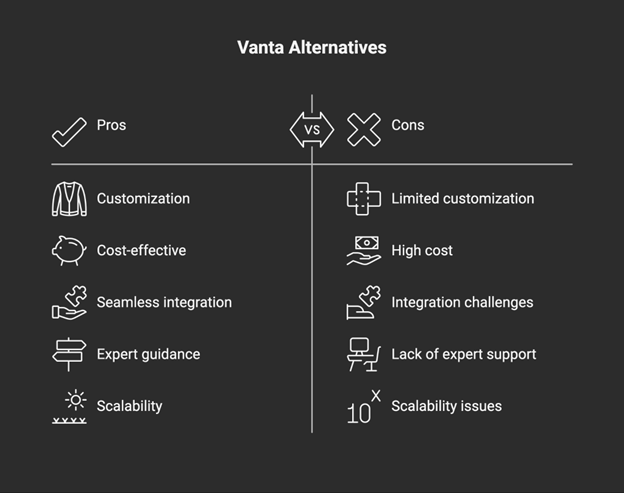
Customized
The needs and requirements of all organisations are different. A few need support, and others go for industry-specific frameworks. This is not possible with Vanta in relation to other specialised platforms.
Budget
As Vanta is expensive, it makes startups or other businesses go for cost-effective solutions that suit them most.
Integration
As mentioned before, every organisation has a different requirement. Vanta does offer a strong integration list. However, other platforms get integrated smoothly with the organisation’s needs.
Expert help
Several organisations prefer to have hands-on advisory services along with expert guidance. So obviously, other solutions with a cheap price will be considered as a good option instead of opting for Vanta.
Scalability and Flexibility
As businesses grow and regulations change, the chosen platform needs to scale seamlessly and offer the flexibility to adapt to evolving compliance requirements.
How to Choose the Right Vanta Competitor
It is crucial to evaluate the needs of your organisation to select the right Vanta competitor. In order to go for the best option based on your needs, you must consider these parameters.
Compliance Frameworks:
Do your deep research about the compliance framework that you will be required to use now and in the future. If you anticipate mapping controls across SOC, ISO, HIPAA, or GDPR PCI, verify native support and cross-mapping features.
Automation Capabilities:
Check how much automation can be done by that particular platform effectively. For example, evidence collection, policy management, risk assessments, and so on.
Integrations:
Take care of the integration system of the platform. How smoothly the platform is capable of getting integrated with tools like Jira, Asana, AWS, Google Cloud, Azure, Microsoft Teams, and so on.
Pricing and Contract Terms:
Understand pricing as how it works. Is it a subscription-based model or usage-based? Calculate the total cost of ownership and whether the contracts are flexible or not.
Ease of Onboarding and Use:
User-friendliness is one of the most important factors in deciding the platform that can help you in the future. Training, support, and design-friendly navigation issues must be taken care of beforehand.
Customer Support:
Go through the quality and responsiveness of the customer support system. It is highly important. Because it is necessary to have a support system for each vendor to resolve issues instantly.
Scalability:
Understand the scalability of the platform that you have decided to opt for. Can it accommodate new frameworks, users, and data volumes without significant disruptions?
Advisory and Expertise:
Determine if your organisation requires additional advisory services, audit readiness support, or ongoing governance guidance beyond platform automation.
Key Features to Compare Across Platforms
When evaluating Vanta competitors, focus on the following key features:
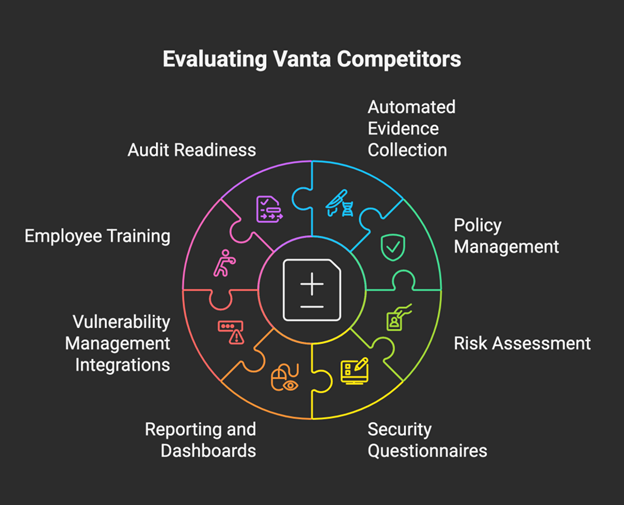
Automated Evidence Collection:
The ability to automatically gather evidence from connected systems, reducing manual effort and ensuring continuous compliance monitoring.
Policy Management:
Features for creating, distributing, and tracking employee acknowledgement of security policies.
Risk Assessment:
Tools for identifying, assessing, and managing security and compliance risks.
Security Questionnaires:
Capabilities for automating the process of responding to security questionnaires from customers and partners.
Reporting and Dashboards:
Clear and comprehensive dashboards that provide real-time visibility into your compliance posture.
Vulnerability Management Integrations:
Integration with vulnerability scanning tools to identify and remediate security weaknesses.
Employee Training:
Features for delivering and tracking security awareness training.
Audit Readiness:
Tools and support to prepare for and manage compliance audits.
Top Vanta Competitors & Alternatives in 2025
While Vanta is a leading name in compliance automation, the market is rich with strong alternatives, each with its own unique strengths. When choosing the right platform, it’s crucial to look beyond a simple feature list and consider factors like user experience, the level of expert guidance provided, and your organisation’s specific needs.
Here is a detailed breakdown of the top Vanta alternatives:
1. Network Intelligence
Network Intelligence takes a fundamentally different approach, offering managed compliance services that go far beyond a purely automated platform. Instead of just giving you software to manage, they provide a team of cybersecurity and compliance experts to act as an extension of your own.
- Key Features: Managed compliance services, expert advisory, readiness assessments, and ongoing governance. This includes hands-on guidance for complex tasks like mapping controls across multiple frameworks (e.g., SOC 2, ISO 27001, HIPAA, and GDPR).
- Pros:
- Expert Guidance: Their primary strength is their human expertise. This is ideal for organizations that lack in-house compliance knowledge or those navigating complex, multi-framework compliance requirements.
- Holistic Approach: They offer a 360-degree view of your cybersecurity landscape, considering people, processes, and technology, not just the technical controls.
- Customization: The managed service model allows for highly tailored solutions that automation platforms often can’t provide.
- Cons:
- Not Pure Automation: This is not a “set-it-and-forget-it” software. It is a service-first model, which may not appeal to companies looking for a DIY software solution.
- Cost: The cost can be higher than a self-service platform, but it can be more cost-effective than hiring a full-time compliance team and purchasing a separate tool.
- Best for: Organizations that need deep, hands-on expertise to navigate complex compliance landscapes, especially when dealing with multiple frameworks or highly sensitive data. This is an excellent option for those who want to offload the burden of compliance management to a dedicated team of professionals.
2. Drata
Often cited as a direct and formidable competitor to Vanta, Drata is a compliance automation platform with a strong reputation for a clean user experience and robust integrations.
- Key Features: Multi-framework support (SOC 2, ISO 27001, HIPAA, GDPR, PCI DSS), continuous compliance monitoring, automated evidence collection, and a strong “Audit Hub” for simplified auditor collaboration. It also includes tools for vendor risk management.
- Pros:
- User Experience: Drata’s interface is known for being intuitive and easy to navigate, which helps technical teams quickly get up to speed.
- Extensive Integrations: It offers a wide range of pre-built integrations with popular tools, making evidence collection seamless.
- Scalability: Drata is well-suited for businesses of various sizes, from startups to large enterprises, and is praised for its ability to grow with your company.
- Cons:
- Pricing: Some users report that pricing can scale quickly, especially as you add more frameworks or your team size grows.
- Customization: While it handles standard frameworks well, some users have noted a lack of flexibility for custom control mapping and unique workflows.
- Best for: Tech-led teams and high-growth companies that need a polished, user-friendly platform with deep integrations to automate the bulk of their compliance work.
3. Secureframe
Secureframe is another popular choice in the compliance automation space, distinguishing itself with a focus on a streamlined onboarding process and continuous monitoring.
- Key Features: Automated evidence collection, continuous monitoring, and a wide range of supported frameworks. Secureframe also offers built-in risk management, policy and document management, and security awareness training resources for employees.
- Pros:
- Streamlined Onboarding: Secureframe is known for its quick and easy setup, which can significantly accelerate the time it takes to achieve initial compliance.
- Strong Support: Users often highlight the platform’s access to a team of compliance professionals and former auditors who provide guidance throughout the process.
- Comprehensive Tooling: The platform offers a full suite of features, from vendor management to security testing and policy management, all in one place.
- Cons:
- Learning Curve: Some users have found that while the onboarding is fast, the platform can have a slight learning curve for more advanced features.
- Pricing: The initial pricing can be steep for very small organizations, and the tiered structure can be complex.
- Best for: Small to mid-sized businesses that want a fast and comprehensive solution to get audit-ready quickly, especially those managing one or two key compliance frameworks.
4. Sprinto
Sprinto is an excellent alternative, specifically focused on simplifying compliance for SaaS companies. It highlights its ease of use and ability to help companies achieve and maintain compliance efficiently.
- Key Features: Adaptive automation, continuous control monitoring, and a dedicated auditor’s dashboard. It also includes a risk assessment module and security/privacy training modules. Sprinto supports a wide range of frameworks, including SOC 2, ISO 27001, and GDPR.
- Pros:
- Ease of Use: The platform is designed to be intuitive, allowing teams to get up and running with minimal friction.
- Transparent Pricing: Sprinto is often praised for its clear and predictable pricing model, which helps with budgeting.
- Audit Readiness: The platform excels at preparing you for audits by organizing and collecting all necessary evidence in a centralized repository.
- Cons:
- Niche Focus: While effective for SaaS companies, its features may not be as broadly applicable to other industries compared to more general-purpose platforms.
- Best for: SaaS and other tech companies that need to get compliant quickly and maintain it with a user-friendly platform that is specifically tailored to their needs.
5. Thoropass (formerly Laika)
Thoropass differentiates itself with a “connected audit” model, bundling compliance software with in-house audit services. This integrated approach aims to simplify the entire compliance and audit process.
- Key Features: Compliance automation platform, integrated audit services, pentesting, and a strong emphasis on risk management and workflow automation. It supports over 30 frameworks, including SOC 2, ISO 27001, HIPAA, and HITRUST.
- Pros:
- All-in-One Solution: The combination of software and audit services under one roof eliminates the hassle of working with a separate audit firm.
- Expert Advisory: The platform provides a heavy advisory layer, with success managers who guide you through the process.
- Efficiency: The integrated model can significantly reduce the time and overhead associated with audits.
- Cons:
- Cost: Bundled services can be more expensive than software-only solutions.
- Performance: Some users have reported that the platform can be slow or cluttered when managing many controls.
- Best for: Organizations that want a streamlined, all-in-one solution that takes the guesswork out of the audit process by providing both the tools and the auditors.
6. Tugboat Logic (Acquired by OneTrust)
Tugboat Logic, now part of the OneTrust platform, offers a risk-centric approach to compliance automation, with a strong emphasis on continuous security assurance and audit readiness.
- Key Features: Automated evidence collection, policy management, vendor risk management, and a security questionnaire feature powered by machine learning. It provides a “Scoping Wizard” to help you define your compliance program.
- Pros:
- Risk-Centric: Its approach is designed to help you identify and manage risks as the core of your compliance program.
- OneTrust Ecosystem: Being part of the larger OneTrust suite provides access to a broader set of GRC tools, including privacy management and data governance.
- Cons:
- Acquisition Transition: As with any acquisition, there can be a transition period where the product roadmap and support might be less clear than with a standalone company.
- Pricing: Pricing can be complex depending on the number of frameworks, employees, and additional features you require.
- Best for: Companies that are already in the OneTrust ecosystem or those that want a robust, risk-focused tool for their security assurance needs.
Vanta vs Competitors: Feature & Pricing Comparison
Feature | Network Intelligence | Vanta | Drata | Secureframe | Sprinto | Thoropass | Tugboat Logic |
Supported Frameworks | Customisable based on client needs | SOC 2, ISO 27001, HIPAA, GDPR, PCI DSS | SOC 2, ISO 27001, HIPAA, GDPR, PCI DSS | SOC 2, ISO 27001, HIPAA, GDPR, PCI DSS | SOC 2, ISO 27001, HIPAA, GDPR, PCI DSS | SOC 2, ISO 27001, HIPAA, GDPR, PCI DSS | SOC 2, ISO 27001, HIPAA, GDPR, PCI DSS |
Automation | Supported through platform integrations & managed services | Strong | Strong | Strong | Strong | Strong | Strong |
Integration | Wide range of security & business tools | Extensive | Extensive | Extensive | Extensive | Extensive | Extensive |
Pricing | Customised based on service scope | Typically subscription-based | Typically subscription-based | Typically subscription-based | Typically subscription-based | Typically subscription-based | Typically subscription-based |
Ease of Onboarding | Dedicated support for onboarding | Generally considered user-friendly | Generally considered user-friendly | Generally considered user-friendly | Generally considered user-friendly | May vary | May vary |
Customer Support | Dedicated account management & expert support | Varies | Often praised | Often praised | Generally positive | Varies | Varies |
Advisory Services | Core offering: Expert advisory & managed services | Primarily platform-focused | Primarily platform-focused | Primarily platform-focused | Primarily platform-focused | Offers some advisory | Offers some advisory |
Audit Readiness | Comprehensive audit readiness support | Features included | Features included | Features included | Features included | Strong focus | Strong focus |
Scalability | Scales with client needs & complexity | Designed for scaling | Designed for scaling | Designed for scaling | Designed for scaling | Designed for scaling | Designed for scaling |
Note: Pricing details are not publicly available for all vendors and may vary based on organization size and requirements. Contact vendors directly for detailed pricing information. Teams that must report against SOC, ISO, ISO HIPAA, HIPAA GDPR, and GDPR PCI benefit from platforms that normalize evidence and control mappings across these frameworks.
As highlighted in the table, while most platforms offer robust automation and a wide range of integrations, Network Intelligence distinguishes itself by providing expert-led services that complement or go beyond the capabilities of a pure automation platform.
Industry Use Cases: Who Benefits Most from Vanta Alternatives?
Startups with Limited Budgets:
May find more cost-effective solutions or those with tiered pricing models better suited to their early-stage needs.
Organizations with Niche Compliance Requirements:
Might opt for platforms that specialize in or offer deeper support for specific industry regulations.
Companies Prioritizing Extensive Advisory Support:
Those who need significant guidance and expertise beyond platform features might prefer solutions that offer strong advisory services or consider a managed service provider like Network Intelligence.
Businesses with Complex Integration Needs:
May choose a platform that offers seamless integration with their specific stack of business tools.
Organizations Seeking a Hybrid Approach:
Companies that want the benefits of automation combined with expert oversight and support may find Network Intelligence’s managed compliance services an ideal fit.
Choosing Network Intelligence Over Vanta
Pros:
Potentially Lower Costs:
Some competitors may offer more budget-friendly pricing options.
Specialized Features:
Certain platforms might offer deeper functionality for specific compliance frameworks or industry needs.
Stronger Focus on Advisory Services:
Some vendors provide more hands-on support and expert guidance.
Better Integration with Specific Tools:
Alternatives might offer tighter integrations with your existing software ecosystem.
Cons:
Potentially Less Mature Platform:
Some newer competitors might lack the extensive feature set or stability of a more established player like Vanta.
Fewer Integrations:
Smaller platforms might have a more limited range of integrations.
Less Brand Recognition and Community Support:
Newer vendors might have a smaller user base and less readily available community support.
When to Consider Managed Compliance Services Instead of Platforms
While compliance automation platforms offer significant benefits, there are situations where managed compliance services like those offered by Network Intelligence might be a more strategic choice:
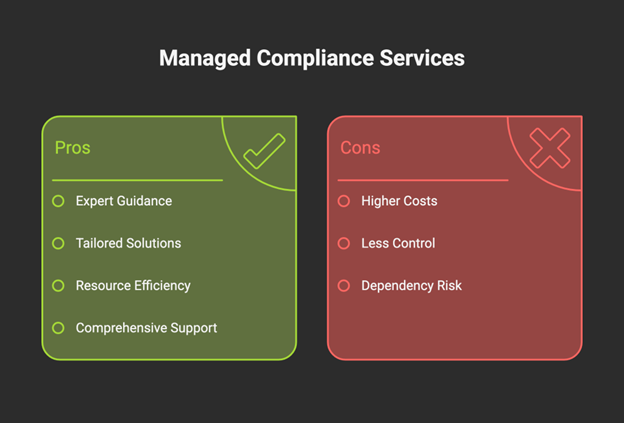
Lack of Internal Compliance Expertise:
Organisations without a dedicated compliance team or in-house expertise can benefit from the guidance and support of experienced professionals.
Complex Regulatory Environments:
Navigating intricate and evolving regulations often requires expert interpretation and strategic advice.
Need for Customised Solutions:
Managed service providers can tailor compliance programmes and solutions to the specific needs and risks of an organisation.
Resource Constraints:
Outsourcing compliance tasks can free up internal resources to focus on core business activities.
Desire for End-to-End Support:
Managed services provide comprehensive support throughout the entire compliance lifecycle, from initial assessment to ongoing maintenance and audit preparation.
The Takeaway
Yes, selecting the right compliance automation solution for your site is a critical decision. Why? It directly impacts the security posture of your organisation as well as operational efficiency. Vanta is a strong contender. Exploring alternatives is beneficial, as they offer better automation and outcome guarantees.
Additionally, by incorporating Transilience in your evaluation process, you are considering the solution that delivers end-to-end compliance ownership and guaranteed certification outcomes.
For more information, get in touch with our experts here.