


Startups do not have it easy. Full stop.
With the renewed, intense focus on digital innovation and transformation, many startups across sectors find themselves tied up by compliance requirements. They have adopted too much too quickly and left themselves compromised.
This is the moment in startup growth where the product stops being the only thing on trial and the organization starts getting evaluated measurably. Buyers want to know whether your company can be trusted with their data, their customers, and their legal exposure.
ISO 27001 works in that moment because it is a common language for trust and security. It is a way to turn security from a series of ad hoc responses into a system you can run, prove, and maintain.
ISO 27001 provides a structured set of policies, risk decisions, controls, and evidence that shows how you protect information over time. The keyword here is “over time.”
ISO 27001 involves a certification cycle that comes with initial audits, ongoing surveillance audits, and periodic recertification. Certification bodies typically conduct a Stage 1 documentation review, followed by a Stage 2 certification audit, and ongoing maintenance audits in subsequent years.
For startups, the challenge with this is maintaining a security program that does not collapse after the certificate is issued.
What is ISO 27001
ISO 27001 is an international standard for building, operating, and continuously improving an Information Security Management System (ISMS) to protect an organization’s private data by managing risks to its confidentiality, integrity, and availability.
It asks your organization to clearly:
- Define what information (data) you must protect and why
- Identify risks to that information
- Choose controls that reduce those risks
- Document decisions and responsibilities
- Collect evidence that controls are working
- Audit the system, fix gaps, and improve it continuously
Key components of an Information Security Management System
An ISMS is a combination of important operating parts that make security decisions repeatable under pressure. These key elements are:
1. Scope and context definition
Scope determines what your security program is responsible for and, just as importantly, what it is not.
A well-defined scope prevents compliance sprawl by anchoring controls to the systems, teams, and data that matter to customers and regulators today.
Without a clear scope, startups either overbuild controls they cannot sustain or under-protect assets that create real risk.
2. Risk management and risk treatment
Risk management is the decision engine of the ISMS. It forces the organization to identify threats, assess impact and likelihood, choose treatments, and document acceptance where risk remains.
3. Asset management
Asset management answers what information the company is responsible for protecting. This includes data, systems, infrastructure, software, and supporting services. When assets are identified and classified, controls can be applied proportionally, and evidence can be tied to real risk.
4. Policy and security controls
A strong information security management system keeps policies concise and maps them directly to operational controls such as access management, logging, encryption, and change approval. The goal is to ensure that every rule has a corresponding technical or procedural mechanism that can be verified.
5. Training and awareness
Effective ISMS programs focus on role-specific behavior. Figuring out what engineers, operators, and business teams need to do differently in their daily work. For startups, this reduces accidental noncompliance and ensures that security decisions are not trapped in the heads of one or two individuals.
6. Incident response and breach handling
It defines how incidents are detected, investigated, contained, and learned from. A mature approach includes testing and post-incident review, so failures strengthen the system instead of exposing the same weakness repeatedly.
7. Monitoring, measurement, and internal review
This includes tracking control effectiveness, reviewing access, validating logs, and running internal audits. In practice, this is where startups either maintain certification with minimal disruption or fall back into last-minute evidence hunts before audits.
8. Business continuity and disaster recovery
These plans define how critical services are restored, how data is protected during outages, and how responsibilities shift during a crisis. For startups, even lightweight, tested plans can dramatically reduce operational and reputational damage when something goes wrong.
9. Continual improvement
This involves using audit findings and operational changes to refine controls, update risk assessments, and improve evidence collection. It prevents the ISMS from becoming stale and ensures it evolves at the same pace as the company’s growth.
Why ISO 27001 matters for startups’
Competitive advantages that show up in real deals
For startups, ISO 27001 is often a shortcut through security friction.
It helps you standardize answers to customer questionnaires, reduce repeated security explanations, and show mature governance in a way that procurement teams recognize instantly.
It also changes internal decision-making. When security controls are tied to risk decisions and ownership, it becomes easier to say “no” to unsafe shortcuts, because you are already enforcing a defined management system.
Building trust and credibility with clients
Early-stage startups often compete on speed and innovation. Buyers in regulated industries compete on risk management. That mismatch kills deals.
ISO 27001 helps bridge the mismatch by giving buyers a credible signal that your company has a defined system for managing information security risks and improving it over time. That credibility can matter as much as feature differentiation, especially when you are selling into finance, healthcare, payments, or enterprise software procurement.
ISO 27001 compliance benefits for startups
Advantages of being ISO 27001 certified include:
1. Access to global markets
ISO/IEC 27001 is widely recognized and designed for organizations of any size and sector. That global recognition is part of the value. It gives international buyers a familiar baseline for evaluating a startup’s security maturity.
It also supports partnership opportunities. Larger platforms and global enterprises often need vendors that can demonstrate structured security practices. ISO 27001 helps you pass the “basic credibility gate” faster.
2. Enhanced security posture
ISO/IEC 27001 forces you to reduce “unknown risk,” as your organization has to answer uncomfortable questions early:
- Who has privileged access?
- Where is sensitive data stored?
- How do you onboard and offboard employees?
- What happens when a production incident occurs?
- How do you know controls are still working?
This matters because breaches are expensive, and the average cost is not trending down. IBM reported that the global average of a cybersecurity breach cost hit USD 4.88 million.
3. Long-term growth and cost savings
ISO 27001 can look expensive until you compare it to the cost of improvisation:
- Time lost to repeated customer security reviews
- Emergency remediation work triggered by one large deal
- Rework caused by unclear ownership and missing documentation
- Operational cost of control drift after the first audit
ISO 27001 reduces long-term costs by making security repeatable. It also makes onboarding new engineers easier because expectations are documented and enforced through the process.
Steps to achieve ISO 27001 compliance
The certification lifecycle is consistent across most accredited certification bodies:
Stage 1 audit, Stage 2 audit, then surveillance audits, then recertification within a multi-year cycle.
What changes is how efficiently you prepare.
Here is the startup-friendly path.
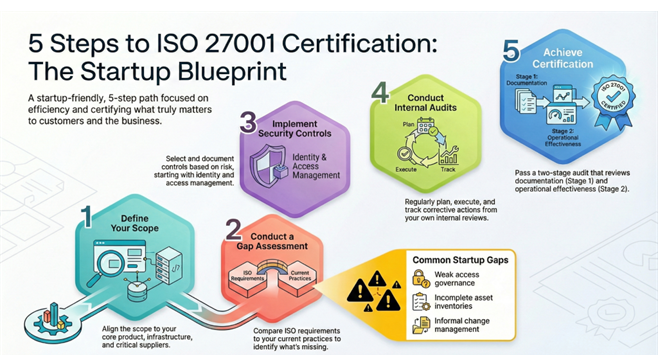
Steps to achieve ISO 27001 compliance
Step 1: Define your ISMS’s scope
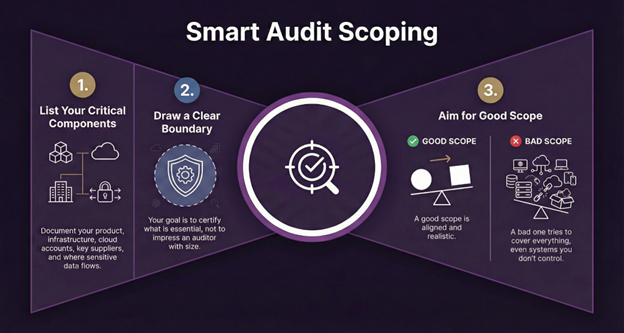
Define your ISMS’s scope properly
A good startup scope is aligned to your product and core operations, realistic for your current team, and defensible to customers. A bad scope tries to cover everything, including systems you do not control.
Step 2: Conduct a gap assessment
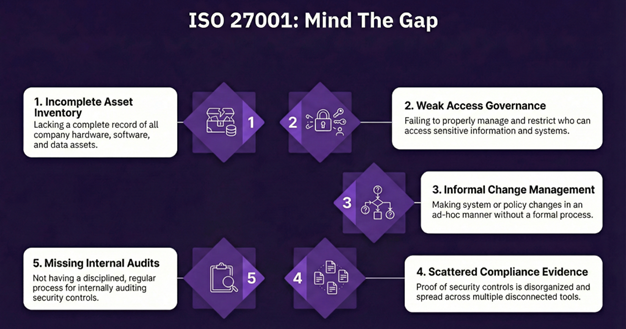
Most common ISO 27001 control gaps: How fragmented governance, assets, and audit practices create hidden risk across the security lifecycle
A gap assessment compares what ISO/IEC 27001 requires, what you already do, and what is missing. This should help you form an execution plan, properly define owners, timelines, and the minimum controls needed to reduce your highest risks.
Step 3: Implement security controls
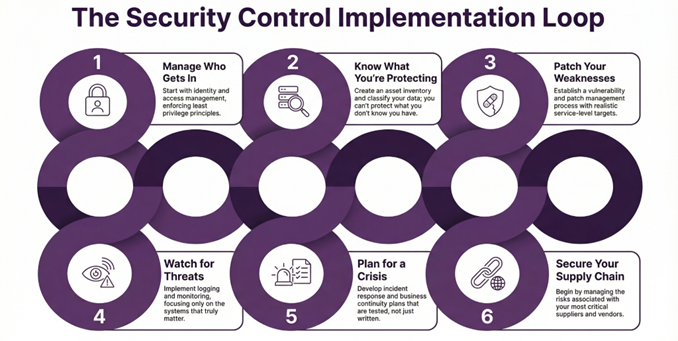
A looped model showing how security controls must operate continuously and not independently.
ISO/IEC 27001 expects you to select controls based on risk and document them in the statement of applicability. The statement of applicability is the bridge between risk and controls, and it is a core audit artifact.
The control implementation plan for startups selling software as a service follows this sequence:
- Identity and access management first (least privilege, joiner-mover-leaver routines, review cadence)
- Asset inventory and data classification next (you cannot protect what you cannot name)
- Vulnerability and patch management (with realistic service-level targets)
- Logging and monitoring (focused on the systems that matter, not everything)
- Incident response and business continuity (tested, not only written)
- Supplier and vendor risk management (start with critical vendors)
Remember the control structure point: controls span organizational, people, physical, and technological categories, so you will need governance and training alongside technical settings.
Step 4: Conduct internal audits
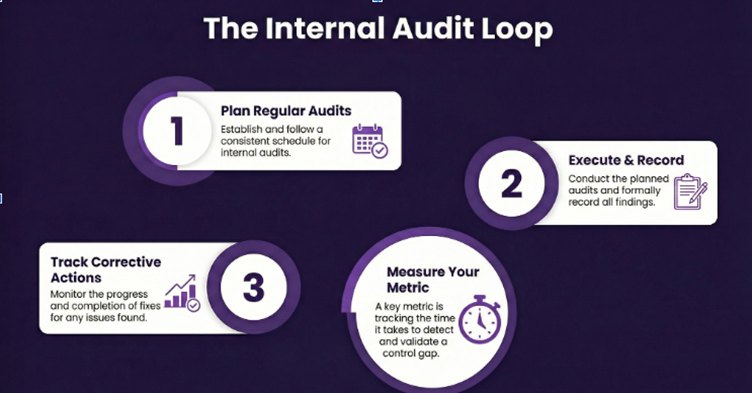
Conduct regular internal audits
Auditors expect to see that you planned regular internal audits, executed them, recorded findings, and tracked corrective actions.
This is also where startups should build a practical metric on how long it takes to detect and validate a control gap.
Step 5: Achieve certification
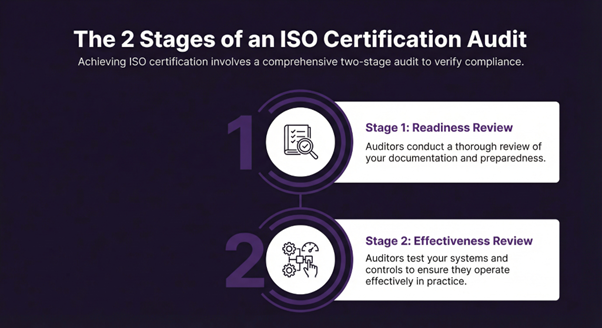
A two-step audit flow of achieving ISO Certification
Certification audits commonly run in two stages:
- Stage 1: Documentation and readiness review
- Stage 2: Operational effectiveness review, where auditors test whether your information security management system and controls actually operate in practice
After certification, you typically face surveillance audits during the cycle and a more comprehensive recertification audit later.
The ISO 27001 certification lifecycle for startups |
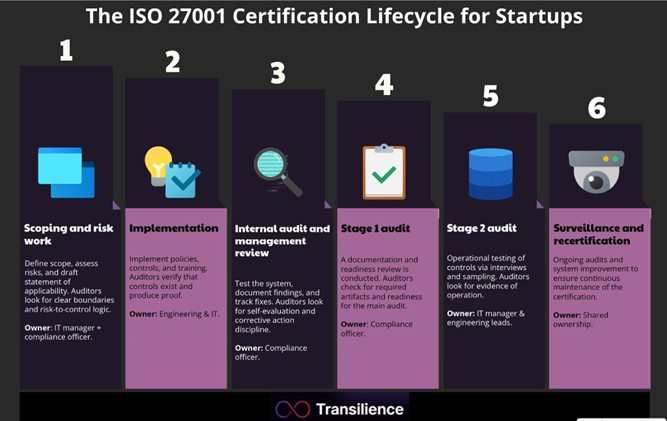
End-to-end visual map of the ISO 27001 journey to certification
Suggested read: Full Guide to ISO 27001 Compliance Checklist |
ISO 27001 compliance challenges for software as a service startups
Startups offering SaaS products face a specific friction:
1. Fast change breaks evidence
Startups deploy often, which is good for product velocity but bad for compliance if change management is informal. Auditors will ask how you approve changes, roll back and prove that new changes did not introduce new risk.
Tie your evidence collection and key controls to change management. Security must be part of how releases happen, not reviewed afterward.
2. Cloud complexity hides real risk
SaaS-based startups usually rely on cloud architecture and managed services. This introduced shared responsibility issues, meaning your provider secures the platform, but you still own your configurations, access policies, and failure modes.
Strive to maintain a critical vendor list, define minimum security requirements, and collect evidence for vendor oversight.
3. Resource restraint and role overload
This is the obvious one. You have limited staff, and the same people ship product and run security. Design a minimum viable information security management system, automate evidence, and choose an operating model that does not require building a large internal compliance team.
Suggested read: Mastering SaaS Compliance: Your Ultimate Checklist and Guide |
Best ISO 27001 compliance solutions for startups 2025
As regards compliance, startups usually need two things at the same time:
- A way to centralize policies, controls, and evidence
- A way to reduce the manual burden of staying audit-ready
That is why compliance automation platforms exist. They connect to your systems, continuously collect evidence, and help you manage controls and audit workflows.
Here are three examples that align with those goals:
1. Network Intelligence’s Transilience AI (managed compliance plus platform)
Network Intelligence is a managed compliance solution powered by Transilience AI that covers certifications, including ISO 27001, and explicitly targets startups as a fit.
The startup-relevant difference is the operating model: it is not only software. It is positioned as a year-round compliance and security partner, which matters when you can not staff a full internal program.
2. Vanta (compliance automation)
Vanta positions its ISO 27001 product around policy creation, risk management, and automated evidence collection to support audit readiness, with flexibility to tailor scope by team, product, or region.
This type of platform tends to work best when you have an internal owner who can drive implementation, coordinate evidence, and manage auditors, even if the system is automated.
3. Drata (compliance automation with continuous monitoring emphasis)
Drata positions its ISO 27001 approach around pre-mapped controls, automation, and continuous control monitoring, centralizing policies, risks, and evidence.
For startups, the practical value is reducing spreadsheet-driven evidence collection and building a more continuous view of compliance status.
Suggested resource: Full Breakdown Review on Network Intelligence vs. Drata vs. Vanta |
ISO 27001 costs and budget planning
Startups hesitate on ISO/IEC 27001 because they assume it is automatically expensive.
It can be expensive. But “expensive” usually comes from two things:
- Overly broad scope, and
- Manual implementation that consumes internal time.
Multiple industry sources commonly place ISO/IEC 27001 certification costs for small to mid-sized organizations in ranges that vary by scope, readiness, and auditor time, often spanning tens of thousands of dollars for the audit and implementation combined.
If your budget is limited, optimize for these three outcomes first:
- Reducing manual evidence collection
- Avoiding scope creep
- Building a system that survives employee turnover
How Network Intelligence can help startups get compliant-ready
Network Intelligence-Transilience AI software to help startups achieve compliance
Startups do not need more compliance tasks, but a way to make compliance always on and measurable.
Network Intelligence provides startups with a complete end-to-end service that supports compliance certifications, including ISO/IEC 27001, pairing automation technology with an expert team to reduce burden.
Where this becomes distinctly valuable for startups is in three areas.
1. Reduces the “compliance project” feeling
Instead of treating ISO 27001 like a temporary sprint, we help you build it as an operating function with defined owners, routines, and evidence flows.
2. Avoids evidence chaos
Evidence is where startups burn time. A managed model, plus automation, reduces the manual tasks handled as documents, and all validation loops are closed and found within a single system.
3. Makes maintenance the default
The certification cycle includes ongoing audits after initial certification, so maintenance is not optional. Network Intelligence’s partner-led approach is designed to keep the ISMS running continuously.
4. Keeps internal teams focused on product and risk decisions
The best use of a startup compliance officer or information technology manager is not document formatting. It is risk prioritization, control ownership, and ensuring the business makes sane tradeoffs.
Offloading heavy execution work can protect that focus. Network I intelligence helps your organization do just that.
Develop a continuous compliance model
If you want a faster, more realistic path to certification and long-term maintenance with limited internal resources, you will need more than good intentions. You will need a repeatable operating model and evidence that stays fresh.
Talk to an expert at Network Intelligence about building and maintaining ISO 27001 with managed compliance.