

Traditional perimeters are technically dead. The shift to a cloud-first, remote work culture has created borderless environments where implicit trust can be fatal. Attack surfaces have scaled exponentially, making them prime targets for AI-driven cyberattacks.
Without continuous, explicit trust verification and clear visibility into every activity across your digital infrastructure, you’re risking data security and business continuity.
That’s why zero-trust implementation (identity-centric defense) is indispensable. Trusting no one, enforcing least-privilege access: these aren’t nice-to-haves; they’re survival essentials against fast-moving cybercriminals and regulatory penalties.
The question isn’t why you need an upgrade, but how to implement zero trust effectively in a sprawling, modern cyber landscape.
This guide is your definitive answer. It is packed with zero-trust basics, business benefits, and actionable steps for implementation and bypassing hurdles.
What is Zero Trust Implementation?
Zero trust implementation represents a paradigm shift from an outdated, static perimeter-based defense (the castle-and-moat approach) to a more secure, agile, identity-centric architecture.
It operates on a simple, stringent rule: “Never Trust, Always Verify.”
Rather than treating your corporate network as a safe zone, zero trust assumes that every access request is a potential breach. This requires you to continuously authenticate and authorize every interaction across your digital infrastructure.
Its core principle is to verify the identity of every entity (human or machine) requesting access, ensuring access is granted only to legitimate ones. By enforcing central zero-trust principles, such as least-privilege access and network segmentation, you can reduce attack surface and minimize the blast radius of a breach.
Packaged and popularized in 2010 by John Kindervag, a former Forrester Research analyst, the Zero Trust Architecture (ZTA) has since become the gold standard for cybersecurity. Since then, several key initiatives have transformed the zero-trust landscape, including:
- 2014-2018: Google implemented the BeyondCorp ZTA framework.
- 2019: Gartner introduced Zero Trust Network Access (ZTNA) and Secure Access Service Edge (SASE).
- 2020: NIST published Special Publication 800-207, a standard ZTA guide.
- 2021: The US President issued Executive Order 14028, directing all federal agencies to implement zero trust.
- 2023: CISA released the updated Zero Trust Maturity Model, a structured roadmap to adopt and optimize zero trust implementation.
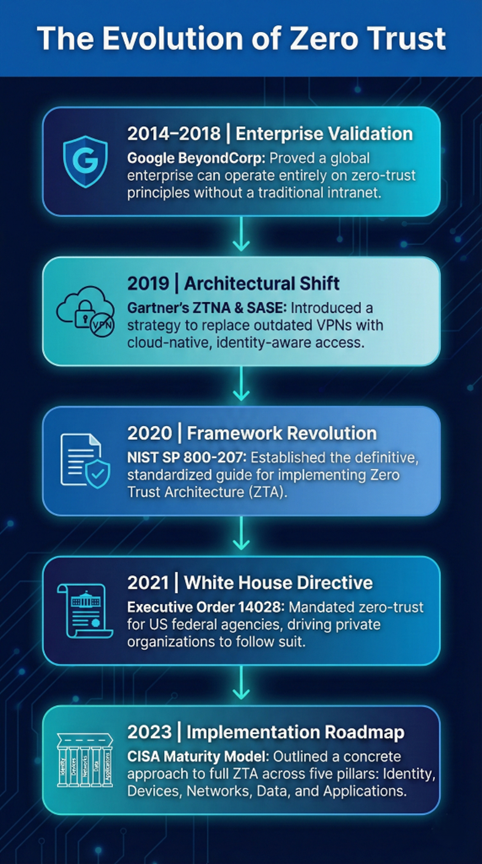
Fig.1 The Evolution of Zero Trust
How is Zero Trust Implementation Changing in 2026?
Zero trust has radically evolved from an experimental idea into a default, non-negotiable security requirement since it was first coined. And in 2026, it is quickly moving toward becoming an automated, AI-driven operational standard.
To answer the question, “How to implement zero trust today?” effectively, you must first view trust confirmation as a dynamic, always-on process, not a one-time event. In modern zero-trust implementations, the single “never-trust” check at the network edge is giving way to continuous, context-aware authentication.
Here’s how zero-trust implementation is advancing in 2026:
- Widespread adoption: ZTA is no longer an enterprise-only necessity but a baseline security approach for all businesses, with Gartner predicting that 70% of organizations will already adopt zero trust as a baseline security by 2027, replacing legacy, high-risk VPNs with ZTNA to provide direct, application-specific access.
- Identity + context awareness: Instead of a one-time login validation, trust has turned from implicit to explicit by continuously evaluating real-time signals throughout the session, including device health, user behavior, geolocation, and risk scores.
As Kindervag warns, “The core weakness of identity today is its inability to prevent attacks after authentication.”
- AI-driven implementation: AI and ML are now essential for managing ZTA at scale, replacing static, manual systems with automated policy enforcement, real-time threat detection and response, and prevention of non-human entities (that far exceed human entities) from becoming unauthorized gateways to sensitive data.
- Measurable success: To achieve security outcomes, organizations are shifting from “Are we doing zero trust?” to “How fast can we revoke access upon threat detection?” The focus is now on reducing the impact of breaches.
- Mandatory compliance: Regulations such as PCI DSS, GDPR (e.g., Articles 25 and 32), and the EU Cyber Resilience Act (CRA, fully effective 2027) now require security-by-design and the implementation of ZT principles (least privilege, segmentation), raising their status from best practices to legal mandates.
What are the Core Principles to Follow When Implementing Zero Trust?
Zero trust is not a product or a service; it’s a continuous journey of mapping sensitive data, enforcing continuous identity and access management (IAM), changing workforce habits, and integrating AI agents into threat detection and response workflows.
To understand how to implement zero trust, you must view it as introducing a security-first culture across your organization rather than an isolated IT project. It requires a fundamental shift in how you handle access, driven by the following key principles:
- Implicit trust denial: Treat every user, device, or application as suspicious, whether it’s inside or outside your network, and whether it’s trusted or not. This requires authentication and authorization for all access attempts, regardless of who made them, when, or from where.
- Breach assumption: You presume that a threat actor (or a compromised credential) is already inside your network or about to enter it. The focus shifts immediately to containment and minimizing the blast radius.
- Identity as the new perimeter & least privilege: With remote work, SaaS sprawl, OT/IT convergence, and multi-cloud ecosystems completely dissolving traditional borders, identity is your primary line of defense. By using ZTNA, you grant users, APIs, and machine identities (such as AI agents and service accounts) only the absolute minimum access required to perform their specific tasks.
- Granular micro-segmentation: Flat networks are a liability most organizations struggle with. In a zero-trust model, sensitive data flows and workloads are deeply isolated by breaking down the network into zones. If a breach occurs, this strict containment stops malicious lateral movement dead in its tracks.
- Continuous monitoring and validation: Trust should not be treated as static. You should use AI/ML to monitor network traffic, device posture, time, and user behavior in real time, enabling dynamic, risk-based access decisions.
Grasping these core tenets is your blueprint for how to implement zero trust basics. Once you lay the foundation, you can scale your ZTA into a mature, org-wide security posture powered by automation and AI.
What are the Key Steps for Zero Trust Implementation?
A zero-trust implementation in 2026 doesn’t require a massive overhaul. You can systematically upgrade your existing infrastructure to a smart, always-on verification system that strengthens data security and reduces breach costs.
To avoid operational disruption, roll this out in sprints, starting small to build confidence and achieve quick wins. With a step-by-step roadmap, you can build resilience while also meeting stringent compliance requirements.
Here’s how to implement zero trust to enhance data security in 6 actionable steps:
Step 1: Map the protect surface and build a live inventory
Traditional security defends the macro perimeter. Zero trust demands you protect the core.
What to do:
- Create a live, continuously updated inventory of your digital surface, including all assets, sensitive data, users, data flows, and shadow IT technologies to establish a risk baseline.
- Identify not only human users but also machine entities, including service accounts, API tokens, and AI agents/bots.
- Conduct a gap analysis against standard zero-trust principles to highlight vulnerabilities.
- Focus your initial efforts strictly on protecting the most critical assets and securing executive buy-in.
Step 2: Enforce strong access policies and continuous verification
With remote work and the cloud-first approach blurring perimeters, identity and device health form your frontline defense.
Verizon’s 2025 DBIR shows 46% of credential compromises originated from unmanaged devices, stressing the urgent need for continuous zero-trust checks.
What to do:
- Set up a robust IAM policy that enforces role-based access and the principle of least privilege (PoLP) for all human and machine entities.
- Implement phishing-resistant MFA (FIDO2, passkeys) and eliminate SMS authentication to neutralize stolen credentials risks.
- Integrate your EPP/EDR platforms to apply context-aware access controls that adapt to risk signals, such as location/device change and behavioral anomalies.
- Tie all access decisions directly to real-time endpoint posture checks, ensuring devices are compliant and threat-free before granting entry.
Step 3: Transform access with ZTNA and micro-segmentation
A verified identity should not get a free pass to your entire network. You must restrict access to exactly what is required; no more, no less.
What to do:
- Replace network-wide VPN access with ZTNA and a Secure Service Edge (SSE) to create direct, application-specific tunnels, granting need-only access and avoiding unnecessary lateral movement.
- Create granular micro-segments to deeply isolate apps and workloads that handle sensitive data, reducing the blast radius in the event of a breach.
- Inspect all traffic (east-west and north-south) to maintain visibility across segmented environments.
- Continuously validate segment policies as your environment evolves.
Step 4: Harden the application and data layers
Securing the network is only half the battle; the assets themselves must be fortified against modern threat actors.
What to do:
- Classify and encrypt data at rest or in transit, and deploy Data Loss Prevention (DLP) to block exfiltration.
- Protect your APIs and workloads with a Cloud Workload Protection Platform (CWPP).
- Implement runtime application protection to detect and block exploits in real time.
Step 5: Enable continuous monitoring, testing, and expansion
Passing an initial check doesn’t equal trust for the entire session. A mature zero trust environment requires continuous verification based on dynamic factors.
What to do:
- Integrate AI/ML-driven threat intelligence and User-Entity Behavior Analytics (UEBA) to continuously monitor network traffic, user behavior, and logs for anomalies, such as impossible travel or data exfiltration.
- Use automated alert triage and incident playbooks to instantly revoke access upon threat detection, significantly reducing alert fatigue while accelerating response times.
- Experiment with the new controls in observation mode, simulate attacks to assess your ZTA’s maturity, and expand only once pilots succeed.
Step 6: Automate policy enforcement and compliance mapping
Automated workflows scale more efficiently than manual processes. Also, tying your zero-trust security controls to your compliance obligations maximizes your ROI.
What to do:
- Define your access policies as code to automate consistent security enforcement across your environment.
- Leverage automation platforms like Transilience to map those automated controls directly to security frameworks (SOC 2, NIST) and regulations (HIPAA, GDPR).
- Integrate AI-enabled GRC workflows (e.g., policy automation, risk management, evidence collection) to unify reporting across security and compliance teams.
Now that you know how to implement zero trust in phases, it’s time for you to screenshot its benefits for your boardroom meeting.
What are the Benefits of Implementing Zero Trust?
Zero trust isn’t just hype; it’s a proven security and business multiplier when executed thoughtfully, especially as cyber threats and regulations evolve at breakneck speed.
Abandoning the implicit-trust-and-perimeter mindset in favor of zero trust provides financial and operational gains beyond cybersecurity.
To appreciate the value of this transition, consider the following results from a zero-trust effectiveness research on real-world cases:
| Performance Metric | % Improvement |
| Reduction in the success rate of lateral movement attacks | 85% |
| Reduction in attack surface | 90% |
| Reduction in the impact of insider threats | 79% |
| Reduction in the average cost of a data breach | 63% |
| Increase in efficiency of security teams | 55% |
| Reduction in operational costs associated with security management and compliance | 50% |
| Decrease in average time to identify and contain a breach | 45% |
Statistics aside, here’s a breakdown of zero-trust implementation benefits that span every layer of your business:
- Shrinks the attack surface: Continuous identity checks and least-privilege access eliminate broad entry points that fuel most breaches. This proactive attack-surface reduction makes it far harder for AI-powered attackers to infiltrate your network.
- Minimizes the blast radius: In the event of a breach, segmented networks trap threat actors in isolated zones, preventing ransomware and other attacks from spreading enterprise-wide. What could be a disaster becomes a contained fix, slashing recovery time and downtime.
- Maximizes security ROI: Integrating legacy VPNs and firewalls into a unified ZTNA-SSE framework drastically reduces software licensing costs and operational overhead. Early threat detection and response further trims breach costs and frees up budget for innovation.
- Secures the cloud-first, hybrid workforce: Zero trust completely decouples security from physical offices. By verifying context in real-time, you can support BYOD, remote teams, third-party contractors, and IoT/OT devices, scaling distributed operations securely without the latency of VPNs.
- Streamlines regulatory compliance: Zero trust bakes auditability directly into your workflows by enabling automated control mapping, access logging, and evidence collection for regulations and industry frameworks like SOC 2, PCI DSS, HIPAA, HITRUST, GDPR, and NIST standards.
Manage compliance smoothly without manual pains or last-minute audit scrambles. - Accelerates cloud transformation: Multi-cloud environments and SaaS tools are now the norm, but they amplify risks. Zero trust extends consistent, identity-based security policies across all cloud workloads, regardless of where data resides. This means faster cloud migrations without security tradeoffs.
- Enhances visibility and control: Continuous, AI-driven monitoring provides unprecedented oversight of your digital environment. By logging every access request, you can instantly detect anomalous behavior and make data-driven security optimization decisions.
- Builds resilience and trust: Zero trust boosts operational resilience by shifting security from reactive to proactive. Strengthened security, coupled with a compliant infrastructure, builds lasting trust among your stakeholders.
What are the Challenges in Implementing Zero Trust?
Moving to zero trust in 2026 is not optional. But, here’s the reality: It’s not a plug-and-play project.
If you see it only as a quick compliance fix rather than as a long-term, strategic commitment to architectural, technological, and cultural shift, you are wasting effort and money. Implementing a zero-trust strategy with modern technologies in a complex, rigid system brings inevitable friction.
Below are the zero-trust implementation challenges you may face and their resolutions:
Challenge #1: Complex legacy tech
While zero trust goes well with cloud deployments, your legacy infrastructure wasn’t designed to be compatible with zero-trust principles. Forcing zero trust on these systems is challenging, often requiring middleware support or even replacement.
Solution:
- Evaluate your existing legacy stack: systems, sensitive data, data flows, and access points.
- Deploy a cybersecurity mesh architecture to wrap legacy assets in modern access controls.
- Isolate legacy systems into small, secure network zones, limiting access to only authorized entities.
Challenge #2: Upfront costs and executive buy-in
Pitching a major change to C-suite executives is an uphill battle. Leadership often balks at the initial price tag of new security initiatives and the perceived disruption to revenue-generating operations.
Solution:
- Promote it as an ROI booster that reduces breach costs, compliance burden, and cyberinsurance premiums rather than just an IT expense.
- Don’t try to boil the ocean; target a single high-risk asset first to prove effectiveness and benefits.
- Offset the initial investment by actively retiring redundant, overlapping legacy tools.
Challenge #3: User resistance to change
If security policies require employees to authenticate every few minutes, they will inevitably find dangerous shadow IT workarounds to get their jobs done.
Solution:
- Use risk-based, adaptive authentication that silently checks context (location, device health, etc.) in the background, balancing security and user-friendliness.
- Test new policies in observation mode to spot workflow bottlenecks before going live.
- Educate users about the importance of strengthened security and clean access management.
Challenge #4: Alert fatigue and tool sprawl
When you verify everything, your dashboards light up constantly. If your team is forced to chase every false positive, real threats slip through the cracks.
Solution:
- Discard disjointed point solutions for a unified monitoring dashboard.
- Use AI-based prioritization modules to filter out noise and flag only legitimate anomalies.
- Build automated playbooks to instantly quarantine compromised assets.
Challenge #5: The crippling talent shortage
Designing a flawless ZTA with extensive micro-segmentation requires highly skilled engineers, who are hard to find and expensive to hire.
Solution:
- Don’t burn your internal IT team on complex initial deployments.
- Partner with seasoned managed service providers like Network Intelligence to handle ZTA implementation.
- Motivate internal teams to receive training and get certified in zero-trust implementation frameworks.
Challenge #6: The explosion of non-human entities
The zero-trust philosophy applies not only to employees but also to the vast web of AI agents, APIs, and service accounts. These invisible users often hold excessive, permanently active privileges, which attackers use to silently siphon sensitive data.
Solution:
- Subject every API call and bot to the same strict, context-aware verification as your human users.
- Automate the lifecycle of machine credentials so tokens rotate constantly and expire immediately after a task ends.
- Deeply inspect machine-to-machine traffic to detect suspicious behavior and ensure a harmful script doesn’t reach your critical data.
Need Professional Assistance? Network Intelligence Can Help
Implementing a mature zero-trust framework is a massive operational shift. Your road to zero trust may be paved with challenges, including aging infrastructure, budget constraints, alert overload, and crippling talent deficits. But you don’t have to walk alone.
At Network Intelligence, we combine decades of cybersecurity expertise with our AI-powered platform Transilience to streamline your transition to a proactive, identity-first zero-trust model.
Here’s how Network Intelligence helps you overcome challenges:
- Strategic roadmap: We evaluate your existing security posture and design proven processes tailored to your unique business needs, minimizing downtime and delivering immediate ROI.
- Modernization: Using a cybersecurity mesh architecture, we securely connect your legacy assets to modern context-aware solutions for added security.
- Technology partnerships: Leverage our inventory of cutting-edge cloud-native and SaaS tools that deliver AI-driven zero-trust capabilities, including PAM, SRE, SASE, XDR, SIEM, SOAR, and more.
- AI-powered GRC automation: Transilience’s AI agents automate key processes, including security testing, vulnerability prioritization, compliance mapping, and evidence collection to keep you ahead of evolving threats and regulatory requirements.
- Professional expertise: Our certified cybersecurity engineers guide you through every step of your zero-trust journey, whether it’s security, compliance, or audit management.
Pair this “How to Implement Zero Trust” guide with our expert-led, AI-driven managed services. Talk to our experts today to see how we can help you achieve true cyber resilience with future-proof security solutions.