


Most email security is built to catch a specific kind of attack: a malicious attachment, a link to a credential-harvesting page, a sender domain that’s an obvious lookalike. Business email compromise doesn’t look like any of that. There’s often no attachment, no link, and sometimes no spoofed domain at all, just a well-timed, well-written request from what appears to be a real account, asking for something the recipient has every reason to believe is legitimate. That’s exactly why it keeps working, and why it accounts for a disproportionate share of actual financial losses compared to attacks that are technically far more sophisticated.
What makes BEC different from ordinary phishing
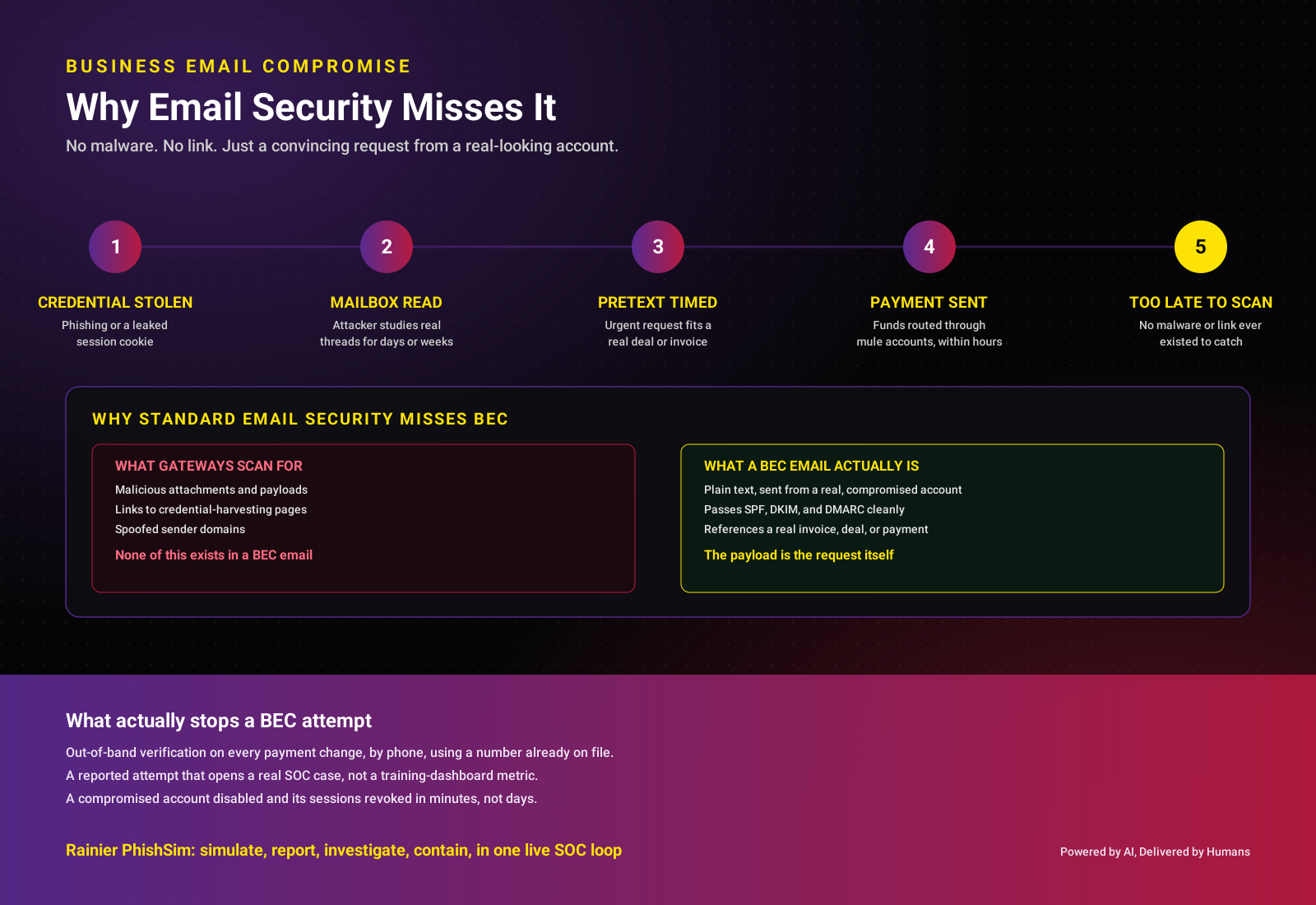
There’s frequently nothing malicious to scan. A gateway built to inspect attachments and links for malware has nothing to inspect in an email that’s just text asking someone to change a bank account number or approve a wire transfer. The payload is the request itself, not a file or a URL.
The sender is often genuinely real, not spoofed. A significant share of BEC attacks don’t impersonate an address, they use one that’s actually been compromised, a real vendor’s account, a real executive’s mailbox, taken over through a previous credential theft or session hijack. Authentication checks like SPF, DKIM, and DMARC all pass cleanly, because the email genuinely did originate from that account.
The attack depends on context, not malware. A convincing BEC attempt references a real deal, a real invoice number, a real upcoming payment, information often gathered by actually reading a compromised mailbox for days or weeks before sending the fraudulent request. That patience is what makes the ask feel routine instead of suspicious.
Urgency and authority do the social engineering, not a fake login page. “This needs to go out today, I’m about to board a flight” from what looks like the CFO’s real account is a different kind of pressure than a generic phishing lure, and it’s aimed at bypassing judgment rather than technical controls.
The financial loss happens immediately, not after a slow compromise. Once a fraudulent payment is approved and sent, the money is typically gone within hours, routed through mule accounts before anyone notices. There’s rarely a lingering dwell time to catch during, unlike a lot of other intrusions.
How an account actually gets compromised before the BEC attempt
BEC rarely starts with the email that asks for money. It usually starts earlier, with the account takeover that lets an attacker read, and eventually send from, a real mailbox. A credential or session cookie stolen through an earlier phishing attempt, or pulled from a stealer log sold on the dark web, gives an attacker quiet access to a real inbox. Our dark web monitoring post covers how that stolen session data surfaces well before most organizations notice, and that gap is exactly the window a BEC attacker uses to read a mailbox, learn its patterns, and time the eventual fraudulent request.
What actually stops it
Testing people against the same pressure tactics attackers use, not just links and attachments. A simulation program that only ever tests whether someone clicks a link doesn’t prepare anyone for an urgent, context-aware payment request from a familiar name. Effective training has to include the actual psychological pattern BEC uses, authority, urgency, and a plausible pretext, not just technical lures.
Closing the loop when a suspicious request is reported. An employee who gets an odd payment request and reports it needs that report to go somewhere that actually investigates, not into a training vendor’s dashboard that never talks to the SOC. A reported attempt should open a real case, get correlated against other activity on that account, and get resolved with an actual answer, not just a thank-you message.
Containing a compromised account in minutes, not days. If the account behind a BEC attempt has actually been taken over, the fastest way to stop the damage is disabling that account and revoking its active sessions immediately, not after a help desk ticket works its way through a queue. Every hour that account stays active is another hour it can be used to escalate the same pretext to someone else.
Verifying payment changes out of band, by policy, every time. No email-based control replaces a simple operational rule: a changed bank account number or an unusual payment request gets confirmed by phone, using a number already on file, not one provided in the email. This single habit defeats a huge share of BEC attempts regardless of how convincing the email is, and it’s worth treating as policy rather than hoping someone remembers it under pressure.
Treating human risk as a measurable, trackable exposure, not a one-time training module. Knowing which specific people and departments are repeatedly vulnerable to this kind of pressure, and feeding that into how those accounts and their requests get scrutinized, closes the gap between “we did security awareness training” and actually reducing risk where it concentrates.
Why this connects to account and session security
A BEC attempt is frequently the visible end of an account takeover that started earlier and elsewhere. The same discipline around non-human and human account lifecycle, credential rotation, session validity, and least-privilege access, covered in our non-human identity post, matters just as much for the human accounts BEC actually abuses. And once a compromised account is identified, the response follows the same discipline as any other confirmed incident: contain first, preserve what’s needed for the investigation, and close every foothold, exactly what our DFIR post walks through in more detail.
What to ask before trusting a BEC defense claim
- Does the simulation program test pretext and urgency, not just malicious links and attachments?
- When an employee reports a suspicious request, does it open a real, investigated case, or just log a training metric?
- Can a compromised account actually be disabled and its sessions revoked in minutes, with proper approval controls, not days?
- Is there a mandatory out-of-band verification policy for any payment or bank-detail change, and is it actually enforced?
- Does the program track which people and departments carry the most risk, and act on that, rather than treating everyone as equally exposed?
- Is the account-takeover side of this, stolen credentials and session cookies, actually monitored, or does the program only look at the email itself?
Where Rainier fits
Rainier PhishSim is built as part of a live SOC rather than a standalone training console, which is exactly the gap BEC exploits. A user-reported phishing or BEC attempt opens a real SOC case, attributed to the right tenant and visible alongside every other incident, instead of disappearing into a separate dashboard. A repeat-clicker’s risk score rises automatically, tying human risk directly into the same exposure model used elsewhere on the platform. And when an account is actually compromised, an authorized analyst can disable the user’s account and revoke active sessions directly from the Human-Risk board in seconds, analyst-approved, fully audited, and built to always refuse admin and break-glass accounts. That closed loop, simulate, report, investigate, contain, is what turns a training exercise into something that actually stops a BEC attempt in progress.
Want to know if your vendor payment process would actually catch a BEC attempt? Talk to Network Intelligence.