


Introduction & Purpose
Navigating the complex landscape of HITRUST certification challenges even the most experienced security professionals. Organizations face mounting pressure to demonstrate robust security controls while managing limited resources and evolving compliance requirements. This comprehensive HITRUST compliance checklist transforms the certification journey from an overwhelming obstacle into a structured, achievable process.
Whether you’re pursuing HITRUST certification for the first time or preparing for reassessment, this guide provides the detailed roadmap and practical insights needed to streamline implementation, reduce costs, and achieve certification success. We’ve distilled years of implementation experience into actionable steps that address both technical requirements and strategic considerations throughout the certification lifecycle.
Why HITRUST Compliance Matters
HITRUST certification has evolved from a healthcare-specific framework to the gold standard for security and privacy across multiple industries. Organizations pursuing certification gain significant competitive advantages:
- Comprehensive Compliance Coverage: A single HITRUST certification demonstrates compliance with multiple regulations including HIPAA, GDPR, PCI DSS, and NIST frameworks, eliminating redundant assessments
- Enhanced Business Opportunities: Many healthcare organizations and enterprise clients now require HITRUST certification from their vendors and partners as a prerequisite for business relationships
- Reduced Security Risk: The rigorous implementation requirements significantly reduce the likelihood of data breaches and security incidents that could damage reputation and trigger regulatory penalties
- Streamlined Third-Party Risk Management: HITRUST certification simplifies vendor risk assessments by providing standardized, verifiable security assurances that reduce assessment overhead
Recent industry analysis indicates that organizations with HITRUST certification experience 32% fewer security incidents and reduce their third-party risk assessment costs by up to 50% compared to organizations using proprietary assessment frameworks.
Understanding the HITRUST Framework
What is HITRUST CSF?
The HITRUST Common Security Framework (CSF) is a comprehensive, certifiable framework designed to harmonize multiple regulatory standards and security frameworks into a single, unified approach. Unlike standalone frameworks like ISO 27001 or NIST, HITRUST provides a structured methodology that scales security requirements based on organizational risk factors while maintaining alignment with industry regulations.
The framework’s risk-based approach enables organizations to implement controls proportional to their specific risk profile rather than applying one-size-fits-all requirements. This scalability makes HITRUST suitable for organizations of all sizes, from small healthcare providers to multinational enterprises managing complex data environments.
HITRUST certification provides independently verified assurance that an organization has met all applicable requirements and maintains appropriate security controls. This third-party validation distinguishes HITRUST from self-assessment frameworks, providing higher confidence levels for regulators, partners, and customers.
Key Components of the HITRUST CSF
The HITRUST CSF contains 14 control categories organized into a hierarchical structure that provides comprehensive coverage across all aspects of information security and privacy:
- Information Protection Program: Establishes governance structures and management frameworks
- Endpoint Protection: Secures devices accessing organizational systems
- Portable Media Security: Controls data movement via removable media
- Mobile Device Security: Manages risks associated with mobile computing platforms
- Wireless Security: Protects wireless network infrastructure
- Configuration Management: Maintains secure system configurations
- Vulnerability Management: Identifies and addresses security weaknesses
- Network Protection: Secures network infrastructure and communications
- Transmission Protection: Safeguards data during transmission
- Password Management: Ensures robust authentication practices
- Access Control: Restricts system access based on need-to-know principles
- Audit Logging & Monitoring: Tracks and reviews security-relevant events
- Education, Training & Awareness: Develops security-conscious workforce
- Third Party Security: Manages vendor and partner security risks
These categories encompass 49 control objectives and 156 control specifications that provide detailed implementation requirements. Each control specification includes implementation guidance that helps organizations understand specific requirements and implementation approaches.
The framework employs a progressive, risk-based approach with three implementation levels:
- Level 1: Provides minimum baseline control requirements suitable for lower-risk environments
- Level 2: Encompasses Level 1 requirements plus additional controls for moderate-risk environments
- Level 3: Includes the most comprehensive requirements for high-risk environments
Each organization’s specific requirements are determined by organizational, system, and regulatory risk factors that establish the appropriate implementation level for each control.
How HITRUST Integrates with Other Standards
HITRUST’s “assess once, report many” approach integrates 65 major security and privacy-related standards, regulations, and frameworks as authoritative sources, including:
- ISO/IEC 27001 and 27002
- NIST SP 800-53 Revision 5
- HIPAA Security and Privacy Rules
- PCI DSS
- GDPR
- CCPA/CPRA
- CIS Critical Security Controls
- NIST Cybersecurity Framework
This integration enables organizations to demonstrate compliance with multiple frameworks through a single assessment, significantly reducing the compliance burden compared to managing separate assessment processes for each framework. Learn more about HITRUST requirements and how they integrate with other standards.
The framework’s cross-mapping capabilities allow organizations to leverage existing compliance investments by identifying control overlaps and gaps between HITRUST and other frameworks they’ve already implemented. This approach reduces duplication of effort and accelerates certification timelines for organizations with mature security programs.
Defining Your Scope and Objectives
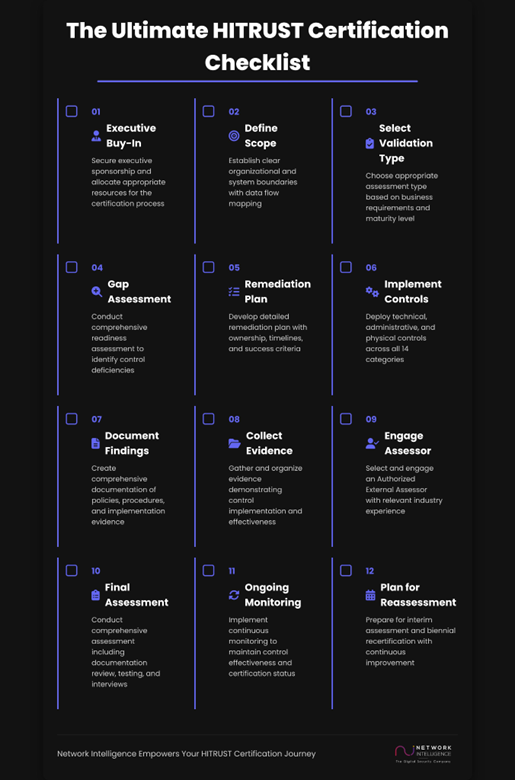
Executive Buy-In and Budget Allocation
Successful HITRUST implementation requires strong executive sponsorship and appropriate resource allocation. Organizations should develop a comprehensive business case that addresses:
- Business Drivers: Identify specific business requirements driving certification, including customer requirements, regulatory obligations, and competitive differentiation
- Resource Requirements: Estimate personnel, technology, and consulting resources needed throughout the certification lifecycle
- Implementation Timeline: Develop realistic project timelines that account for assessment, remediation, and validation phases
- Return on Investment: Quantify expected benefits including reduced audit costs, expanded business opportunities, and improved security posture
Executive sponsors should establish clear governance structures that define roles, responsibilities, and accountability mechanisms throughout the certification process. This governance framework ensures appropriate oversight while providing implementation teams with necessary authority to drive required changes.
Define Organizational and System Scope
Precise scoping represents one of the most critical success factors for HITRUST certification. Organizations must clearly define certification boundaries that include all systems, processes, and data within scope while excluding elements that don’t require certification.
Effective scoping requires:
- Data Flow Mapping: Document how sensitive data flows through systems, applications, and processes to identify all components that store, process, or transmit protected information
- System Inventory: Develop comprehensive inventories of hardware, software, and network components within scope
- Boundary Definition: Establish clear technical and administrative boundaries that define certification scope
- Exclusion Justification: Document and justify any exclusions from certification scope
Organizations should resist the temptation to unnecessarily expand scope, as broader scope increases implementation complexity, costs, and timelines. A focused approach that addresses specific business requirements while maintaining clear boundaries typically yields more successful outcomes.
Select HITRUST Validation Type
HITRUST offers multiple assessment options to meet different organizational needs:
- HITRUST Readiness Assessment: An internal self-assessment that helps organizations prepare for formal validation
- HITRUST Validated Assessment: A comprehensive assessment validated by an Authorized External Assessor that results in a HITRUST Validated Assessment Report
- HITRUST Certification: The most rigorous option, resulting in formal HITRUST CSF Certification when all requirements are met
Organizations should select the appropriate validation type based on business requirements, resource availability, and maturity level. Many organizations begin with readiness assessments to identify gaps before pursuing formal certification, while others may require immediate certification to meet contractual obligations.
The selection process should consider:
- Customer and partner requirements for specific validation types
- Regulatory obligations that may require formal certification
- Resource availability for implementation and validation activities
- Current security program maturity and readiness for formal assessment
Preparation for HITRUST Certification
Gather HITRUST Information
Successful implementation requires comprehensive understanding of HITRUST requirements, processes, and resources. Organizations should:
- Access the HITRUST CSF: Obtain the current HITRUST CSF version through the HITRUST Alliance
- Review Implementation Guidance: Study HITRUST implementation guides and supplementary materials
- Explore the MyCSF Platform: Understand capabilities and requirements of the HITRUST assessment platform
- Identify Training Resources: Determine training needs for implementation team members
Organizations should download our comprehensive HITRUST implementation guide that provides detailed guidance on navigating certification requirements and avoiding common implementation pitfalls.
Assign Key Roles and Responsibilities
Effective HITRUST implementation requires clear role assignments and accountability mechanisms. Key roles include:
- Executive Sponsor: Provides leadership support, removes obstacles, and ensures resource availability
- HITRUST Program Manager: Oversees implementation activities, coordinates workstreams, and manages timelines
- Control Owners: Responsible for implementing and documenting specific controls
- Evidence Collectors: Gather and organize documentation demonstrating control effectiveness
- Technical Implementers: Configure systems and applications to meet control requirements
- Quality Assurance: Reviews evidence and documentation for completeness and accuracy
Organizations should establish a HITRUST steering committee that meets regularly to review progress, address challenges, and make key decisions throughout the implementation process. This governance structure ensures appropriate oversight while maintaining implementation momentum.
Gap Assessment / Readiness Assessment
Before pursuing formal certification, organizations should conduct comprehensive gap assessments to identify control deficiencies and implementation priorities. This assessment should:
- Evaluate Current Controls: Compare existing security controls against HITRUST requirements
- Identify Gaps: Document specific control deficiencies and implementation gaps
- Assess Maturity Levels: Evaluate control maturity against HITRUST’s five maturity levels
- Prioritize Remediation: Develop risk-based prioritization for addressing identified gaps
Organizations can conduct internal gap assessments using the MyCSF platform or engage external assessors to provide independent evaluation. External assessments often identify gaps that internal teams might overlook, providing more comprehensive remediation guidance.
Gap assessment findings should be documented in a detailed report that serves as the foundation for remediation planning and implementation activities. Learn more about HITRUST audits and assessment processes.
Develop a Remediation Plan
Based on gap assessment findings, organizations should develop comprehensive remediation plans that address identified deficiencies. Effective remediation plans include:
- Specific Actions: Detailed descriptions of required remediation activities
- Ownership Assignments: Clear responsibility designations for each remediation task
- Implementation Timelines: Realistic schedules for completing remediation activities
- Resource Requirements: Personnel, technology, and budget allocations needed for implementation
- Success Criteria: Measurable outcomes that demonstrate successful remediation
Organizations should prioritize remediation activities based on risk levels, implementation complexity, and dependencies between different control areas. High-risk gaps with significant security implications should receive highest priority, while lower-risk items can be addressed later in the implementation process.
The remediation plan should be reviewed and approved by the HITRUST steering committee to ensure appropriate governance oversight and resource allocation.
Implement Required Controls and Policies
Control implementation represents the most resource-intensive phase of HITRUST certification. Organizations must systematically implement technical, administrative, and physical controls across all 14 control categories. Key implementation considerations include:
- Policy Development: Create or update security policies and procedures to align with HITRUST requirements
- Technical Controls: Implement required system configurations, security tools, and monitoring capabilities
- Administrative Controls: Establish governance structures, risk management processes, and security awareness programs
- Physical Controls: Implement facility security measures, environmental protections, and physical access controls
Organizations should develop detailed implementation plans for each control category, addressing specific requirements at the appropriate implementation level (1, 2, or 3) based on their risk factors. Implementation should follow a phased approach that addresses highest-priority controls first while managing dependencies between different control areas.
Regular status reviews should track implementation progress, identify obstacles, and adjust timelines as needed to maintain momentum throughout the implementation process.
Document Findings and Results
Comprehensive documentation represents a critical success factor for HITRUST certification. Organizations must document both control implementations and their effectiveness in addressing HITRUST requirements. Key documentation includes:
- Policy Documentation: Formal security policies and procedures that define organizational requirements
- Implementation Evidence: Configuration screenshots, system logs, and other technical documentation demonstrating control implementation
- Process Documentation: Workflow diagrams, process descriptions, and procedural guides
- Testing Results: Evidence demonstrating control effectiveness through testing and validation
- Risk Assessments: Documentation of risk analysis and treatment decisions
Documentation should be organized according to HITRUST’s control structure, with clear mapping between evidence artifacts and specific control requirements. This organized approach simplifies the assessment process and reduces the likelihood of documentation gaps during validation.
Collect and Organize Evidence
Evidence collection represents one of the most challenging aspects of HITRUST certification. Organizations must gather comprehensive evidence demonstrating both control implementation and effectiveness. Effective evidence collection requires:
- Evidence Mapping: Clear association between evidence artifacts and specific control requirements
- Naming Conventions: Consistent file naming that facilitates evidence organization and retrieval
- Evidence Repository: Centralized storage location for all certification evidence
- Quality Control: Review processes that ensure evidence completeness and accuracy
Organizations should develop evidence collection templates that standardize documentation formats and ensure consistent coverage across all control domains. These templates should align with HITRUST’s evidence requirements and facilitate efficient assessor review during validation.
Evidence should demonstrate control maturity across all five HITRUST maturity dimensions: policy, process, implemented, measured, and managed. This comprehensive approach ensures controls are not only implemented but also effectively managed throughout their lifecycle.
Conducting the HITRUST Assessment
Engage an Authorized External Assessor
HITRUST certification requires engagement with an Authorized External Assessor who validates control implementations and submits assessment results to HITRUST for certification. When selecting an assessor, organizations should consider:
- Industry Experience: Assessor familiarity with your specific industry and regulatory environment
- Assessment Approach: Methodology, timelines, and resource requirements for the assessment process
- Team Qualifications: Experience and certifications of assessment team members
- References: Feedback from other organizations that have worked with the assessor
- Support Services: Additional guidance and remediation support available during the assessment
Organizations should engage assessors early in the certification process to benefit from their guidance during preparation phases. Many assessors offer readiness assessments and advisory services that can significantly improve certification readiness before formal validation begins.
The assessor relationship should be formalized through detailed engagement agreements that specify assessment scope, timelines, deliverables, and fees. These agreements should clearly define both assessor and organizational responsibilities throughout the validation process.
Conduct Final HITRUST CSF Assessment
The formal assessment process evaluates control implementations against HITRUST requirements to determine certification eligibility. This process typically includes:
- Documentation Review: Comprehensive evaluation of policies, procedures, and implementation evidence
- Technical Testing: Validation of technical control effectiveness through testing and observation
- Personnel Interviews: Discussions with key personnel to verify understanding and implementation
- Facility Inspections: Physical security assessments of in-scope facilities
- Process Walkthroughs: Step-by-step examination of key security processes
Organizations should prepare for assessments by conducting internal readiness reviews, organizing evidence repositories, and briefing personnel who will participate in assessment interviews. This preparation ensures smooth assessment execution and reduces the likelihood of unexpected findings.
During the assessment, organizations should designate a primary point of contact who coordinates with the assessment team, facilitates information requests, and addresses questions that arise during the validation process.
Validated Assessment
The validated assessment phase involves detailed review and scoring of all control implementations by the external assessor. During this phase, the assessor:
- Evaluates Control Evidence: Reviews documentation demonstrating control implementation and effectiveness
- Scores Control Maturity: Assigns maturity ratings across all five dimensions for each control
- Identifies Gaps: Documents control deficiencies and implementation shortfalls
- Develops Findings: Creates detailed assessment findings for each control domain
- Prepares Assessment Report: Compiles comprehensive assessment results for HITRUST submission
Organizations should actively engage with assessors during this phase to address questions, provide additional evidence when needed, and clarify implementation details that may affect scoring. This collaborative approach ensures accurate assessment results and reduces the likelihood of unnecessary findings.
The assessment report includes detailed scoring across all control domains, with specific maturity ratings for each control requirement. These scores determine certification eligibility based on HITRUST’s scoring criteria.
Submission and Review
After completing the validated assessment, the external assessor submits assessment results to HITRUST for review and certification determination. This submission includes:
- Assessment Report: Detailed findings and scoring across all control domains
- Supporting Evidence: Documentation demonstrating control implementation and effectiveness
- Corrective Action Plans: Remediation plans for any identified deficiencies
- Assessor Recommendations: Certification recommendations based on assessment results
HITRUST conducts quality assurance reviews of assessment submissions to ensure consistency and accuracy. This review process typically takes 4-6 weeks and may include additional information requests or clarification questions.
Organizations should maintain close communication with their assessor during this phase to address any HITRUST inquiries promptly and provide additional information when requested. This responsive approach helps prevent certification delays due to unresolved questions or incomplete information.
Certification and Beyond
Obtain HITRUST Certification
Upon successful completion of the assessment review, HITRUST issues formal certification documentation that includes:
- HITRUST CSF Certification: Formal certification letter confirming successful validation
- Assessment Report: Detailed findings and scoring across all control domains
- Certification Letter: Official documentation suitable for sharing with customers and partners
HITRUST certification is valid for two years, subject to interim assessment requirements at the one-year mark. Organizations should carefully review certification documentation to understand any conditions, limitations, or corrective action requirements associated with their certification.
The certification achievement should be communicated to key stakeholders, including customers, partners, and internal personnel. Many organizations leverage certification for marketing and business development purposes, highlighting their security commitment and regulatory compliance.
Learn more about the complete HITRUST certification process and what to expect at each stage.
Ensuring Compliance Over Time
Ongoing Monitoring
HITRUST certification requires continuous monitoring to maintain control effectiveness throughout the certification lifecycle. Organizations should implement monitoring programs that include:
- Control Monitoring: Regular testing and validation of control effectiveness
- Compliance Dashboards: Real-time visibility into compliance status across all domains
- Change Management: Processes to evaluate security impacts of system and process changes
- Vulnerability Management: Continuous identification and remediation of security weaknesses
- Incident Monitoring: Tracking and analysis of security events and incidents
Automated monitoring tools can significantly enhance compliance visibility while reducing manual effort. These tools provide real-time compliance dashboards, automated testing capabilities, and alert mechanisms that identify potential compliance issues before they impact certification status.
Interim and Re-Assessments
HITRUST certification includes mandatory interim assessment requirements at the one-year mark. These assessments evaluate whether certified organizations maintain effective controls between certification cycles. Interim assessments typically focus on:
- Control Changes: Modifications to control implementations since certification
- Corrective Actions: Progress on addressing previously identified deficiencies
- System Changes: Security impacts of significant system or process changes
- Incident Review: Analysis of security incidents and their control implications
Organizations should prepare for interim assessments with the same rigor as initial certification, ensuring complete documentation and evidence of ongoing control effectiveness. Failure to successfully complete interim assessments can result in certification suspension or revocation.
Full recertification is required every two years and involves comprehensive reassessment of all control domains. Organizations should begin recertification preparation at least six months before certification expiration to ensure adequate time for assessment and remediation activities.
Plan for the Next Assessment
Maintaining certification requires continuous improvement and proactive planning for subsequent assessment cycles. Organizations should:
- Maintain Continuous Documentation: Update evidence and documentation throughout the certification lifecycle
- Track Framework Changes: Monitor HITRUST CSF updates and assess their implementation impacts
- Address Control Deficiencies: Continuously improve controls based on assessment findings
- Enhance Automation: Implement tools that streamline compliance monitoring and evidence collection
- Conduct Regular Self-Assessments: Perform internal evaluations to identify improvement opportunities
Organizations should establish certification calendars that track key milestones, including interim assessment dates, recertification deadlines, and internal readiness reviews. These calendars ensure adequate preparation time and prevent certification lapses due to missed deadlines.
Continuous improvement programs should incorporate lessons learned from previous assessments, evolving best practices, and emerging security threats to enhance control effectiveness over time.
Leveraging the Business Benefits of HITRUST Certification
Beyond regulatory compliance, HITRUST certification delivers significant business benefits that organizations should actively leverage:
- Competitive Differentiation: Use certification to distinguish your organization in competitive markets
- Simplified Customer Assessments: Reduce assessment overhead by providing HITRUST certification in lieu of custom security questionnaires
- Accelerated Sales Cycles: Demonstrate security compliance more efficiently to prospects and partners
- Enhanced Risk Management: Leverage comprehensive controls to reduce overall security risk
- Operational Improvements: Apply structured security practices to enhance operational efficiency
Organizations should develop communication strategies that effectively convey certification benefits to key stakeholders, including customers, partners, investors, and regulators. These strategies should highlight specific ways certification addresses stakeholder concerns and demonstrates security commitment.
Marketing materials should appropriately reference certification status while complying with HITRUST’s usage guidelines. These materials can include certification logos on websites, references in proposals and contracts, and detailed explanations in security documentation provided to customers and partners.
The certification investment should be leveraged to reduce duplicative compliance efforts by mapping HITRUST controls to other framework requirements and using certification evidence to support multiple compliance objectives.
How Network Intelligence Empowers Your HITRUST Journey
Network Intelligence transforms HITRUST certification challenges into strategic advantages through innovative AI-driven solutions that combine 23+ years of global cybersecurity expertise with cutting-edge automation capabilities. Our comprehensive approach addresses both immediate certification requirements and long-term security program development needs, enabling organizations to achieve regulatory compliance while building robust cybersecurity foundations.
Our HITRUST implementation services deliver significant advantages compared to traditional consulting approaches:
- AI-Powered Automation: Our proprietary compliance automation platform reduces implementation costs by up to 70% while improving accuracy and completeness
- Accelerated Timelines: Streamlined implementation methodologies reduce certification timelines by 30-50% compared to traditional approaches
- Continuous Compliance: Automated monitoring provides real-time visibility into compliance status throughout the certification lifecycle
- Comprehensive Coverage: End-to-end implementation support from initial scoping through certification achievement and maintenance
- Industry Expertise: Specialized knowledge across healthcare, financial services, and other regulated industries
Our implementation methodology addresses both technical requirements and strategic considerations throughout the certification journey. We provide:
- Readiness Assessments: Comprehensive gap analysis and remediation planning
- Implementation Support: Technical and administrative control implementation assistance
- Documentation Development: Creation of policies, procedures, and evidence artifacts
- Assessment Preparation: Comprehensive readiness reviews and mock assessments
- Certification Support: Expert guidance throughout the formal assessment process
- Continuous Monitoring: Automated compliance verification and maintenance
Our HITRUST certification services combine human expertise with advanced automation to deliver superior results while reducing implementation costs and resource requirements. This innovative approach enables organizations of all sizes to achieve HITRUST certification efficiently while building sustainable compliance programs that deliver lasting business value.
Talk to an Expert
Ready to transform your HITRUST certification journey? Our cybersecurity experts are available to discuss your specific requirements and demonstrate how our innovative solutions can accelerate your certification timeline while reducing implementation costs.
Schedule a consultation to:
- Receive a personalized assessment of your HITRUST readiness
- Explore how our AI-powered automation can reduce your certification costs
- Develop a customized implementation roadmap aligned with your business objectives
- Learn how other organizations have successfully achieved certification using our methodology
Contact us today to begin your HITRUST certification journey with confidence.