

Compliance, whether SOC 2 or otherwise, MUST be a continuous exercise. The absence of, or little attention to, it is one of the main reasons companies fail to meet regulatory requirements and face reputational and financial consequences.
It’s difficult to implement “continuous” manually. This will only lead to more errors down the line, as it can be arduous to keep track of regulatory changes. Automating compliance is the first step to staying ahead.
Instead of treating compliance as an annual project, automation turns it into an always-on program that continuously collects evidence. Security and privacy controls are validated in real time, and audit-ready documentation is generated without manual scrambling.
This guide covers everything you need to know about SOC 2 compliance automation. You will learn what it does and does not cover, and what separates a self-serve platform from a managed compliance service that takes full ownership of the certification outcome.
But if you are starting from scratch, do check out our guide to building a SOC 2 compliance checklist to get the foundational steps down.
What Does SOC 2 Compliance Automation Actually Cover?
Compliance automation is not a toggle that makes SOC 2 happen by itself. It is a specific set of capabilities that eliminates the highest-friction, most repetitive tasks in a compliance program.
Understanding exactly what automation handles is the right starting point for any evaluation.
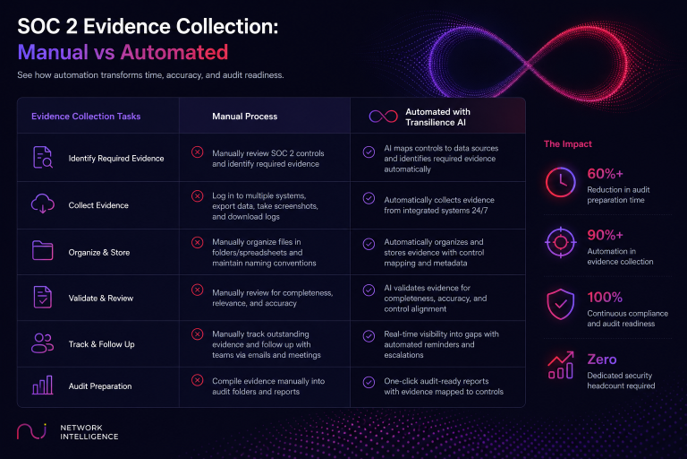
Manual vs. automated SOC 2 evidence collection
What does automation handle well?
- Evidence collection: Platforms connect read-only to cloud environments (AWS, Azure, GCP), identity providers (Okta, Azure AD), HR systems, version control systems (GitHub, GitLab), and ticketing tools (Jira) to continuously collect, timestamp, and organize audit evidence throughout the year.
- Control testing: Automated tests run continuously against configured controls, flagging drift and failures in real time rather than days before the auditor arrives
- Policy management: Templates generated and tracked for employee acceptance, with version history maintained as controls and systems change
- Access log reviews and vendor monitoring: Recurring reviews are automated with completion logs that give auditors traceable proof
- Audit-ready documentation: Report generation and evidence packages compiled without manual assembly, reducing back-and-forth with auditors at fieldwork time
What can automation not replace?
Auditors expect attestations signed by people with actual accountability. Contextual risk decisions, whether it’s a specific misconfiguration that represents a material risk given the business context, require interpretation.
The AICPA Trust Services Criteria define what must be demonstrated, but the judgment behind that demonstration is inherently human.
SOC 2 cannot be fully automated. That is not a flaw in the framework or the tools. Automation removes the grunt work, but humans still own the judgment.
What Does Manual SOC 2 Compliance Actually Cost You?
Type II audit fees run from $15,000 to $50,000 or more, depending on scope, auditor, and complexity.
The hidden cost is harder to measure but more damaging: the organizational bandwidth that manual compliance consumes year-round.
One pattern that repeats itself across mid-market companies looks something like this: There have been weeks spent gathering Slack threads, access logs, and onboarding spreadsheets to satisfy an auditor checklist that could have been prepared in advance if evidence had been collected throughout the year. Every year feels like starting over, even when very little has actually changed.
How much time does manual compliance actually take?
SOC 2 Type I audit preparation typically takes 4 to 9 months for teams starting from scratch.
SOC 2 Type II requires a 3 to 12-month observation period by design, but manual evidence collection extends the total program time further.
During pre-audit preparation, teams without dedicated compliance resources often need the better part of a year to build policies, implement controls, and compile documentation.
The more damaging issue is what happens between audits:
- Controls drift, staff turn over, and access is not deprovisioned.
- New tools are added to the stack without being mapped to existing controls.
None of this surfaces until audit season, and by then, remediation under time pressure is expensive and stressful. For a closer look at how AWS environments handle this, see our guide on automating SOC 2 compliance with AWS services.
Why does your SOC 2 report not say what you think it says?
A SOC 2 report does not prove you were compliant all year. It just proves your company was when the auditor looked.
A point-in-time audit covers a specific observation window. Controls that drifted six months before that window will not appear in the report. That may not affect the certification itself. It will affect the security posture that the certification is supposed to represent.
Continuous monitoring is the structural answer to this gap. It shifts compliance from an annual event to a permanent state, which is what the framework was designed to require, even if annual audits do not always surface the difference.
Accenture’s Compliance Risk Study found that 93% of compliance leaders agree that technologies like cloud and AI are making compliance easier by automating tasks and eliminating errors.
So teams that automate continuously spend less time fixing gaps and more time maintaining defensible compliance.
| Want to see which of your controls can be automated? Talk to a Transilience expert. |
How Does SOC 2 Compliance Automation Work in Practice?
The mechanics are less complex than most teams expect. The starting point is integration, not deployment of new infrastructure, but read-only connections to the systems that already generate compliance evidence.
How does evidence collection work?
A compliance automation platform connects to cloud environments, identity providers, HRIS tools, version control, and ticketing systems. From that point, evidence collection happens continuously.
Access logs are retrieved, configurations are checked, policy acceptances are tracked, and change events are recorded with timestamps that satisfy auditor testing windows.
The critical difference from manual collection is timing. Instead of assembling evidence in the weeks before an audit, evidence accumulates throughout the year.
By the time the auditor asks for it, it is already organized and accessible.
How does continuous control testing change the audit?
Automated control tests run continuously against the defined SOC 2 Trust Services Criteria. When a control fails, such as an access review not completed, a configuration drift detected, or a patch not applied within the defined window, the team sees it immediately rather than at audit fieldwork.
This shift changes the nature of audit preparation from a scramble to a review. Instead of discovering gaps under pressure, teams resolve issues as they occur throughout the observation period.
How does Transilience AI operate?
Network Intelligence’s Transilience AI operates as a managed compliance layer within a customer’s cloud environment. It runs read-only against the customer environment.
No data leaves the account. AI agents continuously handle security monitoring, vulnerability scanning, access log reviews, and evidence collection.
For more on how AI compliance tools compare across the market, we have published a detailed breakdown.
The platform maps 500+ security controls to SOC 2 Type II trust criteria, with 90% automation of evidence collection for AWS environments.
It maintains continuous 24/7 monitoring, including drift detection, audit-period tracking for the SOC 2 Type II observation window, and automated report generation for audit documentation.
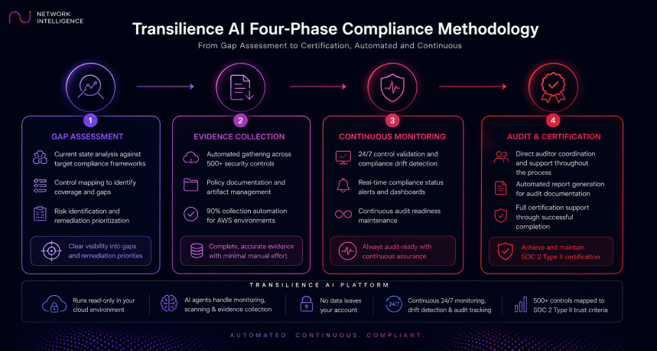
Transilience AI four-phase compliance methodology: gap assessment, evidence collection, continuous monitoring, and audit certification
The four-phase methodology runs as follows:
Phase 1, Gap Assessment: Current state analysis against target compliance frameworks, control mapping to identify coverage and gaps, and risk identification and remediation prioritization
Phase 2, Evidence Collection: Automated gathering across 500+ security controls, policy documentation and artifact management, with 90% collection automation for AWS environments
Phase 3, Continuous Monitoring: 24/7 control validation and compliance drift detection, real-time compliance status alerts and dashboards, and continuous audit readiness maintenance
Phase 4, Audit and Certification: Direct auditor coordination and support throughout the process, automated report generation for audit documentation, and full certification support through successful completion
Can One Compliance Program Cover SOC 2, HIPAA, and PCI-DSS at Once?
For companies in regulated industries, SOC 2 is rarely the only compliance obligation. Fintech companies face PCI-DSS.
Healthcare technology companies operate under HIPAA. Enterprise vendors address customer procurement requirements that span ISO 27001, HITRUST CSF and SOC 2.
Running separate compliance programs for each framework is one of the more expensive and operationally redundant things a compliance team can do.
The controls underlying these frameworks overlap significantly.
SOC 2’s Security criterion shares substantial ground with HIPAA’s Technical Safeguards, PCI-DSS Requirements 10 and 11, and ISO 27001 Annex A controls. Evidence collected for one framework usually satisfies controls in the others.
Compliance automation platforms that map controls across frameworks enable a team to satisfy SOC 2, HIPAA, and PCI-DSS requirements using a single evidence set rather than running parallel evidence-collection efforts.
For organizations weighing multiple tools for this purpose, our breakdown of compliance automation tools compares how leading platforms handle multi-framework coverage.
What does the Transilience framework coverage look like?
| Framework | Coverage | Key Capability |
| SOC 2 Type II | Full trust criteria coverage | Continuous evidence collection, audit period tracking |
| PCI-DSS 4.0 | 12 requirements mapped | Quarterly scans, SAQ/ROC assistance |
| HIPAA | Full technical control coverage | Log reviews, access controls, incident monitoring |
| HITRUST CSF | R2 certification support | Control mapping, audit narrative support |
| ISO 27001 | Continuous monitoring and reporting | Ongoing posture visibility, policy management |
| CIS Benchmarks | 60 controls | Best practices validation, configuration monitoring |
A company that achieves SOC 2 with Transilience is simultaneously building the evidence foundation for ISO 27001 or HIPAA certification. No rebuild is required. The same monitoring infrastructure, the same evidence repository, and the same control testing logic serve all frameworks simultaneously.
Should You Choose a Platform or a Managed Compliance Service?
The SOC 2 software market has matured to the point where most platforms offer similar feature lists: integrations with cloud and identity tools, automated evidence collection, control dashboards, and auditor collaboration portals.
Evaluating tools based on features alone tends to lead buyers to underestimate a critical variable: who owns the program.
What do self-serve compliance platforms actually require from you?
Platforms in this category provide the infrastructure for compliance. A team connects their stack, maps their controls, and uses the platform to collect and organize evidence. The platform alerts to failures and surfaces gaps.
Someone internal, whether a compliance manager, a head of IT, or an engineer pulled into the role, must then interpret those alerts, prepare the audit narrative, manage the auditor relationship, and ensure the program stays on track through the observation period.
For companies with a dedicated compliance function, this model works well. If you are evaluating the leading self-serve platforms, our comparison of Vanta’s competitors and compliance automation alternatives covers the strengths and limitations of each.
What does a managed compliance service actually own?
A managed compliance service takes a different position entirely. The provider owns the compliance outcome, not just the tooling. That means the provider manages evidence quality, auditor coordination, gap remediation guidance, certification support, and ongoing monitoring as an operational service.
The distinction matters most for companies without a dedicated compliance function.
“We thought the tool did everything. We didn’t have someone to own the program” is one of the most common themes in practitioner reviews of self-serve platforms. No software platform eliminates the need for a compliance owner. A managed service becomes the owner.
Which model fits your organization?
| Organizational Context | Self-Serve Platform | Managed Compliance Service |
| Dedicated GRC or compliance team in-house | Strong fit | Optional, may be redundant |
| IT team of 1 to 5 with no compliance specialist | Risky, tool alone won’t suffice | Strong fit |
| Engineering team that cannot absorb compliance work | High friction | Strong fit, no engineering drag |
| Complex hybrid cloud environment | Requires significant internal expertise | Strong fit, managed expertise |
| Previous audit with findings or gaps | Possible, if lessons are applied | Strong fit, managed remediation |
| SOC 2 needed in under six months | Tight, depends on readiness | Strong fit, accelerated timeline |
Network Intelligence’s Transilience AI operates as a managed compliance service. The team does not just get platform access. They get a partner who manages the compliance journey from gap assessment through successful certification, including auditor coordination and evidence-quality review.
Learn more about our SOC audit services.
Not sure whether you need a platform or a managed service? We will help you figure it out. Contact Network Intelligence.
Can You Get SOC 2 Certified Without a Security Team?
The most common objection to a managed compliance path is headcount: “We would need to hire someone to oversee even a managed service.”
Our partnership with Aucctus makes that assumption worth questioning.
What was the challenge?
Aucctus is a SaaS company that needed SOC 2 certification to satisfy enterprise procurement requirements. The company had no dedicated security resources. Their core team was focused entirely on product development and customer growth, and leadership had no appetite for diverting engineering capacity into compliance work.
The question was not whether to get SOC 2 certified. The question was whether it was possible without first building an internal security function.
How did Transilience AI approach it?
Transilience AI deployed a read-only integration into Aucctus’s cloud environment. No infrastructure changes were required on the Aucctus side. AI agents handled security monitoring, vulnerability scanning, and automated evidence collection from day one.
The three-month timeline:
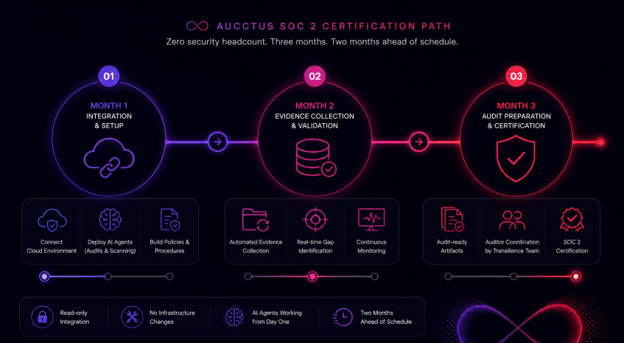
Aucctus SOC 2 implementation: from zero security headcount to certification in three months
- Month one: Integration and setup. Transilience connected to the cloud environment, deployed AI agents for security audits and vulnerability scanning, and built initial security policies and procedures.
- Month two: Evidence collection and validation. Continuous automated evidence gathering began. Real-time gap identification with guided remediation ran in parallel. Continuous security monitoring was established.
- Month three: Audit preparation and certification. Audit-ready artifacts compiled automatically. Auditor coordination managed by the Transilience team. SOC 2 certification achieved, two months ahead of the original schedule.
“Thanks to Transilience agents, we achieved SOC 2 compliance along with best-of-breed security monitoring and vulnerability management, without maintaining any dedicated security resources. With Transilience’s AI agents continuously monitoring, collecting, analyzing, and alerting us when needed, we were able to dedicate 100% of our time to building our product and serving our customers.”
— Vincent Atallah, President, Aucctus
What does this mean for your evaluation?
The Aucctus outcome is not a case for cutting corners on security. The monitoring, vulnerability management, and control validation that enabled SOC 2 certification are operational. They run continuously, not just in the months before an audit. Read the full Aucctus SOC 2 case study for the complete breakdown.
What the case demonstrates is that a well-implemented managed compliance service can absorb the operational overhead entirely, including the ownership question that self-serve platforms cannot answer on their own.
How Do You Evaluate a SOC 2 Compliance Automation Partner?
The SOC 2 compliance automation market has expanded rapidly. Every platform claims to reduce audit time and simplify evidence collection. The questions below cut through surface-level feature comparisons to the operational realities that determine whether a program succeeds.
1. What integrations are actually covered?
“We integrate with AWS” is not the same as “we cover your entire stack.” Get the specific integration list for your cloud provider, identity provider, HRIS system, version control platform, and key SaaS tools. Gaps in integration coverage mean gaps in automated evidence.
2. How often are controls tested?
Real-time continuous monitoring is categorically different from periodic scans. A platform that tests controls daily is not equivalent to one that tests hourly or continuously. Ask vendors specifically how frequently each control type is validated.
3. Does the platform validate evidence or just collect it?
Collection without validation creates a different problem. Audit-quality evidence requires correct timestamps, appropriate context, and alignment with auditor testing windows. Ask how the platform handles evidence that falls outside the testing window.
4. Who responds when a control fails?
A platform can alert to failures. Only a managed service can respond to them. Understand exactly who is responsible for investigating, remediating, and documenting the resolution of control failures during the observation period.
5. How does multi-framework coverage work?
If HIPAA, PCI-DSS, or ISO 27001 are in scope within the next two years, confirm how the platform handles overlapping controls. Specifically, confirm whether evidence collected for SOC 2 is automatically mapped to other frameworks or requires a separate program.
6. What does auditor coordination look like?
Fieldwork efficiency depends heavily on how evidence is shared with auditors. Ask whether the platform provides direct auditor access, how evidence packages are structured, and who manages auditor questions during the fieldwork period.
7. What happens post-certification?
Achieving SOC 2 is the beginning of the compliance obligation, not the end. Understand how the platform or managed service supports ongoing compliance: how controls are maintained between audits, how the observation window for the next renewal is managed, and how drift is addressed before it accumulates into findings.
8. Can you show a case study from a company like ours?
Not a logo. A case study with specifics: company size, stack, timeline, and outcome. If the vendor cannot produce that, the reference list may not reflect your actual situation.
Conclusion
SOC 2 compliance automation reduces the manual overhead of a compliance program. It does not reduce the obligation to run one properly.
The teams that benefit most are those that stop treating automation as a shortcut and start treating it as the operational infrastructure that enables continuous compliance.
The distinction between a self-serve platform and a managed compliance service is where most buying decisions go wrong. A platform gives you tools. A managed service gives you outcomes. That is a meaningful difference when your team lacks the bandwidth or expertise to translate access to tools into a defensible audit program.
Aucctus achieved SOC 2 certification two months ahead of schedule with zero dedicated security resources. The question is not whether that is possible. The question is whether the approach your team is currently taking gets you there, or whether it gets you to audit season with the same scramble as last year.
For Azure-based environments, our guide on automating SOC 2 compliance with Microsoft Azure covers the platform-specific considerations.
Network Intelligence’s Transilience AI was built for this reality. Its multi-agent architecture continuously ingests evidence, tracks control drift, correlates risk signals, and provides your team with interpretable, defensible insights, while human specialists ensure regulatory alignment and audit narratives remain precise.
Talk to an expert today and see how we can help you build a compliance program that stays aligned and is always audit-ready.