


Manual compliance processes (spreadsheets, screenshots, and fragmented tools) are dead ends. And so are tools that promise one-click compliance, but fail to deliver.
If automation were that simple, your team wouldn’t still be struggling with false positives and outdated tech.
You don’t need another tool that fuels your anxiety. You need a partner that understands the dynamic risk landscape of 2026 and delivers:
- Truly automated risk and compliance workflows.
- AI-powered cybersecurity and continuous compliance.
- Accelerated audit readiness with expert guidance and scalability.
Here’s the real question: Which are the best compliance automation tools that offer all of this?
The market is overcrowded. Finding the right fit is exhausting. Don’t worry, we have cut through the noise and curated a list of top compliance automation tools for you.
But before we look at the tools, you must know which features will optimize your investment and accelerate audits without compromising security.
Key Features to Look For in a Compliance Automation Tool
Don’t just look for badges; look for efficiency gains and future-proof security, as trust goes hand-in-hand with closed deals.
Recent trends highlight AI integration, real-time compliance monitoring, and multi-framework support as popular features. While most providers promise these features, they fail to deliver true automation that drives lasting security and reliability.
The best compliance automation tools not only offer deep automation but also go beyond compliance tracking by:
- Integrating AI-powered security workflows.
- Contextualizing and prioritizing vulnerabilities.
- Automating remediation of compliance gaps, not just alerting.
- Reducing manual audit effort by 50-80%.
- Enabling continuous compliance (long after audits).
- Building real trust with robust data security and privacy practices.
Here’s a list of 10 key features to prioritize to boost your ROI and fortify security:
1. Automated evidence collection
Manual processes kill productivity. With 51% of executives predicting a shortage of compliance specialists, automation is your only survival strategy.
- How it works: The platform connects via read-only APIs to your stack (Azure, GitHub, Okta, Jira) to silently pull and timestamp logs 24/7.
- Benefits: Eliminates manual drudgery, ensures a tamper-proof audit trail, and drastically cuts audit prep time.
2. Real-time compliance monitoring
Compliance is no longer a point-in-time exercise; it requires continuous oversight to prevent drift and breach risks.
- How it works: Your platform continuously monitors controls against frameworks. If an employee disables MFA or a cloud config deviates from policy, the system alerts your team immediately.
- Benefits: Ensures timely remediation and guarantees you stay audit-ready every single day, not just during the audit window.
3. Risk assessment and prioritization
Most platforms flood security teams with noisy alerts, but can’t isolate true positives. Prioritization is critical, given that the average U.S. data breach cost reached a record $10.22 million last year.
- How it works: Machine learning (ML) algorithms assign contextualized risk scores based on asset value and exploitability, filtering out the majority of false positives to surface risks that actually matter.
- Benefits: Reduces alert fatigue and ensures you focus resources on threats that endanger business continuity.
4. Policy management automation
Drafting policies for HIPAA or GDPR is legally complex and administratively heavy.
- How it works: Top compliance automation tools provide a library of auditor-vetted templates (e.g., incident response) you can customize in hours. The tool also automates distribution, version control, and acknowledgement.
- Benefits: Creates an immutable audit trail of employee adoption and slashes the legal overhead of policy creation from scratch.
5. Integrated security testing
Most automation platforms lack this essential feature, leaving you to manage separate pentesting vendors.
- How it works: Top-tier tools complement vulnerability scans with continuous, AI-driven pentesting and offensive security drills.
- Benefits: Eliminates blind spots between audits and provides auditors with proof of battle-tested security.
6. Automated alerts and remediation
Overworked analysts ignore 62% of alerts due to volume and burnout. Manual triage simply cannot scale against AI-driven attacks.
- How it works: Agentic AI workflows automatically identify vulnerabilities and execute simple remediations (closing exposed ports, enforcing MFA), while escalating complex issues with added reasoning.
- Benefits: Drastically reduces Mean Time to Respond (MTTR) and prevents simple misconfigurations from becoming audit failures.
7. Audit-ready reporting with auditor access
Manual documentation is the enemy of speed; it delays audit outcomes.
- How it works: A dynamic dashboard consolidates all evidence and logs in a single view. You simply grant the auditor direct, read-only access to this portal.
- Benefits: Eliminates insecure email threads, enables independent verification, and significantly shortens the audit timeline.
8. Automated vendor risk management
Your third-party stack is a backdoor for hackers. According to Verizon’s 2025 DBIR, breaches that involved third parties doubled to 30% from the previous year.
- How it works: The system automatically discovers, catalogs, and scores the security posture of every SaaS tool your employees use.
- Benefits: Secures your supply chain and ensures you don’t inherit external risks from your vendors.
9. Multi-framework support
Forward-thinking businesses are increasingly adopting unified GRC platforms to avoid duplicative work.
- How it works: The platform “crosswalks” your internal controls, mapping evidence artifacts to multiple frameworks (SOC 2, PCI DSS, GDPR, ISO 27001).
- Benefits: Accelerates expansion into new regulated markets without increasing your administrative workload.
10. Expert human guidance
Automation isn’t a silver bullet for nuanced compliance gaps, and tech support can’t resolve systemic issues.
- How it works: Superior providers act as strategic partners. They connect you with certified experts for policy customization and complex control design, supporting your internal team through audits and beyond.
- Benefits: Guarantees favorable audit outcomes and cuts significant consulting costs.
Top 6 Compliance Automation Tools
| Tool | Key features | Ideal for | Pricing and demo |
| Transilience | – Zero-touch evidence collection
– 24/7 control monitoring – AI-powered security workflows (contextual vulnerability prioritization, pentesting, threat intelligence integration) – Automated compliance gap remediation – Audit-ready reporting – Multi-framework support
|
Series A-C startups, heavily regulated industries (finance, healthcare, utilities), and SaaS and cloud services providers. | Custom pricing; demo available. |
| Vanta | – Automated evidence collection
– Vanta Trust Center – AI security questionnaires – Automated risk management |
Fast-growing SaaS companies and startups that need to establish trust among prospects. | Custom pricing; demo available. |
| Sprinto | – Prebuilt policy templates
– Continuous compliance monitoring – Integrated risk management module |
Cloud-native SaaS startups and mid-market companies that need entity-level compliance tracking without complex customization. | Custom pricing; demo available. |
| Drata | – Audit Hub with auditor access
– Vendor risk management – Multi-framework support |
Tech startups and mid-market organizations seeking to get compliant quickly. | Custom pricing; demo available. |
| Secureframe | – Broad integration ecosystem
– Policy automation – Third-party risk management |
Startups and SMBs handling high volumes of sales questionnaires and needing rapid multi-framework compliance. | Custom pricing; demo available. |
| AuditBoard | – Integrated risk management
– Real-time reporting dashboard – Built-in support for 30+ frameworks |
Mid-to-large enterprises with mature GRC functions, especially those looking for SOX compliance or enterprise risk management. | Custom pricing; demo available. |
1. Transilience (by Network Intelligence)
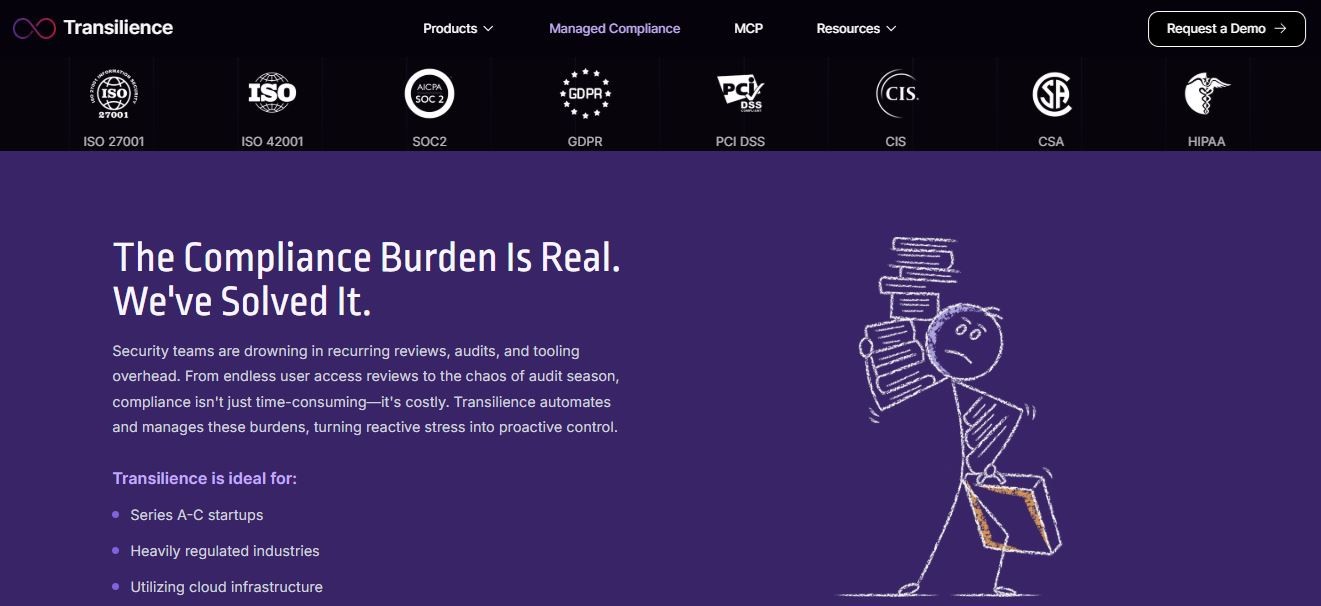
Transilience is the leading GRC platform that combines Agentic AI technology with human expertise. While most compliance automation tools offer passive monitoring, Transilience uses AI agents for contextualized vulnerability prioritization, real-time remediation, and integrated pentesting.
Transilience is among the best platforms for organizations that need speed, cost-efficiency, scalability, and an expert-guided compliance program with zero friction.
Ideal for: Series A-C startups, heavily regulated industries (finance, healthcare, utilities), and SaaS and cloud services providers.
Key compliance automation features of Transilience:
- Automated evidence collection: Fully automates real-time gathering of logs, configs, and artifacts with zero manual uploads or screenshots, enabling continuous audit readiness.
- Real-time continuous monitoring: Provides 24/7 AI agent monitoring for compliance gaps, security events, and sustained adherence long after the audit is over.
- AI-powered risk assessment: Uses ML-based agents to interpret and prioritize vulnerabilities, detect risk patterns, and proactively identify gaps, reducing the attack surface before threats materialize.
- Automated alerts and remediation: Automatically alerts teams to non-compliance gaps and initiates automated remediation workflows to fix simple gaps, while guiding teams on resolving complex issues.
- AI-driven penetration testing: Differentiates itself with automated pentesting to surface zero-day exploits and hidden attack paths, delivering security outcomes 90% faster than traditional testing.
- Audit-ready reporting: Automates artifact organization, report generation, and auditor-ready formats; includes auditor-friendly dashboards and full audit management.
- Multi-framework support: Automatically maps controls to multiple standards and regulations (including SOC 2, ISO 27001, ISO 42001/NIST AI RMF, GDPR, HIPAA, HITRUST, PCI DSS, and more) across industries and regions, with automated suggestions to remediate compliance gaps.
Transilience benefits over other providers:
- Offers end-to-end ownership with a guaranteed audit success in 2-3 months, saving hundreds of hours per audit and $70K+ in security and audit costs.
- Combines GRC with threat correlation and incident response to boost SOC productivity.
- Delivers industry-leading AI vulnerability analysis across 75+ attributes, achieving 70% noise reduction so teams focus only on critical threats.
- Provides zero-touch evidence collection and control mapping for frameworks like SOC 2, PCI DSS, and ISO 27001/42001.
- Offers predictable pricing for startups/mid-market; all expenses covered, including labor, tools, consultation, and audit management.
Pricing and demo
Request a demo or custom pricing through their official websites, Network Intelligence and Transilience.
2. Vanta
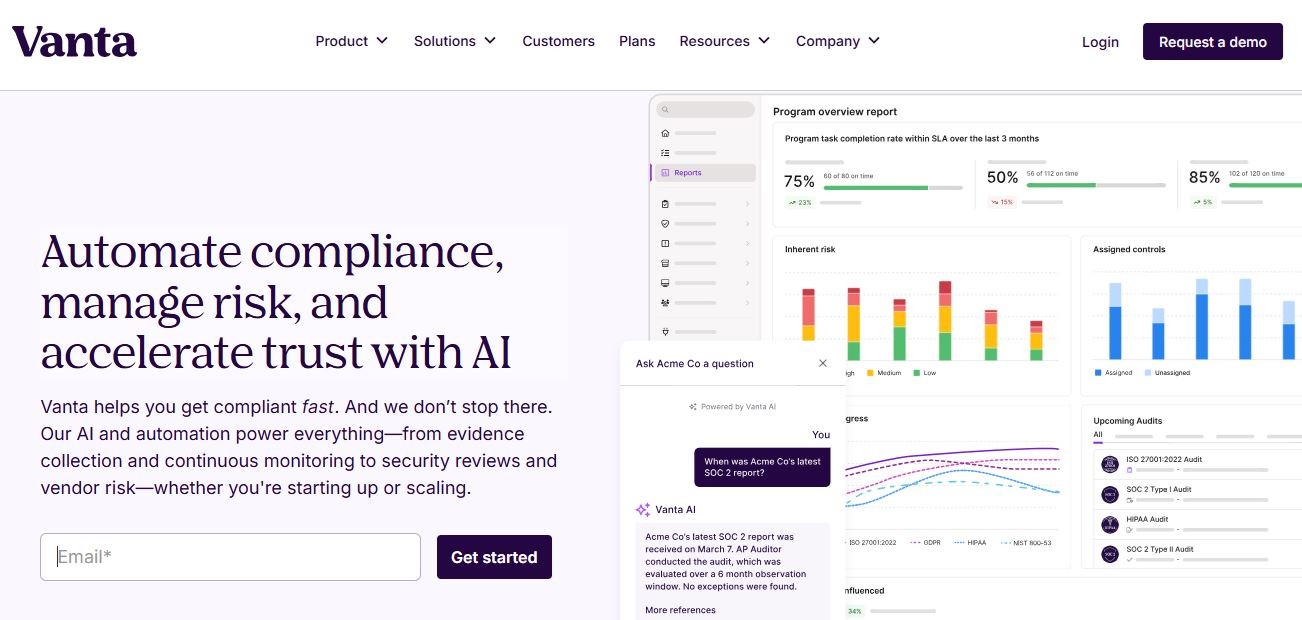
Vanta is a popular Trust Management Platform that simplifies the compliance process. It automatically monitors controls in real time and evaluates them against major frameworks, including SOC 2, ISO 27001, HIPAA, and GDPR.
By centralizing evidence collection and risk management, Vanta helps organizations streamline their audit readiness and demonstrate trust to customers.
Ideal for: Fast-growing SaaS companies and startups that need to establish trust among prospects.
Key features:
- Integration ecosystem: Connects with business systems to automatically fetch evidence and continuously monitor security controls, ensuring your compliance posture remains up to date.
- Trust Center and AI questionnaires: Proactively shares your compliance status with customers via a real-time dashboard. Shortens the sales cycle by automating security questionnaires.
- Automated risk management: Centralizes risk tracking with pre-built libraries and workflows, helping teams continuously identify, assess, and mitigate risks.
Pros
- User-friendly interface for first-time compliance teams.
- Large ecosystem of reliable built-in integrations.
Cons
- Can be expensive for smaller companies or early-stage startups.
- Offers limited customizations to tailor advanced, enterprise-grade reports.
Pricing and demo
Pricing is tiered by buyer’s compliance requirements and features; advanced features are often add-ons. Visit their website to book a demo and get custom quotes.
3. Sprinto
Sprinto is an AI-native GRC and compliance automation platform that helps cloud-first companies achieve and maintain compliance with security standards such as SOC 2, ISO 27001, GDPR, and HIPAA.
It’s best known for real-time, automated evidence collection and continuous monitoring across 300+ cloud tools, reducing manual work and accelerating audits.
Ideal for: Cloud-native SaaS startups and mid-market companies needing entity-level compliance tracking without complex customization.
Key features:
- Policy templates: Includes prebuilt policy templates for popular frameworks and regulations to expedite compliance and save time.
- Monitoring and alerts: Continuously monitors your infrastructure and alerts your teams in real time to any compliance issues identified.
- Risk management: Provides a dynamic risk register across infrastructure, maps risks to controls, and builds risk scores and heatmaps in real time.
Pros
- Fast implementation with a wide range of integrations for cloud-first companies.
- Highly responsive customer support for technical issues.
Cons
- A steep learning curve for non-technical users.
- Occasional UX bugs and interface glitches that need to be fixed.
- Limited flexibility and customization options are reported by some users.
Pricing and demo
Contact their team to request a personalized demo and receive a custom quote tailored to your compliance needs.
- Drata
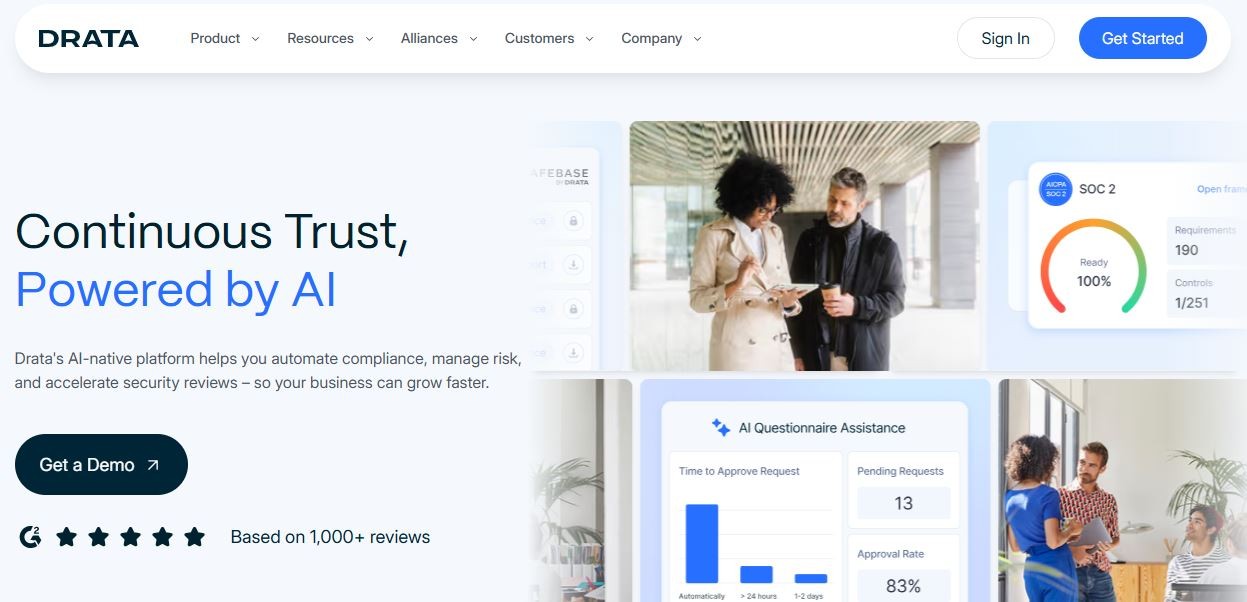
Drata is another compliance automation platform that helps your business get quickly compliant with industry regulations. It enables you to automate several compliance processes, including evidence collection, risk assessment, and security reviews.
Ideal for: Tech startups and mid-market organizations seeking to get compliant quickly.
Key features:
- Multi-framework support: Scales with your compliance needs, with extensive coverage of industry standards and regulations (SOC 2, CCPA, GDPR, ISO 27001, and more).
- Vendor risk management: Helps you manage third-party risks with up-to-date vendor directories, risk assessments with treatment plans, and custom security questionnaires.
- Auditor communication: Streamlines the audit process through its Audit Hub, providing a single-window interface for auditor interaction and eliminating email back-and-forth.
Pros
- Hassle-free deployment and an easy-to-use interface.
- Enterprise-level expert guidance to resolve complex compliance issues.
Cons
- Audit support is limited to connecting customers with auditors.
- May charge steep prices for subscription renewal or additional frameworks.
Pricing and demo
Offers two platform bundles with three plans each, Foundation, Advanced, and Enterprise, with custom pricing and flexible add-ons. Book a demo with them to learn more about the platform and get a tailored quote.
5. Secureframe
Secureframe is an all-in-one compliance management platform that enables organizations to quickly achieve audit readiness and maintain ongoing compliance.
It provides all the core features you need for your compliance journey: risk management, policy management, control mapping, questionnaire automation, and more.
Ideal for: Startups and SMBs handling high volumes of sales questionnaires and needing rapid multi-framework compliance.
Key features:
- Broad integrations: Connects to standard business tools (AWS, Teams, Zendesk, Gusto) to gather evidence and track compliance status in real time.
- Policy automation: Enables rapid creation of infosec compliance policies from auditor-approved templates, with AI-driven customizations and automated distribution.
- Third-party risk management: Streamlines vendor risk management using centralized vendor profiles, continuous tracking of employee app usage, and custom risk assessments.
Pros
- Cuts audit preparation timeline from months to weeks.
- Dedicated support with quick response times.
Cons
- Complex pricing structure, deterring relatively new startups and small companies.
- Steep learning curve and inflexible workflows for complex or non-standard environments.
Pricing and demo
Offers three plans: Fundamentals, Complete, and Federal, based on your compliance and security needs. You can obtain a precise pricing quote by contacting their sales team.
6. AuditBoard
AuditBoard is another risk, audit, and compliance platform that helps businesses manage risks, maintain compliance, and streamline audits. It offers robust automation features, including automated evidence collection, real-time reporting tools, and multi-framework support.
Ideal for: Mid-to-large enterprises with mature GRC functions, especially those looking for SOX compliance or enterprise risk management.
Key features:
- Integrated risk management: Helps your team manage risks using a centralized register with automated risk assessments tied to impact, likelihood, and business assets.
- Real-time reporting: Offers a user-friendly, customizable dashboard with enhanced visuals to gain insights into compliance status and support executive decision-making.
- Scalability: Automates control mapping across 30+ frameworks to enable a “test once, satisfy many” strategy for enterprises with extensive compliance needs, eliminating duplication and accelerating audits.
Pros
- Provides excellent insights to make informed risk and compliance decisions.
- Streamlines audit management and improves collaboration for teams and auditors through a centralized dashboard.
Cons
- Some users feel UX needs improvement and bugs need to be fixed before rollout.
- It takes time for new users to get familiarized with the overwhelming number of features and customizations.
- The risk assessment module needs additional features.
Pricing and demo
Auditboard offers custom plans with pricing tailored to your business needs. Request a demo and talk to their team to obtain a quote.
Why Choose Transilience as Your Go-to Compliance Partner
Superficial compliance is dangerous. A clean audit report won’t stop sophisticated ransomware strikes or AI-driven social engineering attacks. What you need is not only a strong compliance posture but also a comprehensive security strategy.
Buyers often settle for audit-only automation, overlooking the ongoing security needs that actually protect the business. The cost of this error is steep: an additional $20K to $50K+ in third-party pentests and security experts, not to mention costly breaches and penalties that follow weak security.
That’s where Transilience steps in. It consolidates security and compliance management into a single platform with expert human guidance, eliminating the need for consultants or fragmented tools.
By deeply integrating AI agents into your workflows, Transilience helps you automate compliance, streamline vulnerability management, and accelerate security operations—faster, more cost-effectively, and with higher efficiency.
In addition to top compliance automation features, Transilience differentiates itself with AI-powered cybersecurity and end-to-end compliance management:
- Outcome-based pricing: Stop paying for seats or idle users. Our pricing model aligns costs directly with successful audit outcomes, ensuring maximum value.
- AI vulnerability prioritization: Transilience’s AI agents cut alert noise by 70%, allowing your team to focus on critical threats rather than chasing ghosts.
- Cognitive security: We combine our proprietary ADVISE framework with Transilience to intelligently assist your SOC team, proactively suggesting fixes before auditors do.
- Unified platform: Replaces fragmented point solutions by unifying compliance, risk management, and SOC functions under a single AI-native umbrella.
- Human-in-the-loop: Unlike providers that only sell software, our dedicated experts guide you throughout your compliance process, ensuring successful audits and enhanced data security.
Don’t settle for outdated tools. Book a demo today to see how Transilience can help you gain a competitive edge and drive true resilience.